





I recently noticed a phenomenon that I think is worth discussing.
Various agents are currently extremely popular, such as OpenClaw, Claude Code, and Codex, along with AI creation tools like Seedance 2.0 and Xiao Yunque, which have also surged in popularity.
These tools are emerging one after another, and each one is a creative tool unlike anything the world has ever seen.
Many people went to great lengths to install and open them, but then nothing else happened.
They began to feel confused, staring at the blinking cursor, their minds going blank.
I know this isn't just you watching the screen—many people feel the same way. Sometimes, when I see a new AI tool, I feel the same way too.
OpenClaw has pushed this phenomenon to its peak.
Then I came across a voice online saying:
If you installed OpenClaw and don’t know what to do with it, then you don’t need it.
The term OpenClaw can actually refer to all AI tools.
But, frankly, I think that statement is incorrect.
How could anyone possibly not need AI tools or agents? Many people don’t actually lack need—they’ve simply forgotten, amid their busy lives and as they’ve grown older, what they truly need.
Or, to put it more vividly, forgetting one's own creativity.
Actually, we can recall our childhood—given a pile of building blocks, you could play for hours; given a pen, you could draw all over a whole wall.
Back then, you never asked silly questions like, “Do I have creativity?” because back then, you were overflowing with creativity.
Everyone is.
Then what? We went to school, and our teacher told us that this problem had only one correct answer.
Your drawing isn't appealing because the sun should be red, not green. Your essay is off-topic because you didn't follow the template.
Later, you started working. Your boss told you to follow the process, avoid innovation, and just finish the tasks at hand. Your ideas don’t matter—KPIs do. Weekly reports must be submitted on time, presentations must follow the template, and updates must use the STAR method.
Living this way for two or three decades, until the building collapses.
Under layer upon layer of conditioning, your creativity has disappeared; now, faced with AI tools, you don’t know what to do—not because you don’t need to.
Because your creativity has been buried for so long that you’ve forgotten it ever existed.
It looks quite sad to me.
As a designer with nearly a decade of experience and a hardcore gaming enthusiast, I’ve always believed that creativity is an innate human trait—a quality everyone is born with. I’ve also gathered some imperfect personal insights, which I previously used to inspire creativity within my design teams.
So today, I also want to share my own experience, hoping that this article might help you reclaim your creativity.
I'm not sure if it will work, but I hope everyone can give me 10 minutes.
We also hope this will be helpful to everyone.
I. Find the thing that makes you feel uncomfortable
Many people believe creativity is a skill, like programming or English proficiency—some are born with it, while others are not.
But as I mentioned above, creativity is inherently innate.
Creativity is desire.
I come from a UI design background—why can a designer come up with a great interface solution? Often, it’s not because they’re smarter than others; it’s simply because when they see a bad interface, it makes them physically uncomfortable.
That feeling of “This is so disgusting, I can’t take it anymore”—I believe that’s where creation begins.
In psychology, there is a concept called cognitive dissonance, which refers to the intense discomfort the brain experiences when there is a discrepancy between your expectations and reality, prompting you to resolve that gap.
I believe the engine of creativity is this discomfort.
When I previously led a team, I encountered a particularly frustrating situation: I would ask a new team member to design a page, and they’d ask me, “What color should I use here? What icon should I place there?” When I asked them, “What do you think?” they’d say they had no ideas.
Does he really have no ideas? No.
He has no desire. He doesn’t hold onto the obsession of “I must make this thing look absolutely stunning today,” nor does he empathize with the thought that “users will definitely be confused at this step.”
He is simply completing a task, not creating a work of art.
But the same person, when asked to create something they truly care about—like designing a poster for their own band or creating fan art for a game they love—might stay up until 3 a.m. without feeling tired. Truly, once desire is ignited, ability naturally follows.
So I think the first step to reclaiming creativity doesn't require learning any techniques—it requires finding what makes you feel deeply uneasy.
The way I find it is like this.
Every day, while scrolling through your phone or looking outside, you’ll inevitably encounter two moments that make you stop.
One is “so amazing, so awesome”—just skip this, because it will only make you anxious.
Another one is, "This is so terrible," or "Why hasn't anyone done this yet???"
This later type is the seed of your creativity.
Write it down. Just use your phone’s notes app and write one sentence: “The xx feature of xx product is too unintuitive,” “Why isn’t there a tool that can xxx?” or “It would be great if this could xxx.”
Don’t worry about how to solve it—just note it down for now.
When you’ve accumulated ten entries, look back—you’ll notice a pattern: almost all of what you’ve recorded revolves around just one or two areas.
That's what you truly care about.
Your creativity grows from there.
This step may seem simple, but I've seen too many people get stuck here.
They aren’t actually uncreative—they’ve just never seriously asked themselves what they’re truly dissatisfied with.
II. Narrow the scope to one afternoon
After coming up with an idea, most people get stuck on the second step.
Because the idea is too big.
Many people think, “I want to create an amazing AI product,” “I want to shoot an incredible short film,” or “I want to write an unbeatable book.”
Honestly, at this scale, it often doesn’t do much beyond giving you a mental high.
Psychologically, this is known as choice overload.
Barry Schwartz wrote in "The Paradox of Choice" that when there are too many options, people do not become more free—they become paralyzed. For example, in a supermarket, when there are six types of jam, 30% of people make a purchase, but when there are 24 types, only 3% do.
The more options you have, the less likely you are to take action.
When we were designing interactions, we also followed the "7±2" principle for information chunks—no more than that, as exceeding it can cause cognitive overload, causing the brain to shut down.
In the AI era, it’s like being handed 24 types of jam—you have so many options that you’re overwhelmed and end up doing nothing.
The solution is very simple: proactively impose constraints on yourself.
Infinite freedom is the enemy of creativity; the human brain is never good at making choices among infinite possibilities—it excels at finding the optimal solution under limited conditions.
Just like my favorite game, The Legend of Zelda: Breath of the Wild, you’re given only four abilities—magnetism, ice creation, time stop, and bombs—and yet weapons break, arrows run out, and stamina depletes. See? There are limitations everywhere.
But it is precisely these limitations that have led to countless iconic trading moments.
For example, if you want to climb a cliff but lack the strength, you could light a patch of grass at the base of the mountain. As the hot air rises, you open your paraglider and are lifted upward by the thermal current. The game never taught you this trick, but the physics engine shows you that fire produces hot air, hot air rises, and a paraglider can harness that lift. You connected these three ideas on your own.
There’s even the wind弹 technique—veterans should all know it: while shielding and jumping forward, press L to place a circular bomb, then enter Link Time to place a square bomb, switch back to the circular bomb to detonate it, and you’ll immediately enter the gravity slingshot state.
All of these were discovered by players within the constraints.
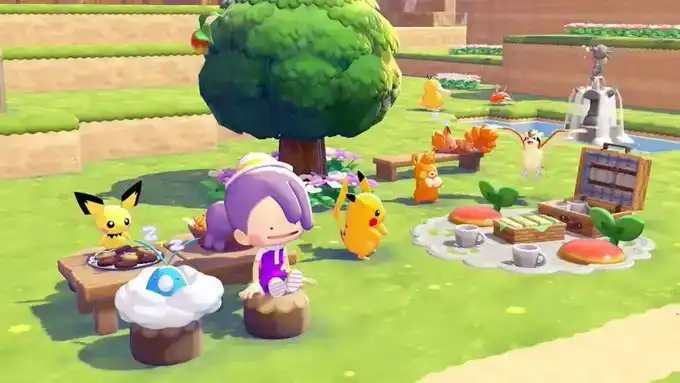
Recently, I’ve been playing Pokémon Pokopia in my spare time, and it has even more restrictions—many things I want to build are unavailable, and numerous Pokémon I desire are missing. But precisely because of this, it has sparked even more creativity and curiosity in me.
Creativity, often, also stems from limitations.
How do you set limits for yourself? I actually think it’s quite simple—just three constraints.
First, tool constraints. For this session, use only one tool—whether it’s Claude Code, Midjourney, or Seedance 2.0—just pick one and don’t try to use too many.
Second, time constraints. Just one afternoon or one evening. Absolutely not a week, not a month—today afternoon, for example, you must have something running before dinner.
Third, scope constraint: Focus on one feature to solve one problem.
Three constraints stacked together, like in Zelda where you only have three moves.
Trust me—by now, your mind may no longer be panicking; instead, it might start to feel excited.
I'll give you a few real examples.
This afternoon, use Claude Code to build a simple personal tool for daily inspiration logging—just an input box and a list.
This afternoon, use Midjourney to design a visual style for your official account, generating just five images.
This afternoon, use Seedance 2.0 to turn a scene from your dream into a 15-second short video.
It's this small—so small you might think it's too easy for me to rely on this.
Then just go do it.
Shigeru Miyamoto has spent his entire life making games, always using this one trick.
He once said, in essence, that good game design is about finding joy in a small room, not getting lost across a vast continent.
Nintendo has contributed by far the most outstanding sandbox games to this world.
The same applies to creation.
Three. Create a crappy product.
The next step is the most critical—and the one most people fail to pass.
Take action.
Many people get stuck saying, “I’ll think about it more,” “I’m not ready yet,” or “I’ll start after I finish learning xxx.”
This idea may have been true in the traditional era, as the cost of creating something was high—changing code could take days, and producing a prototype could cost thousands of dollars.
But in the age of AI, this logic must be completely reversed.
AI has reduced the cost of creation to nearly zero. You simply tell Claude Code something, and a small tool is up and running in five minutes. You describe an image in your mind to Midjourney, and you get results in ten seconds. With PixVerse v6 and Seedance 2.0, a single text prompt generates a video.
The cost of taking action has reached a historic low.
You don’t need to have a perfect idea before you start—just begin by creating something rough, review it, and if you’re not satisfied, make changes. Keep reviewing and refining until you are.
This process is called "prototyping thinking" in the design industry.
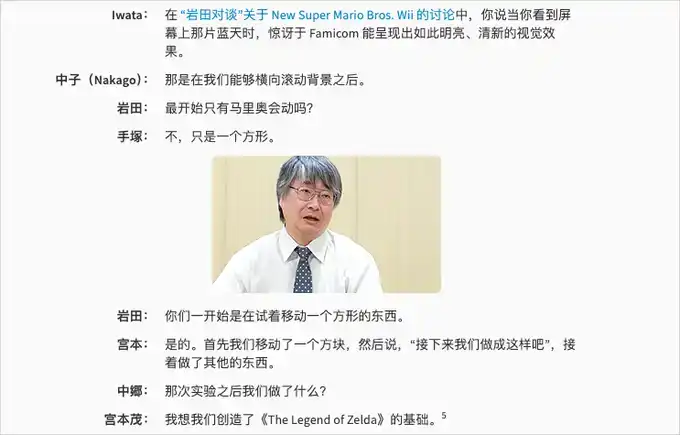
The game designer who has had the greatest impact on me, and who is also my idol, is Shigeru Miyamoto—he has spent his entire career following this same approach.
He dislikes writing lengthy planning documents; instead, he always starts by creating a very rough prototype for people to try—if it’s fun, he refines it; if not, he throws it away.
Mario originally started as a simple block jumping on screen.
In fact, it's not just the gaming industry.
Entrepreneurs and product creators know there’s a core concept called MVP—Minimum Viable Product. Instead of building a perfect product to test the market, you start with the smallest possible version that works, release it, observe user feedback, and iterate quickly.
The principle is exactly the same: release first, then iterate.
Ten years ago, when I was still doing UX design, my manager told me, “Stop thinking—just start drawing. Get something down on paper first. Even if it looks like shit, there’s still gold in shit.”
Crude, but undeniably true.
Because when an idea is just in your mind, it’s vague, uncertain, and even you can’t clearly articulate it.
But once you create it—even the most basic version—you immediately see what’s wrong, what can be improved, and what you truly want.
The process is about thinking—trust me, your hands are faster than your mind.
So, I have a very specific suggestion for you.
Today, open Claude Code or any AI tool you have on hand, take out the few items from your notes that have been bothering you, pick the simplest one, and build a minimal version over the course of an afternoon.
It doesn't have to be good; it just has to exist.
You’ll find that the moment you create your first imperfect version, everything else naturally begins to unfold. As you look at it, you’ll automatically think, “It would be great if we could add xx here,” or “The interaction in that area should be improved.”
These ideas are creativity.
It didn’t fall from the sky—it grew from your first mess.
Four. Steal from other areas.
After creating the first flawed product, the next question naturally arises.
How can I make it better?
For this step, I’d like to focus on one person.
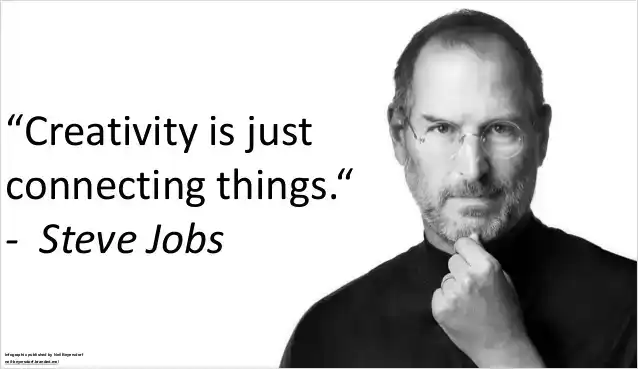
In a 1996 interview with Wired, Jobs made a statement that is perhaps the most widely quoted on creativity.
He said that creativity is simply connecting things.
Creativity is about connecting things.
Then he said something even more important.
When you ask creative people how they did it, they feel a bit guilty, because they didn’t really do anything—they simply saw connections. They were able to see them because their experiences were richer than others’, or because they spent more time reflecting on their experiences.
Look, he didn’t say creativity comes from intelligence or talent—he said it comes from the richness of experience.
The more dots you have, the more lines you can connect; the more lines you have, the stronger your creativity becomes.
This quote has been cited countless times, but few ever tell you exactly how to do it.
My own past experience is that the method consists of three steps.
Step one: Collect dots from unrelated fields.
I am a living example myself.
I started my career in UX design, then transitioned into AI content, which is what this WeChat public account is about.
These two fields seem worlds apart, but when I write articles, I often unconsciously use a designer’s mindset to break down AI products.
For example, when I wrote the article about AI not seeing hearts, others saw it as an interesting phenomenon, but I saw Gestalt psychology—the foundation of interaction design—and the fundamental differences between human and AI perception systems. That perspective wasn’t forced; it came from years of design experience and an intuitive sense that these things were connected.
For example, after playing simulation management games for so many years, when I look at business models, my mind automatically runs a resource circulation model.
What are the inputs, processing steps, outputs, and how is a positive feedback loop formed? Isn’t that exactly the core gameplay of Cities: Skylines and Dyson Sphere Program?
So you're a programmer? Go learn photography.
Are you a designer? Go read some history.
Are you in finance? Go raise a tank of fish.
Don’t take it too seriously or worry about verifying details—just explore, have fun, and experience it.
Step two: analyze others' work and connect the dots.
Find a work you like and break down its structure.
I learned to deconstruct things through gaming—often, playing a game isn’t just about finishing it, but asking why this level made me die ten times and still want to try again? Why does this economy system keep me hooked? That kind of thinking is truly fascinating.
Just answer three questions when splitting.
How did it hook you? How did it gradually draw you in? At what moment did you think, “Whoa”?
The same applies to pulling the film.
After deconstructing a few works, you'll begin to see the world through the eyes of a creator—this mindset is essential.
Step three: Apply the stolen structure to your own endeavors.
This step is the most critical of all. Simply disassembling without using it is the same as not disassembling at all.
Many of the techniques I use for writing articles and creating case studies come from two completely unrelated fields, and I think they’re worth sharing.
The first one is from the screenwriter.
For example, the Hero’s Journey is the underlying narrative structure of many Hollywood films: an ordinary person is called to adventure, undergoes trials, obtains a treasure, and returns to everyday life transformed. Sometimes, when I write stories, the structure is almost identical.
First, I’ll explain what problem I encountered, then how I used AI tools to solve it step by step, and finally reveal the mind-blowing result.
Many of He Tongxue's videos follow the rhythm of the hero's journey.
Another example is Chekhov’s gun, a screenwriting principle that states if you hang a gun on the wall in the first act, it must fire by the third act.
In content creation, every detail you plant upfront must resonate later. When I write articles, I sometimes leave a small hook at the beginning or middle, then circle back to it at the end—this makes readers feel they’re experiencing a cohesive piece, not just a collection of disconnected information.
Wait, wait—many techniques in screenwriting are actually useful for pacing content creation.
The second one is from comedy.
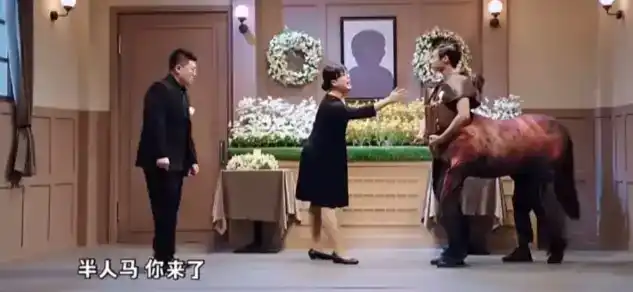
I was introduced to sketch theater through Xiren Qimiao Night and learned a technique called "sheng fan."
Find a fun gameplay element, then level up round by round, with each round becoming more exaggerated and unexpected than the last.
For example, the classic "Father's Funeral" becomes more absurd with each round.
I’ve used this scaling logic too many times in my AI cases.
A tool doesn't reveal its full power right away.
First, show the basic features to give users a sense of adequacy, then introduce an advanced use case to spark interest, and finally reveal an unexpected, clever trick that makes them think, “Wait, you can do that?”
Rising step by step, the audience’s emotions are carried along in this way.
Look, I’ve applied both screenwriting and comedy—two seemingly unrelated fields—to AI content creation.
This is connecting the dots.
Dots don't appear out of nowhere—they're added to your mind each time you engage with a new field.
The more you put out, the more likely it is that one day a line will suddenly light up between two dots—that’s creativity.
Jobs also said another quote:
You can't connect the dots looking forward; you can only connect them looking backward.
So you must trust that those dots will somehow connect in the future.
Every unrelated thing you learn now is saving the most valuable asset for your future creativity.
V. Give your brain some time to do nothing.
The four steps above are all actions taken.
This step is the opposite—it’s about what not to do.
I really believe that, besides attention depletion, there’s another thing that is the greatest enemy of creativity.
It's comfortable.
There was once an interesting concept in the stand-up comedy industry called "poor gate."
At the height of his popularity, He Guangzhi told jokes about his impoverished life—earning only 1,400 yuan a month and living in northern Shanghai—turning his hardships into hilarious yet touching stories that left audiences in stitches.
But later, during those two seasons, he became popular and wealthy, moved into the inner ring, and the jokes about poverty grew fewer; the content began to decline, and the creativity and philosophy rooted in everyday life diminished significantly—once something grows from the soil of life, it withers when torn from that soil.
However, He Guangzhi is an outstanding stand-up comedian who eventually found a way to adjust and ultimately won the championship.
There’s also Liu Cixin, who worked for over twenty years at the Niangziguan Power Plant in Shanxi, a place surrounded by mountains. Yet, amid the pressure of state-owned enterprise layoffs in Northeast China, he wrote "The Wandering Earth" and "The Village Teacher" in what seemed like a remote and dull location.
Even under the depressive mindset of that era, Da Liu began to experience some adverse physical symptoms, and a quack told him he had liver cancer and had only a few days to live.
Thus, faced with the ultimate anxiety of death, Liu Cixin fully unleashed his creativity.
Thus, "Ball Lightning" was released.
Later, when the Niangziguang Power Plant was shut down, only 400 out of 2,000 employees could be retained; the remaining 1,600 had no idea where to go. This anxiety over death and survival competition directly gave rise to the Dark Forest法则.
Thus, one of the greatest science fiction masterpieces, "The Three-Body Problem," was born.
Later, it was discovered to be a misdiagnosis, and with the popularity of "The Three-Body Problem" and increased financial stability, as everyone knows, his output dropped sharply. Online, people often joke that he can no longer produce good work, mainly because he no longer has that sense of stealth from his former workplace...
So, the real fuel for creativity today is friction.
The sense of disparity between you and reality, the feeling of "I'm not satisfied with this," and the conviction that "my situation must change."
Then why would I say you shouldn't do it?
Anxiety is fuel, but fuel needs a spark to ignite.
That engine is the blank time.
In neuroscience, there is a theory that when a person is in a state of doing nothing, the brain enters the default mode network and begins free association, randomly connecting scattered memories and thoughts.
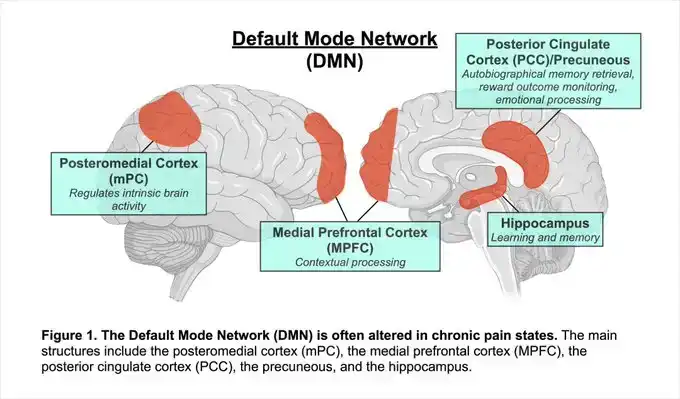
To be honest, in this day and age, we never lack anxiety.
The anxiety of work, the anxiety of comparison, the anxiety of falling behind—there’s so much fuel, it’s almost spilling over.
What we truly lack is that spark—the quiet moment that allows the mind to settle and ignite the fuel.
Our current lives are filled with our phones in every spare second.
Scrolling on your phone while waiting for the elevator, riding the subway, using the restroom, or before bed—your brain is constantly processing external input, leaving no chance for the default mode network to activate.
Therefore, I have always advocated for reducing noise and selecting high-quality information—and I practice what I preach.
You can also reflect on when the best ideas in your life have come to you. I suspect, like me, they probably occurred while you were showering, walking, zoning out, or just before falling asleep.
In those moments, your mind finally gets the chance to process the built-up anxiety and thoughts.
So, here is a very specific recommendation.
Set aside 30 minutes each day—no more, just 30 minutes.
You don’t need to force a meditative emptiness—just take a walk without headphones, linger a little longer in the shower, or lie down and do nothing at all.
These 30 minutes aren’t meant for you to relax—they’re meant to give your brain the chance to connect accumulated stress, dissatisfaction, and thoughts on its own, turning them into creativity.
Often, the things you struggle to figure out—believe me.
It will appear on its own within these 30 minutes.
Six. Do it only for your own pleasure
The last one, and possibly the most important.
When you see too much of what others are doing, your brain activates a dangerous mechanism.
That is, comparison.
This person built a website using Cursor—it’s way better than anything I could make. That person’s AI video quality is so high; I could never produce anything like that. Someone already did this idea, and they did it better than I imagined.
Each comparison slightly diminishes your creativity.
In the end, you conclude: "Forget it, I can't compete anyway."
Psychology calls this learned helplessness.
In 1967, Martin Seligman conducted a classic experiment in which, after repeatedly experiencing uncontrollable setbacks, a creature would no longer attempt to escape even when the conditions changed and escape became possible.
Because it has learned helplessness.
You weren't born helpless—you learned helplessness through repeated comparison.
Honestly, I've been there too.
I’ve been running a public account for three years, and sometimes, when I see someone else’s article performing better than mine—with higher engagement and faster follower growth—I can’t help but feel a momentary emptiness, wondering, “What am I even doing here?”
But then I realized.
When you create something, you should first do it to satisfy yourself.
My original motivation for writing this WeChat public account was never to build a huge platform—it was simply that I discovered there are so many fascinating things in the AI era, and I couldn’t keep them to myself; I just wanted to share them.
I made a tutorial on Claude Code not because this topic is popular—it really isn’t—but simply because I enjoy using it so much that I couldn’t keep it to myself.
Deci and Ryan's Self-Determination Theory states that humans have three basic psychological needs: autonomy, competence, and relatedness.
When you do something out of intrinsic interest rather than external rewards or punishments, your creativity, persistence, and sense of satisfaction all improve significantly.
Just like I play Pokémon Pokopia, my island certainly isn't as beautiful as those designed by the pros, but it’s my island—every tree I planted, every corner filled with my memories.
You want me to trade with someone else? I’m not trading.
You do these things first and foremost for your own enjoyment.
Not to gain followers, not to meet KPIs, not to please your boss, and not to show off on social media.
It's because the feeling of creation is just so rewarding.
What you create can be terrible, but it's yours.
I really feel that it's more important than anything else.
In conclusion
As I was finishing up, I suddenly remembered a book I had read before.
Homo Ludens, written by Dutch historian Huizinga in 1938.
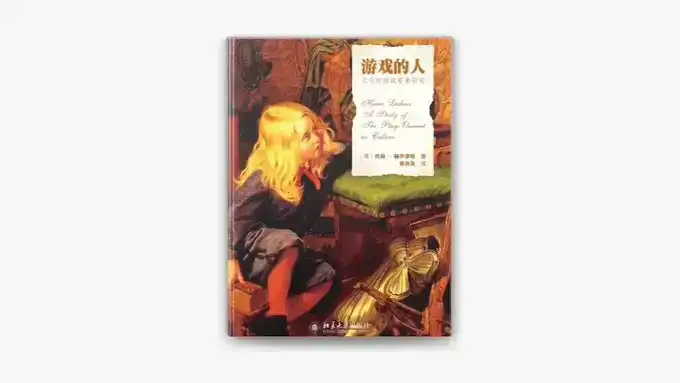
He said that human civilization was not born from labor, but from play.
Language is a game, poetry is a game, law is a game, art is a game.
All of humanity's great civilizational achievements can be traced back to the impulse to play.
Everything in our society is, at its core, a series of rules.
When we look back at children, what was their earliest way of learning? It was play.
They didn’t study any so-called theories—they jumped right in, played around, and learned the rules of the world through experience.
They aren't afraid of failure because in the game, you can always try again.
They also don’t need to worry about costs, because the game itself is the goal.
They also don’t need external motivation because playing it comes with its own joy.
Fearless of failure, unconcerned with cost, and naturally joyful.
Isn't this the purest state of creativity?
After we grow up, it seems we’ve lost all three of these things.
Afraid of failure because it comes at a cost. Weighing the costs because time and energy are limited. Need external motivation because without KPIs or recognition from others, it’s hard to see the point of doing something.
But I really want to say.
The AI era has given us a tremendous opportunity.
It’s helping us get these three things back.
What’s the cost of failure? Almost zero. If the code written by Claude Code isn’t good enough? Just delete it and try again. What’s the cost of getting started? Extremely low. AI skips the most tedious startup phase for you, letting you jump straight into the “playing” stage.
As for bringing your own happiness...
You'll need to recover it yourself—AI can't help you with that.
But my own approach has already been laid out in this article.
I’m not sure if this will be helpful to everyone, but I’ve shared it wholeheartedly. If it helps even one or a few friends, I’m already very happy.
Huizinga said that in play, we come closest to ourselves.
I strongly agree.
Go play, go create.
Even if it's just from something very, very small.