



Author:@clairegu1,@MorrisSHYang and the Hubble Research Team
Polymarket's trading volume continues to set new records, making it the liquidity hub of the global prediction market. However, for traders, there is an unavoidable question: within the billions of dollars in trading volume, how much represents real human wisdom and strategic competition, and how much is the silent battle of algorithms?When most retail investors look for smart money based on trading volume rankings, they may be walking straight into a robot's meat grinder.
Secret Bot Zone: A Tiny Minority Creates the Majority of the "Prosperity"
During the full-scale address penetration, Hubble discovered a group that is located in "Bot Zone" Abnormal account:
A game for a very few people: This portion of accounts accounts for only 3.7%(approximately 54,000 addresses).
Absolute authority to speak: These 3.7% of accounts contributed to the entire platform's 37.44% Total transaction volume.
Cognitive lieStatistics show that 99% of real users participate in fewer markets in their lifetime than 289 itemsHowever, the number of markets participated in by the "Bot Zone" accounts is generally higher than 500 .
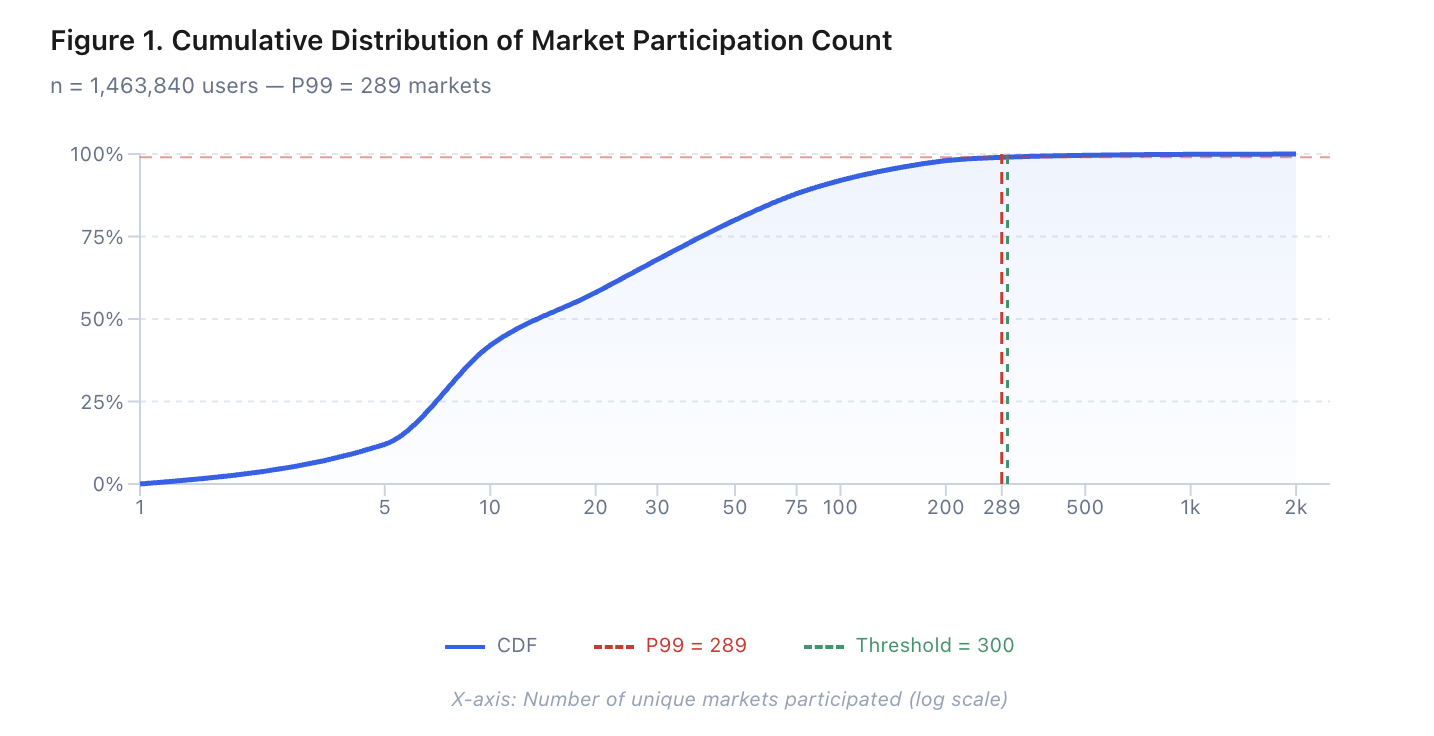
For traders, this means that nearly 40% of the "market sentiment" you see is actually just code fluctuating.
If you
Decisions based on trading volume mean you are likely just providing liquidity for a viewless hedging script (see previous article:
The Hidden Trap of 99% Win Rate: Why Polymarket's Super Tail Strategy Can Actually Lead to Losses?
How does Hubble identify algorithms?
To accurately identify these "machine predators," Hubble has developed a set of techniques based on... "Quadrant Analysis Method of X and Y Axes" 's filtering logic.
The "Diagonal Law" of Real People
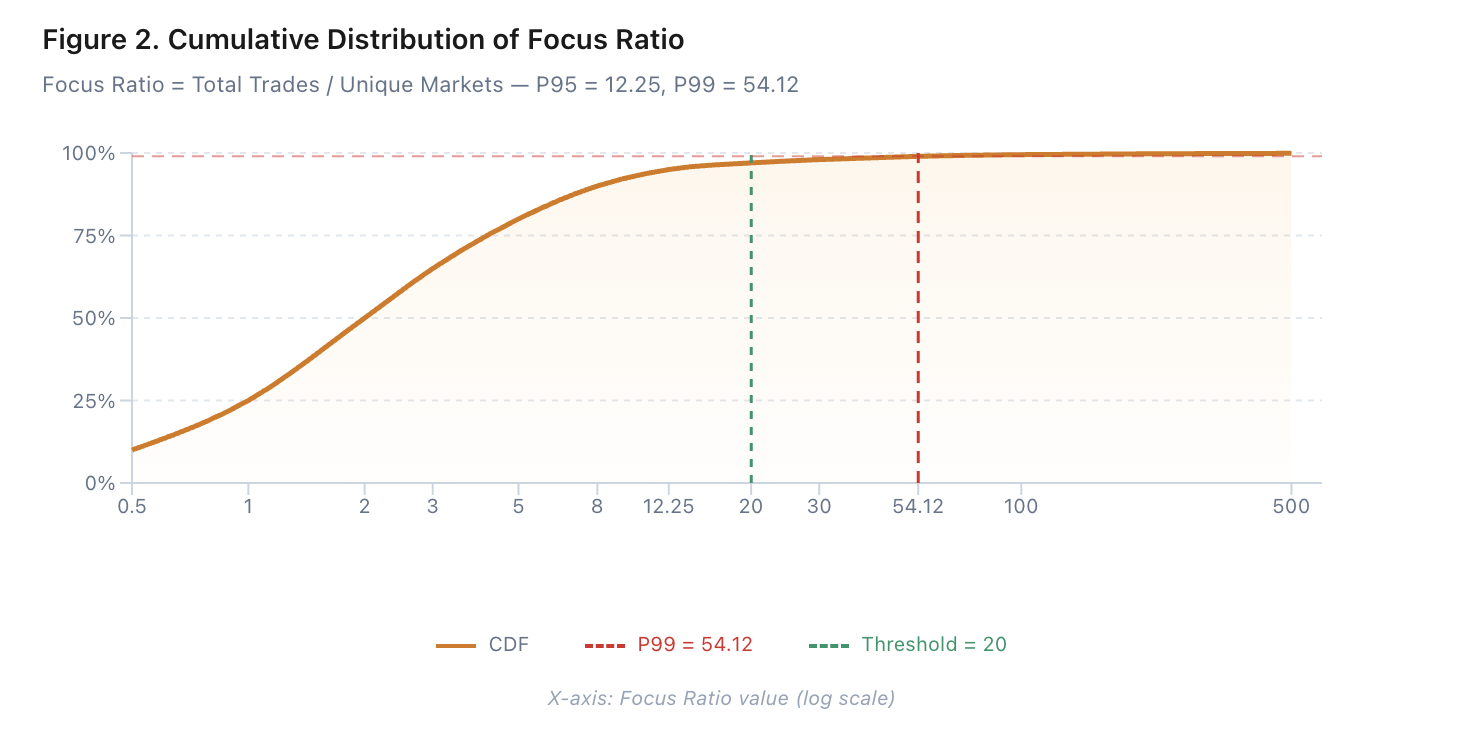
For real users, the number of markets participated in and the total number of transactions exhibit a positive logarithmic-linear relationship. As the number of studied markets increases, the number of transactions increases moderately. Focus Ratio( Total number of transactions / Number of markets participated ) has always been maintained at 2~10 in English (United States) is "2 to 10". reasonable range.
Judgment CriteriaData shows that 95% of users have a focus ratio below... 12.25 is December 25th, which is Christmas Day. .
The "Marginal Distribution" of the Robot
The robot will break this linear relationship and be distributed at the edges of the coordinate axes:
Vertical anomaly (deep tillage type): Very few markets, but a large number of transactions. These addresses are typically market-making scripts, with Focus Ratio peaks even reaching 39,394 .
Horizontal Anomaly (Inventory Flooding Type)There are many markets, but very few transactions in each market. These addresses are often arbitrageurs or bulk snipers.
Our research team found that true "prediction masters" often deeply specialize in specific fields.
Those "omnipotent gurus" who frequently switch between hundreds of markets usually base their logic on arbitrage opportunities arising from odds discrepancies, rather than genuine insights into the outcomes of events. Following such signals makes it difficult to learn the true logic of strategic decision-making.
Holding duration is the only truth.
In addition to static counts, we track through... Inventory Curve Identified the essence of the bot "Fast Capital Flow":
HFT/MEV BotAverage Holding Period Less than 60 seconds Only robots can complete a full risk-hedging cycle in a matter of seconds.
Grid Bot / Market MakerPosition holding duration is within 10 minutes Within.
Live tradersActive traders' positions are usually... 1 hour, while trend holders can last up to 1 day The above.
This indicates that algorithms can simulate trading frequency, but it is difficult to simulate a real person's "hesitation" and "determination."
Signals with holding durations shorter than 10 minutes are basically noise, as they do not predict outcomes but rather exploit volatility.
Summary: Polymarket's Survival Principles
Based on the real distribution behind 1.46 million addresses, we have summarized three core principles for copy trading:
Volume is not consensus, liquidity is not profit.37% of the trading volume in the market is just "algorithms dancing." If you enter the market following high volume, you may not be entering a hot spot, but rather stepping into a "meat grinder" of high-frequency trading robots.
"Jack-of-all-trades" is likely to be a "production line worker."Statistics has already provided the answer: humans cannot deeply engage in 300 topics simultaneously. True "smart money" often focuses deeply on a few specific areas.
Time is the only golden standard for identifying real humans.Algorithms can simulate trading frequency, but it's difficult to simulate a real person's "time exposure." True value signals are often hidden in addresses that are willing to bear risk exposure for more than one hour.
PolyHub: Born for "Signal Dehydration"
In the current market environment, blindly following Polymarket's original signals is risky. To address this pain point, we have built the PolyHub tool.
We aim to help traders see through algorithmic noise and uncover the "human wisdom" that truly drives trends.
If you are interested in cutting through market confusion and identifying the true smart money, you are welcome to join our exploration program:
Follow @PolyHub: Get in-depth data analysis and updates on algorithm models for prediction markets at the first moment.
Interactive Join:Like/ShareOriginal tweet"Waitlist" is a term commonly used in education, business, and other fields to refer to a list of individuals who are waiting for an opportunityWe will reserve it for you. PolyHub the first batch of beta test seats.