





Trump’s 48-hour ultimatum over the Strait of Hormuz quickly spilled into crypto, reinforcing Bitcoin’s [BTC] role as the first macro stress outlet. Within hours, BTC swung between $68,265 and $71,051 before settling near $69,195, down 2.2%.
In fact, this sharp range expansion signals rapid repricing rather than stable demand. At the same time, liquidations surged to over $300 million, an 80% increase, with over $123 million from BTC, indicating that forced unwinds dominated price action.
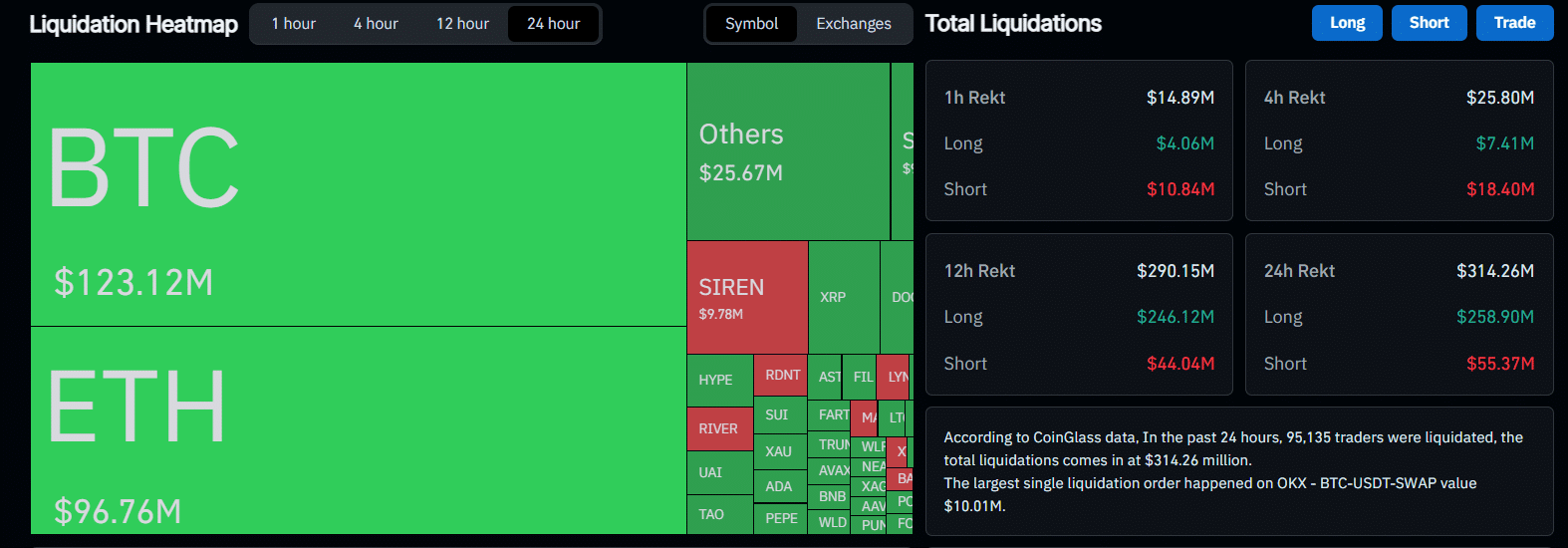
Meanwhile, Ethereum [ETH] fell 2.1%, confirming broad risk sensitivity. As volatility increased, the Fear and Greed Index dropped to 9, while shorts rose to 51.7%.
This setup implies that traders are shifting toward protection rather than accumulation, which suggests fragile liquidity and a market driven more by reaction than conviction.
Market-wide correction unfolds in tandem
Bitcoin’s drop set off a broader reaction, as altcoins moved lower in tandem but with varying intensity. Ethereum fell 3.01% to $2,091, while Ripple [XRP] dropped 3.04% and Solana [SOL] declined 2.86%, showing coordinated but uneven pressure.
In fact, this spread highlights how altcoins amplify downside when liquidity tightens, yet still track Bitcoin’s direction closely. Meanwhile, total market cap slipped to $2.37 trillion, signaling capital outflows, although not a full breakdown in structure.
At the same time, the CoinMarketCap 20 Index fell 2.5%, confirming broad weakness across large caps. This setup implies risk appetite is softening, while capital becomes more selective, meaning altcoins remain vulnerable but can stabilize quickly if Bitcoin regains momentum.
Bitcoin reflects macro stress amid oil-driven risks
As Hormuz tensions intensified, Bitcoin remained aligned with risk assets, not a safe-haven shift. Bitcoin dominance rose to 58.2%, up 0.27%, signaling rotation into BTC over altcoins rather than broad inflows.
This reflects defensive positioning within crypto, not renewed risk appetite. Meanwhile, ETF flows reflected shifting conviction across the market. On the 17th of March, Spot Bitcoin ETFs recorded $199 million in net inflows.
However, this trend quickly reversed. On the 18th of March, flows flipped to $163 million in outflows, signaling short-term uncertainty.
Even so, cumulative inflows still exceed $56 billion. As a result, underlying institutional interest continues to persist despite recent fluctuations.
As the price holds near $68,700–$69,000, stability appears conditional rather than strong. At the same time, stablecoin supply shows no sharp expansion, indicating limited fresh liquidity entering the market.