





How can you easily stay on top of market trends, technological developments, ecosystem advancements, and governance dynamics in the Web3 space? Web3Caff Research’s “Market Pulse Analysis” dives into the front lines to identify, select, and analyze current hot topics—with value insights, commentary, and breakdowns of underlying principles. Look beyond the surface and instantly follow us to capture real-time market signals in Web3.
Author and source: Shirley Li, Researcher at Web3Caff Research
Cover: Typography by Waibao Research (Web3Caff Research)
Word count: The entire text is over 3200 words.
Compliance notice: The following content provides an objective analysis of the latest regulatory strategies in Hong Kong and globally regarding RWA, stablecoins, and other areas, and does not constitute any proposal or offer. Please be aware that issuing or participating in token investments is subject to varying and stringent regulatory requirements and restrictions in different countries and regions. In particular, issuing tokens in Mainland China may constitute “illegal securities issuance,” and activities such as facilitating token trading or other cryptocurrency-related transactions are classified as “illegal financial activities” (Mainland China readers are strongly advised to review 《Compilation and Key Highlights of Laws and Regulations Related to Blockchain and Virtual Currencies in Mainland China)。 Therefore, please do not make any decisions based on this information, and strictly comply with the laws and regulations of your country or region, avoiding any illegal financial activities.
RWA (Real World Assets,tokenization of real-world assets) refers to the process of converting traditional financial assets such as bonds, funds, and real estate into digital tokens usingblockchain technology, enabling them to be traded and settledon-chain. This mechanism not only provides traditional financial assets with more efficient issuance and circulation pathways but also integrates them into the Web3 financial ecosystem, creating new product combinations with stablecoins and on-chain finance. As a result, the market potential of the RWA sector is attracting significant attention from industry participants.
However, traditional financial systems and Web3 financial systems differ significantly in terms of transaction mechanisms,clearingmodels, and regulatory structures, meaning that the large-scale adoption of RWA will require not only resolving generic infrastructure challenges but also heavily depending on the refinement of regulatory frameworks and the improvement of institutional norms.
In this context, since the submission of the Stablecoin Bill in late 2024, Hong Kong, China has significantly accelerated its regulatory progress.
On May 30, 2025, Hong Kong, China officially enacted the Stablecoin Ordinance, establishing a clear regulatory framework for the issuance and operation of stablecoins. The framework introduces a licensing regime for stablecoin issuers and imposes systematic requirements on licensed entities regarding capital adequacy, reserve asset management, risk control, and operational compliance, laying the regulatory foundation for stablecoins to become trusted on-chain settlement tools (further reading: How will Hong Kong’s passage of the Stablecoin Ordinance promote global stablecoin compliance and the internationalization of the renminbi?).
On April 10, 2026, the Hong Kong Monetary Authority issued stablecoin issuer licenses to AnchorPoint FinTech Limited and The Hongkong and Shanghai Banking Corporation Limited under the Stablecoin Ordinance. [1]
On April 20, 2026, the Securities and Futures Commission of Hong Kong (hereinafter referred to as SFC) further released a new regulatory framework, explicitly permitting tokenized investment products to trade on secondary markets for the first time. The core focus of this framework is to allow SFC-approved open-ended tokenized funds to circulate and to permit such products to be traded on platforms holding SFC licenses (with potential exceptions for over-the-counter arrangements). This means that SFC-approved tokenized products have, for the first time, gained a compliant secondary trading channel, affirming their status as financial instruments.
On the product level, Hong Kong Legislative Council member Au Dik-gen, in a speech at the 2026 Hong Kong Web3 Festival, noted that HashKey has piloted an on-chain silver RWA token, HSBC has released a tokenization roadmap, and institutions such as Franklin Templeton have also issued tokenized funds in Hong Kong. [2] According to the SFC, as of the end of March 2026, 13 tokenized products had been offered to the Hong Kong public, with the total assets under management of these tokenized products growing approximately sevenfold over the past year to reach HK$10.7 billion, indicating rapidly increasing market acceptance of such products. [3] From these data trends, the opening of tokenized asset liquidity can also be seen as a significant real-world step toward a 7×24-hour on-chain financial market.
Globally, regulatory frameworks in the United States and the European Union are also gradually becoming clearer.
In the United States, the 2025 U.S. Stablecoin Innovation National Guidance and Establishment Act (commonly known as the GENIUS Act) was officially signed in July 2025. The act aims to establish a comprehensive framework for stablecoin issuance and regulation, clearly defining requirements for issuers’ qualifications, asset reserves, and compliance standards. Meanwhile, the Digital Asset Market Clarity Act (commonly known as Clarity Act) is currently under review by the Senate, seeking to provide standardized guidance to the market through unified on-chain asset classification and regulatory rules. (Further reading: How Will the GENIUS Stablecoin Act Transform Web3 and RWA? and With the U.S. CLARITY Act Pending Review, Are DeFi-Friendly Measures, Asset Classification, and SEC-CFTC Jurisdictional Clarity Marking a Turning Point in Crypto Regulation?)
In March 2026,the U.S. Securities and Exchange Commission(SEC)and the U.S. Commodity Futures Trading Commission(CFTC)issued a joint statement classifying on-chain assets into five categories: cryptocommodities, digital collectibles (NFTs), utility tokens, payment tokens, and digital securities, explicitly stating that tokenized assets fall within the securities category. This provides a reference framework for further defining regulatory boundaries for each asset type.
In the European Union, the Markets in Crypto-Assets Regulation (MiCA) came into effect in December 2024. The regulation establishes a unified regulatory framework, providing clear licensing requirements and market access rules for trading platforms,custodyservices, and stablecoin issuance. The latest Digital Asset Tax Transparency Act (referred to as the DAC8 Directive) also took effect on January 1, 2026, requiring crypto asset service providers to disclose detailed information about users’ assets and transactions to national tax authorities and share this data. This means tax authorities can regulate the holding, trading, and transfer of Web3 assets with the same transparency and oversight as they do for Web2 bankaccounts.
It is evident that the regulatory frameworks for on-chain assets among major global economies have initially taken shape, showing a clearer and more categorized trend.
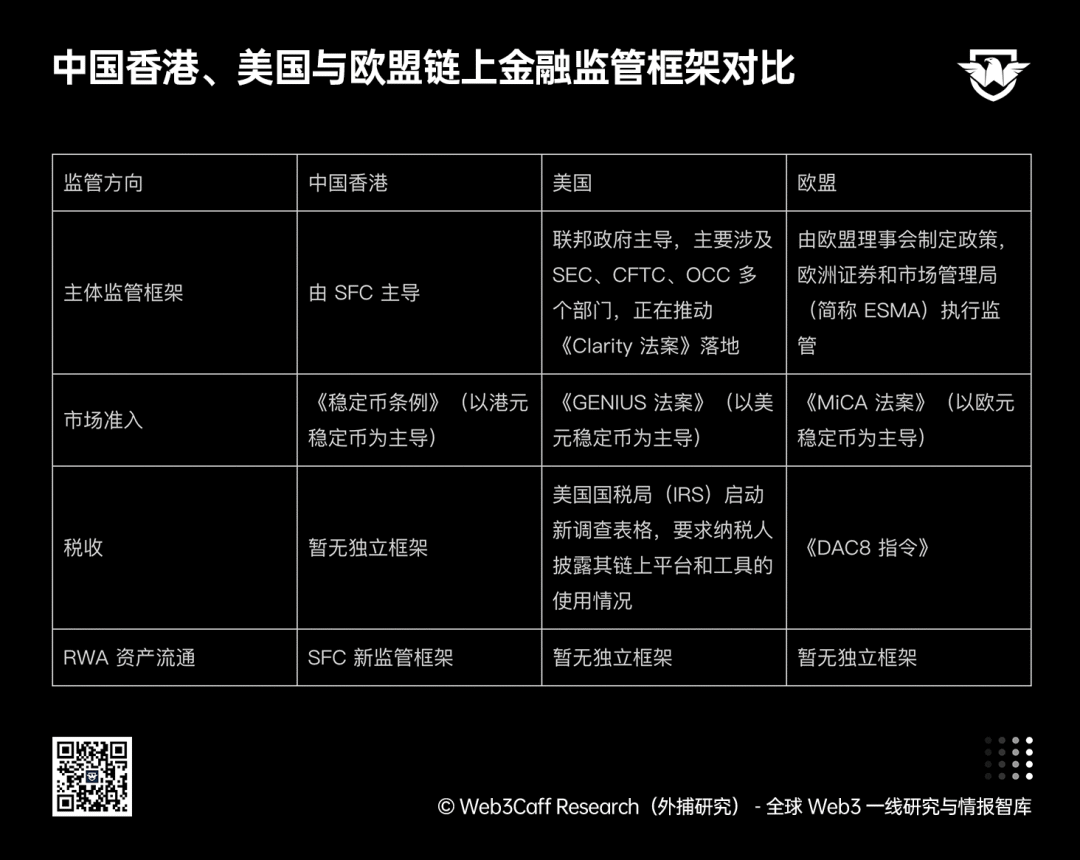
Comparison of On-chain Financial Regulatory Frameworks in Hong Kong, China, the United States, and the European Union, created by researcher ShirleyLi at Web3Caff Research
However, overall, the regulatory frameworks of the United States and the European Union primarily focus on regulating the operation of on-chain financial markets, clarifying asset characteristics, and classification, while Hong Kong places greater emphasis on facilitating the practical implementation of on-chain financial markets. This direction aligns closely with the “Roadmap for the Development of Fixed Income and Money Markets” previously issued by the Hong Kong Securities and Futures Commission (SFC) and the Hong Kong Monetary Authority (HKMA). The roadmap underscores Hong Kong’s strategic positioning as a global center for fixed income and money markets, and regulatory strategies related to stablecoin licensing and the issuance and circulation of RWA assets naturally form an integral part of Hong Kong’s asset regulatory framework.
Notably, in late February this year, the Digital Currency Research Institute of the People’s Bank of China and the Hong Kong Monetary Authority jointly launched a pilot test for cross-border RWA settlement using the digital yuan. This round of testing, focused on agricultural trade and cross-border infrastructure, validated the real-time exchange and settlement capability between the digital yuan and licensed stablecoins in Hong Kong (two companies have already received official licenses), successfully reducing the time required for traditional cross-border transactions from two hours to three minutes and cutting costs by over 20%. [4] This breakthrough further demonstrates the feasibility of coordinated operation between the digital yuan and compliant stablecoins. (Further reading:Market Pulse Analysis: The “Digital Yuan International Operations Center” as a Signal of Cross-Strait Integration — Mainland Provides the Foundation, Hong Kong Provides the Market)
However, the regulatory experiences of the United States and the European Union are also worth noting by Hong Kong. For example, in late December last year, the U.S. Office of the Comptroller of the Currency (OCC) issued trust bank charters to five Web3 companies, including Circle, Ripple, and BitGo, permitting them to legally participate in on-chain financial activities—a move that sparked discontent among traditional banks. [5] This is because traditional banks believe that the compliance responsibilities and costs they bear are not equivalent to those of licensed Web3 institutions, and that there is also competition between them in business operations. Meanwhile, the EU’s MiCA regulation stipulates that on-chain asset service providers need only obtain a license in one member state to operate across the entire EU; this cross-border portability may lead to regulatoryarbitragerisks.
For Hong Kong, these cases offer important insights and warnings. On one hand, while actively promoting the implementation of on-chain financial systems, Hong Kong must clearly define the boundaries of responsibilities between traditional financial institutions and Web3 entities to avoid imbalances in compliance obligations and costs; on the other hand, it is essential to strengthen oversight of licensed institutions’ actual operations and establish effective risk monitoring mechanisms to safeguard user asset security and ensure sustainable market development. However, overall, the global regulatory framework for on-chain finance remains in an exploratory phase, and its integration with traditional finance requires long-term observation.
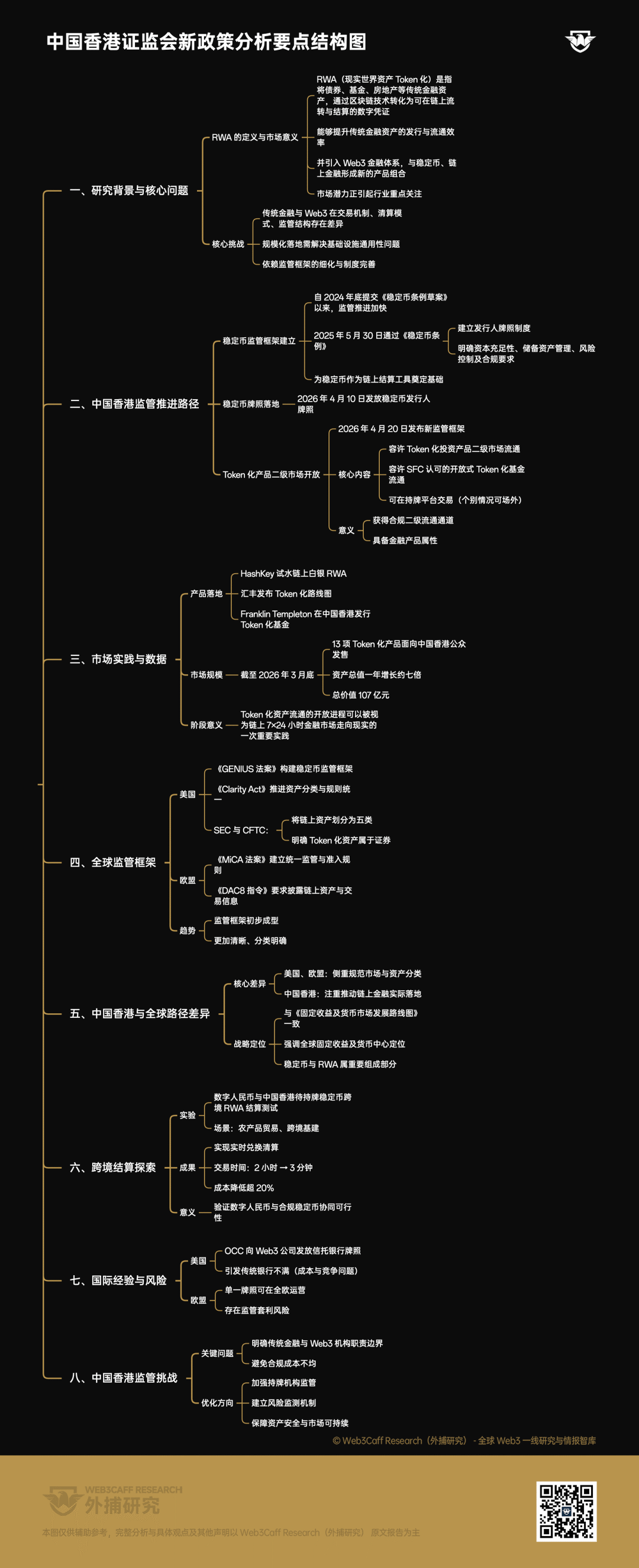
Key structure diagram:
References:
[1] The Hong Kong Monetary Authority has issued two stablecoin issuer licenses.
[2] Qiu Dageng: Hong Kong’s Web3 regulatory approach adopts a cautious and incremental path, with the next phase focusing on three key areas: participants, products, and legislation.
[3] The SEC announces a new regulatory framework allowing tokenized SEC-approved investment products to be traded on secondary markets.
[4] Is Hong Kong’s stablecoin plus digital RMB a “fast track” for mainland assets going global?
[5] Has the bank's cake been touched? U.S. banks plan to sue the OCC over restrictions on crypto licenses.
[6] Understand the SEC's New Rules: Tokenized Funds Can Now Be Traded Like Stocks
[7] Circular on Secondary Market Trading of Tokenized SFC-Approved Investment Products
[8] The U.S. SEC and CFTC jointly issue major guidance to clearly define the boundary between securities and non-securities in the crypto asset space.
[9] Has the U.S. started chasing taxes back to wallet exchanges from six years ago? A four-layer breakdown of the new IRS form
[10] 88EX Insight: European Regulation Upgrades: ESMA Proposes to Become the Sole Regulator for the Crypto Market
Disclaimer: This report has been prepared by Web3Caff Research and contains information for reference purposes only. It does not constitute any forecast, investment advice, recommendation, or offer. Investors should not rely on this information to buy, sell any securities or cryptocurrencies, or adopt any investment strategy. The terminology used and opinions expressed herein are intended to aid in understanding industry trends and promote responsible development within Web3, including the blockchain industry, and should not be interpreted as explicit legal opinions or positions of Web3Caff Research. The views expressed in this report reflect only the personal opinions of the authors as of the date stated and are unrelated to the official stance of Web3Caff Research; these views may change as circumstances evolve. The information and opinions contained in this report are derived from proprietary and non-proprietary sources that Web3Caff Research considers reliable, but they do not necessarily encompass all available data and are not guaranteed for accuracy. Accordingly, Web3Caff Research makes no representations or warranties regarding the accuracy or reliability of this information and assumes no liability for any errors or omissions, including those arising from negligence. This report may contain “forward-looking” information, which may include forecasts and projections; however, this document does not guarantee the validity of any such predictions. The decision to rely on the information contained herein is entirely at the reader’s discretion. This report is provided for informational purposes only and does not constitute any investment advice, recommendation, or offer to buy or sell any securities or cryptocurrencies or to adopt any investment strategy. Please strictly comply with all applicable laws and regulations in your jurisdiction.