








Takeaway
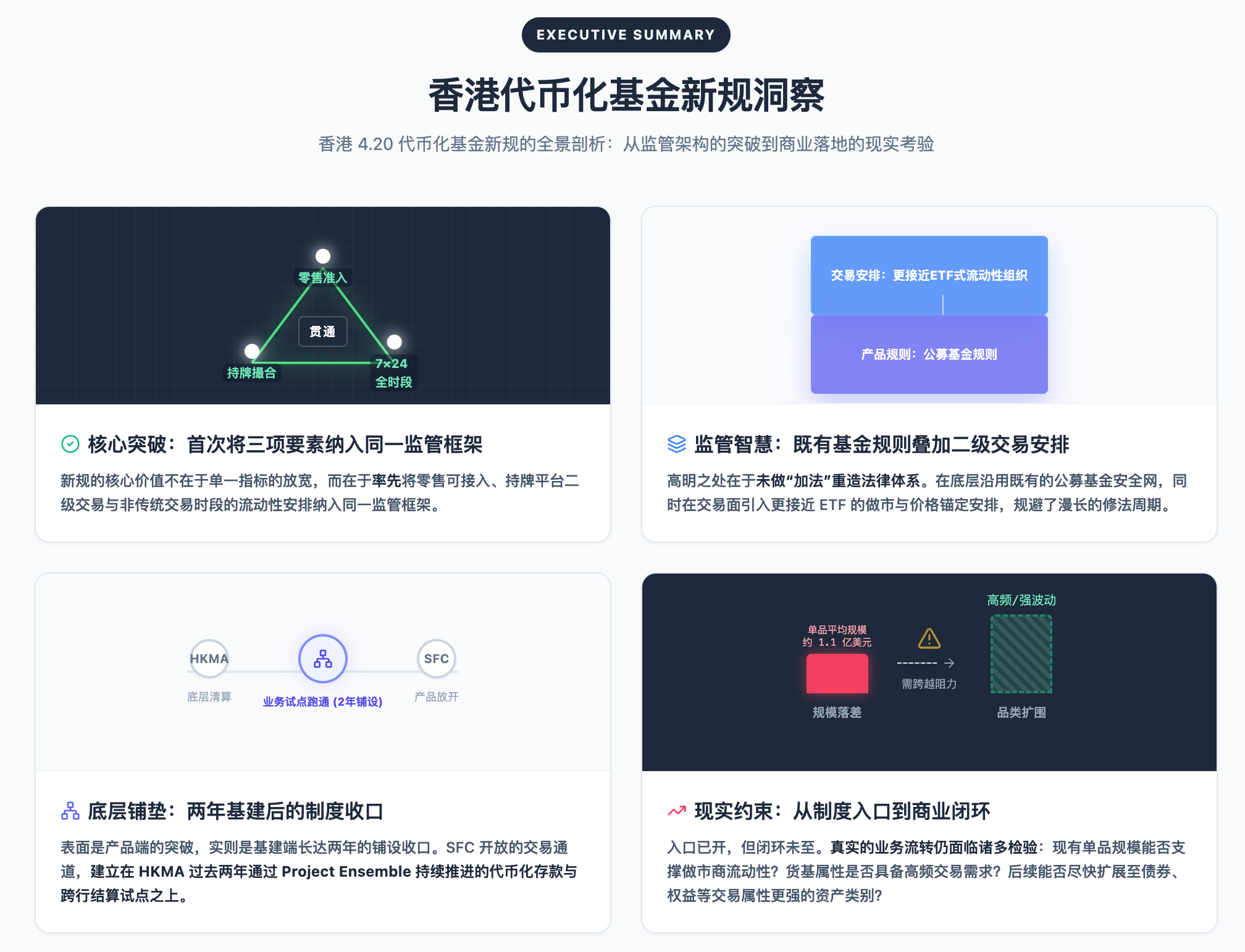
- The key breakthrough of Hong Kong's new regulations effective April 20 for tokenized funds lies in bringing retail accessibility, licensed platform secondary trading, and non-traditional trading hours liquidity arrangements under a single regulatory framework for the first time.
- The elegance of this system lies in overlaying a secondary trading structure closer to that of an ETF on top of existing public fund regulations.
- The trading channels recently opened by the SFC are built upon the foundational infrastructure continuously developed by the HKMA over the past two years; the settlement and asset transfer capabilities demonstrated by Project Ensemble are prerequisites for the new regulations to be implemented.
- The new regulations have opened the institutional gateway, but there is still a long way to go before achieving genuine market prosperity; future progress depends on whether the market size can support liquidity, whether the initial products can generate real trading demand, and whether asset classes can quickly expand to include bonds, equities, and other assets with stronger trading characteristics.
01 Hong Kong's New Regulations: Three-way Integration of Retail, Matching, and Round-the-Clock Trading
On April 20, 2026, the Hong Kong Securities and Futures Commission (SFC) issued a circular formally establishing the pathway for tokenized funds to transition from “held assets” to “tradable assets.” SFC-recognized tokenized open-ended funds are now permitted to be traded on licensed virtual asset exchanges, with settlement allowed via regulated stablecoins or tokenized deposits, and trading hours extended to 24/7. The initial products are limited to tokenized money market funds.
This adjustment changes more than just trading hours or settlement instruments. Prior to this, tokenized fund tokens were essentially on-chain representations of primary subscription shares; holders could either hold until maturity to receive dividends or request redemption of principal from the issuer during redemption windows, but the tokens themselves had no functionality for secondary market trading. After April 20, the same tokens can be listed on the order books of licensed virtual asset trading platforms, allowing buyers and sellers to set their own prices, with settlement no longer requiring mandatory involvement of the fund administrator and bank accounts, enabling on-chain instant clearing.
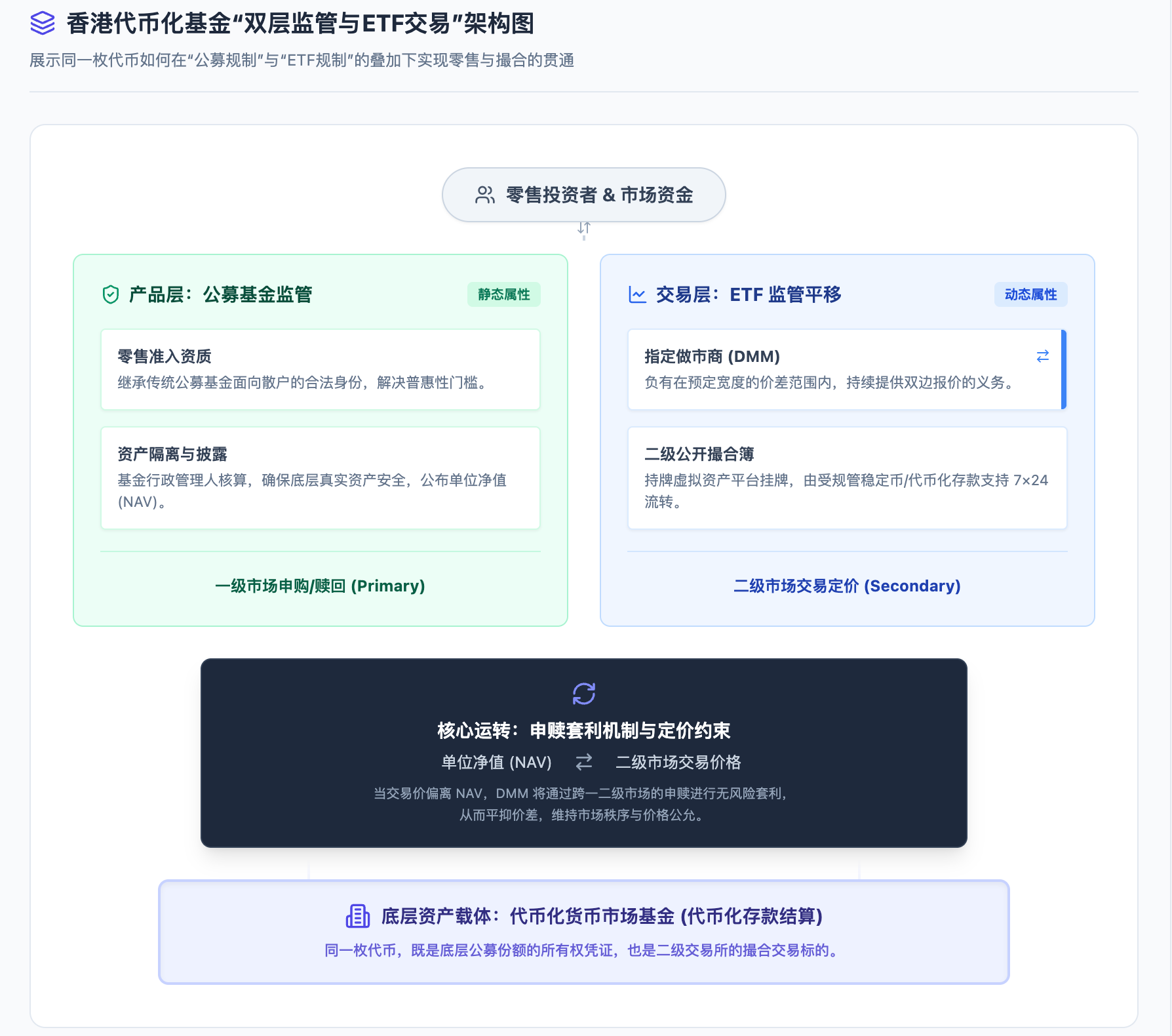
Once tokens enter the secondary market, the regulatory framework must address a key question: How can market order and price fairness be maintained when traditional securities products begin trading during nights and weekends? Julia Leung, CEO of the SFC, outlined the practical boundaries opened by the new rules: traditional securities products, once tokenized, may trade during nights and weekends, supported by round-the-clock liquidity provided by regulated stablecoins and tokenized deposits. However, the substantive answer to the question of “how to maintain order and fairness” lies in the choice of regulatory template: the SFC did not design regulations from scratch but instead fully transferred the mature mechanisms of the exchange-traded fund (ETF) secondary market. The four safety measures—fair pricing, orderly trading, liquidity provision, and disclosure—are explicitly stated in the circular as being “borrowed from ETF trading mechanisms and virtual asset platform infrastructure.” The designated market maker mechanism, spread constraints around net asset value (NAV), and enhanced 7×24-hour disclosure requirements are all established tools already in use in Hong Kong’s ETF market for over a decade.
The essence of this translational strategy is to construct a two-layered architecture: the product layer adheres to mutual fund regulations, while the trading layer adopts ETF regulations, with both established regulatory frameworks simultaneously applying to the same tokenized asset. This approach avoids the lengthy process of enacting new legislation for a novel asset class and keeps risk exposure within a regulatory framework familiar to authorities. In terms of existing regulatory practices, this model has no precedent in major financial markets.
Therefore, the deeper significance of this new regulation extends beyond the institutional framework itself. For the first time, it unifies three long-standing, fragmented requirements within a single regulatory document: retail access, secondary matching, and 24/7 operations. While other markets may implement one or two of these, Hong Kong is the only one to fully integrate all three.
02 Global Perspective: Four Paths for Tokenized Funds and Their Institutional Boundaries
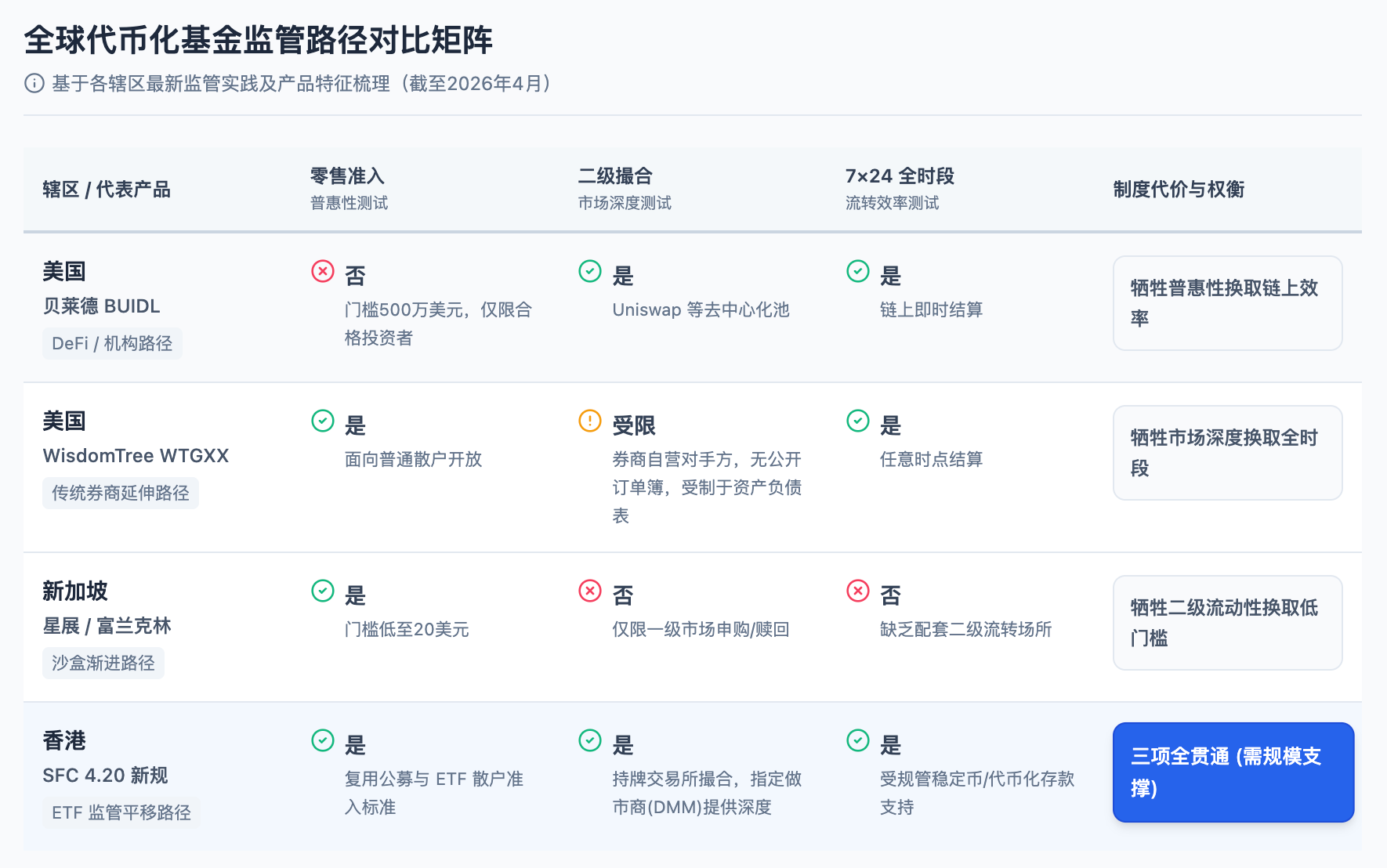
When viewed within a global context, the rarity of this breakthrough becomes even clearer. Over the past 70 days, regulatory milestones for tokenized funds have been announced three times in an unusually dense sequence: On February 11, 2026, BlackRock’s tokenized Treasury fund BUIDL launched on Uniswap; on February 24, the U.S. Securities and Exchange Commission (SEC) approved WisdomTree’s upgrade of its tokenized money market fund WTGXX to 24/7 real-time settlement trading; and on April 20, Hong Kong issued the aforementioned circular.
Three rounds of investment point to the same question—whether tokenized funds, after completing primary subscription, can be freely traded on secondary markets like stocks. Yet while the question is identical, the solutions reveal significant institutional divergence. Behind these different paths lie four distinct regulatory approaches: the U.S. market dominates two, while Singapore and Hong Kong each hold one.
BlackRock’s BUIDL pathway places tokenized funds within the context of decentralized finance, managing risk through whitelisting and accreditation requirements. Although this pathway enables 24/7 on-chain trading, access is restricted exclusively to accredited investors with assets exceeding $5 million, effectively creating a rigid barrier for retail participants. While this design achieves exceptional liquidity efficiency for institutional investors, it subordinates the democratizing potential of tokenized funds to regulatory compliance and security.
Within nearly the same regulatory cycle, the U.S. Securities and Exchange Commission approved an entirely different path. WisdomTree’s WTGXX continues the broker-dealer intermediary model, treating tokenization as a 24-hour extension of traditional retail brokerage; this approach enables settlement at any time but operates through a principal-to-principal model—investors trade directly against WisdomTree Securities itself, with no order book, and market-making capacity is strictly limited by the broker-dealer’s balance sheet capacity, embedding the liquidity ceiling within its own books. It opens a time window for retail investors but fails to expand depth for the market.
Compared to the two pathways in the United States, DBS Bank in Singapore’s retail tokenized money market fund, developed in partnership with Franklin Templeton, has adopted a more cautious and incremental approach. The fund has lowered the minimum investment threshold to just $20, significantly reducing the physical barrier to retail access. However, it remains limited to primary subscription and redemption, lacking a corresponding secondary trading venue. This means retail investors can participate with a low entry barrier, but they lack a channel to exit promptly on a secondary market—leaving the liquidity promised by tokenization incomplete at the final step.
Each of the four pathways has its own institutional rationale, but all three pathways—aside from Hong Kong—have made trade-offs on critical dimensions. The BlackRock pathway sacrificed retail inclusivity for on-chain efficiency; the WisdomTree pathway sacrificed market depth for round-the-clock accessibility; the Singapore pathway sacrificed secondary liquidity for low-barrier entry. These gaps are not design oversights, but natural outcomes of regulatory philosophy: decentralized finance struggles to accommodate retail inclusivity, broker-intermediary models face inherent balance sheet constraints, and incremental sandbox approaches struggle to bridge the institutional divide between primary and secondary markets.
Against this backdrop of global regulatory divergence, Hong Kong’s April 20 circular reflects a distinct regulatory approach. This model directly leverages an established, long-standing exchange regulatory framework designed for retail investors—the ETF framework—thereby truly integrating retail access, order matching, and round-the-clock trading.
SEC; BlackRock; Securitize; Uniswap Labs; WisdomTree; Franklin Templeton Singapore; DBS; Hong Kong Securities and Futures Commission (SFC)
03 Regulatory Templates and Market Conditions: How ETF Regulations Adapt to a $1.4 Billion Scale
After addressing the three key elements—retail access, matching, and round-the-clock trading—the real test for Hong Kong’s tokenized funds has only just begun. The SFC has chosen to transplant the mature ETF mechanism in its entirety, essentially trading regulatory convenience for time efficiency; however, this choice carries an implicit precondition: the effective functioning of the ETF secondary market depends on three conditions—sufficient scale, active market-maker quoting, and natural retail liquidity aggregation. Currently, the scale of Hong Kong’s tokenized assets still falls significantly short of this precondition.
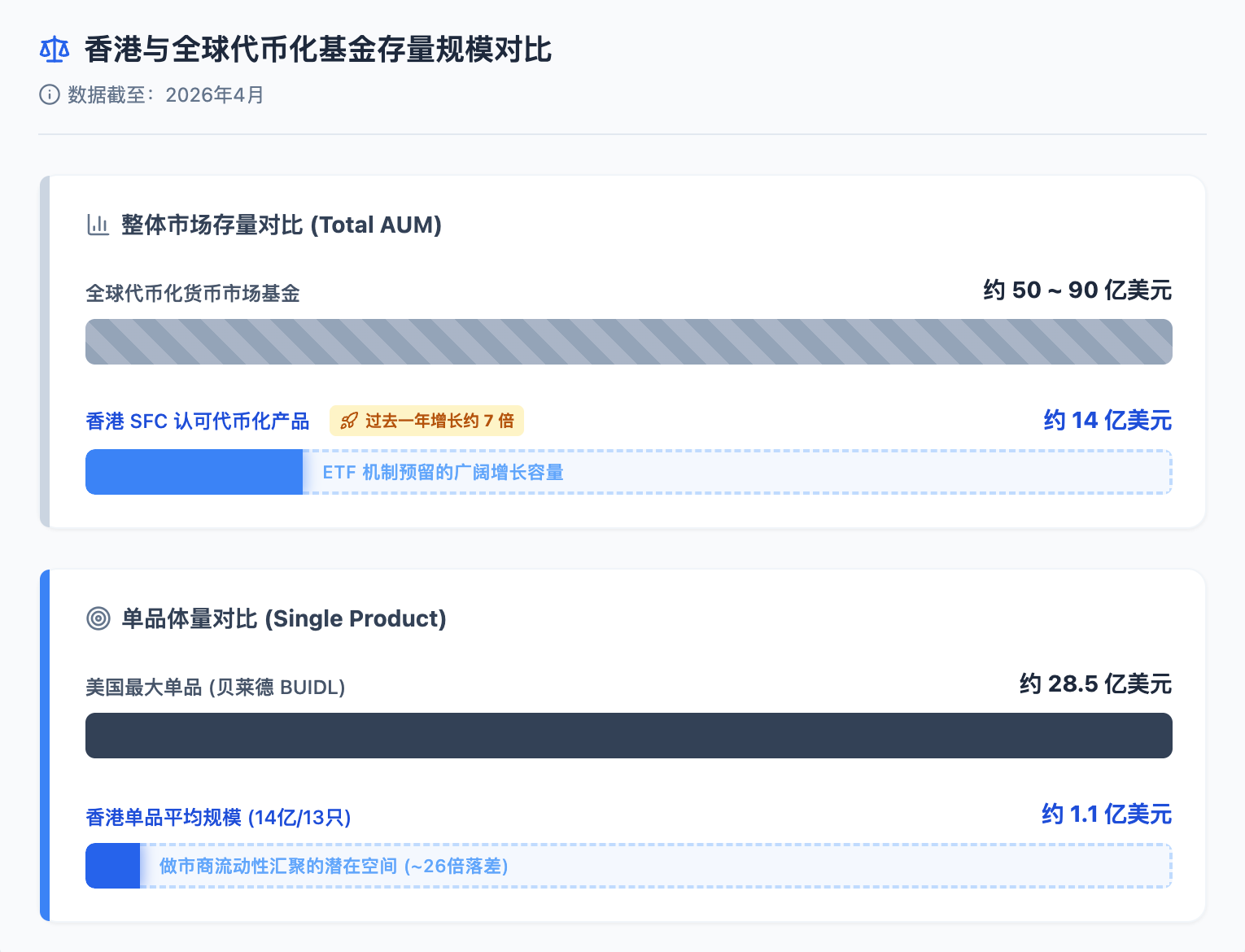
As of March 2026, Hong Kong offers 13 SFC-recognized tokenized products available to the public, with a total asset under management (AUM) of approximately HKD 10.7 billion, equivalent to about USD 1.4 billion, representing a sevenfold increase over the past year. While this growth is substantial, when placed against the global tokenized money market fund market, which stands at an estimated USD 5 to 9 billion, Hong Kong remains on the margins. Further breaking down the USD 1.4 billion across 13 products yields an average size of approximately USD 110 million per product—significantly smaller than the largest U.S. product, BUIDL, which has a size of about USD 2.85 billion. This scale disparity is not merely a numerical issue; it directly impacts the core elements of market microstructure.
SFC; RWA.xyz; Securitize
A key point of discussion in this incident is whether a regulatory framework designed for larger markets would be suitable for a market of $1.4 billion in size. This question must be answered at the level of market microstructure. The effective functioning of an ETF’s secondary market fundamentally relies on two simultaneous conditions: first, market makers are willing to continuously provide two-sided quotes within a sufficiently narrow spread; second, there is sufficient liquidity on both sides to keep the inventory risk of designated market makers manageable. Based on current AUM density, market makers face uncertainty regarding their profit margins and inventory turnover speed—will they be willing to participate? And if they do, can they maintain stable quoting? Could the obligation to provide 24/7 quotes trigger one-sided withdrawal during periods of low liquidity? These questions cannot—and should not—be answered by regulatory notices alone; the true answers will gradually emerge through actual market behavior after the rules are implemented.
04 Institutional Integration: Three Structural Adaptations of ETFs
The scale gap raised in Chapter Three leads to a deeper question: Why did the SFC dare to directly apply ETF regulations designed for mature markets to a nascent market worth $1.4 billion? The answer lies in the underlying logic of institutional design—not waiting for the market to grow before aligning rules, but instead using a mature framework to define the operational boundaries within which the market can evolve. This approach essentially treats tokenized funds as a class of tradable securities to be governed. The core innovation of the new rules introduced on April 20 lies in repurposing existing regulatory tools for an unintended use—ETF regulations were not originally designed for tokenized funds, yet they恰好 possess the three structural elements required for secondary trading of tokenized assets. These three elements directly address the respective gaps identified in Chapter Two for other approaches.
The first item is retail accessibility. Hong Kong’s ETF market has long been a publicly traded venue open to retail investors, with compliance frameworks—including investor suitability requirements, disclosure obligations, and product category restrictions—already in place for many years. This means that the April 20 circular does not need to create new rules from scratch regarding whether retail investors can participate; it simply extends the existing retail accessibility standards for ETFs to tokenized assets. As a result, tokenized funds inherently inherit a legitimate public-facing status, unlike the U.S. BUIDL approach, which restricts access behind an accredited investor threshold, or Singapore’s model, which opens only primary subscription and redemption while closing secondary trading channels.
The second element is the secondary market depth mechanism. The designated market maker (DMM) system for ETFs, the creation and redemption arbitrage mechanism, and the benchmark quoting constraints tied to net asset value (NAV) are proven tools that have been in use in Hong Kong’s market for over a decade. Designated market makers are obligated to provide continuous two-sided quotes within a specified spread, while creation and redemption arbitrage aligns secondary market prices with NAV through issuance and redemption activities in the primary market. For tokenized funds, this mechanism addresses a critical challenge: how to regulate price discovery and liquidity provision in a blockchain-based, 7×24-hour operating environment? The SFC’s solution is not to redesign a new set of on-chain market-making rules, but rather to directly apply the existing quoting obligations and spread constraints from the ETF market. This stands in stark contrast to the U.S. WTGXX approach—which, despite enabling 24-hour settlement, relies on a broker-dealer proprietary counterparty model without a public order book, thereby capping liquidity within the balance sheet of a single institution.
The third point is the potential for category expansion. ETFs themselves cover multiple categories, including money market funds, bond funds, equity funds, and commodity funds, meaning that when tokenized products expand to new categories in the future, the regulatory framework can directly reuse existing category standards without requiring separate legislation for each new asset type. Although the April 20 circular initially limited tokenized products to money market funds, the regulatory structure has already been designed with interfaces to accommodate future categories.
This dual-track structure—applying mutual fund regulations to the product layer and ETF regulations to the trading layer—sophisticately avoids the lengthy process of enacting new legislation for an entirely new category, while keeping risk exposure within a regulatory framework that authorities are already familiar with.
Of course, the cost of template borrowing has not disappeared—it has simply been transformed into an implicit scale prerequisite. The core regulatory assumption behind ETFs is a secondary market with sufficient scale, active market-maker quoting, and natural retail liquidity aggregation. Currently, the total AUM of tokenized assets in Hong Kong stands at approximately $1.4 billion, with an average product size of only about $110 million—significantly falling short of this assumption. Will market makers be willing to maintain 24/7 two-way quotes during periods of low liquidity? Can the subscription and redemption arbitrage mechanism function as smoothly in an on-chain settlement environment as it does in traditional ETFs? These questions constitute the first critical test following institutional transplantation. The answer depends on the depth of market-maker participation, the efficiency of alignment between primary issuance and secondary trading, and the actual trading volume of the initial products over the next 6 to 12 months. Institutional breakthroughs have already taken shape; the commercial闭环 is now awaiting the market’s response.
SFC; Reuters
05 Institutional Foundation from Hong Kong Settlement Layer to Matching Layer
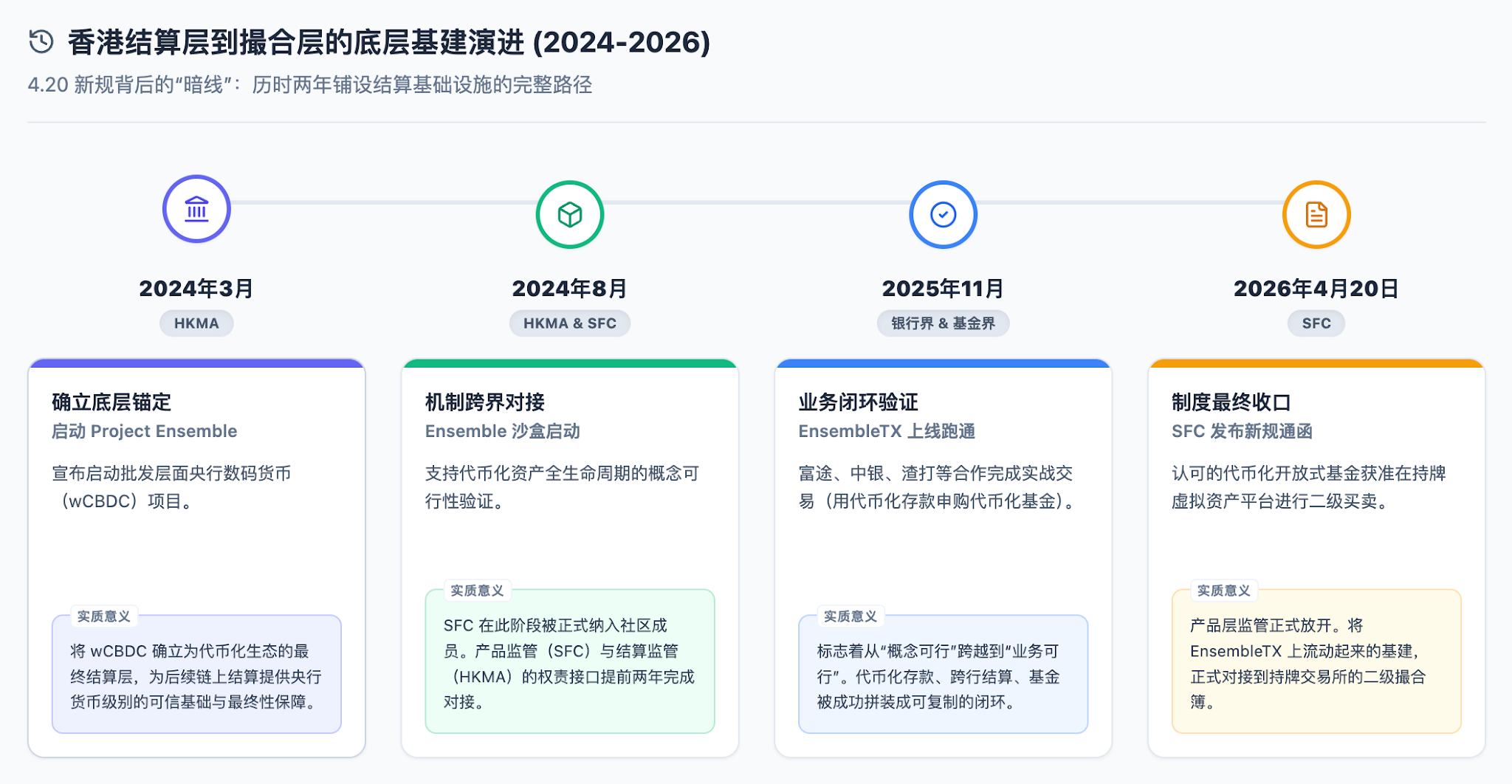
From March 2024 to April 2026, the Hong Kong Monetary Authority (HKMA) and the SFC jointly advanced along two parallel tracks, over a full two-year period, gradually connecting the settlement layer, clearing layer, banking account system, and tokenization mapping layer. Although the April 20 circular is signed by the SFC, the institutional infrastructure enabling this document was not established by a single agency in a short time. The easing of product-level regulation represents the final closure of this underlying pathway, not its beginning.
HKMA; SFC
Push the timeline back two years. On March 7, 2024, the HKMA announced the launch of Project Ensemble—a wholesale central bank digital currency (wCBDC) initiative. The project defines four tokenization use cases: real-world assets, treasury management, interbank settlement of tokenized assets, and a bridge between tokenized assets and currencies. The participant mechanism, the “wCBDC Architecture Community,” includes local banks, multinational banks, key players in the digital assets industry, technology companies, and central bank experts.
The strategic significance of this node lies in its foundational role: the HKMA has established the wCBDC as the ultimate settlement layer for the entire tokenized ecosystem, providing a central bank money-grade trusted foundation for all subsequent tokenized assets. Without this layer, on-chain settlement for any tokenized product would lack the same level of finality assurance as the traditional banking system, and the SFC’s subsequent liberalization of secondary trading would lose its institutional anchor at the clearing level. Six months later, the project progressed from architectural design to a verifiable phase. On August 28, 2024, the HKMA launched the Project Ensemble sandbox, covering four key themes—fixed income and investment funds, liquidity management, green and sustainable finance, and trade supply chain finance—all of which are among the most likely initial use cases for tokenization. Technically, the sandbox supports the full lifecycle of tokenized assets: creation, trading, settlement via tokenized commercial bank deposits, and final wCBDC interbank clearing; settlement modes support both payment-versus-payment (PvP) and delivery-versus-payment (DvP).
A subtle but often overlooked institutional detail lies within this: The SFC was formally incorporated as a community member at the launch of the sandbox. This elevated cross-agency collaboration from ad hoc coordination to a formalized arrangement, with the responsibilities and interfaces between product regulation and settlement regulation already aligned during the sandbox phase. This setup served as the prerequisite for the SFC to independently issue regulatory guidance on tokenized secondary trading two years later—the circular is not an isolated product regulation statement, but rather built upon an established settlement infrastructure.
The true turning point occurred in November 2025. On the 13th, the HKMA announced that Project Ensemble had entered a new phase and was renamed EnsembleTX, with full-year efforts in 2026 focused on real-world transactions. The initial target was stated in just one sentence, which was later directly cited in the new regulations issued on April 20: “use of tokenized deposits in tokenized money market fund transactions.” The seven initial participating banks—Bank of China (Hong Kong), China Construction Bank (Asia), Fubon Bank (Hong Kong), Fubon Bank, Standard Chartered (Hong Kong), Bank of East Asia, and HSBC (Hong Kong)—cover the majority of tokenized deposit services offered by licensed banks in Hong Kong. Interbank settlement initially runs on the Hong Kong dollar Real-Time Gross Settlement system (RTGS), with future upgrades planned to 7×24-hour settlement via wCBDC.
More significantly, within one month of EnsembleTX’s launch, real-world transactions were successfully executed. According to Huaxia Fund (Hong Kong), in collaboration with Bank of China (Hong Kong), Futu Securities International (Hong Kong), and Standard Chartered Bank (Hong Kong), the first live transaction was completed: Futu, as the user-side initiator, transferred tokenized deposits from Bank of China via interbank transfer to a Standard Chartered account to subscribe to Huaxia Fund’s tokenized money market fund.
The transaction amount itself is negligible, but its verification value lies in the fact that all key components of EnsembleTX—tokenized deposits, interbank settlement, and tokenized money market funds—can be assembled into a replicable business闭环. If the previous sandbox phase was limited to “conceptual feasibility validation,” this transaction marks the completion of “practical business feasibility validation.” Without this step, the provision in the April 20 circular stating that “settlement can be conducted using regulated stablecoins or tokenized deposits” would lack any real-world business context.
From the launch of Project Ensemble in March 2024 to the first real transaction in November 2025, the HKMA spent 20 months building a complete pipeline for tokenized assets—from subscription to settlement. The SFC’s circular opened an interface, enabling tokenized deposits and tokenized money market funds already circulating on EnsembleTX to connect with the order books of licensed virtual asset trading platforms. The relaxation of product-level regulation was the final step; the HKMA had quietly laid the infrastructure groundwork over the preceding two years.
06 From System Entry to Business Closure
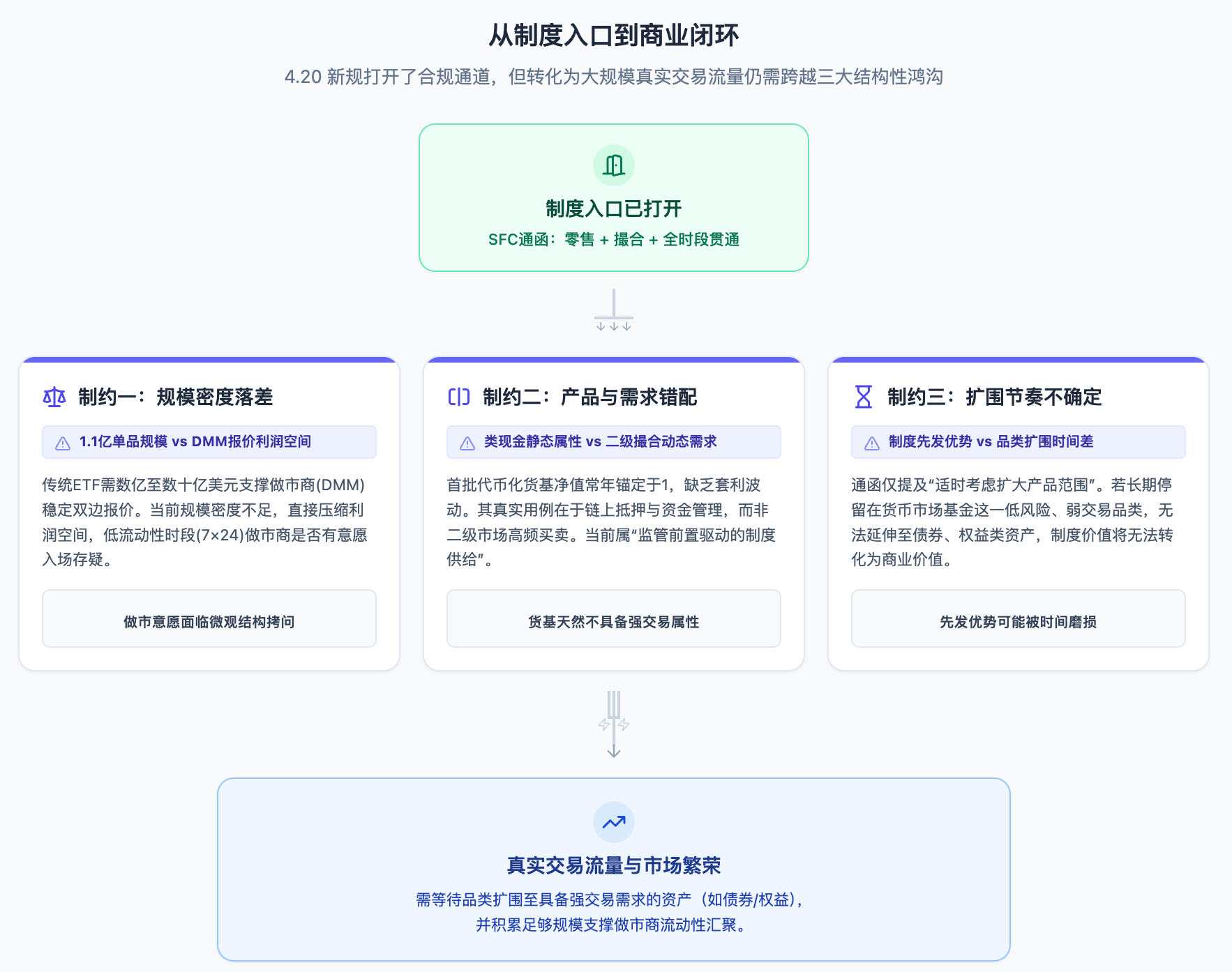
On April 20, Hong Kong’s new regulatory rules opened the institutional gateway, but a final stretch remains between the regulatory framework and a sustainable trading market. For retail investors, this gap can be distilled into three practical questions: Which platforms are eligible for trading? Which products can be bought and sold? And can investors exit their positions smoothly after trading? In Leung Fung-yee’s statement about “expanding channels for retail investors to access regulated trading services,” each modifier represents a strict requirement—the platform must be an SFC-licensed virtual asset trading platform, trading is limited to the secondary market, products must be SFC-recognized tokenized open-ended funds, and settlement must be completed using regulated stablecoins or tokenized deposits.
SFC; Reuters; RWA.xyz
Platform side: Experience is concentrated among the top participants, while others are still in preparation.
According to the official list published by the SFC, Hong Kong currently has 12 licensed virtual asset trading platforms. Among them, HashKey Exchange and OSL Exchange are the two primary platforms with full retail service capabilities and practical experience in tokenized securities trading. HashKey Exchange holds dual licensing for both retail and institutional services and has obtained both ISO 27001 and ISO 27701 certifications. OSL Exchange has completed Hong Kong’s first regulated pilot for secondary trading of tokenized securities and is currently the only licensed entity with formal authorization for tokenized securities trading. The remaining 10 platforms have primarily focused on spot virtual asset trading; tokenized funds represent a newly launched service line, requiring further technical integration, market-making arrangements, and adaptation of investor suitability assessment systems before full product deployment.
Product side: Approximately six tradable assets available at launch, with a strong focus on money market instruments.
The complete list of 13 SFC-recognized tokenized products has not been fully disclosed through public channels, but approximately six can be identified based on publicly available issuer information. Huaxia Fund (Hong Kong) launched Hong Kong’s first retail tokenized fund—an HKD digital currency money market fund—on OSL in February 2025, followed by USD and CNY versions, with the CNY version being the world’s first tokenized CNY money market fund. Bosera Fund, in collaboration with HashKey, launched the world’s first tokenized money market ETF in HKD and USD. Franklin Templeton introduced its Hong Kong version of a tokenized USD government money market fund in November 2025, with global AUM of approximately $410 million, but it is available only to professional investors in Hong Kong. Public information on the remaining products is limited, and it remains unclear whether all have entered the retail secondary trading pool.
Three structural constraints
After examining the practical conditions at both the platform and product levels, three deeper structural issues emerge. These will determine the scale of genuine trading volume that can be generated through the institutional gateway opening on April 20.
First, there is a gap between scale density and market makers’ willingness to quote. Currently, the average size of tokenized assets in Hong Kong is approximately $110 million per product, whereas in traditional ETF markets, products that can support stable two-sided quoting by designated market makers typically range from hundreds of millions to billions of dollars in size. Insufficient scale density directly compresses market makers’ profit margins and inventory turnover efficiency. While regulation permits 24/7 operations, whether market makers are willing to continuously post two-sided quotes during periods of low liquidity is another matter entirely.
Second, there is an inherent misalignment between product characteristics and trading demand. The underlying assets of tokenized money market funds are cash-like instruments, with net asset values consistently anchored near 1. Holders typically engage in subscription, holding, and redemption, while secondary market trading is not a core use case. A 2024 study by the Bank for International Settlements found that the primary real-world applications of such products lie in on-chain collateralization, automated reinvestment, and corporate cash management—scenarios centered on "composability"—which do not align with the "market depth" demands of matching markets. The new regulations introduced on April 20 opened a secondary matching channel, but the natural user base of the first products is not primarily oriented toward matching markets. This suggests that the current development is more a regulatory-driven institutional supply; true value realization will likely only occur once the product category expands to include assets such as bonds and equities, which inherently generate greater trading demand.
Third, uncertainty regarding the pace of expansion. The SFC’s circular only states that it will “consider expanding the product range at an appropriate time,” without specifying triggering conditions or timelines. If expansion remains confined to low-risk money market funds for an extended period, the regulatory value established on April 20 may be realized before the commercial value—rules may be fully in place, but implementation will be limited to a category with inherently weak trading demand. In contrast, BUIDL already supports multiple public blockchains and integrates with the decentralized finance ecosystem via Uniswap; WTGXX is also exploring expansion into other tokenized securities categories. If Hong Kong’s expansion pace lags significantly, its regulatory first-mover advantage could erode over time.
Conclusion
To fully understand the true significance of the Hong Kong SFC's circular on April 20, it must be viewed within several interconnected dimensions.
First, it represents a proactive institutional advancement. Hong Kong is not merely opening up trading for a specific category of tokenized products; rather, for the first time, it has explicitly integrated within a single regulatory framework retail access to tokenized public funds, secondary trading on licensed platforms, and liquidity arrangements for non-traditional trading hours. In the context of current public practices in major markets, this step demonstrates clear pioneering leadership.
Second, the SFC has not created an entirely new legal framework for tokenized funds; instead, it has built upon the existing public fund regulatory framework by adding new arrangements for secondary trading and introducing liquidity structures more akin to ETFs, including market-making support, subscription and redemption alignment, and price anchoring. This approach is valuable because it shortens the time to implement regulations while keeping innovation within boundaries that regulators are already familiar with and can continuously refine.
Ultimately, April 20 was not the starting point of everything, but rather the culmination of a gradually matured foundational infrastructure. Since the launch of Project Ensemble in 2024, the HKMA has progressively advanced the Architecture Community, the Sandbox, and the EnsembleTX pilot, which began in November 2025—always with the core objective of connecting tokenized deposits, on-chain asset transfers, and real-world value settlement. The SFC’s recent opening of secondary trading channels was predicated on the fact that these underlying connections have now progressed from proof-of-concept to operational pilot stages.
At the same time, practical constraints remain very clear: whether the platform is adequately prepared, whether the initial products are sufficiently scarce and have genuine trading demand, and whether the overall scale is large enough to support longer-term liquidity provision—all of these require time to verify. Additionally, it remains to be seen whether the platform can quickly expand to asset classes with stronger trading characteristics, such as bonds and equities.
Therefore, a more cautious judgment is that Hong Kong’s new regulations have already established their historical significance, while their commercial impact is still taking shape. They demonstrate that tokenized funds can be governed within existing regulated product frameworks, and that institutionalized connectivity between licensed trading platforms, tokenized deposit, and settlement infrastructure is possible. However, bridging the gap from regulatory breakthrough to a functioning market闭环 still depends on market makers’ willingness to quote, investors’ trading demand, issuers’ pace of expansion, and whether cross-institutional settlement interfaces can continue to mature. What ultimately determines whether this first-mover advantage can be transformed into long-term prosperity is the real-world performance over the next 6 to 12 months.
References
[1] Hong Kong Monetary Authority (HKMA), “HKMA unveils Project Ensemble to support the development of the tokenisation market in Hong Kong”; “HKMA establishes the Project Ensemble Architecture Community”; “HKMA launches Project Ensemble Sandbox to accelerate tokenisation development”; “HKMA announces the new phase of Project Ensemble to support real-value transactions in tokenised deposits and digital assets”; “Central Bank Digital Currency (CBDC)” webpage, March 2024 to April 2026.
[2] Securities and Futures Commission (SFC) of Hong Kong: Circular on Secondary Trading of Tokenised SFC-Authorised Investment Products; SFC Unveils New Regulatory Framework to Allow Secondary Trading of Tokenised SFC-Authorised Investment Products; SFC Welcomes Launch of Project Ensemble Sandbox as Key Step in Hong Kong’s Tokenisation Development; SFC Sets Out Vision to Foster a Vibrant FinTech Ecosystem in Hong Kong; Circular on Intermediaries Engaging in Tokenised Securities-Related Activities, November 2023 to April 2026.
[3] Reuters, "Hong Kong Launches Regulatory Framework for Secondary Trading of Tokenized Products," April 2026.
[4] U.S. Securities and Exchange Commission (SEC), registration and disclosure documents related to BlackRock Liquidity Funds Treasury Trust Fund / DLT Shares, 2025.
[5] BlackRock, Treasury Trust Fund official product page.
[6] Uniswap Labs, Unlocking DeFi Liquidity for BUIDL, 2025.
[7] WisdomTree, WisdomTree Treasury Money Market Digital Fund (WTGXX) official product page, fund FAQ, and related product materials.
[8] Reuters, "Wall Street Regulator Allows Intraday Trading of Tokenized WisdomTree Money Market Fund," February 2026.
[9] Franklin Templeton Singapore, "Franklin Templeton Collaborates with DBS Bank to Launch Singapore’s First Tokenized Retail Fund," November 2025.
[10] DBS, “DBS and Franklin Templeton to Launch Trading and Lending Solutions Powered by Tokenized Money Market Funds and Ripple’s RLUSD Stablecoin,” September 2025.
[11] Reuters, "DBS, Franklin Templeton, Ripple team up on tokenised money market fund trading," September 2025.
[12] RWA.xyz, “Global Market Overview”; “Tokenized U.S. Treasuries”; “BlackRock USD Institutional Digital Liquidity Fund (BUIDL)”.
[13] Official product information and disclosures from the issuance platform regarding Securitize and the BlackRock USD Institutional Digital Liquidity Fund (BUIDL)