





Introduction
At year-end, riding on the momentum of HashKey's listing, Hong Kong's Financial Services and the Securities and Futures Commission jointly announced that, in addition to proceeding with the originally planned regulatory framework, they will issue licenses for two types of services—“virtual asset trading” and “virtual asset custody”—under the Anti-Money Laundering Ordinance (AMLO). In addition, they are preparing to introduce two new license categories: one for “providing advice on virtual assets” and another for “virtual asset management,” and have already initiated public consultations. If all goes smoothly, the entire value chain of core mainstream services for virtual assets—“trading,” “custody,” “advisory,” and “asset management”—will be fully established, each subject to individual licensing and regulation.
Up to this point, are there any readers who feel puzzled?Can't Hong Kong provide these services now? It feels like the train has been departing for a long time, but when I look back, I find out the tickets haven't even started selling yet?
As of now, in Hong Kong, only 11 specialized platforms holding VATP licenses are permitted to operate as virtual asset trading platforms. For individual services related to virtual assets, such as trading, investment advisory, and asset management, compliance is achieved by upgrading traditional licenses (Classes 1, 4, and 9), which is akin to constructing a temporary structure on the foundation of existing traditional licensing rules. The significance of the new regulations lies in separately licensing these key individual services, allowing each to function independently and appropriately. Encrypted Salad believes the signal is clear: regulation of virtual assets should, and will, be developed on a dedicated path.
However, the official licensing process is likely to be completed no earlier than 2026. Looking back, this year was significant for licensed virtual asset trading platforms, as the Securities and Futures Commission (SFC) issued two key circulars on November 3, 2025. Crypto Salad has previously analyzed one of these documents; please see the following for details:Web3 Lawyer's In-Depth Policy Analysis | Hong Kong's New Virtual Asset Trading Platform Regulations (Part 1): "Guidance on Virtual Asset Trading Platform Liquidity Sharing."Today, let's have a detailed discussion on the second part: "Circular on the Expansion of Virtual Asset Trading Platform Products and Services."
I. What does the Circular discuss?
Everyone working on the front lines of the industry can sense that virtual asset businesses in reality have clearly surpassed the original scope envisioned by the VATP regulatory framework. The initial licensing system was designed solely around "centralized virtual asset trading platforms," with a primary focus on trade matching, client asset segregation, and the maintenance of basic market order. However, with the continuous emergence of stablecoins, tokenized securities, RWA (Real-World Assets), and various investment products linked to digital assets, the roles that platforms actually play in practice have long since extended far beyond that of a purely transactional venue.
Against this backdrop, the real dilemma facing regulators is no longer whether "these businesses should exist or not," because if they continue to remain outside a clear regulatory framework, the market will evolve on its own in a gray zone. Rather than allowing industry players to find ways to circumvent the rules, it is better to clearly define what can be done and simultaneously ensure that corresponding responsibilities are properly assigned. We believe this is precisely the starting point of this circular.
From the specific content, the circular has introduced several measures at the platform level that appear to be "relaxations," but in fact, they have reallocated various responsibilities.
First, it is about adjustments to the token inclusion rules.Previously, for a virtual asset to be listed on the VATP platform, it typically needed to meet a minimum trading history requirement of at least 12 months. This standard essentially used time as a means to filter out risks. However, in practice, this approach is not always reasonable: a project with a longer existence does not necessarily imply sufficient information disclosure or controlled risks; conversely, a newly launched project is not necessarily lacking adequate disclosure and prudent evaluation.
It should be noted that this circular does not fully eliminate the 12-month performance requirement, but instead clearly provides exemptions under two specific circumstances:
First, virtual assets that are provided only to professional investors; second, specified stablecoins issued by licensed issuers authorized by the HKMA.In other words, the CSRC did not deny the value of past performance records, but rather acknowledged that risk assessment should not be a one-size-fits-all approach for different investor groups and different asset types. Instead of using a formal time threshold to shield platforms from risk, it would be better to require platforms to take on more substantive responsibilities in making their own judgments.
Accordingly, the circular also strengthens disclosure requirements. For virtual assets without a 12-month performance record but offered only to professional investors, licensed platforms must clearly indicate this information on their websites or applications and provide adequate risk warnings.
The second significant change is that the China Securities Regulatory Commission (CSRC) has, for the first time, clearly specified requirements at the licensing condition level.The VATP platform can distribute tokenized securities and digital asset-related investment products while complying with the existing regulatory framework.
Currently, VATP has already taken on a function similar to that of a "product gateway" in practice. Once entering a new distribution role, the platform is no longer facing only counterparty risk, but rather the typical responsibilities of a financial product distributor, including product understanding, suitability assessment, and obligations for information disclosure. This is not a regulatory concession, but rather a change in responsibilities resulting from a change in role.
The third adjustment focuses on the custody rules.The circular allows licensed platforms to provide custody services for virtual assets or tokenized securities through their affiliated entities, even if these assets are not traded on the platform.
What changes will this bring? In current practice, the assets of many projects do not necessarily need to be traded on a platform, yet clients still hope that these assets are held or managed by regulated institutions. As a result, the design of such requirements is often not smooth, usually requiring multiple layers of arrangements to be implemented勉强 (勉强 can be translated as "barely" or "勉强" in this context). After the circular takes effect, it essentially provides a clearer and more compliant path for these existing business needs.
If the main body of the circular outlines the overall policy direction, then the three appendices reflect more specifically the CSRC's considerations regarding implementation at the operational level.
Appendix I's revisions to the token inclusion rules appear to lower the listing threshold for certain products, but in essence, they do not reduce the platform's prudential obligations. The threshold has not disappeared; rather, the VATP must now support its decisions with more thorough due diligence and disclosures.
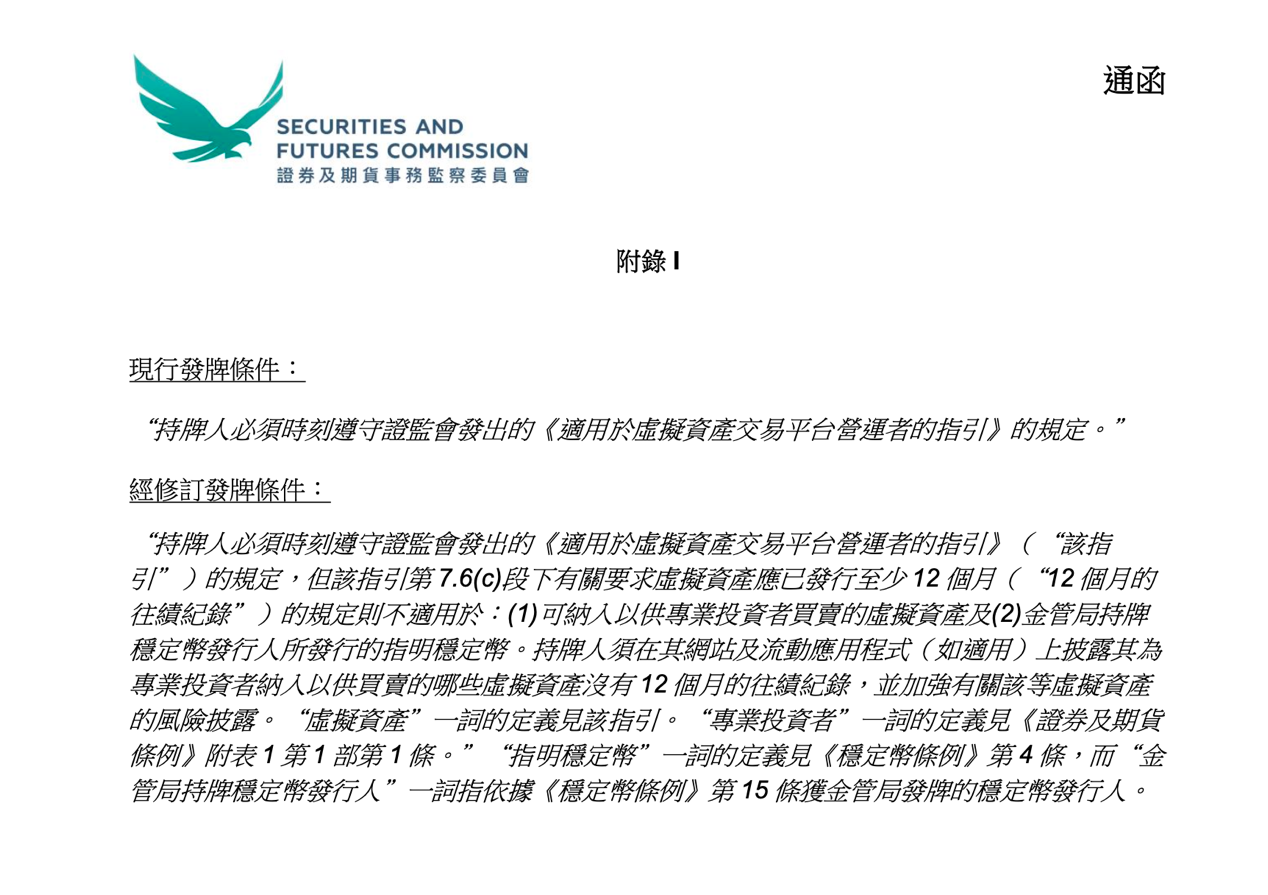
The image above is captured from the official website of the Hong Kong Securities and Futures Commission.
Appendices II and III further clarify the boundaries of the platform's business scope and the arrangements for holding customer assets during the distribution process. By redefining "relevant activities," the SFC formally includes the distribution of digital asset-related investment products, tokenized securities, and custody services for non-platform-traded assets within the scope of VATP (Virtual Asset Trading Platform) operations. At the same time, in the distribution business, platforms are now permitted to open and maintain trust accounts or customer accounts at relevant custodians in their own names, for the purpose of holding these assets on behalf of clients. These adjustments are not intended to lower the requirements for protecting client assets, but rather to ensure that the business structure is legally and regulatorily viable.
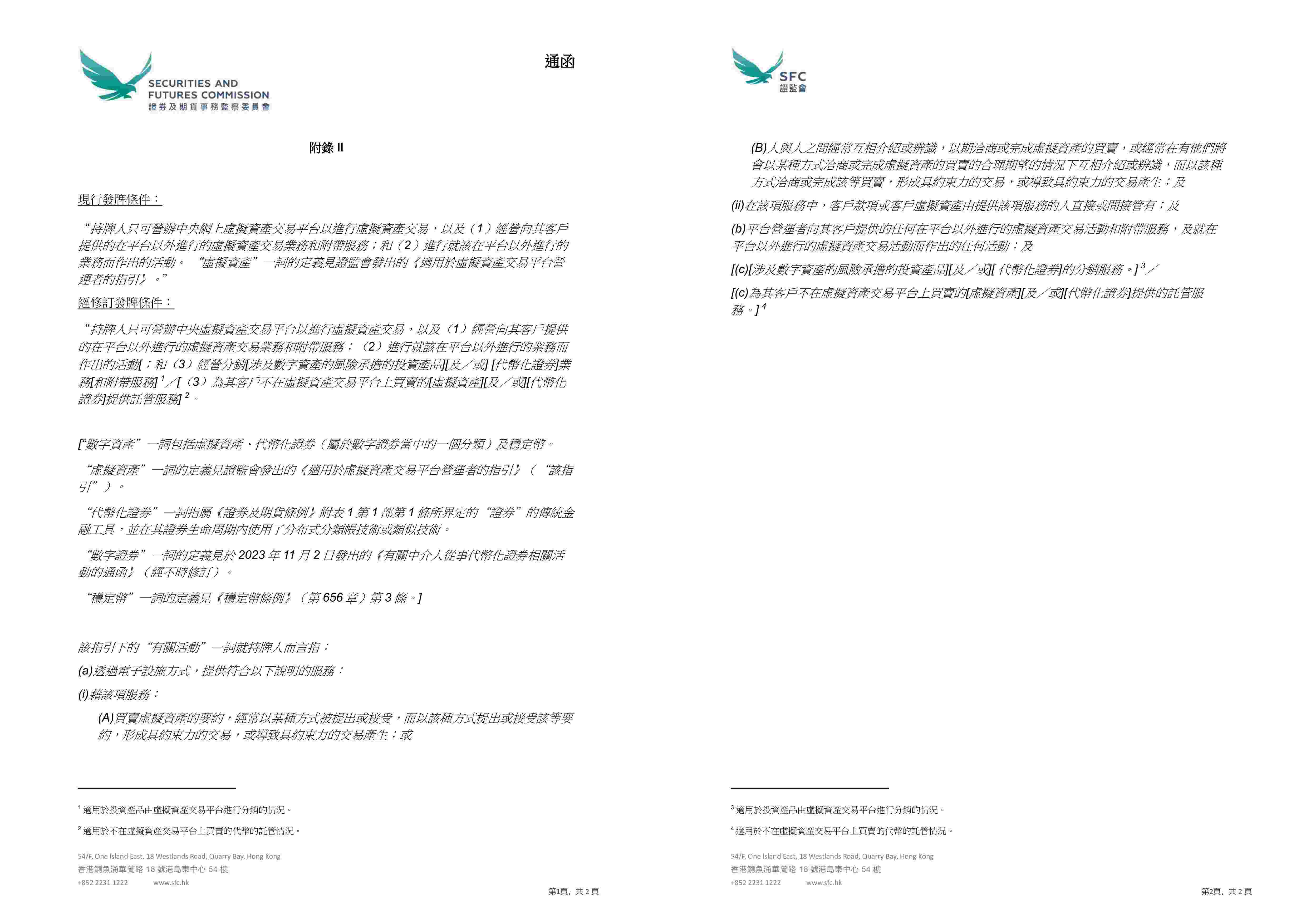
The image above is captured from the official website of the Hong Kong Securities and Futures Commission.
II. After the circular is issued, what changes should practitioners pay attention to?
A new circular has been issued. Previously, for VATP (Virtual Asset Trading Platform), transactions, custody, research, product introduction, and even part of the distribution activities could be collectively categorized under the scope of "platform services," as long as the entire operation was subject to VATP license regulation. However, now it must be more clearly defined.Distinguish which activities fall within the core functions of the exchange, and which are approaching independent custody, distribution, or advisory services. Achieve compliance by appropriately arranging different legal entities and clearly defining business boundaries.
For other participants such as OTC platforms and hosting service providers, the space previously reliant on ambiguous roles or overlapping functions is rapidly shrinking. Now, they must clearly address one key question:What specific category of virtual asset services are you engaged in? And under which regulatory framework should you assume the corresponding responsibilities?
III. Conclusion
Overall, what this circular reflects is not a sudden shift in regulatory stance, but rather a more pragmatic approach: VATP platforms are gradually evolving from mere trading venues into compliant nodes that connect trading, products, and asset management. In response, regulators are shifting their focus from formalistic requirements to whether platforms genuinely assume the responsibilities they are expected to.
This notice does not imply that the industry has suddenly been "loosened up" overnight, but the shift in regulatory attitude is clear: compliance is no longer merely about "not crossing the line," but rather about taking responsibility for one's own judgments. For project parties and investors, this also means that regulatory expectations are gradually becoming clearer, rather than continuing to rely on ambiguous gray areas for survival.
Next, how far the market can go is no longer determined by whether regulators provide space, but by whether the participants are truly ready to operate under a clearer and more serious regulatory framework.
Special Statement: This article is an original work of the Encrypted Salad team and only represents the personal views of the author. It does not constitute legal advice or legal opinions regarding specific matters. If you wish to republish this article, please contact us via private message to discuss authorization: shajunlvshi.