





Written by Zuo Ye
Looking back 500 years, labor-capital conflicts under the capitalist system have always been marked by the continuous triumph of capital.
On the production side, labor participation has gradually narrowed to machine operation; on the consumption side, user value lies in generating usage data for the platform.
Together, they support the company’s valuation in the capital markets.
Yet human organizational structures have long resisted complete quantification; white-collar KPIs and OKRs remain hierarchical, and both million-dollar annual salaries and piece-rate wages are variants of Taylorism.
Without a clear formula, capital cannot be valued, which affects capital efficiency. Whether algorithmic stablecoins are the Holy Grail of DeFi remains unknown, but the computability of organizations is indeed the measuring cup for financial leverage.
Large models are using token volume as a brute-force solution; the collapse of security SaaS is merely a surface symptom—the design of new products is already underway, aiming to replace niche professional capabilities and scale them up, which is the key challenge, as innovation ventures into uncharted territory.
This offers us endless insights, especially as DeFi’s DAO model gradually collapses and tokenomics increasingly fails.
Why is the organizational model of AI and the token model more efficient than DeFi?
How did it all begin?
Token democratization, agent practicalization.
For a 300% profit, capitalists would sell their own rope.
To keep their current job, workers can write skills for agents.
At the capital level, agents empowered by skill hold a status equal to that of profit.
The agent transforms human capability into skill, and human organizations evolve into interaction chains centered around agents.
Prompt, context, and even today’s Harness engineering are all about transforming human organizational models into无人区, at least reducing the need for human involvement.
Your next colleague isn't a robot—it can be an "ability" instinct.
This is not an illusion; the scaling law at the data level is gradually breaking down. However, data collection and production are no longer the key factors—before AGI succeeds, new valuation metrics are needed.
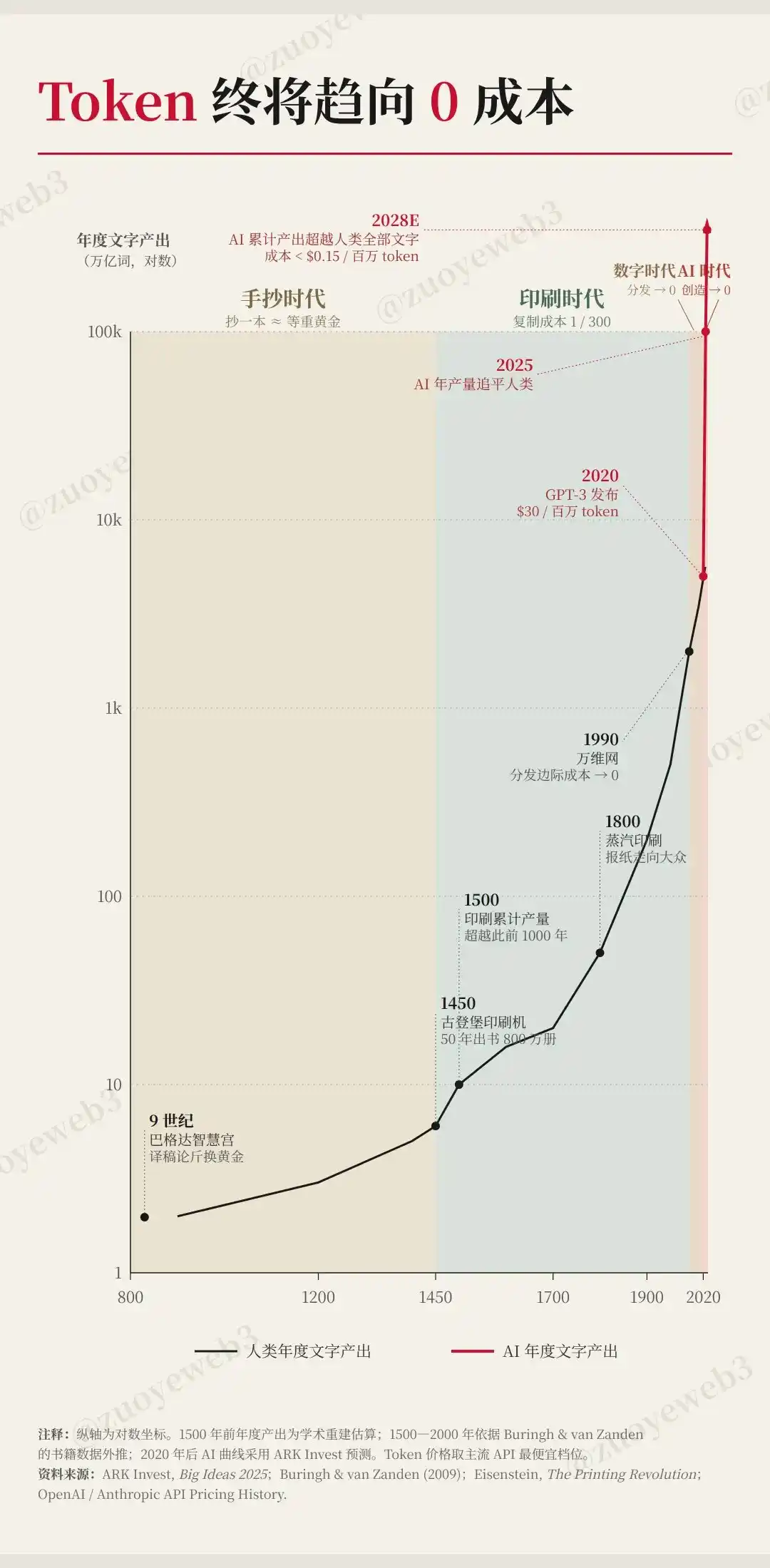
Image caption: The content is no longer valuable
Aggregate information: @ARKInvest
Starting from Claude’s selection of the programming domain to achieve the first step toward AGI, AI has moved beyond the entertainment mode of chat boxes and entered established real-world markets such as programming, security, and newly released design tools.
This disruptive innovation will either create new economic growth or push the economy into a permanent low-employment model where tokens take over jobs and people are laid off—we are witnessing this process unfold.
However, the current commoditization of tokens has decentralized capabilities once monopolized by a few large corporations to small and medium-sized enterprises, thereby empowering super individuals—not a fantasy.
Taking China as an example, token usage has increased from 100 billion per day in 2024 to 100 trillion per day by the end of 2025, and now stands at 140 trillion per day—marking the imminent arrival of a zero-cost era for content and data production.
It should be noted that computing power scarcity is a relative condition; while large enterprises no longer monopolize capability, they still seek to maintain their existing advantages by controlling computing power—yet they cannot stop the inevitable trend of tokens becoming generally inexpensive.
There are many paradigms for evaluating foundational large models, but the evolution of "how AI helps humans" has long received little attention.
In my view, Harness is a spatial configuration that enables agents to focus on tasks within boundaries for the first time, using a depth-first strategy, distinct from the breadth-first approach of question-answer systems.
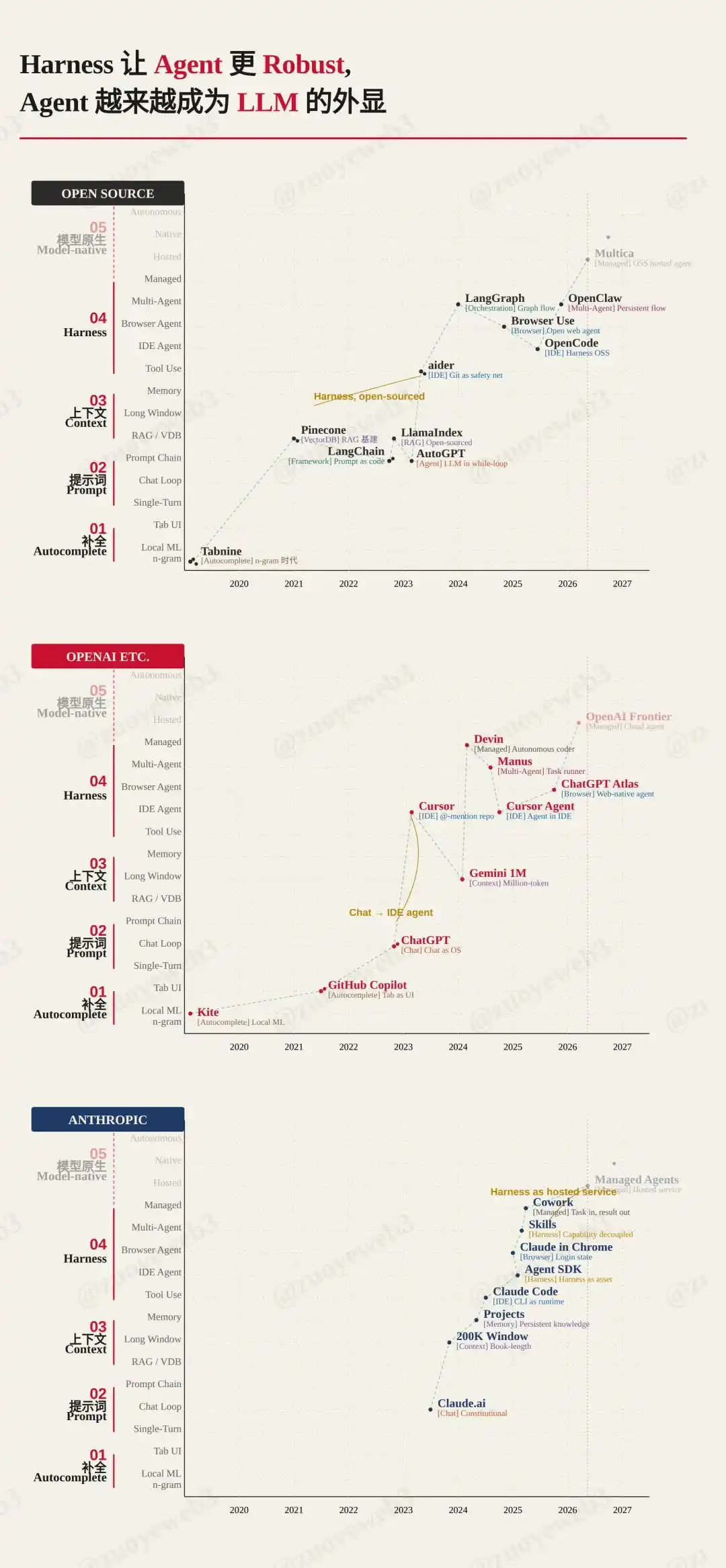
Image caption: The Evolution of Agents
Image source: @zuoyeweb3
It’s only a matter of time until humans become the input layer for AI, ever since the Tab key was first used for code completion.
The cost of experimentation has decreased exponentially, enabling more interesting attempts at human collaboration:
- Software: SaaS; the source of human capability is no longer human beings, but the emergence of agents.
- Hardware: AI accelerator cards + HBM—data centers serve AI demands directly for the first time
- Space: Harness, not a physical space for human collaboration, but a digital space for agent interaction
- Interaction: DouBao mobile has failed; Google supports GUI Agent at the Android system level.
The ability of AI to speak lacks strong commercial value, as the cost of generating text is very low for humans. However, "doing things" will cause token consumption to surpass that of image and video generation, similar to how AWS sells not servers, but usage time.
AI doesn't sell tokens—it sells "work capacity," which is the root of SaaS industry fears; unfortunately, DeFi has become SaaS, not large models.
SaaSification of DeFi protocols
DeFi is not outdated, but overly premature.
AI is reinventing software engineering, and while it's not only SaaS that is being replaced, SaaS is undoubtedly the most typical example.
Even Bloomberg Terminals derive their most important business value not from technological sophistication, but from the authority of their information—authority built over decades through industry connections, networks, and non-standard data.
The agent offered a choice to infer future outcomes from the data, allowing you to potentially outperform competitors and earn small profits, even with the next risky step.
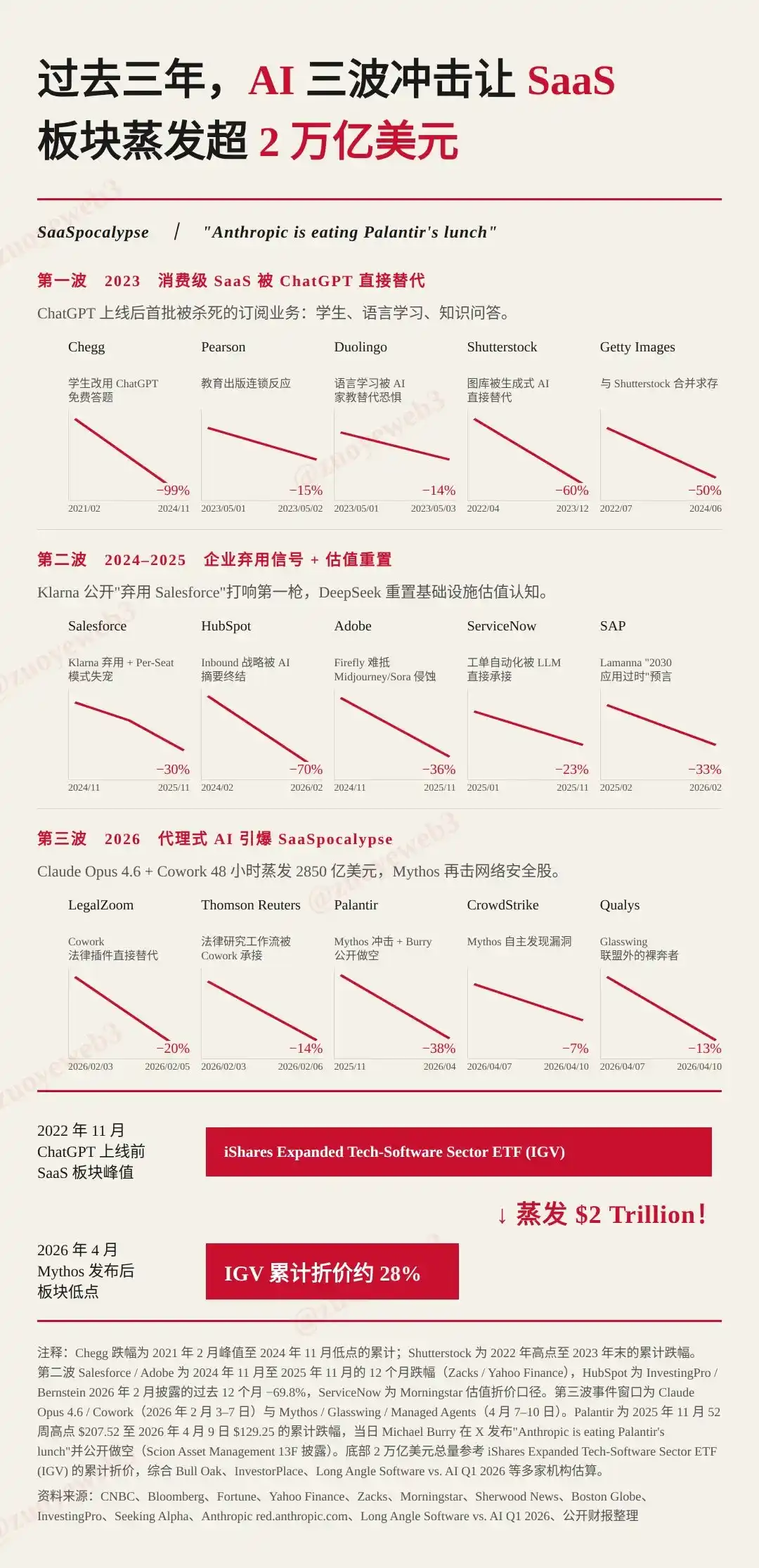
Caption: SaaS is down
Image source: @zuoyeweb3
You can think of the Agent as skillfully leveraging capital's pursuit of profit—whether waiting for complete Bloomberg Terminal data or using fragmented, inaccurate data to chase potential gains.
This is not new: IBKR’s founder, Thomas Peterffy, pioneered, or rather assembled, the first physical trading terminal in finance, all starting with a spare P101.
If a particular way of using data can generate higher profits, you will gain more data, and the flywheel will begin to turn.
The era of SaaS monopolies is over; the future of sales is AI.
Unfortunately, we must now turn to DeFi—remember the paywall on Dune/DeFiLlama’s API, or Arkham Exchange’s eventual shutdown, where valuable data is held hostage while begging for scraps.
Data in the cryptocurrency industry has never been valuable.
However, as a directly open financial system, the cryptocurrency industry generates data that can be continuously learned from—even before AI, the speed of forked projects had already slowed to a monthly pace, and PumpFun’s meme clones can be replicated in seconds.
There is a counterintuitive implication here: DeFi is the beta test for the financial system, and the AI + DeFi combinations we experiment with today will become the blueprint for the future evolution of finance.
For example, before the 2008 financial crisis, the unsecured LIBOR rate contributed to the financial tsunami, later replaced by SOFR, derived from Treasury transactions; however, the overcollateralization mechanism ensures the finality of DeFi liquidations.
For example, large model providers do not want to sell tokens based on consumption; they insist on tiered marketing, customized capabilities, and professional modifications—tokenomics has twisted the concept of "utility" into a knot.
Crypto tokens are focused on utility value, while AI tokens are focused on economic value.
From this perspective, DeFi hacks are merely routine stress tests—external entropy that open systems cannot self-repair.
Like a Catch-22, without external signal system stimulation, the crypto system defaults to assuming the environment is secure; should a security crisis occur, it collapses into a centralized processing system.
For example, in the Drift incident, the target of blame unexpectedly became Circle for its slow freeze response.
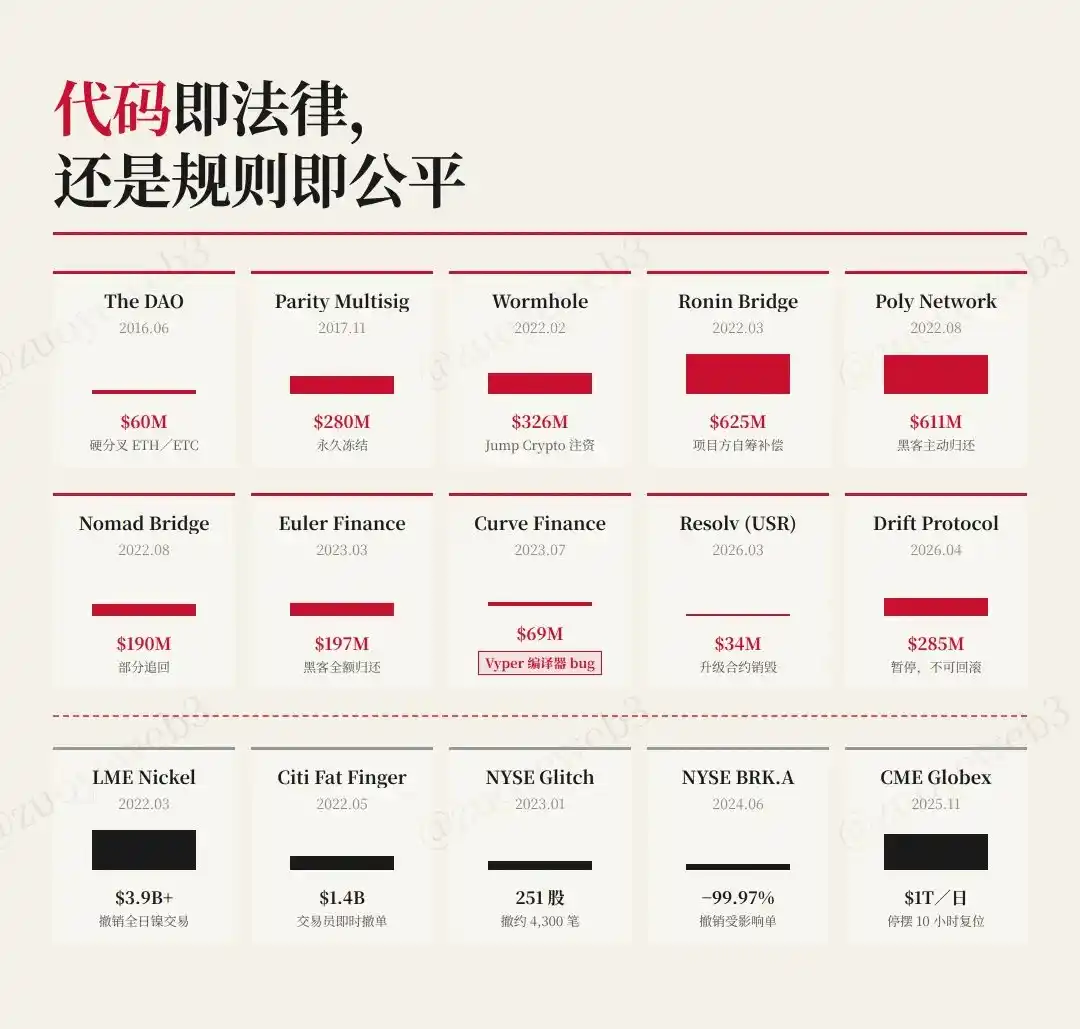
Image caption: Code cannot solve security issues
Image source: @zuoyeweb3
Before the leap in AI capabilities, DeFi had already undergone SaaS-like transformation, allowing only fee collection based on transaction volume, making it impossible to directly move "finance" on-chain.
RWA tokenization lacks liquidity, and DeFi has no good solution for this.
However, the evolution of agent capabilities seems to offer a faint, yet uncertain, glimmer of hope for rewriting the rules of DeFi.
Tokenomics: Deploy usage across multiple channels based on "capital efficiency";
Rules: Mythos provides secure finality; the AI firewall battles zero-day threats;
Human organization: Great, DeFi has long been managed by a few people overseeing hundreds of billions.
The Revival of Engineering Narratives
Where does security come from? The determinism of a Turing machine. Where does danger come from? Infinite possibilities.
I deeply resonate with YC’s Garry Tan’s concept of “Fat Skill, Thin Harness”—essentially establishing clear foundational rules to create a “freedom within order.”
Turing machines can be infinitely combined; the von Neumann architecture always has a time lag between memory and computation; large models cannot generate true random numbers.
In a future where data is worthless, only human behavior can generate value from the flow of money.
However, human behavior still requires time to be fully learned by AI and subsequently internalized as engineered, code-based representations.
To pursue the infinite with the finite is ultimately futile; LLMs cannot completely eliminate hallucinations. Only by approaching a level where “this is beyond the reach of AI and beyond human capability” can market mechanisms properly price it, allowing us to truly trust smart contracts.
Current smart contracts are far from successful; the DAO fork, the Curve programming language bug, and even Drift’s multisig all demonstrate that humans retain ultimate control over code.
Moral scrutiny has no economic value; the collaborative model in DeFi has shifted from DAOs to foundations and "teams" due to practical needs such as contract upgrades and business partnerships.
But humans simply cannot write code that is forever secure and dynamically upgradable—remember, it’s impossible.
If you never upgrade, Curve’s own experience shows that even your technology stack can fail.
The present decides the past; the past decides the future.
From the Medallion Fund to Numerai’s AI strategies, AI is not uncommon in finance—another counterintuitive example is that trading signals actually help AI evolve.
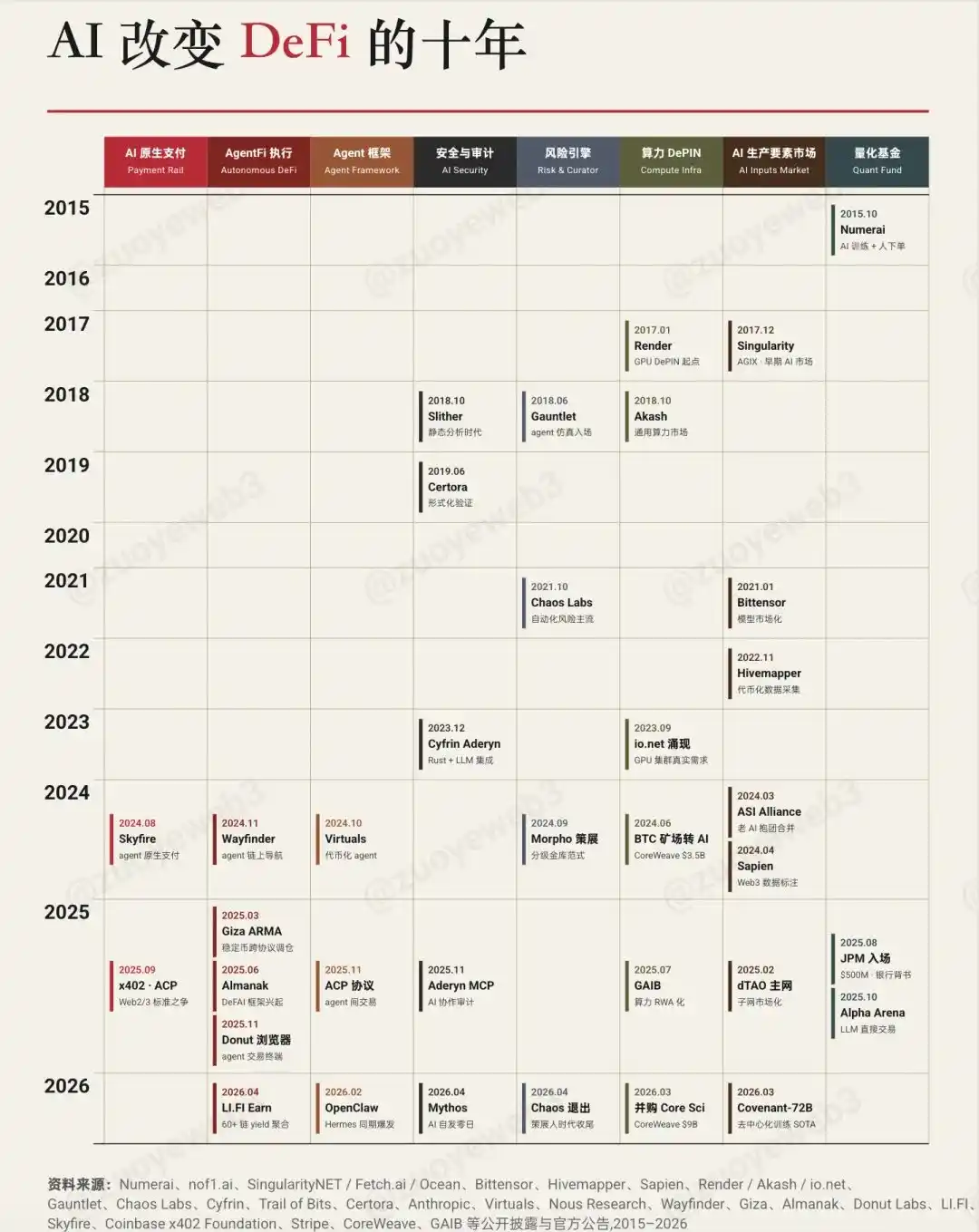
Caption: AI and DeFi in 10 Years
Image source: @zuoyeweb3
AI models are still within the computational paradigm—a state machine that processes signals; without external inputs, they lack the ability to simulate the external world. The bet by Yann LeCun and Fei-Fei Li on world models lies precisely in this direction.
From a DeFi perspective, the prerequisite for AI to trade autonomously is that the agent learns human intent through behavior—this underscores the importance of humans to AI, as even when agents replace human effort, they are still mimicking and summarizing human actions.
Moreover, humans cannot intentionally generate randomness; even slight deliberate actions create statistical patterns. True randomness may stem from human physiological traits—for example, “I simply have a physiological preference for Ethena’s market-making strategy and dislike XX’s arbitrage strategy,” which reflects a vague, subjective bias.
Very certain that making blockchain/DeFi the infrastructure for AI has suffered a tragic failure over the past decade, and deAI/deAgent/deOpenclaw will meet a similar fate.
Directly leverage the latest large models to transform DeFi structures—for example, after Mythos testing, contracts are inherently secure, and any modifications are detected in real time, thereby increasing the risk level.
In terms of human organization, AI’s choice is “no humans,” only leveraging human “capabilities.” DeFi is the most suitable industry for this—even without comparison—where, after rule design, DeFi enhances capital efficiency solely under security constraints. Analogous to the L1/L2/L3/L4 levels of autonomous driving, it will inevitably progress through stages of information authorization → limited fund access → full fund access.
If agents continuously learn engineered trading skills and curator management capabilities, they will inevitably surpass humans in trading and profitability. However, unfortunately, the accumulated DeFi data has not yet been systematically learned and trained by AI systems, and current crypto AI is still in the stage of raising funds.
But I am very confident that the actual use of funds is the next major wave in AI’s transformation of DeFi, and it is inevitable.
So, after security (smart contracts) and organization (humans) have been upgraded, what will the token economy look like?
In the PoW era, tokens were proof of computational power consumption, which is essentially the same as current AI tokens;
In the PoS era, tokens are discount vouchers for expected returns; AI tokens are evolving in this direction (the ability to replace human labor is the economic expression of AI value).
In the AI era, crypto tokens have surpassed our engineering scope and can only be unpredictably speculated upon through theory.
Sky uses token allocation to control APY across channels, while Claude prices model capabilities based on token consumption; future crypto tokens will likely serve as certificates of return on capital.
Note the distinction: In the PoS era, tokens such as ETH have expected returns based on economic assumptions and prior empirical reasoning. In contrast, AI-driven engineering designs in DeFi can approach real-world conditions with near-perfect accuracy, offering highly reliable and continuously verified rates of return and risk.
Moreover, users can determine the current price of a token based on the large models and agents used by DeFi protocols, along with the scores of Harness optimization metrics—buying if optimistic and selling if pessimistic.
Conclusion
Countless unspeakable troubles and the unpredictable future of humanity.
The future of DeFi, broken down into economic and technical aspects: tokenomics still lacks solid solutions, but security shows a glimmer of hope—Claude Mythos could threaten the world, but conversely, it could also manage money effectively.
AlphaGo completely solved the game of Go, Claude completely solved programming—such scenarios will only become more common in the future; DeFi contracts, human organizations, and even units of economic valuation all have theoretical room for optimization.
At the very least, people don’t need to worry about being completely replaced; even in an era where data is worthless, human actions still hold meaning. Currently, AI agents taking over human tasks remain limited to small, repetitive details—micro-tasks and micro-payments. We must find ways to generate value from these repetitive, replicated actions. AI is causing the value of data and content to plummet toward zero cost, while the unit economic value (cost) of both AI tokens and crypto tokens continues to decline—this is the inevitable trend.
In fact, this is the first time that money has truly been opened up to individuals—whether for AI work or for crypto spending.