





Article by: Sylvain Saurel
Compiled by Chopper, Foresight News
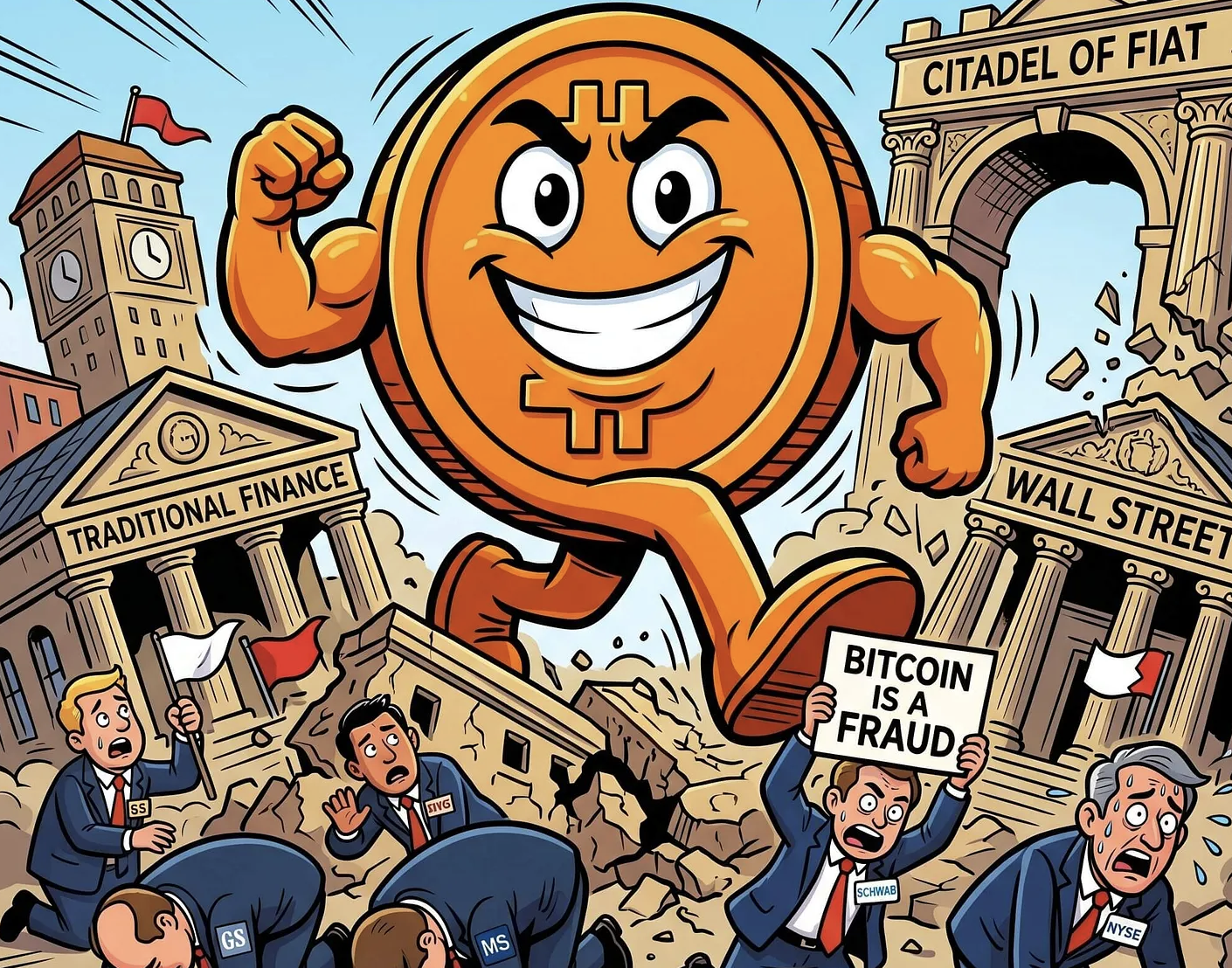
Over the past few days, the axis of the financial world has been completely reversed. We have just witnessed the fastest, most dazzling, and most unapologetic shift in values in human history.
Wall Street, the formidable bastion of traditional finance and the ivory tower of fiat currency, has officially raised the white flag.
They were not merely surrendering—they were racing to crown the victor.
For fifteen years, traditional finance giants told everyone that Bitcoin was a joke, a Ponzi scheme, a bubble, a tool for illegal transactions, digital tulips, and a gimmick created by a group of basement-dwelling cypherpunks. They first mocked it, then suppressed it—and now? They’re desperate to hold it.
Let’s look at how institutional dignity has collectively collapsed over these past few days.
The Fortress Falls: Surrender List
Goldman Sachs: From "Scam Tool" to Bitcoin ETF
Yes, that’s Goldman Sachs—the global investment banking giant once mockingly dubbed by Rolling Stone magazine as “a vampire squid wrapped around the face of humanity”—now extending its reach into the new realm of digital assets.
For years, Goldman Sachs executives seized every opportunity to mock decentralized currency. We all remember the disdain on financial news channels, where suited executives, adjusting their ties, confidently told the public that Bitcoin had no intrinsic value. Its CEO once publicly declared Bitcoin to be a “tool of fraud.” The purpose of this narrative was to keep wealth locked within their closed circle, allowing them to continue collecting tolls.
But now, the tune has completely changed—Goldman Sachs is launching a Bitcoin ETF. This hypocrisy is both shocking and predictable: an institution that once warned you away from a “scam” is now charging you management fees to hold it.
Why the sudden change of heart? Because Wall Street has no eternal morals, only eternal interests. When high-net-worth clients threatened to withdraw their funds and strongly demanded allocation to the best-performing asset of the past decade, so-called ethics vanished overnight. The "scam" transformed into an "innovative alternative asset." Goldman Sachs didn't have an epiphany—it felt the pressure.
Morgan Stanley: Banned terms become the largest IPO in history
If Goldman Sachs’s reversal was a comedy, Morgan Stanley stands as a textbook example of historical irony. Not long ago, Morgan Stanley was fiercely hostile toward digital assets, with rumors suggesting it banned the use of the term “cryptocurrency” in internal emails. It became Voldemort—a category of asset that could not be named. They viewed it as a plague, a virus that would contaminate their noble, tightly regulated mahogany boardrooms.
And now, just in recent days, Morgan Stanley launched its largest ETF debut in company history.
What is the underlying asset of this record-breaking financial product? Yes, it’s Bitcoin.
This asset, once attempted to be erased from the corporate dictionary, has now become the crown jewel of modern product lines. Advisors who were once forbidden even to utter the word are now calling their wealthiest clients one by one, urging them to allocate 1% to 5% of their portfolios to “digital gold.” The cognitive dissonance is staggering, but institutional FOMO has overridden every ban. They’ve finally realized: you can’t ban the future—you can only give it a ticker symbol and sell it to the masses.
Charles Schwab: Opening the Door to Spot Trading for Retail Investors
While investment banks are playing the ETF game, Charles Schwab is taking a more direct approach: deciding to offer direct cryptocurrency spot trading to its large customer base.
Charles Schwab represents the average investor—the guardian of middle-class wealth, retirement accounts, and mainstream portfolios. For years, they’ve kept clients within the safe, predictable realms of mutual funds, traditional stocks, and municipal bonds. Want to buy Bitcoin? You have to leave Schwab and venture into the wild world of cryptocurrency exchanges, managing your own private keys.
Times have changed. By integrating spot crypto trading, Charles Schwab has effectively acknowledged that an investment portfolio without Bitcoin is incomplete. This isn’t just about offering an ETF—it’s about enabling millions of everyday investors to directly hold the underlying assets through a trusted brokerage account.
This move cannot be overstated in its significance for Bitcoin’s adoption. It places this decentralized orange coin directly alongside Apple, Amazon, and the S&P 500 on the dashboards of ordinary American investors. It removes barriers, erases stigma, and opens the floodgates to a vast pool of capital that has been watching, eager to enter but hesitant.
New York Stock Exchange: Fully building out infrastructure
Then there’s the heart of traditional finance: the New York Stock Exchange (NYSE). The hallowed trading floor, once filled with traders shouting on paper slips, is now quietly and efficiently building dedicated cryptocurrency infrastructure.
The NYSE doesn't just facilitate trades—it’s building the pipeline. This infrastructure is live, integrated, and "running as smoothly as a cat curled up on a warm laptop." When the underlying systems of global equities decide to build roads and bridges for digital assets, the debate is already over.
The New York Stock Exchange does not build infrastructure for fleeting trends or invest millions in technological integration for Ponzi schemes. They build systems for things that last. By integrating crypto assets at the exchange level, the old system formally connects itself to the new digital paradigm. They acknowledge that the future of value transfer, settlement, and asset ownership will, at least in part, operate on crypto networks.
False Economics
To understand this massive and rapid transformation, we must look beyond surface-level announcements and delve into the underlying psychology and economic logic of Wall Street.
First they ignore you, then they laugh at you, then they fight you, and then you win.
This quote is often mistakenly attributed to Gandhi, but in the field of disruptive innovation, it holds universal truth and perfectly encapsulates Bitcoin’s struggle against traditional finance.
The period of ignorance and ridicule (2009–2017)
In the early days, Wall Street didn’t care. Bitcoin was just a toy for cypherpunks and libertarians. When it began to gain attention, mockery followed, dismissed as “Monopoly money.” How could a decentralized, leaderless network with a fixed supply of 21 million coins possibly challenge the U.S. dollar as the dominant currency? At Davos and Wall Street cocktail parties, it was the ultimate joke.
Attack period (2017–2023)
As Bitcoin repeatedly rose from the ashes of bear markets, laughter turned to fear. It was during this phase that JPMorgan’s executives threatened to fire any trader who dared to buy Bitcoin, the SEC launched relentless crackdowns, and the media repeatedly published obituaries declaring “Bitcoin is dead”—hundreds of times.
They attacked it because it threatened their business model. Traditional banks rely on gatekeepers, intermediaries, and fractional reserve banking, while Bitcoin requires none of these. It is peer-to-peer, self-custodied, and mathematically transparent. This frightened them.
Surrender period (current phase)
What happens when you spend 15 years trying to kill an idea, and it refuses to die—only to grow into a multi-trillion-dollar asset class entirely beyond your control?
You have to surrender.
Wall Street's shift did not stem from a sudden epiphany. They did not read the Bitcoin whitepaper last night and suddenly grasp the brilliance of Satoshi's proof-of-work mechanism.
No, they surrendered because Wall Street is essentially a machine designed to extract fees. Over the past decade, a historic transfer of immense wealth occurred entirely outside their ecosystem—native crypto exchanges earned hundreds of billions in revenue, while traditional banks, constrained by arrogance and regulation, could only stand by.
In the end, the numbers speak for themselves. The opportunity cost of ignoring Bitcoin is too high to bear. They have recognized the ultimate truth of this era: if you can't eliminate it, join it.
They decided: since people are going to buy Bitcoin anyway, it might as well be through the Goldman Sachs ETF, so Goldman can charge a 0.25% management fee; since trading is happening anyway, it might as well take place on Charles Schwab. Wall Street never embraced the spirit of Bitcoin—only acknowledged its inevitability and sought to profit from it.
Mathematical certainty
This series of events is filled with poetic justice.
Traditional finance relies on trust: you must trust that the central bank won’t devalue the currency, that commercial banks won’t gamble away your deposits, and that clearinghouses will settle transactions properly.
History has repeatedly shown that this trust is often abused, from the 2008 financial crisis to the hyperinflation of the 2020s.
Bitcoin relies on mathematics—open-source code, cryptographic hashing, and rigid rules enforced by nodes across the network. It doesn’t care about your lineage, zip code, or management scale. It simply produces a block every 10 minutes—tick—and then the next one.
It was this ruthless, unwavering consistency that ultimately broke institutional resistance. Wall Street realized it was trying to fight gravity—you cannot legislate away mathematics, nor can you公关 away absolute digital scarcity.
The fiat system is crumbling under the weight of astronomical sovereign debt, endless money printing, and geopolitical instability, while Bitcoin stands in stark contrast. In a world saturated with financial fiction, it is a pure, immutable ledger. Smart money has finally recognized this: Bitcoin is not a hedge against the old system—it is a lifeboat.
Everyone will eventually bow down.
Let the past few days be etched into financial history as the “Great Surrender.”
This is an acknowledgment of early holders: cypherpunks, retail investors, believers who held through an 80% crash, those mocked by family on Thanksgiving, and visionaries who saw the future before institutions did.
They were right; the suit-wearing elites were wrong.
Now, these major players are forced to buy this asset from the very people they once mocked, at prices that reflect years of their own ignorance.
Goldman Sachs has bowed down, Morgan Stanley has bowed down, Charles Schwab has bowed down, and the New York Stock Exchange has bowed down.
They have no choice—the financial architecture of the 21st century is being rewritten on decentralized protocols.
The narrative has been completely reversed. Today, holding Bitcoin is no longer seen as risky—in traditional finance, the greatest professional risk is not holding Bitcoin at all. Institutions have realized the train has already left the station, and they’re racing toward the platform, throwing their briefcases onto the train, desperate to secure a seat.
We have moved past the adoption phase and entered the assimilation phase. But don’t be mistaken: it wasn’t Wall Street that assimilated Bitcoin—it was Bitcoin that assimilated Wall Street.
The Trojan horse has entered the city, and soldiers are pouring out. Infrastructure is in place, ETFs are trading, the spot market is open, and the old gatekeepers have lowered their dignity just to get a share.
Bitcoin cannot be stopped; it has never been possible to stop it. It is an idea born of necessity, backed by the most powerful computing network in human history.
So, welcome to the revolution, Wall Street giants.