





Written by: Jeff Park
Compiled by Saoirse, Foresight News
The International Monetary Fund’s Global Uncertainty Index has recently reached its highest level since its inception in 2008. The lack of clear direction and coordination in policy and trade has significantly worsened market sentiment since the previous historical high, and this trend is likely to intensify further—particularly in the Middle East, where fragile existing global alliances are being drawn into an unprecedented conflict.
Meanwhile, the accelerating adoption of exponential technologies such as artificial intelligence has left both experts and the general public increasingly puzzled: how can productivity-driven deflation be reconciled with a credit-driven inflationary monetary system? Compounding the issue, private credit is experiencing an epic collapse, as it previously propped up this fragile capital supply chain by manipulating capital prices at the expense of liquidity.
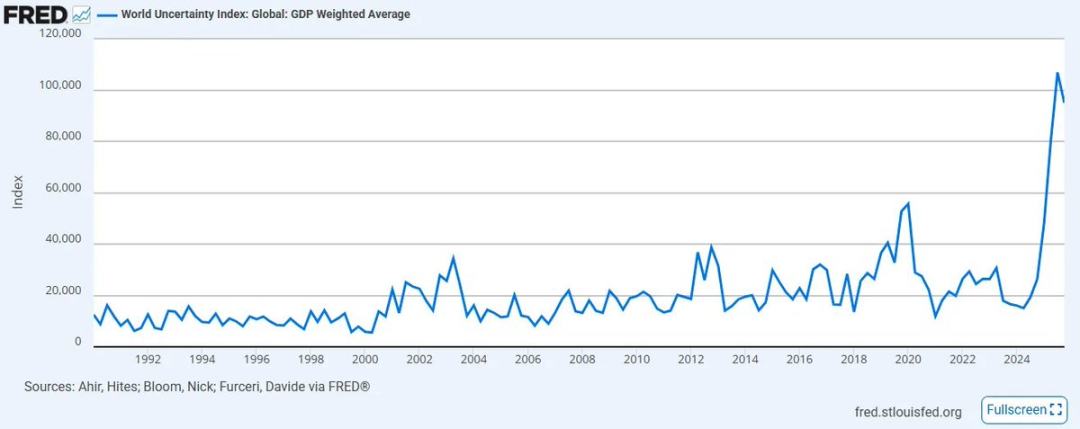
Over the past week, we have witnessed a series of events:
- Iran has designated Mojtaba Khamenei as the new Supreme Leader, while U.S. crude oil prices surged nearly 40%, marking the largest weekly gain since 1983;
- The AI company Anthropic has sued the U.S. Department of Defense citing "supply chain risks";
- BlackRock has set a 5% redemption cap on its $25 billion direct lending fund, while investor redemption requests are nearly twice this level.
No one can accurately predict the direction of these complex issues, as they are all unprecedented (note that the three events mentioned above are not independent—I will elaborate on this later). In moments like these, we need to step back and refocus on the fundamentals: rather than fixating on the unknown, anchor yourself in the facts you are absolutely certain of—facts that are direct causes of the events above.
As Holmes said to Watson: “When you have eliminated the impossible, whatever remains, however improbable, must be the truth.” Therefore, our task is not to chase after elusive unknowns, but to ground ourselves in the fundamental, undeniable facts that already exist.
Following this line of thinking, over the next decade of immense uncertainty, I see three undeniable truths—whose certainty is only becoming more pronounced today. By “undeniable,” I mean these are events with a 100% probability of occurring. The only true unknowns are the precise timing and, to some extent, the severity—but the catalysts for each event are destined to emerge within our lifetimes. By anchoring ourselves in these indisputable facts, we can transform widespread feelings of helplessness into a firm conviction about how to respond to the future.
Fact Check One: The global population pyramid is inverted, and all asset classes built upon it will collapse as well.
In 2019, a statement released by the World Economic Forum triggered a major shake-up in institutional consensus: “The number of people aged 65 and older surpassed the number of children under five for the first time.” Seven years later, after a devastating global pandemic, societies around the world have already felt the heavy burden and consequences of this trend—and this is only the beginning.
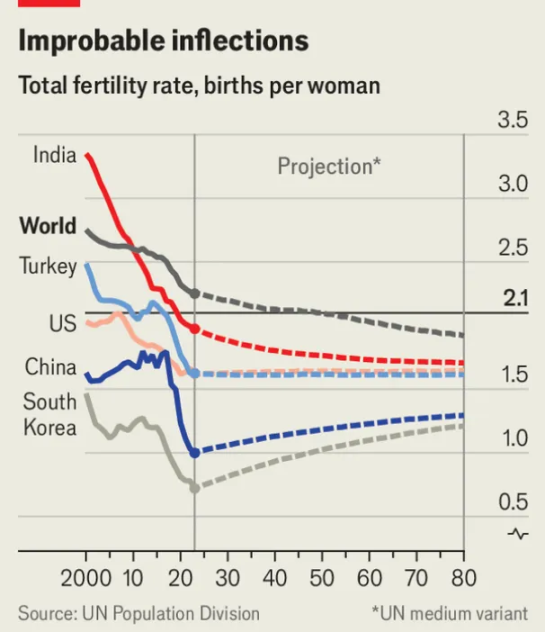
Global fertility rates are dangerously approaching below replacement level, and in developed markets, this threshold has long been a thing of the past. The combination of declining birth rates and an aging population will create the highest dependency ratio in human history. Even worse, the elderly ruling class in developed countries will ultimately need to liquidate liquidity to fund their increasingly extended lifespans. The result is a massive intergenerational wealth transfer: the entire generation’s accumulated financial assets must be withdrawn from the market through large-scale liquidity exits.
This capital scale is staggering: the total market capitalization of U.S. equities alone is approximately $69 trillion (with baby boomers holding over $40 trillion), and U.S. residential real estate adds another $50 trillion (despite baby boomers and their predecessors accounting for less than 20% of the population, they hold over $20–25 trillion in assets). In total, nearly $60–70 trillion in wealth must exit the capital asset system, while the next generation of younger individuals faces declining income-generating capacity and minimal disposable wealth.
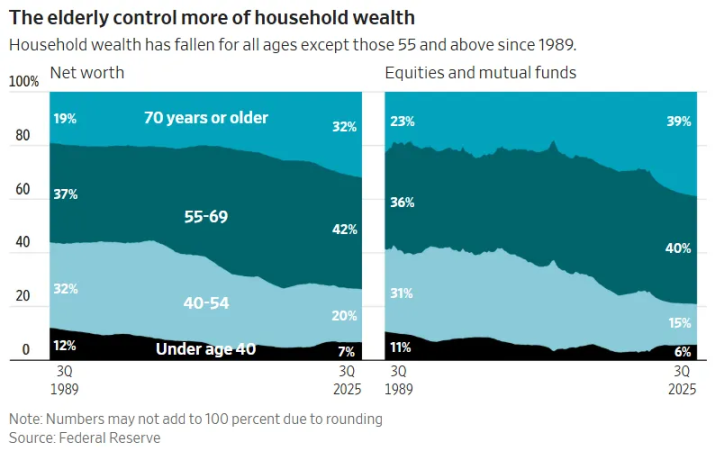
When this generation of aging individuals is ultimately forced to sell their assets, it will almost certainly trigger prolonged asset deflation.
The underlying logic of the stock market is essentially a reflection of demographic trends: when the group of savers accumulating assets steadily grows and moves toward retirement, the market rises. The catastrophic collapse of private credit is the most direct example—another $2 trillion “time bomb” lurking within pensions, endowments, and life insurance companies, which claim to provide liquidity transformation for younger generations but are nearly fraudulent.
But once the younger generation realizes they are becoming the "last buyers" of liquidity for their parents' generation, they will choose not to enter the market. No one willingly buys an asset that is in long-term decline. This is precisely why the Trump administration has strongly promoted children’s investment accounts, why the U.S. is actively advancing stock tokenization (to make it easier for foreign capital to absorb U.S. stocks), and why registered investment advisers (RIAs) are widely adopting automated model portfolios without questioning the fundamental issue: “Why are we doing this?”
These measures are all designed to delay the inevitable: when the baby boomer generation sells assets with inelastic pricing, there will be no buyers unless young people, foreign capital, or machines are forced to take the other side. The design of Trump’s child account makes this clear: it prohibits any form of diversification, explicitly banning bonds, international stocks, and alternative investments, and allows only U.S. stock index exposure. Upon turning 18, the account converts into an Individual Retirement Account (IRA) with substantial withdrawal penalties—starkly contrasting with standard Uniform Transfers to Minors Accounts (UTMAs), which permit full freedom of withdrawal upon adulthood. Clearly, this is not a wealth-building tool for children, but a decades-long one-way closed channel designed—intentionally or not—to turn an entire generation of young people into passive liquidity takers for the previous generation.
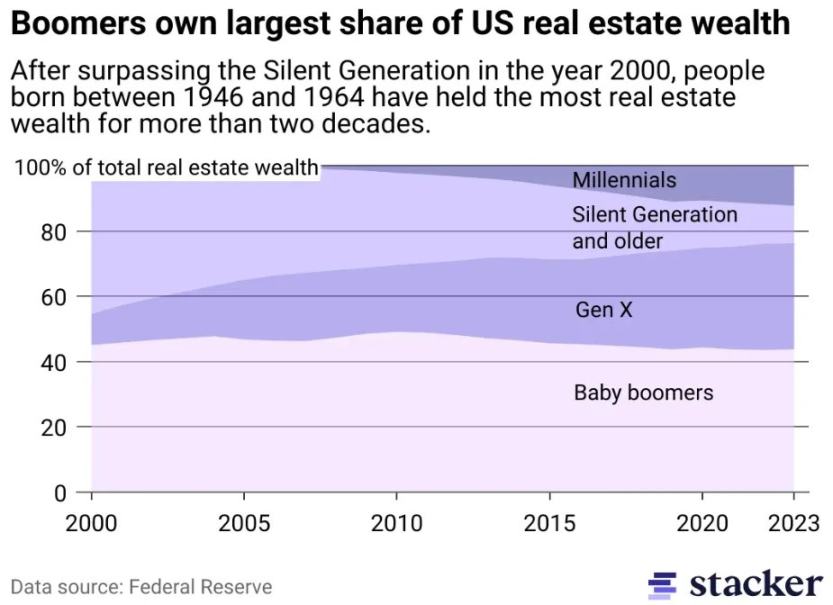
This phenomenon will be even more pronounced in real estate, which sits at the center of the largest asset bubble in history. For a generation, the deliberate, decades-long hoarding of fixed-supply assets has exploited duration effects, completely severing home prices from the underlying economic productivity of communities. For the vast majority of residential and commercial real estate—excluding high-quality assets operating within a separate economic system—"affordability" has long been a fiction. A generation of young people whose wages have consistently failed to keep pace with housing prices will not buy homes at current prices. For the fortunate, many properties will eventually pass naturally to their children; if there are no heirs, they will ultimately be sold into a market structurally diminished in both the number of potential buyers and household formations. Once again, the mathematical logic is cruel and inevitable: a significant deflation in real estate is not a possibility—it is an inevitable outcome.
To accelerate this liquidity event, the transition of real estate from an investment asset to a consumer good will compound negatively with rising property taxes—causing home prices to become increasingly tied to government spending inflation, including public schools, social services, municipal infrastructure, and the broader trend in which service costs consistently exceed goods costs. Fiscal pressure alone will force selling pressures the market cannot absorb. New York City Mayor Mamdani’s push to raise property taxes is not an isolated case, but a harbinger of a larger shift toward an era of “lazy capital asset taxation,” a trend that will be especially pronounced in cities where wealth inequality has reached levels making the status quo politically unsustainable. This leads me to my second confirmed truth.
Fact Two: Wealth inequality will reach a tipping point, and a wealth tax will become the unforeseen solution.
The above demographic challenge is essentially a vertical collapse: the population pyramid slowly inverts, with the base shrinking while the weight of the elderly dependency group at the top becomes unsustainable. In addition to this vertical demographic collapse, the world also faces a more alarming horizontal fracture—income inequality.
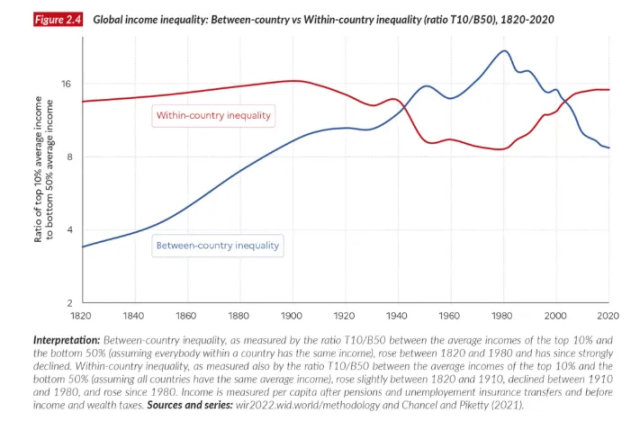
When encountering headlines like “10% of the global population owns 76% of the world’s wealth” (source: United Nations 2022 World Inequality Report), it’s essential to understand a key distinction: this is not a story of some countries getting rich while others fall behind, but rather a phenomenon occurring within every country globally—wealth inequality is widening everywhere, and accelerating across all measurable time frames.
More precisely, the issue is not just income inequality, but wealth inequality. Throughout human history, there has never been such a high proportion of wealth concentrated in the hands of the top 1%. In the United States, for example, the share of net wealth held by the top 1% has continued to rise and now approaches one-third of the nation’s total wealth.
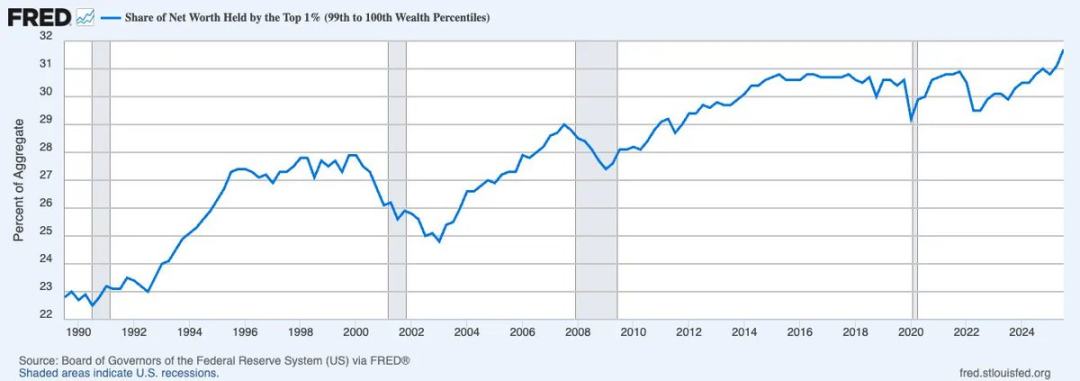
The distinction between income and wealth is crucial. Income is a transactional concept—“money in motion”—serving as a market-based measure of productivity; wealth is not. Non-capital wealth is “money at rest”: it lacks inherent productivity and slows the velocity of money necessary for economic activity within a credit-driven zero-sum game. When wealth becomes as highly concentrated as it is today, it ceases to flow, quietly suffocating the consumption velocity that sustains broad economic activity.
Under these circumstances, and in the absence of significant productivity growth to generate new resources, wealth taxation—despite ongoing controversy—will inevitably become the logical outcome of fiscal nihilism. The only viable mechanism to rebalance this dynamic is to tax wealth itself, regardless of how crude its design or how flimsy its logic. Wealth taxation can be seen as the mirror image of social security: the former extracts funds from the bottom to subsidize survival, while the latter extracts funds from the top to sustain it. Both are essentially taxes on unrealized value, differing only in direction—the former is vertical (extracting from the young), the latter is horizontal (extracting from the wealthy).
The implementation of a wealth tax has already begun. On February 12, 2026, the Dutch House of Representatives passed a landmark bill mandating a uniform 36% tax on the annual appreciation of stocks, bonds, and cryptocurrencies, regardless of whether these assets have been sold. The bill is currently awaiting approval by the Senate, where parties supporting it hold a majority, making its passage virtually certain. Whether this policy is morally justifiable, mathematically sound, or legally enforceable is irrelevant—those fixated on these issues miss the larger point. The truly critical question is simple yet far-reaching: What happens when other countries around the world follow suit?
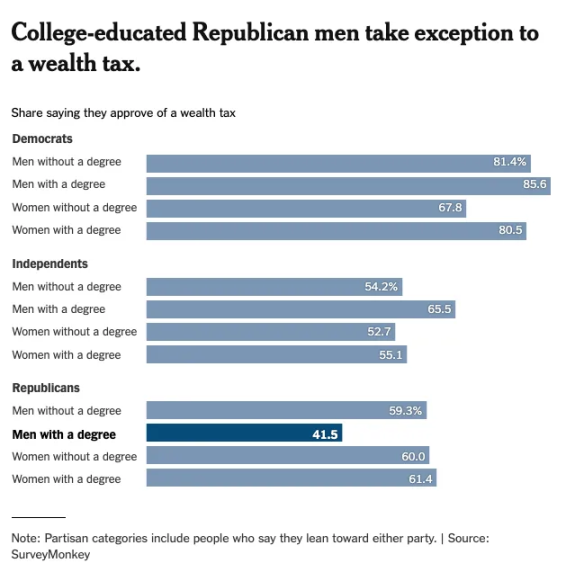
Look at the birthplace and final stronghold of capitalism—the United States. A New York Times poll on public attitudes toward wealth taxes shows that, except among men with college degrees (a demographic rapidly shrinking), support for wealth taxes is nearly uniform across all population groups.
This is precisely the core of understanding capital’s “citizenship.” While it is widely assumed that capital account liberalization is an inherent feature of the modern world, vulnerable populations know full well that capital can be restricted at any moment when a state chooses to do so—countries like China and Russia have already demonstrated this. The historical problem has been “betrayal”: if any single country imposes a wealth tax, capital simply flows to other jurisdictions. But as global fiscal nihilism intensifies, political will across nations is increasingly converging on the only viable option: collective negotiation arrangements will become inevitable, and the havens that have long profited from the prisoner’s dilemma will no longer be allowed to stand aside.
Following the Netherlands' decision, the EU is actively coordinating a tax framework aimed at preventing capital flight between member states. By mid-century, the global passport for capital will be revoked, replaced by a "Schrödinger visa"—simultaneously valid and invalid in the eyes of different regulators. Local capital restrictions will only intensify demand for "external funds" capable of bypassing compliance layers. Welcome to the era of hard currency-backed prices—the renaissance of species economics.
Drawing on the framework presented by David Hume in his 1752 essay "On the Balance of Trade," modern investors have long assumed that "external funds" refer to assets such as gold or bitcoin—assets that are stateless, jurisdiction-free, and independent of any sovereign authority. But four centuries later, a new class of "external funds" is emerging, one that will fundamentally redefine the concept of comparative advantage. It is time to write a new essay on international relations: "On the Balance of Intelligence."
As Hume observed, trade surpluses and the flow of gold determined a nation’s relative power; today, the new determinant of comparative advantage will be the concentration of productive AI infrastructure—who controls computing power, who owns the data, and who sets the model rules upon which all other systems operate. Capital will flow toward AI dominance just as it once flowed toward manufacturing supremacy. The nations, institutions, and individuals who first grasp this trend will define the new hierarchy of wealth. This leads me to my third unshakable truth.
Truth Three: Artificial intelligence will erode the relative value of labor and redefine the value of capital in an intention-driven economy.
Karl Marx, in Capital, described capital as “dead labor, which, like a vampire, can only live by sucking living labor, and lives the more, the more labor it sucks.” This famous quote highlights the socialist perspective that capital, existing in the form of accumulated labor, continuously increases in value by consuming the living labor of workers.
However, Marx made a critical error in his analysis: he believed that capital itself is inherently inert and must continuously consume human labor to generate profit. But with the rise of credit and now the explosion of artificial intelligence, we are entering a new paradigm—where "vampires" are not only fully autonomous but can even bypass human labor entirely, generating profit solely through the continuous consumption of energy. As shown in the chart below, the long-term trend of rising capital income share and declining labor income share has been building for over a decade, and artificial intelligence will push this trend past an irreversible tipping point.
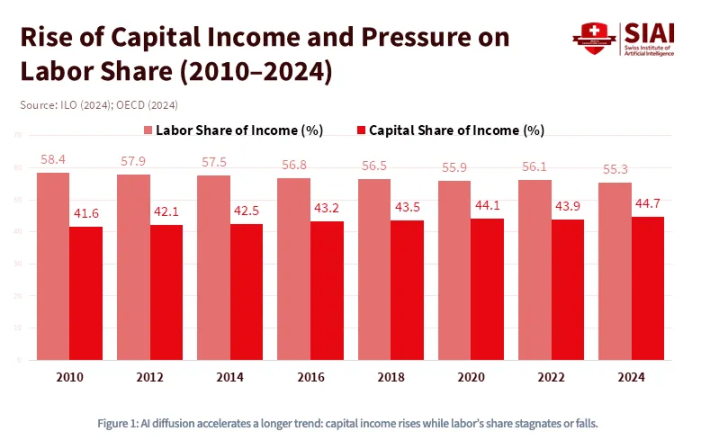
Since 1980, the share of labor income in U.S. GDP has declined from approximately 65% to below 55%, even before the widespread adoption of large language models (LLMs). In 2023, Goldman Sachs estimated that generative AI could expose 300 million full-time jobs to automation risk.
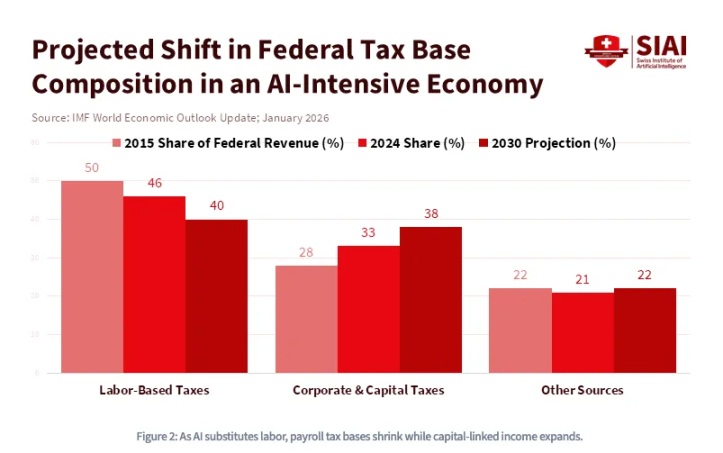
In other words, artificial intelligence is not only a capital-intensive technology but also a labor-displacing one. The rise of AI will permanently alter the fundamental economic principles underlying society and reshape the irreversible relationship between capital and labor. More specifically, when labor costs converge with computational costs, a new “capital war” will erupt globally, requiring unprecedented government subsidies, aggressive industrial policies, and fiscal measures. In this world, capital will dominate: ownership of assets will become the sole barrier between dignity and a permanent underclass. This is precisely what the International Monetary Fund predicts: in an AI-dominated economy, the federal tax base will shift from labor income to corporate income taxes and capital gains taxes.
However, capital itself will be redefined—because asset ownership is no longer confined to financial assets. The vast artificial intelligence industry also relies on another critical element, one even more valuable and irreplaceable than pure energy: data. Specifically, the digital footprint you leave every day provides the context for models to reason and learn. The world is moving toward a new paradigm: human thoughts, behaviors, commands, preferences, and especially intentions, will hold immense value. When intention itself becomes capital, an entirely different economic order will emerge—asset ownership will take on a strange “non-custodial” form,脱离我们熟知的 KYC / 反洗钱(AML)金融机构的框架。智能代理系统已开始配备加密货币钱包,自主支付算力、应用程序接口(API)和数据。对于一个价值需要在智能代理系统间无缝流转、偏好显性交易型使用的世界而言,这是切实的必然 —— 在其中,劳动与资本将处于叠加的「薛定谔状态」。 (Note: The last part of the text contains Chinese characters that were not translated. Here is the fully translated version with the Chinese portion corrected.) However, capital itself will be redefined—because asset ownership is no longer confined to financial assets. The vast artificial intelligence industry also relies on another critical element, one even more valuable and irreplaceable than pure energy: data. Specifically, the digital footprint you leave every day provides the context for models to reason and learn. The world is moving toward a new paradigm: human thoughts, behaviors, commands, preferences, and especially intentions, will hold immense value. When intention itself becomes capital, an entirely different economic order will emerge—asset ownership will take on a strange “non-custodial” form,脱离我们熟知的 KYC / 反洗钱(AML)金融机构的框架。智能代理系统已开始配备加密货币钱包,自主支付算力、应用程序接口(API)和数据。对于一个价值需要在智能代理系统间无缝流转、偏好显性交易型使用的世界而言,这是切实的必然 —— 在其中,劳动与资本将处于叠加的「薛定谔状态」。 (Note: The original text contains untranslated Chinese segments. Below is the fully accurate English translation of the entire passage.) However, capital itself will be redefined—because asset ownership is no longer confined to financial assets. The vast artificial intelligence industry also relies on another critical element, one even more valuable and irreplaceable than pure energy: data. Specifically, the digital footprint you leave every day provides the context for models to reason and learn. The world is moving toward a new paradigm: human thoughts, behaviors, commands, preferences, and especially intentions, will hold immense value. When intention itself becomes capital, an entirely different economic order will emerge—asset ownership will take on a strange “non-custodial” form, outside the framework of traditional KYC/AML financial institutions. Intelligent agent systems are already being equipped with cryptocurrency wallets to autonomously pay for compute power, APIs, and data. For a world in which value must flow seamlessly between intelligent agents and preferences are expressed through explicit transactional use, this is an inevitable reality—in which labor and capital will exist in an overlapping “Schrödinger state.”
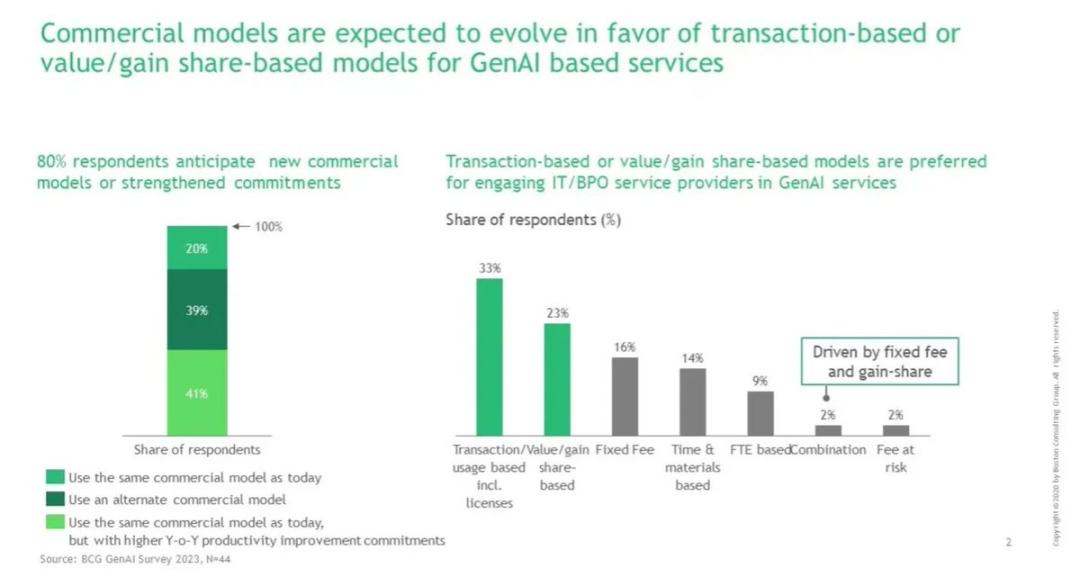
Historically, financial assets have always clearly fallen within regulatory boundaries defined by financial regulators such as the U.S. Securities and Exchange Commission (SEC), the Commodity Futures Trading Commission (CFTC), the Financial Industry Regulatory Authority (FINRA), and the Financial Accounting Standards Board (FASB). But as assets evolve into forms with “active attributes”—where your data footprint becomes collateral and intent becomes a monetizable output (through open, API-based products embedded with context)—AI systems will blur these regulatory boundaries from all directions. The Federal Communications Commission (FCC) has jurisdiction because your cognitive information is transmitted over spectrum; the Federal Trade Commission (FTC) has jurisdiction because intent collection falls under consumer protection; and the Department of Defense (DoD) has jurisdiction because data sovereignty is a national security issue.
In other words, this cumulative effect extends beyond the asset level and rises up to the entire regulatory system. When no single institution can clearly define the boundaries of "financial assets," the definition of money—who issues it, who protects it, and who seizes it—will become the most contentious geopolitical issue of this century.
Welcome to the era of smart money.
Three confirmations of the truth, two convergences, one conclusion
If you’ve read this far, you may feel uneasy—perhaps realizing you’re once again caught in profound uncertainty. But remember: the entire purpose of this article is to arrive at clear answers. Let’s restate the most fundamental conclusion together: the collapse of population, wealth inequality, and AI-driven labor substitution are all inevitable. They are not separate risks to be weighed or hedged individually; rather, they are logically converging simultaneously. The population pyramid is collapsing vertically, while wealth at the base is fracturing, and both are being amplified by a technological revolution that favors capital alone.
Many investors attempt to address this uncertainty with piecemeal solutions: rotating assets here, hedging there, betting on thematic investments in AI infrastructure, or placing blind faith in cryptocurrencies. The most appealing—and most likely to lull traditional investors into complacency—counterargument is the “escape hatch” of technological optimism: AI-driven productivity growth will rapidly expand the wealth pie, sufficient to outweigh the impact of population decline. This argument sounds compelling, yet it is precisely a logic that appears complex but fundamentally misses the point.
Throughout human history, the speed and fairness of productivity gains have never been sufficient to prevent political and social fragmentation caused by inequality. The Industrial Revolution did not avert labor uprisings—it ignited them, even as it generated unprecedented total wealth. Crucially, artificial intelligence is not a neutral multiplier of productivity: from its very architecture, it is a concentrator of capital. Every unit of productivity it generates accrues first and most enduringly to those who control computing power, data, and models. Optimists are not wrong to believe the economic pie will grow larger—they are wrong about who gets to eat from it—and that is precisely the core of the entire debate.
When you examine these truly irreversible global phenomena from a sufficiently macro perspective, your conviction about the direction becomes unexpectedly clear:
- The global population is aging and shrinking; the demographic situation will inevitably worsen—this is 100% certain;
- Wealth inequality will expand to trigger capital controls on a global scale—whether across borders or domestically, this is 100% certain;
- Artificial intelligence will structurally favor capital, giving rise to a new form of transitional capital never before seen in the global economy—this is also 100% certain.
Most importantly, the common core characteristic of these three points points to one word: global. Generational demographics, asset allocation, and cost of capital have never been as closely interconnected as they are today—and this interconnection continues to strengthen. Moreover, this correlation spans not only space but also time—because the demographic evolution of wealth is unidirectional and irreversible. This means that this convergence is not only global but also synchronized.
In summary, this has formed what I see as the most central collective action issue of the modern era: the generational exit from the liquidity prisoner’s dilemma. It raises the question:
- When the younger generation also perceives government directives as "taking over for their parents' generation," will they still voluntarily participate in "American capitalist ownership"?
- When wealthy friends are shifting toward "tax-efficient" planning, will ultra-high-net-worth individuals still voluntarily bear high tax burdens?
- When profit-driven competitors ignore capital costs and continue expanding, will AI companies voluntarily slow down their growth?
A Nash equilibrium will emerge: all participants will choose betrayal as the rational dominant strategy—regardless of others’ actions—because the cost of inaction is too high. Thus, when the critical moment arrives, everyone will rationally seek to exit liquidity simultaneously.
This kind of liquidity Faustian bargain must not be viewed as a potential risk or a tail risk requiring modeling and hedging; rather, it should be recognized as the most predictable large-scale coordinated event in the history of human capital markets. Some may argue that in a deflationary environment, you should hold nominal interest-bearing instruments like bonds or ride the wave of AI stocks. Perhaps. But my core principle is simpler and more structural: hold assets that won’t leave you as the last holder liquidity. Under this framework, the assets you should least hold, in order, are: real estate, bonds, and U.S. equities. These are all duration manipulation tools that, whether intentionally designed or not, constitute the greatest intergenerational wealth transfer in history.
Conversely, your ideal asset should satisfy all three inverse conditions:
- Currently has the lowest ownership rate among demographic groups, but is expected to become the asset with the highest ownership rate in the future;
- When capital liquidity is heavily taxed, restricted, or seized, it is most likely to become a safe haven in a jurisdiction-free environment;
- The form of capital that most closely approximates an autonomous intelligent world, seamlessly operating without intermediaries to replace human labor in performing productive functions.
When the Ottoman Empire breached the walls of Constantinople in the 15th century, the Byzantine merchant class lost all assets denominated in imperial credit—land, titles, government bonds—everything was lost. But the young, ambitious scholars and enterprising merchants carried portable wealth—manuscripts, gold, knowledge—westward to Florence, ultimately igniting the flame of what would later be known as the Renaissance.
Among this group was a young Byzantine scholar named Johannes Bessarion. Born in 1403 in Trebizond on the Black Sea, he fled Constantinople with dozens of crates of irreplaceable Greek manuscripts containing nearly the entire intellectual heritage of the ancient world. He was the single greatest supplier of books and manuscripts to the West in the 15th century, and in doing so created one of the earliest forms of “information technology”: the Marciana Library—the first open-access knowledge repository (public library) in Latin Europe. The collection housed in Venice became the direct source material for Aldus Manutius, who used it to print the complete works of Aristotle and dozens of other Greek classics, sparking a printing revolution that in turn gave rise to the Reformation, the Scientific Revolution, and the Enlightenment. The portable, autonomous, jurisdiction-free capital that Bessarion carried with him,历经五个世纪, ultimately gave birth to Western civilization.
Capital that can flow across time and space survives; that which cannot perishes.
This leads us to our final conclusion—the only radical decision worth considering when faced with the pitfalls of traditional options:
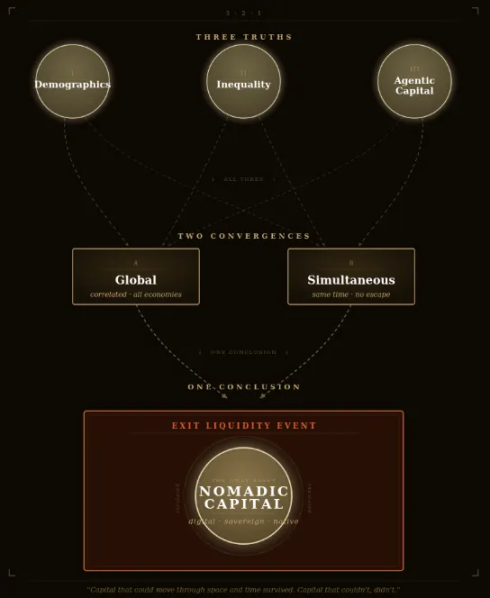
What you truly need to hold is nomadic capital—capital that can freely migrate across generational demographics, political boundaries, and AI-native ecosystems, bypassing the "Strait of Hormuz" of currency. In the 21st century, nomadism is digitization. Specific investment tools vary by individual, but radical investment theory offers a viable framework: allocate 60% to compliant assets and 40% to risk-resistant assets. Yet if you carefully adhere to these three principles—holding assets that young people will ultimately need, holding assets beyond government reach, and holding assets that are genuinely tradable within autonomous economic systems—the outcome is no longer a prediction, but an inevitability. Uncertainty will ultimately become certainty.
After all, throughout history, only one disruptive asset has met all three of these criteria from the very first line of code. For highly motivated individuals, this step is already straightforward.
The rest is just a matter of timing.