





Around 9:00 PM on April 15, 2026, a weather sensor at Paris Charles de Gaulle Airport suddenly recorded a temperature spike from 16°C to 22°C. Twenty-four minutes later, the temperature quietly returned to its original level.
Meanwhile, readings from all surrounding weather stations remained completely unchanged. After conducting a physical inspection and data analysis, Météo-France discovered signs of "illegal human interference" after ruling out equipment malfunction: someone had secretly heated the sensor.
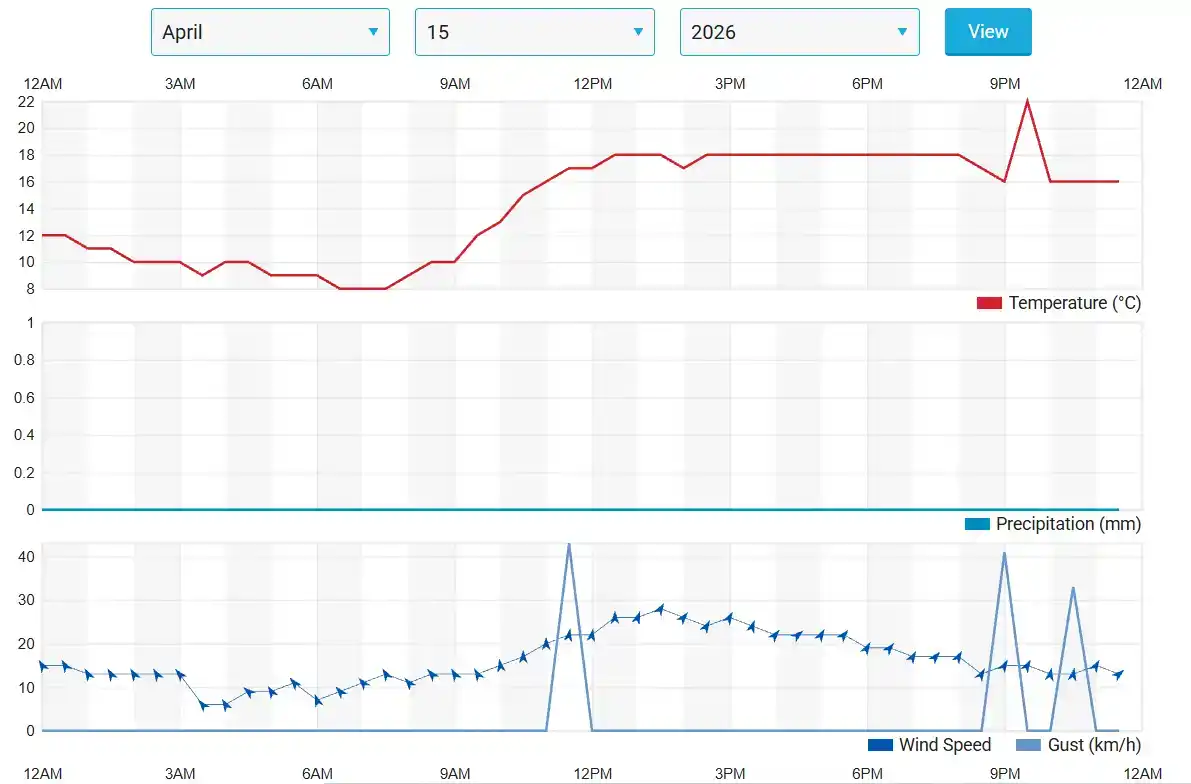
As of the publication of this article, the French Meteorological Agency has officially filed a criminal complaint with the Roissy Airport Gendarmerie. If convicted, the individuals involved could face the maximum penalty under French criminal law for tampering with automated data processing systems of public institutions: up to seven years in prison and a fine of €300,000.
What appears to be a minor, abstract event actually points to a prediction market platform called Polymarket.
Principles of prediction markets
Polymarket is a blockchain-based prediction market platform for binary options. Here, users can place bets on any event with a clear outcome, from "Will Trump win the election?" to "Will today's high temperature in Paris exceed 22°C?"
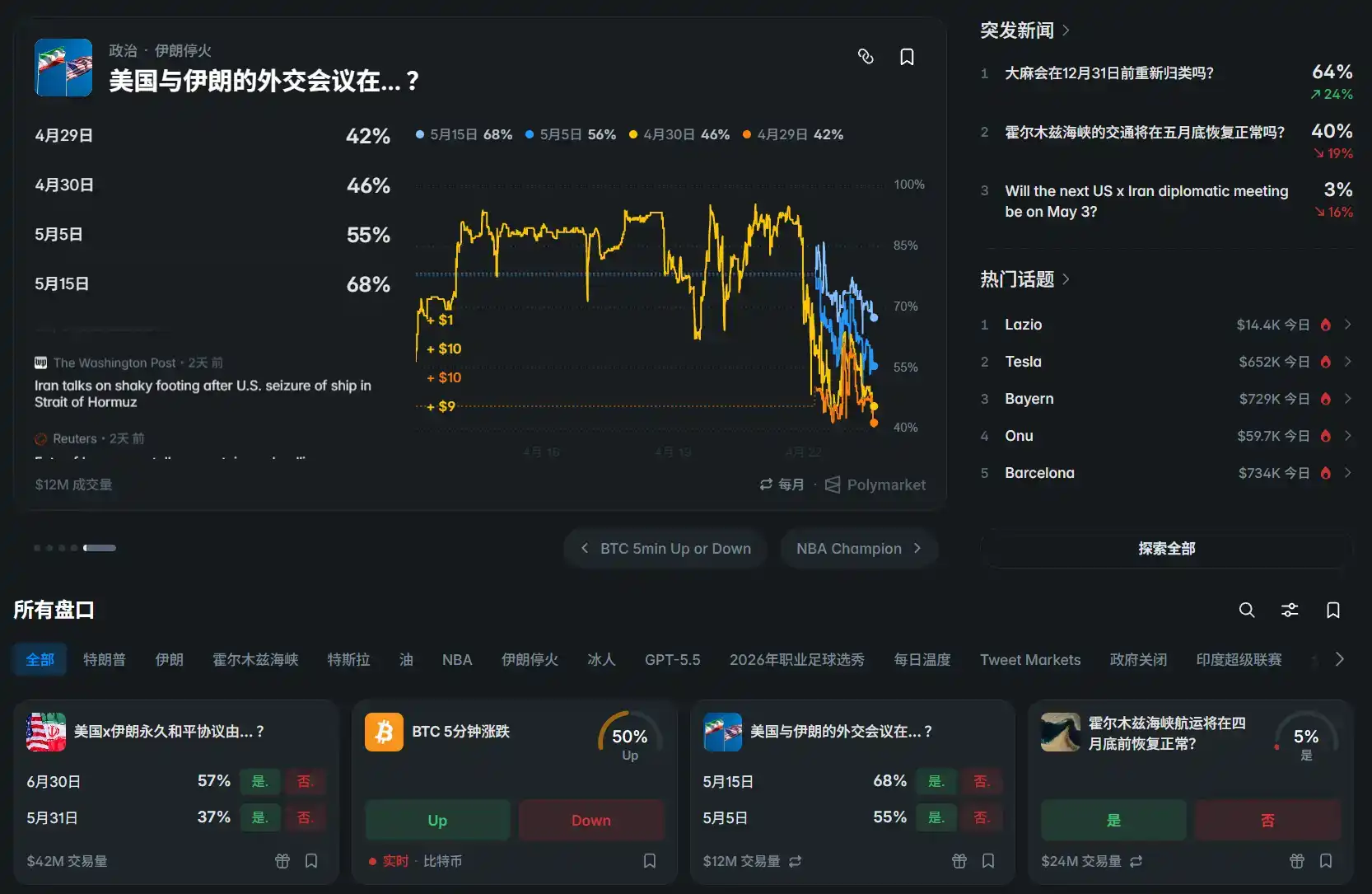
Each market’s answer is either “Yes” or “No,” and the real-time fluctuating price precisely represents the probability of the event occurring, reflecting the collective judgment of participants. Correct guesses yield proportional profits; incorrect guesses result in the loss of the entire stake.
For markets like regional high temperatures, Polymarket uses official data published by specific weather stations as the settlement source to avoid ambiguity. For the Paris daily high temperature market, the settlement source is the automated weather station at Charles de Gaulle Airport (LFPG) operated by Météo France.
The rule itself was not problematic—until someone discovered that the sensor was positioned just outside the track’s perimeter fence, near a public road, with almost no fencing or cameras around, making it accessible to anyone.
Earned 178 times in half an hour, with just a $35 hair dryer as your initial investment.
Around 9 PM Paris time on April 15, the probability on Polymarket that the highest temperature in Paris on April 15 would be 18°C had already reached over 99%. At this point, temperatures were entering their nightly decline, and the market appeared to be in "garbage time."
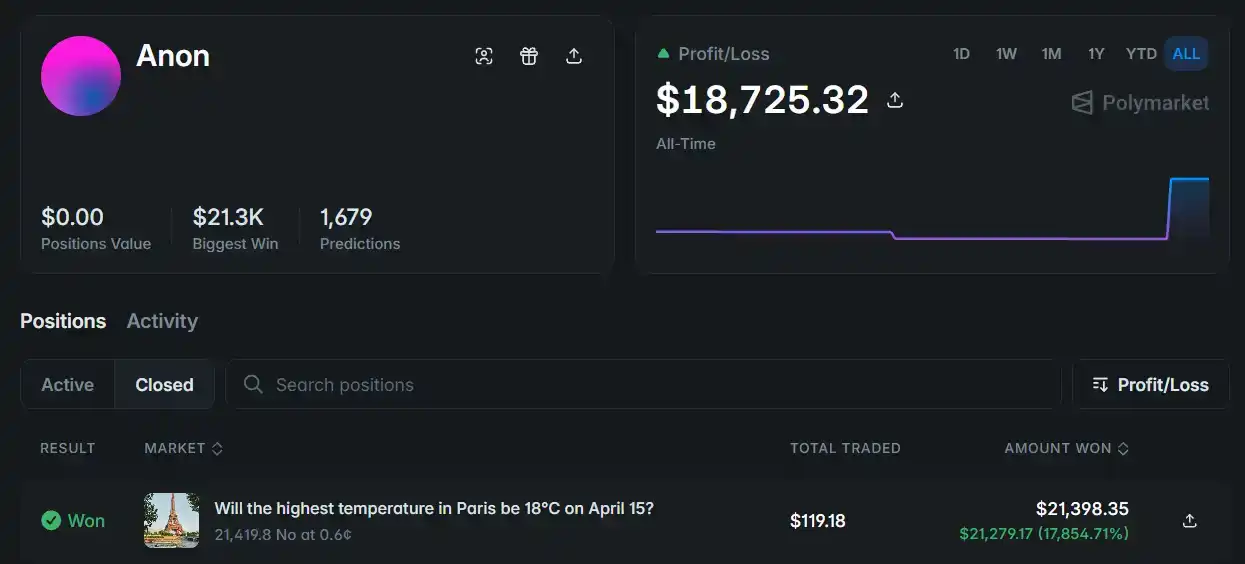
Yet at this moment, an account with ID xX25Xx placed a substantial bet on "No" for less than $120—due to the probability-odds mechanism, the potential return on this bet exceeded $20,000.
Even so, traders at the time did not take this bet seriously. On this platform, the gamble mentality of risking small amounts for large gains is not uncommon; opposing these gamblers and profiting from their stakes is one of the most reliable ways to generate returns.
Immediately after the next temperature reading was released, the sensor jumped from 16°C to 22°C. The probability of the high temperature being 18°C instantly dropped to zero. xX25Xx’s original $120 bet multiplied by approximately 178 times, while professional traders and quantitative bots, who had long been consistently profitable in such markets, suffered significant losses in this event.
Meteorologist Paul Marquis later pointed out: "With no changes in wind direction or relative humidity, and no other station recording any anomalies, the most plausible explanation is physical interference with the sensor probe using a heating device."
The motive behind tampering with temperature data has now become clear: aware of how weather sensors work, xX25Xx placed a high-odds bet that the day’s high temperature would exceed 18°C, then artificially altered the sensor readings by heating the device to profit from the bet.
xX25Xx has since changed their account ID, as if deliberately avoiding public attention; however, Polymarket’s blockchain-based mechanism ensures that all of their transaction records remain publicly accessible.
The ultimate "oracle" leading the polls
Polymarket isn’t just about betting on the weather. Here, you can bet on whether Israel and Hamas will reach a ceasefire, whether the Federal Reserve will cut interest rates at its next meeting, or which profession will be next replaced by AI. Its markets cover politics, economics, technology, sports, natural disasters—almost any event with a clear outcome can be traded.
What truly brought prediction markets into the mainstream was the 2024 U.S. presidential election. At the time, most polls showed Trump and Harris in a dead heat, yet on prediction markets, Trump’s probability of winning had consistently remained above 90%. The final outcome proved that this collective judgment, driven by real money, pointed to the correct answer earlier than the vast majority of professional polls.
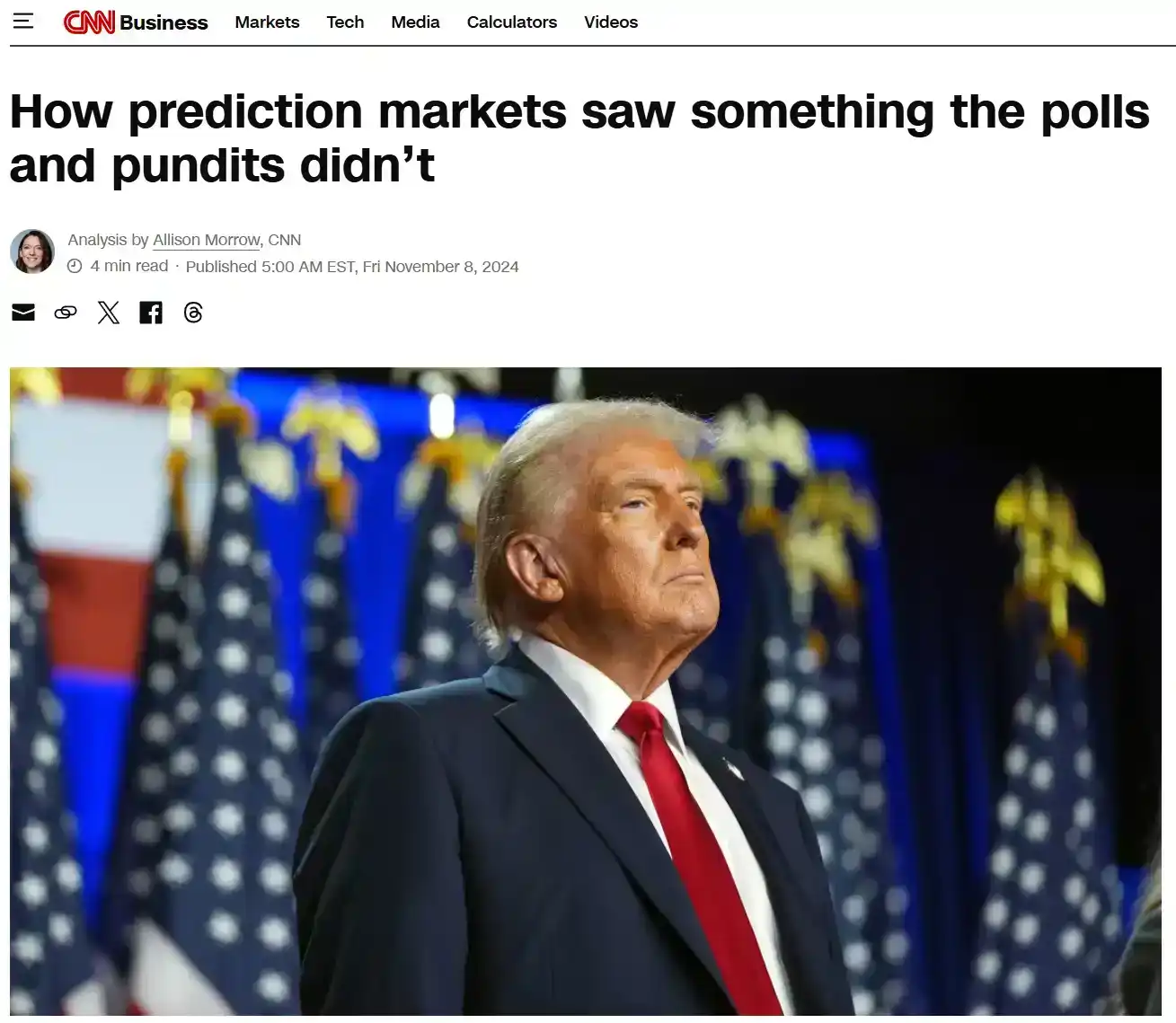
After this event, prediction markets came to be seen by an increasing number of people as a unique information tool—not gambling, but a "poll funded with real money." Participants risk their own capital, giving them incentive to gather accurate information rather than simply guessing what feels right. This mechanism, in theory, causes market prices to more closely reflect true probabilities.
But this logic has a vulnerability: the greater the influence, the stronger the motive to attack. When prediction markets become the "oracles" cited by global media, and when their prices begin to influence people’s judgments about real-world events, every vulnerability in a data source becomes a loophole worth exploiting.
The weather market is precisely the most vulnerable among them, and exploiting the vulnerability extends far beyond merely heating sensors.
The airport temperature recorder no one cared about is now running a paid group.
In addition to physical tampering, information asymmetry itself is another widely discussed "source of advantage" in the weather market.
This month, Polymarket launched daily high-temperature markets for multiple Chinese cities, including Shanghai Pudong Airport, Shenzhen Bao'an Airport, and Beijing, with settlement also based on airport METAR data.
According to discussions in the trading community, a new type of trader—dubbed "weather prophets"—has emerged in these markets; unlike professional traders or quantitative bots, they consistently anticipate the direction of bets related to temperature changes before official weather data releases.
Unlike traders who build their own prediction models using open-source weather data, these traders appear to have a clear time advantage. There are even rumors within the community that some individuals have publicly shared screenshots of their profits and trading strategies, along with creating paid membership groups.
In a market where "insiders" were originally least expected—weather—delays in meteorological reports and disparities in data update frequencies are causing traders to widely question the reliability of weather markets in certain Chinese cities.
When weather data becomes an asset that can be priced and traded, those who understand it transform from being overlooked to becoming the most valuable players. Those who had access to METAR data feeds and could act faster than the market suddenly found themselves in an unexpected position.
A sensor heated for half an hour undermines the foundation of trust in a trillion-dollar business system.
So far, this still sounds like a financial game confined to the small world of prediction markets, with stakes of only tens of thousands of dollars, and wins and losses circulating solely within that circle.
However, METAR data from airport weather stations has never been the sole basis for Polymarket's settlement.
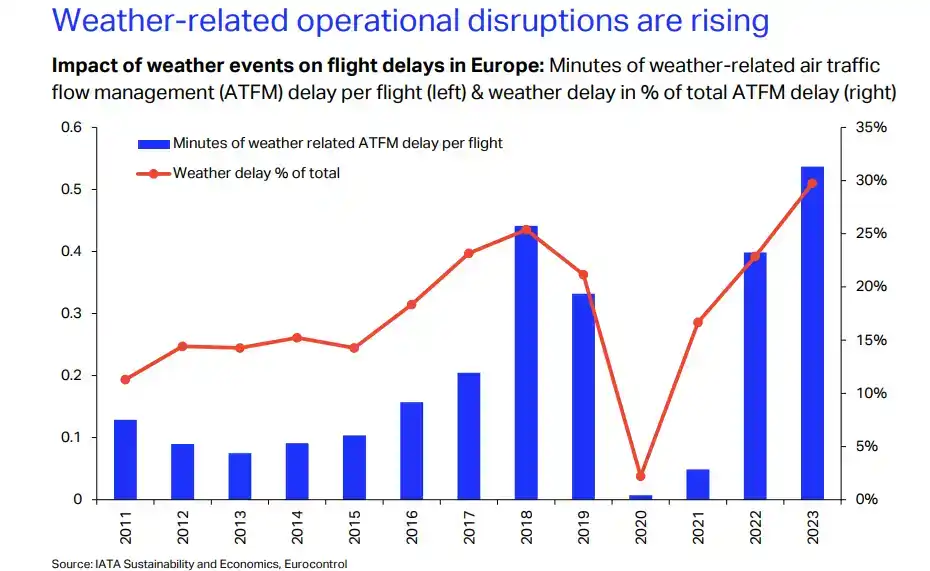
Every operational decision made by an airline is based on meteorological data. According to the U.S. FAA, more than half of flight delays are weather-related, and extreme weather is the single largest cause of 42% of flight cancellations. Weather-related flight disruptions cost the aviation industry over $60 billion annually. Behind this figure are countless scheduling decisions that rely on accurate data.
The pricing logic for agricultural insurance is also based on meteorological data. The global agricultural insurance market is valued at approximately $46 billion, with many products utilizing a "parametric insurance" mechanism—when meteorological indicators such as temperature and rainfall meet predefined conditions, payouts are automatically triggered without the need for manual assessment. This mechanism relies on the authenticity and reliability of meteorological data; if the data is manipulated, the triggering conditions become distorted.
Above that is reinsurance. Global reinsurance companies price their exposure to extreme weather events using actuarial models built on long-term meteorological data. A data quality issue at a single site may have limited impact in a single event; however, if such human interference with a single data source can be replicated at low cost, the credibility of climate data will be fundamentally undermined.
These are just the known and traceable commercial dependencies. Energy companies use weather data to predict peaks in electricity demand; logistics firms rely on it to plan routes and warehouse operations; construction schedules depend on weather forecasts; and price fluctuations in commodity futures are influenced by real-time assessments of weather conditions in agricultural regions.
In this system, the sensors at the weather station serve as the lowest-level input. Someone, aiming to make tens of thousands of dollars in a prediction market, placed a heating device near that sensor—a small action, but one that touched a data chain stretching from an airport runway all the way to global financial markets.
The investigation into this case in France is still ongoing. After Polymarket switched the settlement source for the affected market in Paris, no settled markets have been refunded. Funds from previously profitable accounts remain in place.
The underlying risks behind this incident may be higher than we realize. While the objectivity of temperature data makes anomalies relatively easy to detect, in the landscape of prediction markets, there are many markets settled based on a single source of information—some of which involve events far more complex than weather and much harder to verify independently.
Prediction markets were once called the "ultimate oracle" for their ability to reveal the truth. But when their own data sources became targets of attack, the meaning of that title became much more complex.