








Original author: Binance News
On the morning of April 20, 2026, the stock price of Xinhuo Group (01611.HK) surged sharply, rising more than 11% intraday.
What triggered this market rally was a piece of news that ignited both the financial and crypto worlds: Fu Peng, former Chief Economist at Northeast Securities, has officially joined Xinhuo Group as Chief Economist.
The news was first revealed by Tencent News' "Yi Line," and Xinhuo Group subsequently confirmed it. Fu Peng also stated to the media: "Primarily, there will be a synergy between FICC and C businesses."
Among these, FICC refers to Fixed Income, Currencies, and Commodities, and C refers to cryptocurrencies. His primary responsibility in joining is to integrate digital assets into the global asset allocation framework, providing macroeconomic research and asset allocation support to Xinhuo’s institutional clients.
This is his first appearance in the public eye in a formal capacity since leaving Northeast Securities nearly a year ago. For him, this is not just a change of employer, but more like a fresh beginning to his professional story.
The first half reached its peak within the traditional financial system, only to be forcibly interrupted amid controversy and hardship; the second half chooses Hong Kong, the crypto sector, and a crossroads where traditional finance and digital assets are slowly converging.
The Non-Traditional CEO Path
In 2004, Fu Peng joined Lehman Brothers, and later served as Head of Global Macro Hedge Strategy at Solomon International Investment Group, where he led integrated analysis of currencies, commodities, and major asset classes for nearly four years.
Returned to China at the end of 2008 and worked at various institutions, including Shandong High-Tech Investment, Zhongzhongqi, Galaxy Futures, Galaxy Securities, and Anxin Securities.
In February 2020, he joined Northeast Securities as Chief Economist. His approach in this role differed from that of most peers: he made self-media his primary battlefield.
He frequently uses analogies and metaphors to explain economic concepts, delivering his content in a highly performative style. His Weibo account, "Fu Peng's Financial World," has amassed over 4 million followers, while his Douyin following has reached 1.485 million. On Xiaohongshu and Bilibili, he has also gained 355,000 and 773,000 followers, respectively.

In 2024, he published "Witnessing the Counter-Tide," using a three-layer framework of "politics/distribution—macro—assets" to explain the shift in global asset dynamics after 2016.
This approach earned him significant recognition in the finance community, establishing him as an analyst who can present complex macroeconomic concepts in an accessible way to everyday investors.
The consequences of a speech
In late November 2024, Fu Peng was invited to deliver an end-of-year speech at HSBC Private Wealth Planning’s internal event in Shanghai, addressing China’s declining effective demand, shrinking middle-class incomes, growing consumption polarization, and his assessment that current stimulus policies are unlikely to replicate the effectiveness of those in 2008.
The recording and transcript subsequently spread widely online, were removed by multiple platforms, and his WeChat and short video accounts were suspended for nearly six months.
There is a rumor circulating that the event was canceled due to regulatory scrutiny. Fu Peng publicly responded, directly criticizing HSBC, and shared chat records stating, “The legal notice is on its way—wait for your apology.”
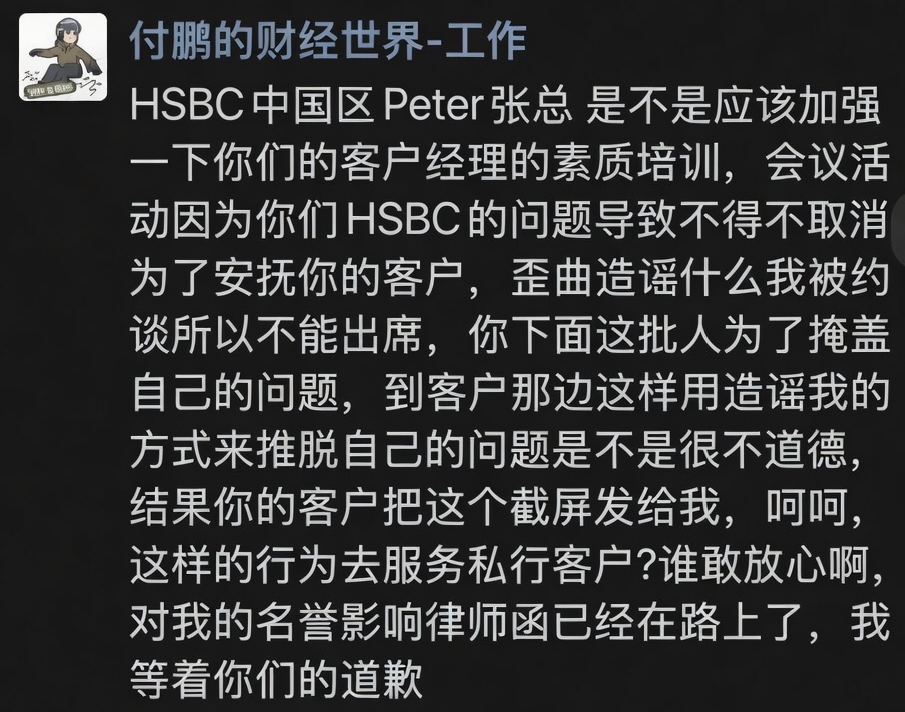
Dongbei Securities also stated that there had been no regulatory meeting recently. HSBC responded by saying it was "looking into the matter," after which the incident quietly faded from public attention with no further developments, ultimately being dropped.
During the account suspension, Fu Peng's public communication channels were significantly restricted.
On April 30, 2025, he officially resigned from Northeast Securities, publicly stating that he had just undergone two major surgeries and required more than six months of rest and recovery.
Predictive Capability and Boundaries
Among Peng Fu’s followers, there are many stories circulating about his accurate predictions, covering the 2008 financial crisis, Japan’s stock market recovery, and turning points in China’s real estate cycle. Since 2016, he has consistently emphasized deglobalization and shifts in the interest rate floor, and some of his frameworks have since been partially validated.
However, his prediction record is not consistent. There are clear biases in areas such as short-term exchange rates and specific policy windows, and some of his judgments have been criticized as overly pessimistic or significantly inaccurate in the face of policy interventions.
He also acknowledged that macro research focuses on structural variables, not quarterly data. This serves both as a methodological clarification and a preemptive explanation for short-term inaccuracies.
What he provided is a framework for understanding the world, not a reliably reproducible predictive tool. Describing him as a prophet who always gets everything right is a misinterpretation.
One of his key strengths is his ability to explain complex macroeconomic concepts in an accessible way while maintaining independent judgment. This allows his influence to reach a broader audience—a quality that New Fire Group values most.
Why choose Xinhuo?
There are theoretically more than one option for Fu Peng’s return. Traditional securities firms would welcome him back, and the role of chief economist is not unfamiliar to him—but he chose Xinhuo.
The space for traditional finance is narrowing; for someone who spoke so frankly at a HSBC event, what does it mean to return to the system? He should understand better than anyone.
His skill set has never been limited to traditional assets—FICC has always been his area of expertise. As crypto assets become more institutionalized, their connection to macroeconomic dynamics is becoming increasingly evident. Interest rate cycles, U.S. dollar liquidity, and geopolitical risk premiums all simultaneously impact both traditional and digital assets.
Another more practical factor: a comeback requires the right stage.
Xinhuo Group is licensed to operate in Hong Kong and listed on the Hong Kong Stock Exchange, operating within a compliant framework; at the same time, its size and stage provide sufficient flexibility for an independent-minded individual to build a new research system—this is entirely different from assuming a fixed role within a mature, large institution.
Why does Xinhuo need him?
Xinhuo Group is currently positioned as a digital asset management institution serving high-net-worth clients, holding Hong Kong SFC Type 1, 4, and 9 licenses, as well as a TCSP trust license, making it one of the earliest institutions in Hong Kong to achieve full licensing for virtual asset management.
In 2025, Weng Xiaoqi became CEO, launched Bitfire Premium services, acquired a majority stake in the licensed Japanese exchange BitTrade, exited the retail market, and focused on family offices, publicly traded companies, and institutional clients. By the end of March 2026, the company was renamed Bitfire Group Holdings Limited, with the English name Bitfire Group.
Financially, total revenue for fiscal year 2025 reached HK$8.661 billion, representing a year-over-year growth of over 450%. However, this growth was primarily driven by increased volume in low-margin crypto OTC trading, and the company remains overall unprofitable. Management has set fiscal year 2026 as the turning point for profitability, facing considerable pressure.
The compliance framework is in place, and the growth metrics are solid, but what Xinhuo truly lacks at this stage is not traffic, but trust.
Their clients—partners in family offices, financial officers of publicly traded companies, and private investors who have already accumulated substantial wealth—do not lack information or data; what they lack is a compelling narrative framework that gives them confidence in digital assets, along with a professional image rooted in traditional finance.

Weng Xiaoqi articulated this logic quite clearly: “Fu Peng’s profound global macro analysis capabilities and precise insights into market liquidity will serve as the company’s premier strategic brain… helping clients accurately seize certainty in the era of ‘FICC+C’.”
Fu Peng’s background in international investment banking and hedge funds, his independent public voice, and his influence of millions serve as a recognizable professional signal for traditional wealthy individuals evaluating whether to allocate more capital to digital assets.
This is a transaction where both parties benefit.
A beginning without a conclusion
On one side is someone who came from the traditional financial system, having experienced highs, controversies, and an enforced interruption, now seeking a new space to continue expressing and contributing.
On the other hand, a company is striving to transition from a trading platform to an institutional service provider, aiming to establish a language more easily understood by traditional capital.
Can the appeal of macro narratives be translated into real institutional capital inflows? How long can Fu Peng’s independent style be maintained within the institutional framework of a publicly traded company?
Do traditional affluent clients' trust in digital assets ultimately rest on framework alignment, or must they still wait for further regulatory clarity?
These all still require time to verify.