





Author:Nicky Sap
Translated by: Felix, PANews
On January 22, Dan Romero, CEO and co-founder of Merkle Manufactory, officially announced that Farcaster has been acquired by infrastructure provider Neynar. Neynar will also take over the Farcaster application (formerly known as Warpcast) and Clanker.
It feels as if writing this sentence is already planting the seeds for chaos to come.
As a result, it's no surprise that people outside the Farcaster community receive not clear messages, but even more confusion.
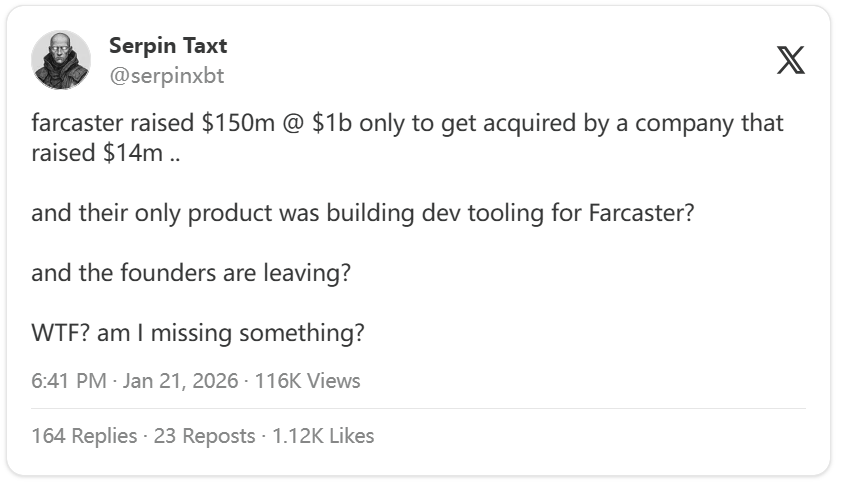
Many people think the entire Farcaster project has been completely shut down.
Others are asking who Neynar is, or why a company that is only one-tenth the size of Farcaster would acquire a unicorn valued at $150 million.
Some people have even completely misunderstood the Farcaster architecture.
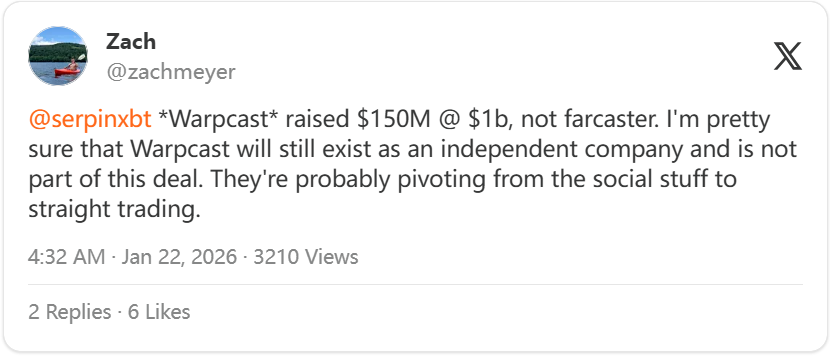
If you couldn't understand it either, congratulations—you've just experienced firsthand the core issue that Farcaster has always had: extremely chaotic information delivery.
There's no doubt that Dan and Varun have achieved something remarkable. They successfully built a blockchain-based social protocol without issuing tokens, introduced many new primitives, and enabled developers to find product-market fit (PMF) before distribution.
The concept of Frames is indeed innovative, with a top-tier protocol architecture, and the community formed around it is genuine and vibrant.
What truly overwhelmed Farcaster was not its ability to execute its unique vision.
In short, it was a combination of unnecessary mistakes, investor pressure to meet Web2 social media metrics, a lack of strong conviction within the team, and an inability to clearly communicate the vision. These factors collectively led to Farcaster's gradual decline.
From the beginning, those chaotic and almost mysterious brand names have confused the public. Merkle Manufactory is the for-profit entity that develops Farcaster (an open protocol), while its single client, Warpcast, was renamed to Farcaster only a few months before the acquisition.
Every change stirs up waves, but outside the Farcaster ecosystem, these changes rarely bring positive feedback. On the X platform, users often criticize Farcaster for constantly shifting directions.
But brand repositioning is not the only unexpected transformation.
Its lack of firm commitment to any principles has continuously drawn negative attention from the outside. Let's review the timeline below.
Farcaster (i.e., Warpcast) initially emerged as a decentralized Twitter, primarily attracting early adopters, developers, and crypto natives who wanted to escape the noise of other platforms.
In 2024, Frames launched, introducing a brand-new set of social and on-chain primitives. Its focus on "full decentralization" (which later became a point of criticism) attracted a large user base. Degen, a meme coin that later reached a market cap of $2 billion, emerged from these primitives. However, because Frames' vision was not centered around cryptocurrency, it overlooked Degen's potential. Degen eventually faded away, and users gradually left.
The Farcaster Developer Day in September 2024 once again sparked excitement. Channels will become "first-class citizens," and Moxie is preparing to redefine how creators monetize their content. The slogan at the time was: "Come for the community, stay for the network."
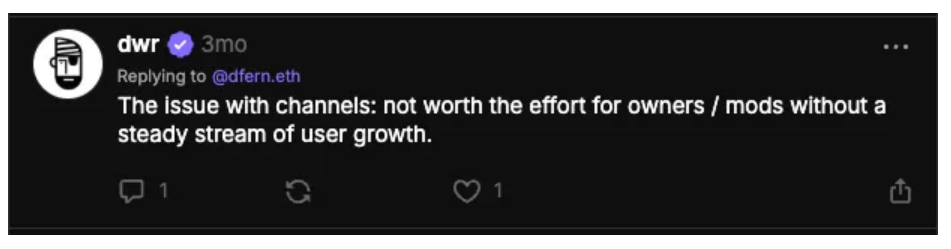
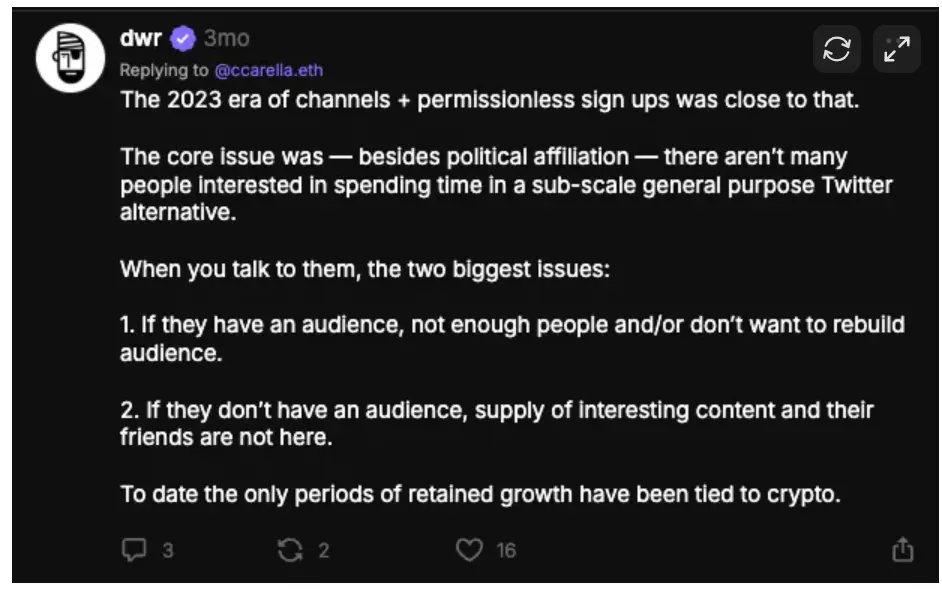
But Channels ultimately failed to be incorporated into the protocol, due to the lack of conviction from Channels' owners and the absence of meaningful growth to fill Channels. Moxie's dream of revolutionizing content creators' monetization models also collapsed due to poor token design.
The 2025 Farcon Conference: Miniapps are seen as the growth engine. A large portion of the conference focused on helping more developers gain their first users on Farcaster and achieve monetization.
Late in 2025, it was reported that the main client of Farcaster will be open-sourced.
But by the end of 2025, the direction had completely shifted: from developers to traders, and the leadership admitted the failure of a decentralized Twitter. This marked the beginning of its decline.
It is worth mentioning that the client has still not been open-sourced to this day.
In October 2025, Clanker, the flagship AI token launcher that acquired Base, fully launched its financialization roadmap. Dan posted a contract address, saying it was a random address, and anyone who Ape'd into it would be low agency (low liquidity).
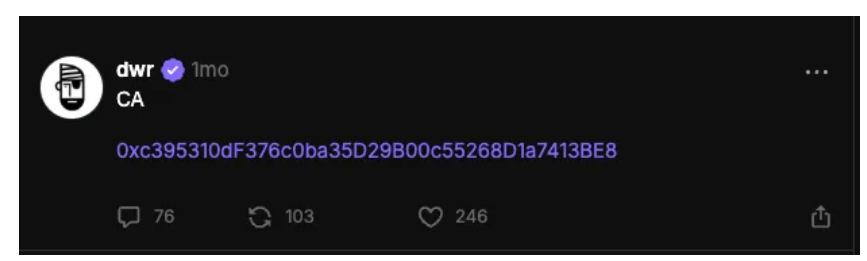
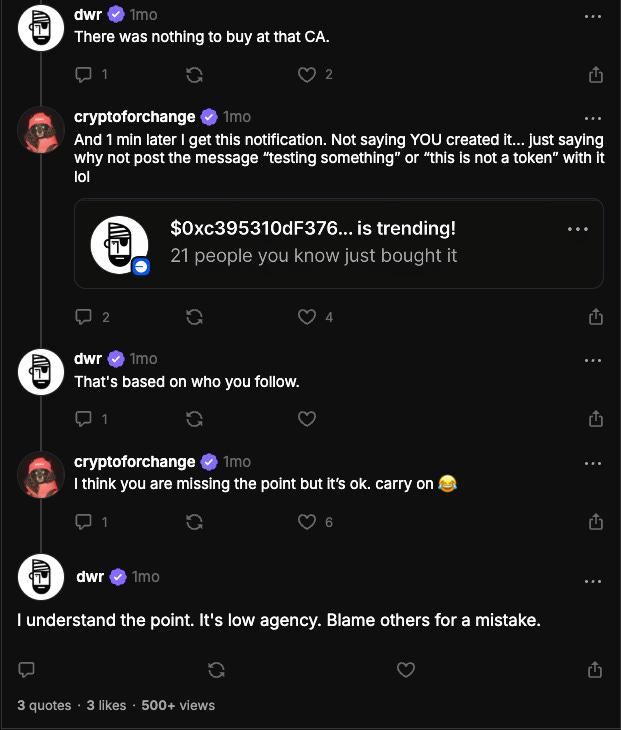
From then on, things started to go wrong. Dan found himself in a difficult situation, surrounded by problems on all sides. His mood clearly deteriorated, and he posted far less frequently. He was already completely exhausted.
Soon after, the app completely lost control, unintentionally promoting rug pulls, misleading users into blindly following trends to purchase scam tokens, and providing a list of low-quality, shoddy tokens. They attempted their first Clanker presale, but it was instantly swept up by a single wallet. Users were told this was a normal part of the presale process. Subsequently, the presale was canceled.
Each event sparks a wave of heated discussions, with articles, podcasts, and comments from onlookers pouring in. A good project isn't one that constantly forces you to update your understanding in order to grasp obscure details. Instead, it should convey a unified and coherent message, consistently communicated over time. Users don't need to know anything about Cook's private life to understand that Apple will release a new phone in September.
If you look at all of this from the perspective of an outside observer, it might seem as though all of these problems could have been avoided. But from the inside, these shifts might have made sense at the time, given the isolated circumstances. Merkle was seeking growth, and investors likely kept pressuring the team to meet targets that were unreasonable from the very beginning.
Farcaster is not Twitter, nor has it ever aimed to become the next Facebook. At its peak, it was merely a protocol with 100,000 active users. It should not be viewed as a unicorn in the social media space. Instead, it is better suited to become the social infrastructure of the crypto ecosystem.
This is exactly why this acquisition makes sense for the entire Farcaster network.
Neynar is a leading infrastructure provider in the Farcaster ecosystem. If you've ever developed a Frame or a Miniapp, you've definitely used their services. Their API is excellent. They are one of only two Snapchain operators in the "sufficiently decentralized" network. Their vision aligns more closely with Farcaster's direction than Merkle's chaotic growth strategy.
Today, a developer-centric leadership might take necessary steps to expand the network's reach. They finally have the opportunity to open-source the client, reduce the difficulty (and even cost) of running a Snapchain node, thereby encouraging more clients and unique primitives to be built on this powerful dataset. Free from the pressure of venture capital chasing 100x growth, Neynar can now truly build what Farcaster was always meant to be.
The timing is also just right. The vibe coding meta narrative is currently at its peak, with a constant stream of new ideas, applications, skills, and "Claude for xxx" concepts emerging. Everyone is eager to build疯狂ly.
Neynar has launched a Mini App Studio, enabling non-technical users to build and deploy their first prototypes on Farcaster within minutes.
Neynar doesn't need to tell stories. They just need to keep the infrastructure running stably. Maybe that's enough.
The problem has never been with the protocol itself, but rather in forcing a story onto something that doesn't need one.
Related Reading:Is Decentralized Social Dead? After Five Years of Exploration, Farcaster Transitions to Building a Wallet