

Ethereum Secures $166B in Stablecoins but Struggles to Capture Value

iconAMBCrypto
Share
Share IconShare IconShare IconShare IconShare IconShare IconCopy
AI summary iconSummary

expand icon
Ethereum news shows the network holds $166.1 billion in stablecoins, reflecting on-chain capital for structured finance. Ethereum ecosystem news highlights tokenized U.S. Treasuries surpassing $12 billion, as traditional finance adopts blockchain. Daily fees remain near $157,000, but ETH issuance still outpaces burns. The network’s future depends on turning usage into consistent value capture.

Ethereum’s role shifted as capital moved on-chain for structured financial use rather than speculation. ETH stablecoins held roughly $166.1 billion, showing where liquidity settled.

Source: DeFiLlama

Tokenized U.S. Treasuries crossed $12 billion, signaling that traditional finance began relying on blockchain rails. This changed demand, as capital sought yield, settlement, and automation over transfers.

That shift positioned Ethereum as the base layer securing high-value flows. As activity grew, execution became more complex, increasing both opportunity and strain.

AD

This dynamic suggested that stronger capital deepened Ethereum’s role. However, sustained growth depended on handling complexity without reducing reliability.

Ethereum secures capital, but value capture lags

This expanding role now brings a deeper question into focus, as rising activity and future demand begin to test how much value ETH can capture. With stablecoins already moving at scale, quarterly transfer volume reached nearly $8 trillion, showing sustained capital presence.
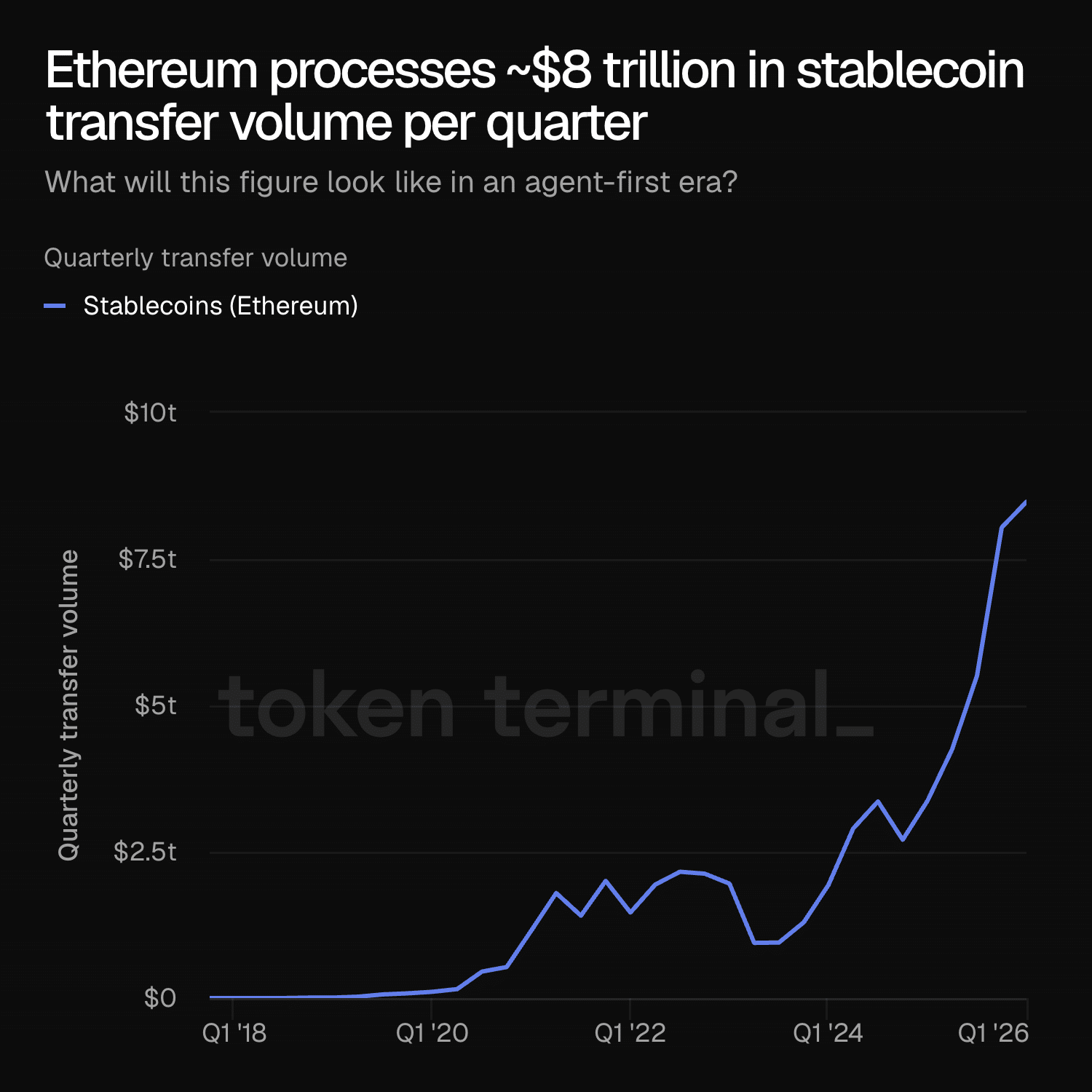
Source: Token Terminal

This growth matters because it sets the base for even higher activity, especially as AI-driven agents could execute millions of transactions daily. Such flows would increase demand for blockspace and settlement, strengthening Ethereum’s role in programmable finance.

However, value capture remained uneven. Fees stayed near $157,000 daily, while ETH issuance continued to outpace burns. This showed activity grew, but monetization lagged.

That imbalance left Ethereum’s outlook tied to converting demand into reliable value capture rather than just scaling usage.

Ethereum demand builds, but activity remains muted

Demand faced another test, as activity needed to translate into stronger on-chain movement. DeFi TVL held near $52.6 billion, while DEX volume reached about $548 million.

This gap showed capital remained within the system but lacked enough circulation to drive higher economic activity. Growth appeared stable but not accelerating.

Even so, Ethereum relied on rollups. Base fees hovered near 0.6 Gwei, allowing low-cost execution while shifting activity off mainnet.

That tradeoff improved access but reduced direct value capture. The market now depended on stronger capital rotation to lift fees and deepen activity.


Final Summary

  • Ethereum [ETH] secures growing institutional capital and high-value flows, yet weak fee generation shows value capture still lags behind expanding usage.
  • Ethereum now depends on stronger capital rotation, where increased activity must convert into higher fees and deeper on-chain engagement to sustain growth.
Disclaimer: The information on this page may have been obtained from third parties and does not necessarily reflect the views or opinions of KuCoin. This content is provided for general informational purposes only, without any representation or warranty of any kind, nor shall it be construed as financial or investment advice. KuCoin shall not be liable for any errors or omissions, or for any outcomes resulting from the use of this information. Investments in digital assets can be risky. Please carefully evaluate the risks of a product and your risk tolerance based on your own financial circumstances. For more information, please refer to our Terms of Use and Risk Disclosure.