




Summary
Ethereum is the second-largest cryptocurrency by market capitalization globally (approximately $250 billion as of March 2026) and has served as the foundational protocol of the crypto industry since its launch in 2015 as the first smart contract platform. It pioneered the decentralized finance (DeFi) ecosystem, ignited the NFT wave, and now supports over 60% of the value of tokenized real-world assets. Most investors first explored Ethereum during the 2017–2018 ICO boom. A decade later, the technology has undergone transformative changes—from transitioning from proof-of-work mining to proof-of-stake validation, and from 15 TPS to a roadmap targeting 10 million TPS—making a comprehensive reassessment not only necessary but essential.
This report presents the argument that “Ethereum: The One Chain to Rule Them All”—whether it’s institutional settlement of tokenized U.S. Treasuries, the demand from AI agent economies for trustless payment networks, the exploration of quantum-resistant infrastructure, or onboarding the next billion users, every path ultimately converges on Ethereum’s unique architecture. We will examine its technical roadmap (“Strawmap”), analyze the blockchain trilemma and how Ethereum resolves the challenges of scalability, decentralization, and security, evaluate ETH’s advantages, and explore the upcoming hard forks in 2026 that will deliver the first functional components toward this ultimate vision.
Breaking the blockchain trilemma
The blockchain trilemma (first proposed by Ethereum co-founder Vitalik Buterin) describes an engineering constraint: no single blockchain can simultaneously maximize scalability (high throughput), decentralization (low barrier to entry for validators), and security (resistance to attacks and censorship). Historically, blockchains have had to sacrifice one dimension to excel in the other two. Bitcoin prioritizes security and decentralization but has a throughput limit of approximately 7 TPS. Solana prioritizes scalability and speed but requires validators to use industrial-grade hardware, leading to network centralization. For years, Ethereum appeared to occupy a middle ground—secure and decentralized—but its base layer was extremely slow, with only 15 to 30 TPS.
By 2026, Ethereum is no longer merely acknowledging the trilemma—it is actively dismantling it at its base layer. This breakthrough lies in zero-knowledge (ZK) cryptographic technology: instead of requiring every validator to re-execute every transaction (the historical bottleneck that forced blockchains to choose between throughput and decentralization), Ethereum’s roadmap offloads the heavy computation to specialized “provers” who generate concise mathematical validity proofs. Validators then need only verify these proofs in milliseconds using consumer-grade hardware. This single architectural shift unlocks massive layer-one network scalability (a native target of 10,000 TPS, with a full-ecosystem goal of 10 million TPS) without increasing hardware requirements for validators, thereby preserving decentralization. Combined with the strongest economic security of any smart contract platform (~$110 billion staked) and a zero-downtime record since 2015, Ethereum is simultaneously addressing all three dimensions of the trilemma at the protocol level. This is the core insight behind Ethereum’s recently formalized multi-year roadmap, “Strawmap.”
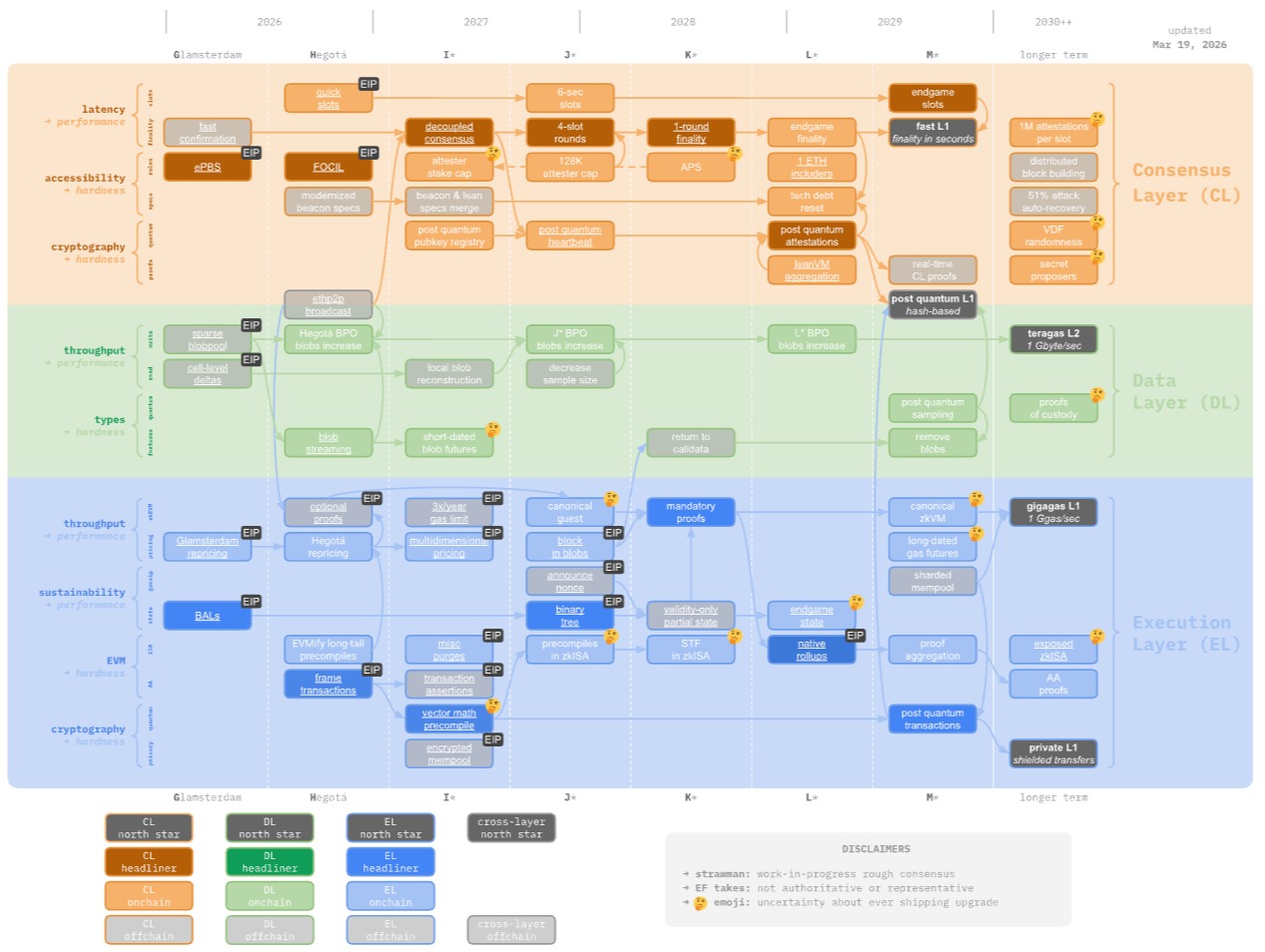
Strawmap
Strawmap: Ethereum's 2030 Blueprint
“Strawmap,” a portmanteau of “strawman” draft and “roadmap,” was introduced by Ethereum Foundation researcher Justin Drake in February 2026. It outlines approximately seven network upgrades (roughly every six months) through 2029, transitioning Ethereum from its experimental phase into what the foundation calls the “engineering era,” characterized by predictable, industrial-grade software delivery cycles akin to those of iOS or Android.
Strawmap established five "guiding missions" that define the ultimate architectural form of Ethereum:
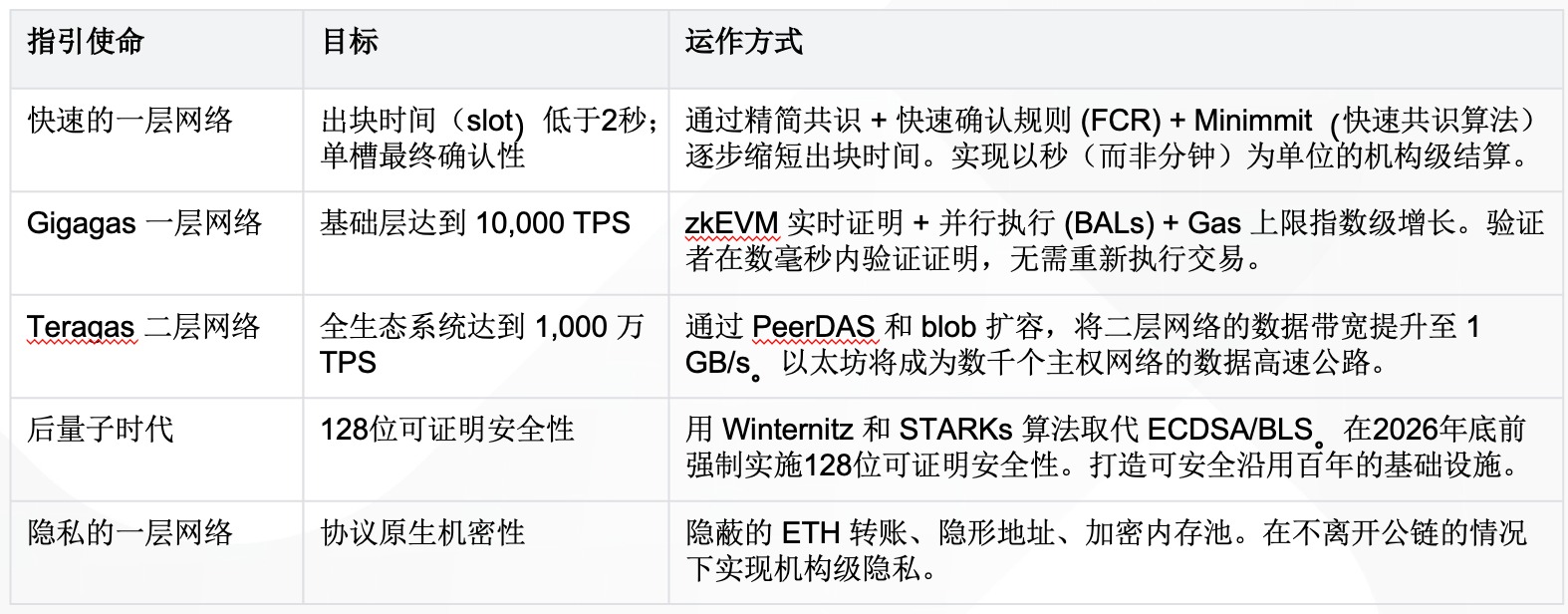
Strawmap’s upgrades are not random feature releases—they are deliberate steps toward building an extremely simplified final architecture. This “lean” philosophy is uniformly applied across three layers of the Ethereum tech stack: the consensus layer, the data availability layer, and the execution layer. In each case, the core principle is the same: leverage advanced cryptography (ZK proofs, erasure coding, data sampling) to shift heavy computational burdens off individual nodes, enabling exponential network scaling while keeping the base layer light enough to run on consumer-grade hardware. Think of Strawmap as a construction schedule, and these three lean initiatives as the blueprints for the finished building.
Pillar One: Simplifying Ethereum (Consensus Layer)
Today, Ethereum’s “Gasper” consensus requires around one million validators to each sign attestations within every 12-second block slot, creating massive signature aggregation overhead that limits the chain’s finality speed. Simplified Ethereum replaces this with a dramatically streamlined approach: a rotating committee of 256 to 1,024 validators that sign each block using Winternitz post-quantum hash-based signatures aggregated via STARKs, while the remaining validators provide economic security through staking without bearing the burden of signing every block. This enables progressive slot time reductions (12s → 8s → 4s → 2s) and single-slot finality. The result is faster settlement, quantum-resistant consensus, and a radically simplified codebase that encourages more diverse client implementations—reducing single points of failure and strengthening decentralization in the long term.
Second pillar: PeerDAS (Data Availability layer)
The Data Availability (DA) layer is tasked with providing massive, low-cost block space for Layer 2 networks. Under traditional architectures, every validator must download 100% of all Layer 2 “blob” data—a fundamentally unscalable requirement that directly ties data capacity to node hardware limitations. PeerDAS (Peer-to-Peer Data Availability Sampling, EIP-7594), the cornerstone of the Fusaka upgrade by end of 2025, solves this problem by applying erasure coding and peer-to-peer subnets: now, each node only needs to download a small fraction (about 1/8) of the blob data and, through probabilistic sampling, gains statistical certainty that the full dataset is available across the network. This effectively decouples data capacity from node hardware requirements. Ethereum can now multiply blob capacity, scaling from 6 blobs per block to 48 or more, with the ultimate goal of achieving 1 GB/s of data bandwidth, reducing Layer 2 transaction costs to fractions of a cent, and propelling the ecosystem toward the goal of 100,000+ TPS—all without forcing home stakers to purchase enterprise-grade hardware. This scalability is achieved by doing less work locally.
Third pillar: EOF and statelessness (execution layer)
The execution layer (the Ethereum Virtual Machine, or EVM) bears the heaviest technical debt. It suffers from “state bloat”—the requirement that nodes store the full history of Ethereum balances and smart contracts to verify new transactions—as well as a decade’s worth of opcodes and design compromises that make formal verification difficult. Two major cleanup initiatives aim to address this issue:
The EVM Object Format (EOF), set to be introduced in the Glamsterdam upgrade in the first half of 2026, is the most comprehensive rewrite of the EVM since Ethereum's inception. By strictly separating executable code from data, it eliminates legacy inefficiencies such as dynamic JUMP targets, restructures how smart contracts are written and executed, and makes it easier for compilers and AI agents to perform formal verification of smart contracts. By shedding years of EVM technical debt, EOF makes the execution layer faster, more secure, and cheaper to operate—essentially the execution-layer counterpart to the lean consensus work done at the validator level.
The "Stateless Path" permanently solves state bloat through two mechanisms. First, history expiration (EIP-4444) allows nodes to delete transaction history older than one year, immediately reducing storage requirements and shifting the burden of long-term archiving to dedicated archive nodes and portal networks. Second, ZK-verified state replaces the traditional Merkle-Patricia tree (and the previously planned Verkle tree) with a binary hash tree proven via STARKs, aligning with the direction of post-quantum cryptography. The Keccak-256 hash currently used in Merkle-Patricia trees will be replaced by Poseidon, an algebraic hash function friendly to ZK, which is eight times more efficient, reducing proof generation time from 16 minutes to under 10 seconds. The final form is radical: a fully stateless Ethereum, where nodes no longer need to store any state to validate blocks. They simply receive each block along with a compact zero-knowledge proof confirming its validity. The goal is to eventually enable smartphones and even smartwatches to run Ethereum nodes with full validation capabilities.
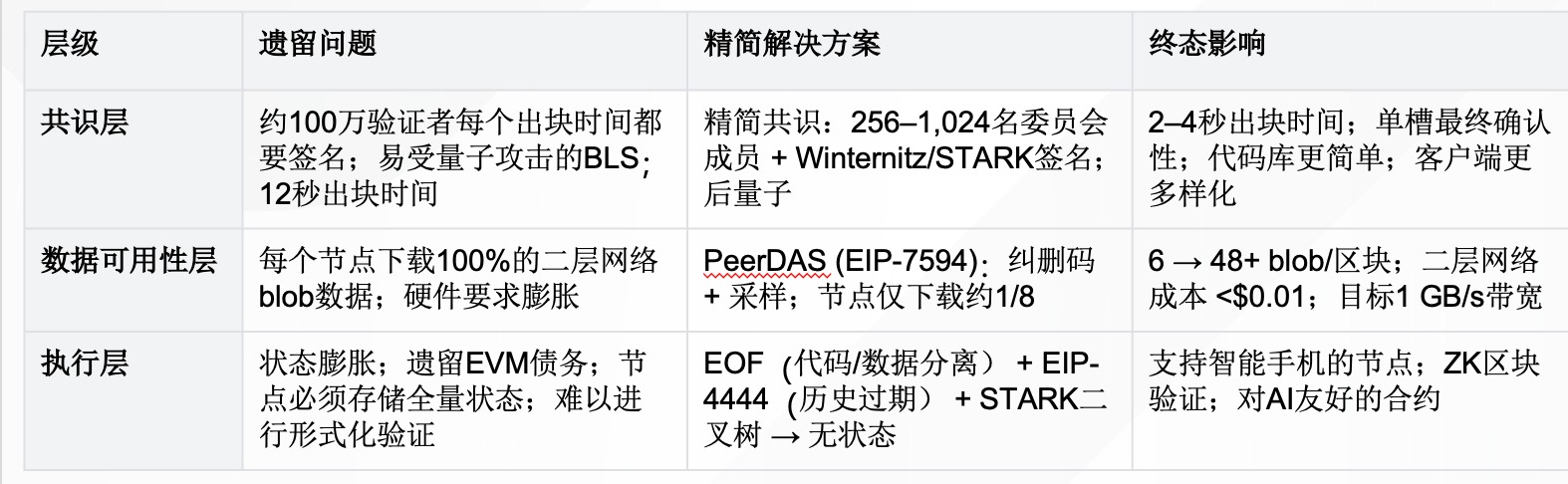
A unifying theme across these three pillars is cryptographic compression: leveraging advanced mathematics (ZK proofs, erasure coding, data sampling) to offload heavy computations from individual nodes. This delivers two critical guarantees. First, predictability: Strawmap’s biannual upgrade cadence provides institutions with a concrete timeline to plan multi-billion-dollar deployments. Second, a century-long security guarantee: when all three layers reach their streamlined final state, every cryptographic primitive—from consensus signatures to state proofs to data availability commitments—will carry 128-bit provable post-quantum security, while the base layer remains lightweight enough to run on consumer-grade hardware. The trilemma is not solved through compromise or delegation, but by engineering each dimension to its theoretical limit within a single, unified base layer.
Scalability: from 15 TPS to 10,000 TPS
Ethereum’s scalability strategy unfolds along two parallel fronts: actively scaling the base layer (Layer 1) itself and providing massive data throughput for a highly specialized Layer 2 ecosystem. This dual-pronged approach is precisely what structurally distinguishes Ethereum from its monolithic chain competitors.
Expand one layer of the network: The path to Gigagas
The Ethereum mainnet currently handles approximately 15 to 35 TPS. Strawmap aims to build a native "Gigagas Layer 1 network" supporting 10,000 TPS. This 300- to 600-fold improvement will be achieved through three consecutive engineering phases:
Phase 1: Parallelization and Gas Cap Expansion (2026). In 2025, Ethereum’s block gas limit doubled from 30 million to 60 million, tripling network throughput. This 60-million-gas cap was determined through extensive benchmarking while maintaining a small chain size to enable independent node operators to verify and download the chain. Currently, Ethereum processes transactions sequentially—one at a time. The EIP-7928 (Block-Level Access Lists), to be introduced in the Glamsterdam upgrade, requires transactions to pre-declare which state elements they will access. This allows execution clients to safely assign non-conflicting transactions simultaneously to multiple CPU cores, transforming Ethereum from a single-lane road into a multi-lane highway. Combined with EIP-7732 (Built-in Proposer-Builder Separation, which decouples block building from consensus and extends validators’ processing window from ~2 seconds to ~9 seconds), the network can safely utilize a larger proportion of each 12-second block time for computation.
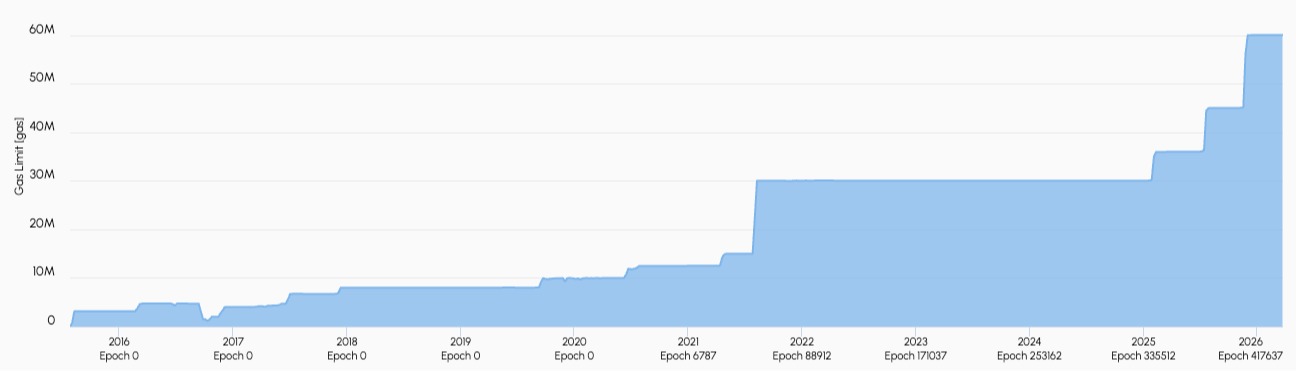
Ethereum block gas limit
In addition, the Fast Confirmation Rule (FCR) is expected to be deployed in mid-2026 (currently available for testing). FCR significantly reduces transaction finality time from approximately 12 minutes to 12 seconds by leveraging proofs from the vast majority of validators in real time. Since FCR is a “soft” consensus change that does not require a hard fork, independent nodes and exchanges can begin adopting it immediately after their chosen client software releases an update.
Phase Two: Multidimensional Gas Pricing (2026–2027). Today, the EVM prices all operations—whether executing mathematical functions or creating permanent new state—with a single "Gas" metric. Ethereum is introducing separate pricing for "state creation Gas" and "execution Gas." Writing new permanent data will become extremely expensive, while raw computation will become extremely cheap. This economic separation enables EIP-7938 to safely increase the Gas limit by 100 times over four years without causing blockchain state database bloat.
Phase Three: zkEVM’s “Killer App” (2026–2029). The ultimate scaling solution involves transitioning to a “fully SNARKed Ethereum.” Heavy computations are no longer re-executed by every node for each transaction; instead, they are offloaded to specialized “provers” that generate concise zero-knowledge validity proofs. Verifiers need only validate these proofs in a few milliseconds. On target commercial hardware (around $100,000), proof generation time has dropped from 16 minutes per block to under 10 seconds.
To maximize proof efficiency in the long term, the research community believes the traditional EVM should be replaced with RISC-V, an open-source instruction set already used internally by ZK provers to compile EVM code down. Eliminating this intermediate step can yield 50 to 100 times greater efficiency and significantly simplify the execution client codebase.
Layer 2 networks: From general-purpose to specialized
The Ethereum Layer 2 ecosystem roadmap for 2026 represents a profound transformation: shifting from the past five years’ “Layer 2-centric” vision to a “Full Spectrum” architecture. The proliferation of general-purpose Layer 2s has triggered a liquidity fragmentation crisis: over $40 billion is dispersed across more than 55 incompatible chains, degrading user experience, introducing security vulnerabilities through cross-chain bridges, and failing to deliver unique value propositions. Meanwhile, Layer 1 itself is actively scaling, rendering general-purpose Layer 2s increasingly obsolete.
Looking ahead, layer-2 networks must evolve into highly specialized environments that deliver unique user experiences not natively possible on Ethereum’s layer one:
- Optimized for specific applications or non-EVM execution environments, such as decentralized social media or gaming.
- A ultra-low-latency chain that provides sub-millisecond pre-confirmations for AI agents at near-zero cost, or internalizes MEV generated by high-frequency trading platform order books.
- The institutional chain can use STARK proofs submitted to the Ethereum Layer 1 network to mathematically guarantee algorithmic transparency (inheriting Layer 1 security), while retaining centralized control over its internal rules.
- A privacy-focused layer-2 network providing a confidential execution environment.
- Native Layer 2: Layer 2 developers will be able to build “EVM with additional features” using the built-in zkEVM precompile on the base layer, inheriting the exact same security as Ethereum and automatically upgrading alongside Layer 1, without relying on risky cross-chain bridge multisigs.
To unify this diverse ecosystem, the entire industry is actively deploying the Ethereum Interoperability Layer (EIL) in 2026. The EIL functions like HTTP did for the early internet; by leveraging account abstraction (ERC-4337) and cross-chain intent (ERC-7683, co-developed by Uniswap and Across), wallets will abstract away the complexity of managing assets across dozens of layer-2 networks. Users will be able to seamlessly execute cross-chain swaps or minting with a single click, making the fragmented layer-2 landscape “feel like one chain” again—without forcing users to trust third-party cross-chain bridge operators.
Decentralized: An Impenetrable Moat
Decentralization for Ethereum is far more than an ideological talking point—it is the fundamental economic moat that elevates it from a high-throughput utility token to a sovereign, institutional-grade reserve asset. It ensures censorship resistance, which in turn guarantees the neutrality required to settle trillions of dollars, protecting it from the risks of national-level intervention or corporate control.
Ethereum vs. Competitors: An Unbridgeable Gap
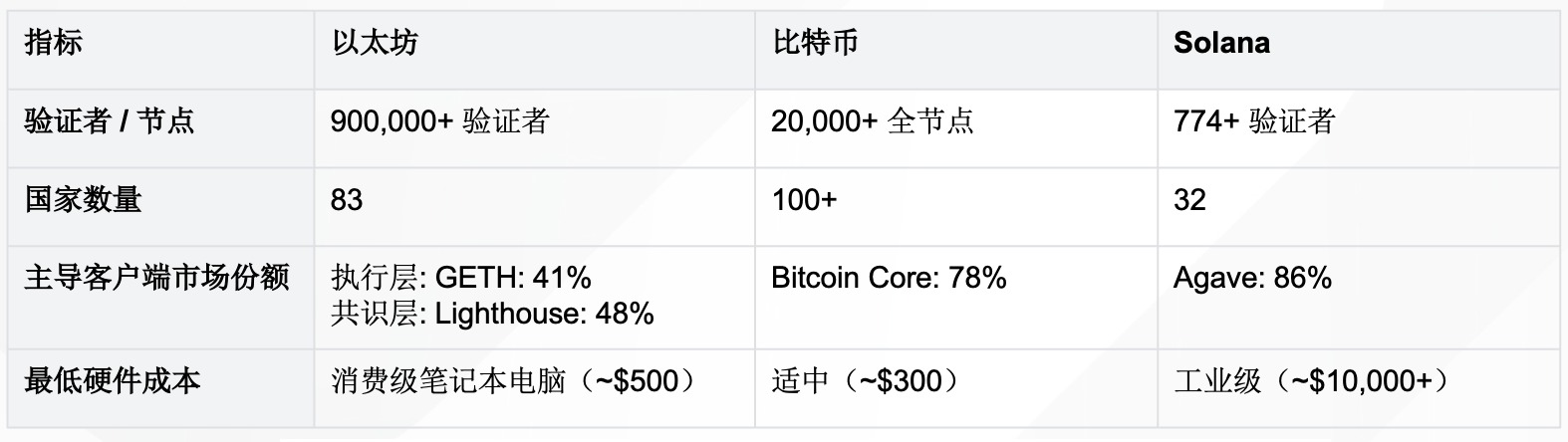
No other Layer 1 blockchain comes close to Ethereum’s level of decentralization. Ethereum runs nearly one million active validators spread across 83 countries, with over five independent execution clients (Geth, Nethermind, Besu, Reth, Erigon) and over five consensus clients (Lighthouse, Teku, Lodestar, Nimbus, Grandine)—plus several new “lightweight” clients under development. This multi-client approach ensures that a bug in any single software implementation cannot bring down the entire network. Since its launch in 2015, the Ethereum mainnet has never experienced an outage.
In contrast, Solana operates approximately 774 validators across 32 countries and has historically relied on a single primary client (Agave, formerly Solana Labs), with its alternative client, Firedancer, only recently entering production. Solana validators require industrial-grade hardware costing over $10,000, effectively excluding home stakers and leading to network centralization. Bitcoin runs over 20,000 full nodes and also relies predominantly on a single software implementation.
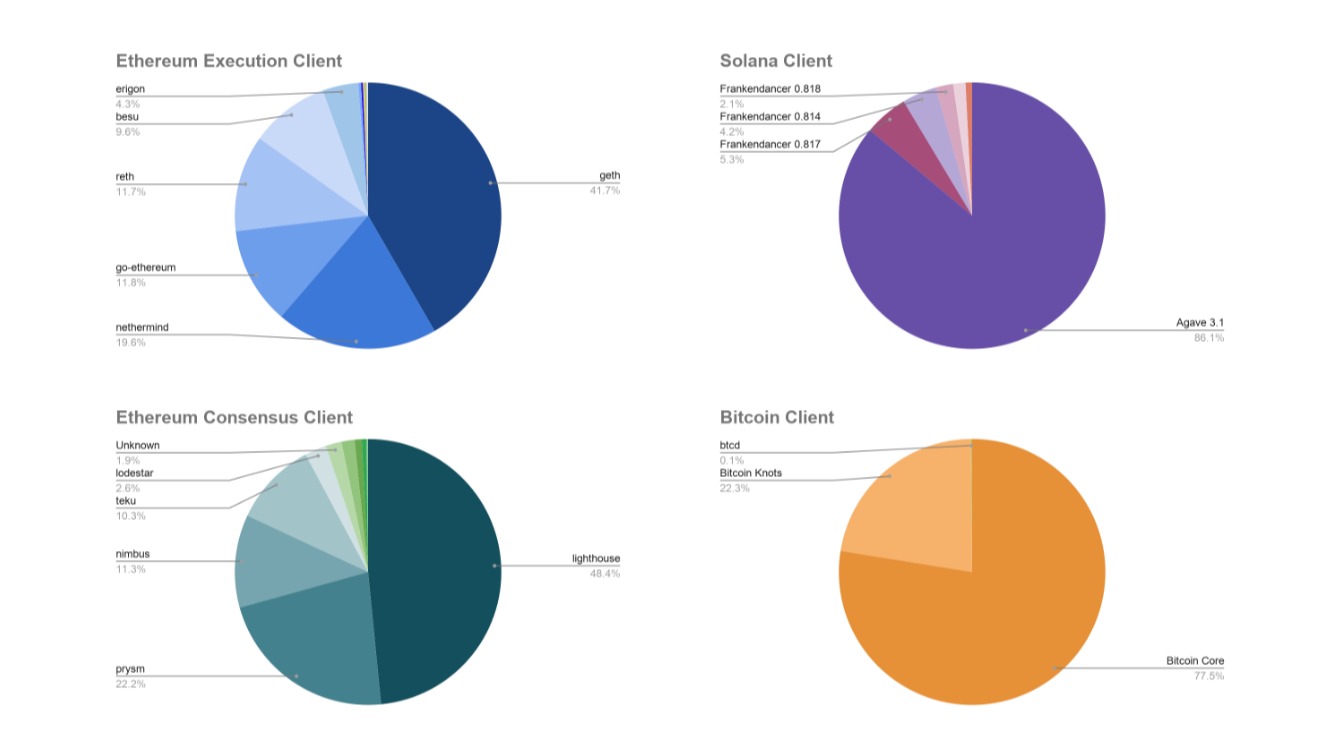
Market share of Ethereum, Bitcoin, and Solana clients
Decentralized architecture ensures
Ethereum’s roadmap actively protects decentralization through several mechanisms. The Verge phase enables a transition from the heavy Merkle Patricia Trees to the efficient binary state tree (EIP-7864), allowing "stateless clients" to verify the blockchain using ZK proofs without storing the entire state database. The Purge phase eliminates the requirement for nodes to store historical data older than one year. By significantly reducing storage bloat, the network can accommodate faster state growth from higher gas limits without forcing node operators to use expensive hardware. PeerDAS allows nodes to verify massive amounts of Layer 2 data blobs by sampling tiny cryptographic fragments instead of downloading everything. Together, these mechanisms ensure that even with a 100x increase in throughput, Ethereum’s base layer remains verifiable on consumer-grade hardware.
In terms of MEV, the protocol-native proposer-builder separation (ePBS) brings the block builder market inside the protocol, eliminating reliance on trusted third-party relays. Fork Choice Forced Inclusion List (FOCIL / EIP-7805) goes further: a randomly selected committee of validators can mandate that specific transactions be included in every block. Even if malicious actors control 100% of the block building market, they cannot censor transactions. This combination ensures Ethereum’s “neutrality” at the protocol level—a feature unmatched by any other network layer.
Distributed Validator Technology (DVT), through projects like Obol and SSV Network, enables a single validator key to be split across a set of independent, geographically distributed nodes. This empowers home stakers and reduces the risk of regulators targeting centralized staking service providers. The recent MaxEB upgrade (EIP-7251) increases the maximum validator balance limit from 32 ETH to 2,048 ETH, further safeguarding network health by reducing signature bloat and peer-to-peer network overhead, allowing the system to absorb institutional capital without overwhelming smaller home nodes.
Security: Preparing for the Post-Quantum Era
Ethereum's security posture far exceeds its approximately $83 billion staked economic security. The network is executing the most comprehensive post-quantum cryptography transition of any blockchain, addressing a survival threat, while its largest competitor, Bitcoin, remains structurally unprepared to meet this threat.
The four pillars of Ethereum's post-quantum architecture
Ethereum’s quantum roadmap targets the four most vulnerable areas to quantum attacks: consensus layer signatures (replacing BLS with hash-based Winternitz signatures aggregated via STARKs), data availability (shifting from quantum-vulnerable KZG commitments to STARK-based proofs), user account signatures (enabling post-quantum key exchange via account abstraction/EIP-8141), and zero-knowledge proofs (transitioning from elliptic curve SNARKs to quantum-safe STARKs with recursive proof aggregation). By the end of 2026, any ZK proof system on Layer 1 must guarantee 128-bit provable security, eliminating reliance on unproven mathematical conjectures.
A critical and often overlooked urgent issue is the threat of “harvest now, decrypt later” (HNDL). Unlike signature forgery, which can be remedied by an emergency hard fork, privacy leaks are irreversible. Adversaries can collect encrypted on-chain data today and decrypt it once quantum computers become available. Every disclosed stealth address, every encrypted compliance credential, and every viewing key becomes a permanent target. Ethereum’s roadmap requires all new confidentiality protocols to immediately adopt post-quantum key exchange (ML-KEM) to prevent the accumulation of massive “privacy troves.”
Proactive cryptographic upgrade
As the timeline for quantum computing advances, the crypto industry faces the urgent need to secure traditional cryptographic architectures against sufficiently powerful systems capable of running Shor’s algorithm. Within the broader cryptocurrency ecosystem, vast amounts of digital assets are secured by static public keys, which are theoretically vulnerable to future quantum capabilities. Addressing this issue requires robust and forward-looking architectural solutions that preserve network consensus and protect fundamental property rights.
Ethereum addresses this imminent cryptographic challenge with a framework that has structural advantages: account abstraction. By leveraging Frame Transactions, Ethereum effectively transforms standard wallets into flexible, programmable smart contracts. This enables seamless switching of signature schemes at the individual account level.
Institutions and individual users can proactively migrate their vault wallets rather than waiting for a globally coordinated layer-one network upgrade, which may be technically complex and politically contentious in a decentralized system. They can upgrade to quantum-resistant standards, such as lattice-based or hash-based cryptography, on their own timelines. This “Ship of Theseus” approach provides unparalleled user-level flexibility, ensuring the network can dynamically adapt to the quantum era without requiring disruptive, all-or-nothing cryptographic upgrades.
Sustainable security budget in mature markets
Beyond cryptographic resilience, a core structural challenge facing any digital asset network valued in the trillions of dollars is the long-term sustainability of its security budget. Across the industry, early network security has often been heavily subsidized by inflationary block rewards. However, as block subsidies programmatically decrease over time—particularly in PoW consensus—the network must find ways to ensure that economic incentives for securing the blockchain remain robust, even as transaction fee revenue fluctuates.
Ethereum’s PoS consensus mechanism provides a sustainable, long-term solution to the security budget equation. Instead of relying on external, energy-intensive resource expenditures that require continuous high levels of inflation to subsidize, Ethereum compensates its validators through a balanced, self-reinforcing economic cycle.
The network maintains a low block reward issuance rate (approximately 2.5% annually), and its unique fee burning mechanism offsets this issuance. This dynamic results in a net annual inflation rate of approximately 0.8%, a notably efficient rate when compared to other smart contract platforms such as Solana, which has an annual inflation rate of about 3.94%. Additionally, MEV and standard transaction fees further supplement validator rewards.
Because Ethereum’s security scales proportionally with the intrinsic value of the staked ETH, rather than relying on depreciating external subsidies, it creates strong security guarantees. As the network and its native asset become more valuable, the capital required to attack the network naturally becomes more prohibitive, ensuring long-term structural economic stability.
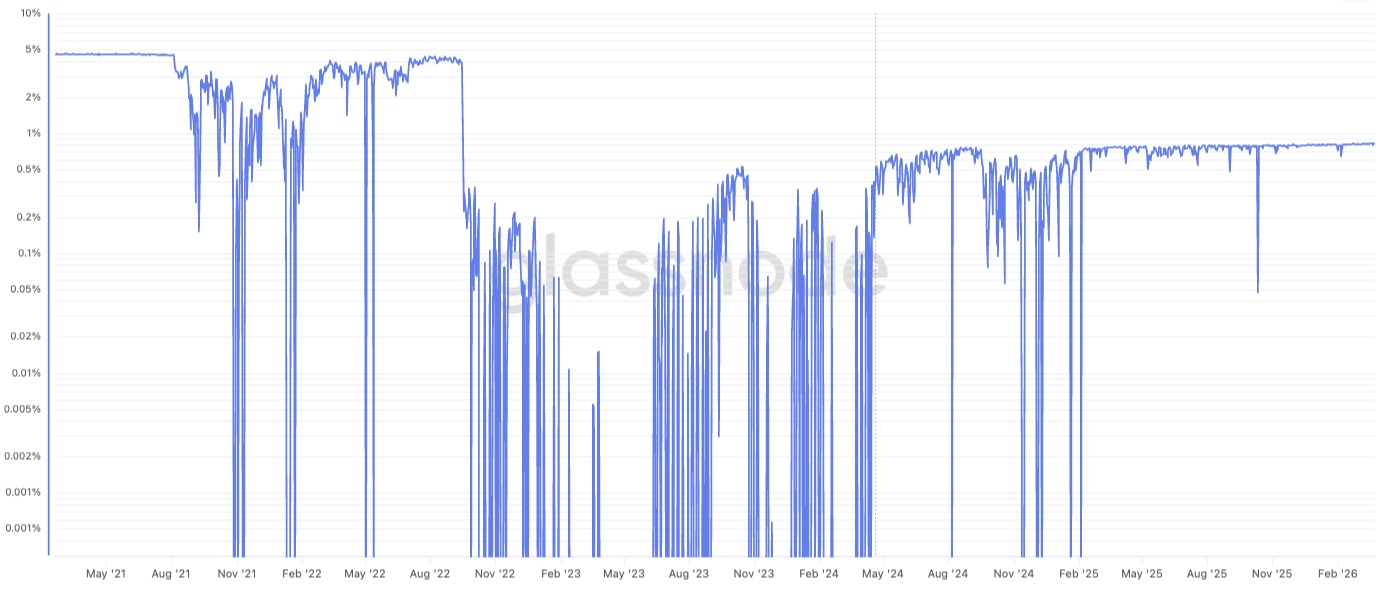
Ethereum inflation rate (0 or below cannot be displayed on a logarithmic scale)
Privacy: Transforming the public ledger into a digital sanctuary
The Ethereum Foundation has restructured its cryptography team into the Privacy & Scaling Explorations group (PSE), adopting a "Defipunk" mission: privacy must be an unconditional default, not an optional add-on. This North Star goal of a "layer for privacy" consists of three pillars:
- Private Write (Confidential Execution): Protocol-native confidential ETH transfers using stealth addresses (ERC-5564) that generate one-time, cryptographically unlinkable recipient addresses, alongside research into fully homomorphic encryption (FHE) enabling smart contracts to compute on encrypted data.
- Private Reading (Anti-Monitoring): Private Information Retrieval (PIR) and Oblivious RAM enable institutions to query the Ethereum state without the RPC server knowing which data was requested, completely eliminating metadata leakage.
- Private Proof (Client-Side Verification): Optimizes ZK proof generation for local devices, supporting zkTLS (privately proving off-chain network data on-chain) and zkID (unlinkable digital identity proofs).
The Lucid encrypted mempool seals transaction details until they are irreversibly locked into blocks, structurally eliminating toxic MEV such as front-running and sandwich attacks. For institutions managing trillions of dollars, the ability to execute compliant, selectively disclosed, and fully confidential RWA transfers on a public network is a mandatory prerequisite for deployment. Ethereum is the only major smart contract blockchain that treats this as a first-class protocol feature.
Institutional entry: The migration of real-world assets to Ethereum
By early 2026, the on-chain tokenized RWA market surpassed $20 billion, quadrupling from $5 billion at the beginning of 2025. U.S. Treasuries alone accounted for $10 billion, led by BlackRock’s BUIDL fund ($2.6 billion AUM), Ondo Finance, and Franklin Templeton’s FOBXX. McKinsey forecasts that by 2030, the broader tokenized RWA market could reach $2 trillion, with some estimates as high as $16 trillion. By value, nearly 60% of all tokenized RWAs are anchored on Ethereum.
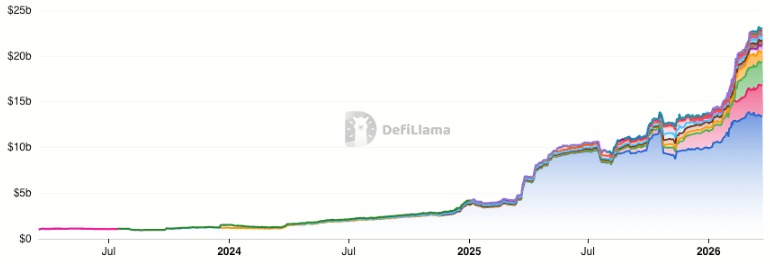
Total RWA tokenization market cap: Ethereum (blue)
For institutions, the choice of settlement layer is a matter of survival. They require censorship resistance (no government can arbitrarily freeze or seize tokenized assets), quantum-resistant security (to protect trillions in assets over the coming decades), compliance interfaces (the uRWA standard, ERC-7943, directly embeds legal enforcement primitives like forceTransfer and setFrozen into token contracts), privacy (LUCID encrypted mempool and stealth addresses prevent front-running of large institutional trades), and fast settlement (rapid confirmation rules). No other blockchain currently meets all five of these requirements simultaneously.
Major pilot projects are now live. Project Guardian, a collaboration between the Monetary Authority of Singapore, UBS, and SBI Digital Markets, is testing institutional-grade DeFi on Ethereum. By integrating with Swift and Euroclear, banks can use their existing Swift messaging infrastructure to send instructions to Ethereum smart contracts, enabling atomic cross-chain settlement of tokenized funds. JPMorgan’s Onyx has already processed over $900 billion in tokenized repurchase transactions. In short, when it comes to introducing high-value tokenized RWAs, Ethereum is the undisputed choice.
AI Agent Economy: Stablecoins as the轨道, Ethereum as the foundation
The integration of AI and blockchain is creating a new economic paradigm: autonomous machine-to-machine commerce. McKinsey predicts that by 2030, AI agents could facilitate $3 to $5 trillion in global consumer commerce, with the overall AI agent market projected to reach $236 billion by 2034. Ethereum is positioning itself as the economic coordination layer for this revolution—not by competing on raw speed, but by providing the trust infrastructure required by autonomous agents.
Its technological foundation lies in the transition from traditional accounts to intelligent "agent wallets." Through ERC-4337 account abstraction and the ERC-7579 modular smart account standard, AI agents can operate independently, with gas fees abstracted by paymasters and programmatic spending limits enforced via session keys—all without exposing the primary private key. The Ethereum Foundation’s newly established "dAI" department is leading this effort, with Ethereum co-founder Vitalik envisioning an economic layer where "robots can hire robots," manage security deposits, and conduct trustless transactions via ZK payments.
Two key standards have emerged. ERC-8004 (Trustless Agents) introduces an on-chain identity registry (based on ERC-721), complemented by reputation and verification registries where an agent’s capabilities are verified through stake-guaranteed re-execution, TEEs, or zkML proofs. As of January 2026, over 150,000 agent identities have been minted under this standard. ERC-8183 (Agent Commerce, developed jointly by Virtuals and the Ethereum Foundation) establishes an on-chain work escrow system: client agents hire provider agents, funds are locked in escrow, and upon submission of work, evaluators (which can be AI, ZK verifiers, or DAOs) confirm or reject it before releasing payment.
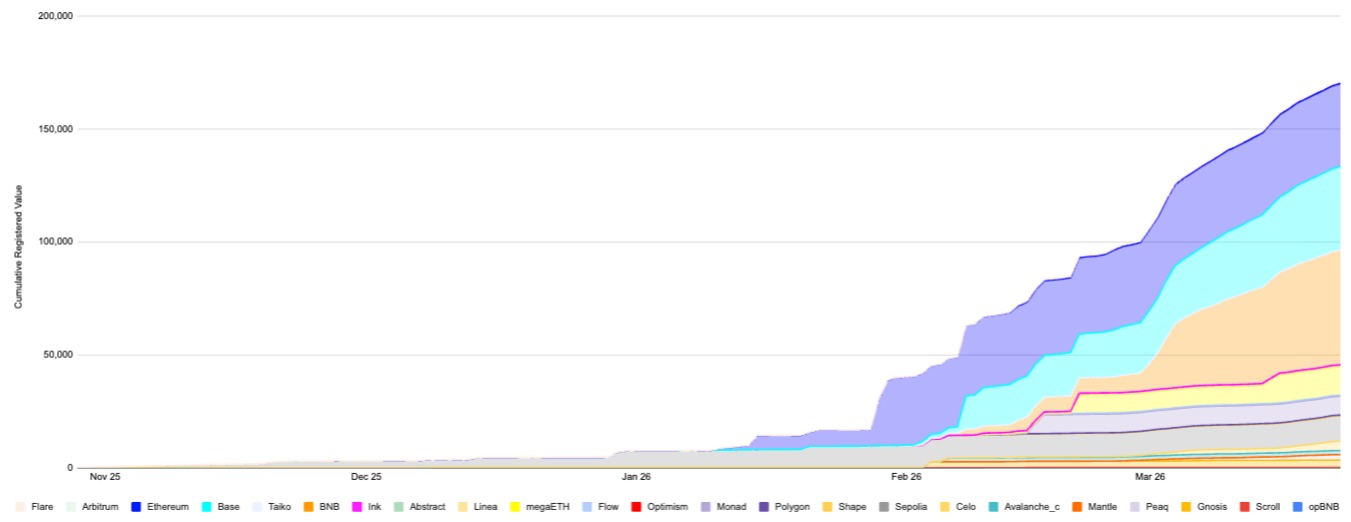
ERC-8004: Cumulative Registrations
Agent Payment Rail: The "Payment War" of 2026
Stablecoins are the core payment rail for AI agents, whereas traditional card rails have a per-transaction cost of approximately $0.0195 to $0.50, which structurally hinders the thousands of microtransactions agents require per hour. The x402 protocol embeds stablecoin payments directly into HTTP requests: when an agent encounters a paywall, the server returns an HTTP 402 status code, and the agent’s wallet automatically pays using stablecoins, then retries the request with the payment information attached. Over 20 million machine-to-machine transactions have already been completed via x402. The x402 protocol itself is free (service providers may charge fees at their hosting layer), and users typically pay only network settlement fees—approximately $0.0001 on high-performance Layer 2 networks like Base. Stripe’s Machine Payment Protocol (MPP), launched via Tempo, introduces session-based streaming micropayments. Google’s Universal Commerce Protocol (UCP) covers the full checkout flow. OpenAI’s Agent Commerce Protocol (ACP) enables in-chat purchases. Visa’s Trusted Agent Protocol provides cryptographic authentication for transactions between agents and merchants.
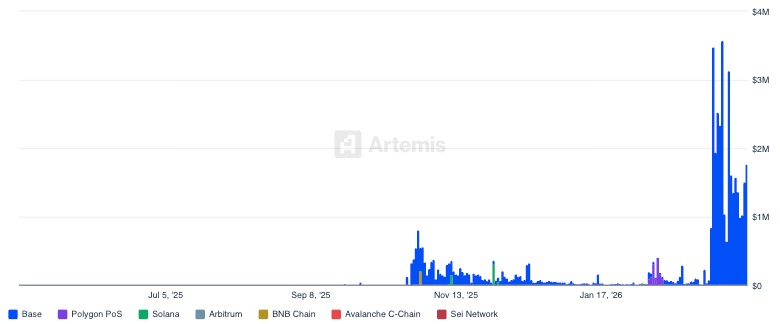
Real x402 trading volume
All these pathways ultimately converge on stablecoins, with Ethereum hosting over 52% of the global stablecoin market (approximately $164 billion). As the AI agent economy expands, the volume of stablecoins flowing through Ethereum’s infrastructure further compounds ETH’s value as a secure anchor for this new economy. The upcoming account abstraction upgrade (EIP-8141) and interoperability layer (EIL) are specifically designed to make Ethereum the frictionless settlement backbone for autonomous commerce.
The 2026 hard fork: Glamsterdam and Hegotá
The first two deliverables from Strawmap will arrive in 2026 as back-to-back network upgrades, each addressing a distinct but complementary goal.
Glamsterdam (first half of 2026)
- EIP-7732 (Protocol-Embedded Proposer-Builder Separation / ePBS): Moves the block builder market directly into the protocol, eliminating reliance on trusted third-party relays. Decouples consensus from execution, extending the validator processing window from approximately 2 seconds to about 9 seconds. Creates a transparent, trustless MEV market. This is an architectural prerequisite for securely increasing the gas limit.
- EIP-7928 (Block-Level Access Lists / BALs): Enables parallel transaction execution by requiring transactions to declare in advance which state elements they access. Transforms Ethereum from sequential to multi-core execution. Directly advances the goal of achieving a "Gigagas Layer 1" network.
- EIP-8037 (Multidimensional Gas Pricing) (under discussion): Begin separating state creation costs from execution costs, making computation extremely cheap while preventing state bloat.
Hegotá (second half of 2026)
- EIP-8141 (Framework Transactions / Native Account Abstraction): Transform all wallets into flexible smart contracts at the native level. Enables social recovery (eliminating seed phrases), gas sponsorship (paying fees with stablecoins), transaction batching, and—critically—provides a mandatory exit path from traditional ECDSA to post-quantum signature schemes. This is the most significant user-facing upgrade in Ethereum’s history.
- EIP-7805 (FOCIL / Fork Choice Mandatory Inclusion List): Authorizes a committee of validators to require that specific transactions be included in every block, removing the ability of malicious or compliant builders to censor transactions. Even if the builder market reaches 100% concentration, no transaction can be excluded.
- EIP-8184 (LUCID Encrypted Mempool) has been rejected: Core developers commented, "This hard fork came too early." It cryptographically seals pending transactions until they are irreversibly committed to a block, eliminating toxic MEV. Institutions can safely broadcast large trades without exposing their strategies.
- EIP-7807 (SSZ Execution Blocks) has been rejected: Core developers believe SSZ can be rolled out by updating the Engine API on nodes, rather than implementing a full network hard fork. This is a unified binary format that replaces JSON and RLP, reducing data transmission latency by 50%, enabling independent block hash verification, and making it much easier to check specific data without downloading the entire blockchain.
Conclusion: The CROPS Mission and Ethereum's Endgame
The Ethereum Foundation has recently formalized its ideological and technical boundaries through the EF mission, solidifying the CROPS framework as the non-negotiable foundation for all protocol development: censorship resistance, open source, privacy, and security. Every upgrade, every EIP, and every roadmap decision must fundamentally uphold these four attributes. The Foundation has adopted a “less is more” philosophy and is planning its own graceful exit; its ultimate measure of success is the “handoff test”: if the Ethereum Foundation were to dissolve tomorrow, the protocol must be able to continue running and evolving perfectly without it.
This philosophy is highly controversial. Critics argue that it prioritizes ideological purity over commercial pragmatism, disregarding price trends and market sentiment. However, for institutional capital allocating billions of dollars into long-duration assets, CROPS is an essential guarantee. It means no government can force Ethereum to censor transactions. No corporation can control the protocol. No quantum computer can break its cryptography. No single entity can shut it down. It is precisely the “digital sanctuary” that traditional finance needs to migrate trillions of assets on-chain.
The investment thesis for Ethereum is also very straightforward. Ethereum simultaneously embodies multiple roles: it is the most decentralized smart contract platform today (with over 1 million validators, 10 clients, and zero downtime); it is the blockchain most prepared for the quantum era (mandating 128-bit security by end of 2026 and enabling user-level migration through account abstraction); it is the settlement layer dominated by institutional assets (with $164 billion in stablecoins, over 60% of RWA share, and integrations with BlackRock, JPMorgan, and Swift); it is the coordination layer for the emerging AI agent economy (ERC-8004, ERC-8183, x402, stablecoin rails); and it is the only blockchain actively executing a path from 15 TPS to 10 million TPS without compromising any of the above characteristics.
All chains converge on Ethereum.