




Author: Zhou, ChainCatcher
Many people believe that crypto VCs are heading toward twilight.
Over the past decade, crypto VCs have been highly homogenized—clustering in the same sectors, telling the same stories, and competing for the same projects. Seemingly vibrant, the industry is in fact fragile beneath the surface.
But what’s happening right now may be one of the most exciting moments since the industry’s inception, as the market has for the first time truly begun to diverge.
By the end of February 2026, two funding announcements appeared in succession.
On one side, Dragonfly Capital has completed fundraising for its fourth fund, raising 6.5 billion dollars, with a focus on stablecoins, on-chain financial infrastructure, and the tokenization of real-world assets.
On the other side, Paradigm is seeking up to 15 billion dollars in funding for its new fund, with investments expanding from cryptocurrency to cutting-edge technologies such as AI and robotics.
As top-tier venture capital firms in the crypto industry, both operating through the same downturn cycle, why have they taken such different paths?
If we also consider a16z Crypto, the situation becomes more interesting, as the firm is currently raising $2 billion for its fifth fund.
These three funds represent three distinctly different responses from today’s crypto VC firms to the industry’s challenges.
Watch: The long-cycle logic of a16z Crypto
In the cryptocurrency venture capital fundraising landscape, a16z Crypto has long held a top position. This is the dedicated crypto investment fund line under Andreessen Horowitz (a16z), which has completed four funding rounds since 2013, raising over 7.6 billion dollars in total—making it one of the largest cryptocurrency funds globally.
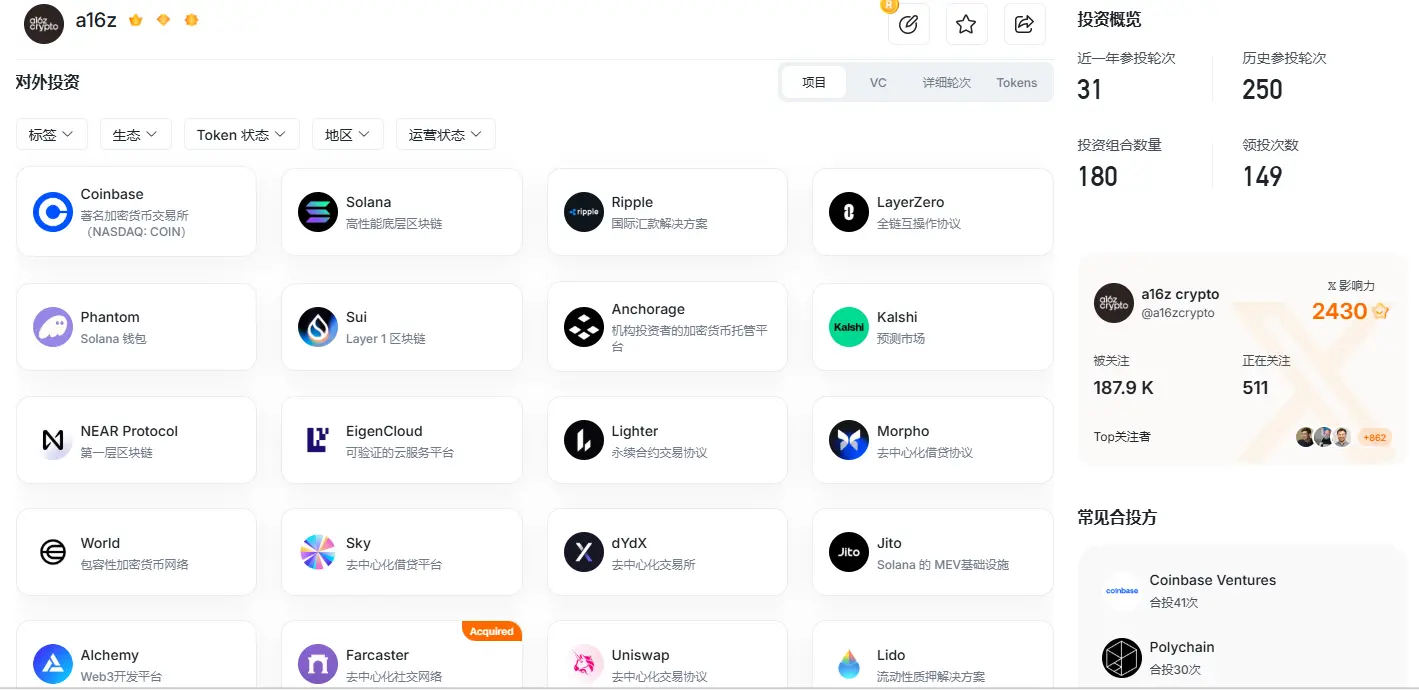
At the beginning of this year, a16z completed a new funding round of 15 billion dollars, spanning infrastructure, application layers, and growth funds, with the intersection of AI and crypto identified as a key investment focus.
According to Fortune magazine, a16z Crypto is raising its fifth fund with a target of approximately $2 billion and plans to complete the fundraising by the first half of 2026.
a16z Crypto partner Chris Dixon views blockchain as the next foundational infrastructure of the internet, believing the crypto industry is currently in a prolonged "foundation phase", much like the 1943 neural network paper was to today’s AI—true mainstream adoption requires decades of groundwork.
Dixon has publicly stated that a16z Crypto has held onto 95% of its historical investments, because in venture capital, selling high-quality assets too early is the worst possible decision.
The team’s annual report on the cryptocurrency industry each year sends a consistent message to investors: even in a低迷 market, we remain deeply committed to understanding what is truly happening in this space.
The investors targeted by a16z Crypto are the long-term institutional capital and established players with deep faith in the entire industry.
For them, as long as they still believe in the future of crypto, a16z Crypto is a natural choice.
Evolution: The Financialization of Dragonfly
Dragonfly was founded in 2018 as an early-stage crypto VC connecting Asian and U.S. markets. Its first fund raised just 1 billion dollars, with its core competitive advantage at the time being the co-founders’ geographic arbitrage across both the U.S. and Chinese markets.
Since 2019, Dragonfly has gradually expanded into the secondary market, beginning to manage liquidity funds and establishing its own trading team. It serves not only as a risk hedging tool but also provides real-time market data to support primary market investments, offering an auxiliary perspective for evaluating projects.
In 2022, Dragonfly acquired Metastable, the crypto hedge fund co-founded by Naval Ravikant in 2014, bringing it under its umbrella and establishing three parallel business lines: Dragonfly Ventures (early-stage investments), Dragonfly Liquid (liquidity strategies), and Metastable (hedge fund).
The judgment of a Tier 1 VC, combined with trading capabilities in the secondary market, is the core differentiator between Dragonfly and pure primary-stage crypto funds.
But establishing this system did not happen overnight. Building an investment system spanning both primary and secondary markets means creating two entirely different frameworks for decision-making, risk management, and talent structure—primary requires deep technical judgment for early-stage projects, while secondary demands precise quantitative capabilities in market microstructure.
Dragonfly previously listed job openings that explicitly required candidates to possess professional skills such as delta-neutral hedging and derivatives inventory risk management. Such talent is already scarce in the crypto industry, and recruiting from traditional financial institutions also requires a lengthy adaptation period.
This trading system is the barrier built up over many years by Dragonfly and the hardest aspect for other funds to directly replicate.
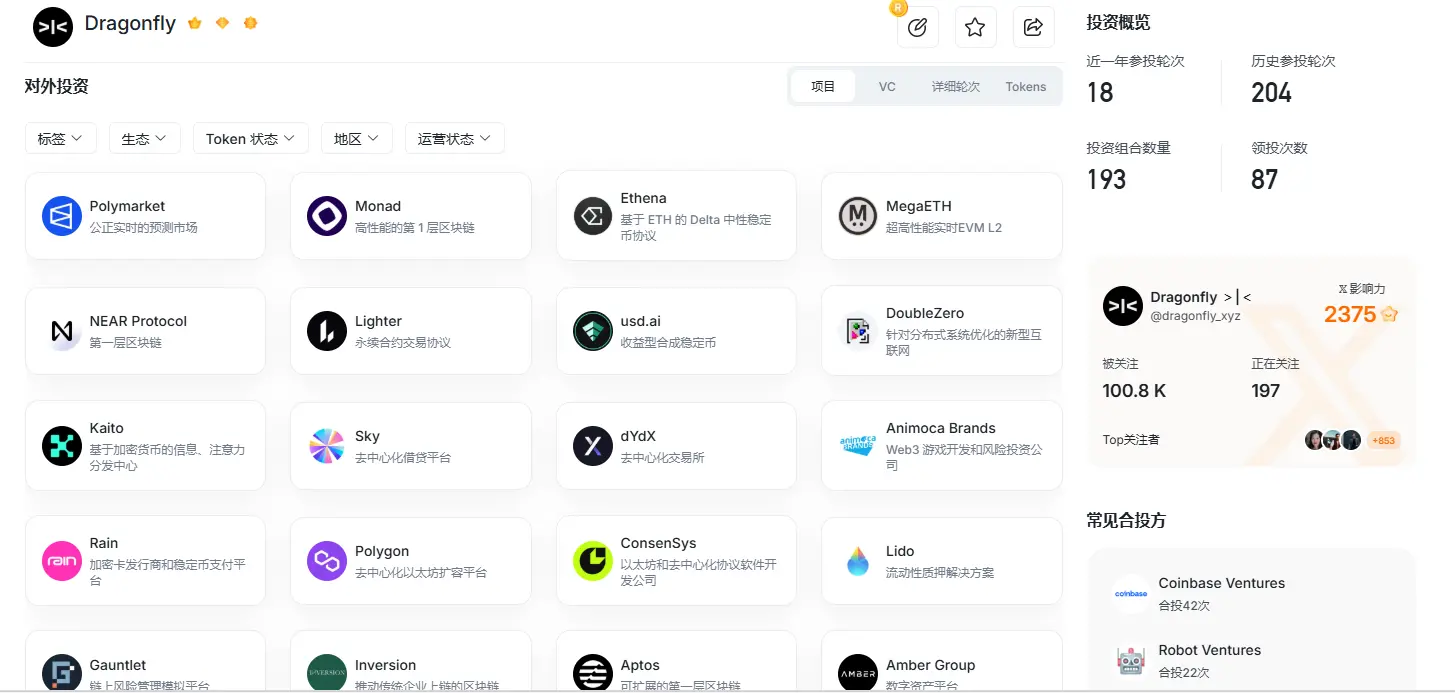
Today, Dragonfly is a transaction-driven institution spanning both primary and secondary markets, with total assets under management of approximately 40 billion dollars, and a portfolio that includes unicorns such as Ethena, Polymarket, and Monad Labs.
However, behind this is an unoptimistic industry trend.
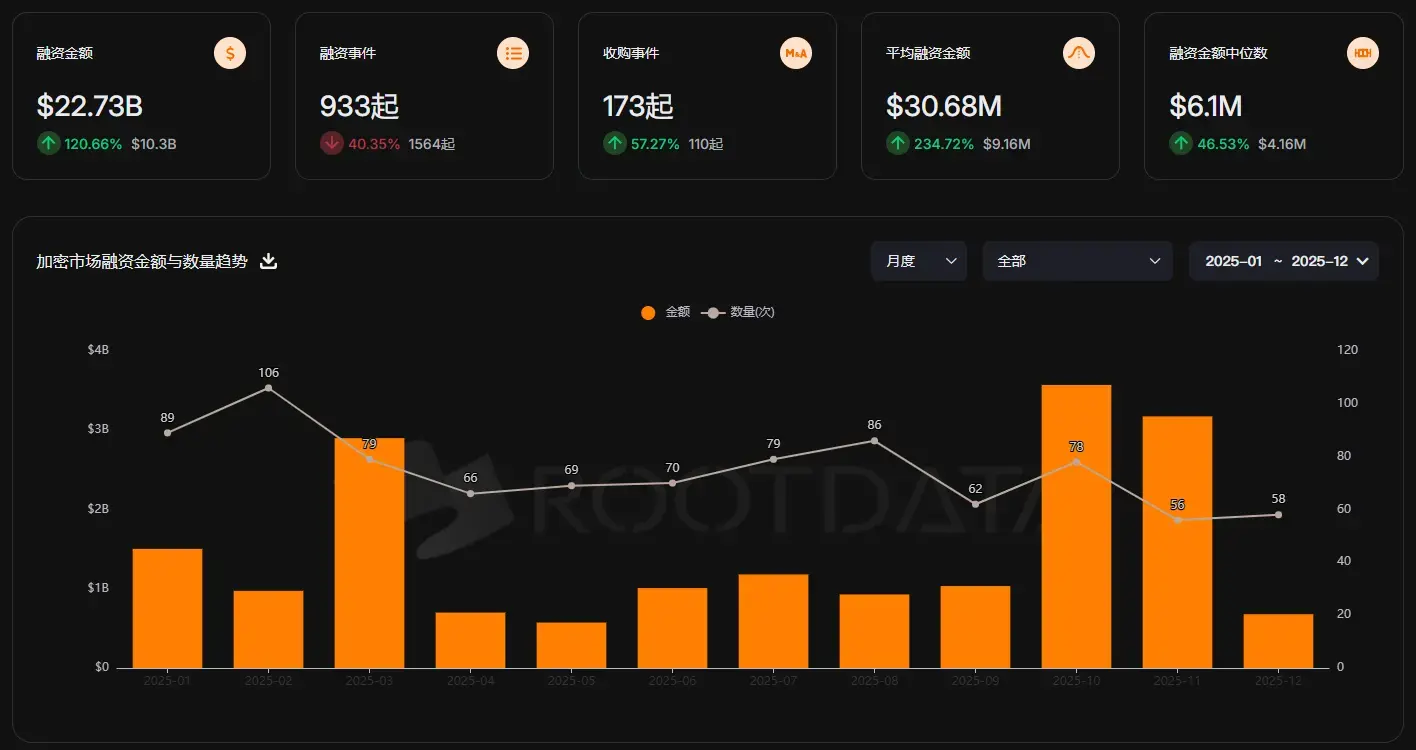
According to RootData, the cryptocurrency primary market raised $22.73 billion in 2025 (excluding Post-IPO and debt financing), a 120.6% increase compared to 2024; however, the number of funding events totaled 933 for the year, a 40.3% decline from last year—the lowest in five years—with monthly funding events showing a nearly one-way downward trend.
Total funding amount is rising, but the number of projects receiving funding is falling, indicating that capital is becoming increasingly concentrated, leaving less room for small and medium-sized early-stage projects.
Dragonfly managing partner Haseeb Qureshi believes that past experiments with broad, non-financial crypto applications have been disproven by the market. The new fund will focus exclusively on stablecoins, DeFi, and on-chain financial services.
He said that the recent growth of investments in Ethena, Polymarket, Rain, and Mesh speaks for itself: “Crypto’s reach is about to explode, and we want to support founders at the center.”
DragonflyIts investors include financial institutions, trading-driven allocators who believe in the logic of blockchain financialization, and investors with a pragmatic attitude toward crypto.
They may not need the grand narrative that crypto will change the world—real liquidity and sustainable trading returns are the answers they truly need.
DragonflyThe key to this path is going with the flow—the crypto industry is becoming increasingly financialized, and it simply got ahead of others by turning this trend into its core competitive advantage.
Breaking: The boundary narrative of Paradigm
Paradigm The story of Paradigm begins with a change in numbers.
In 2021, Paradigm raised $2.5 billion, setting the record for the largest single fundraising in cryptocurrency fund history at the time.
In 2024, the third fund shrank to $850 million.
This time, the target is $15 billion, with investments expanding from cryptocurrency to AI, robotics, and other cutting-edge technologies.
The foundation of Paradigm is venture capital combined with incubation; co-founder Matt Huang comes from Sequoia Capital and founded a machine learning startup at the age of 19, which was acquired by Twitter; the other co-founder, Fred Ehrsam, was a co-founder of Coinbase.
The team’s strength lies in its early trend identification and technical risk management. Matt Huang’s collaborator and Stripe founder Patrick Collison once evaluated him: "He is calm, meticulous, and patient—qualities particularly suited to complex technologies with delayed impact."
Paradigm’s portfolio includes early protocols such as Uniswap and Coinbase, whose early investments established its industry standing.
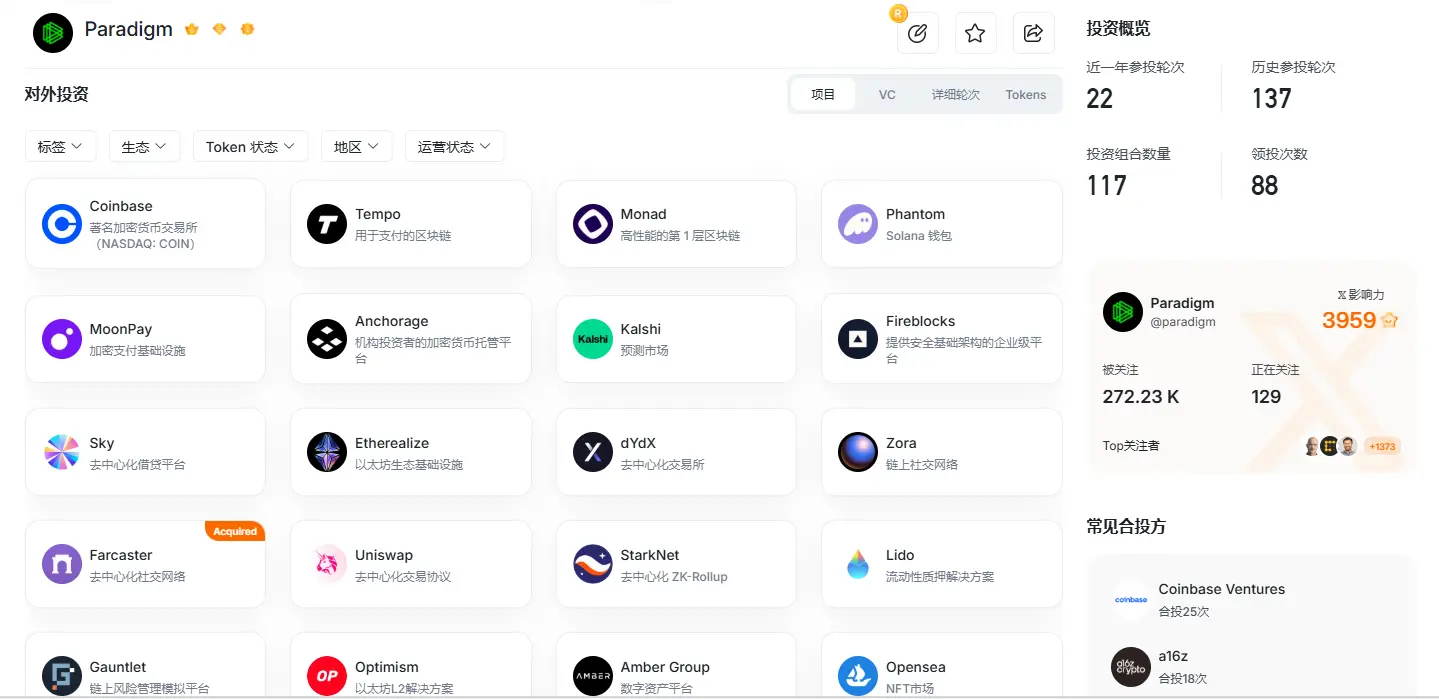
Paradigm has therefore been described by outsiders as "more of a hybrid between a research lab and an engineering organization than a traditional VC".
After the collapse of FTX, Paradigm spent three years rebuilding. However, the underlying issue of a lack of high-quality early-stage opportunities in the crypto industry has not been fundamentally resolved—making it harder for a fund that emphasizes judgment and孵化 capability to find good projects to invest in, a challenge more fundamental than a decline in market value.
Therefore, Paradigm's shift toward AI is far from impulsive.
In fact, as early as 2023, Paradigm quietly removed all Web3-related content from its official website. Matt Huang later explained that the progress in AI was too fascinating to ignore, and emphasized that cryptocurrency and AI are not zero-sum competitors, but rather will have significant overlap. Earlier this year, Paradigm and OpenAI jointly released EVMbench, a benchmark tool designed to test whether AI models can identify and patch vulnerabilities in smart contracts.
According to OECD data, global AI venture capital (VC) investment reached $258.7 billion in 2025, accounting for 61% of total global VC investment, compared to just 30% in 2022.
However, looking at a more practical level, Paradigm's shift toward AI stems from more structural reasons.
In the overall crypto VC fundraising landscape, a16z Crypto holds the top position for long-term capital, while Dragonfly is the most transaction-savvy hunter in the financialization space.
The team DNA of Paradigm cannot replicate the long-term belief narrative of a16z Crypto, nor is it suited for the trading-driven approach of Dragonfly.
Its team DNA dictates that it can only pursue a narrative of integrated innovation to attract new capital that has moved on from pure crypto but remains willing to bet on cross-industry technological convergence.
This is the underlying driver behind Paradigm's shift, and its only point of misalignment.
Hack VC Managing Partner Alexander Pack (formerly Managing Partner at Dragonfly) said that KKR and Bain Capital have shifted from pure private equity to credit and public equities, and a16z has established funds targeting various subsectors within technology. Paradigm’s move, in line with broader industry trends, signals the firm’s maturation and reintegration into the wider technology landscape.
Three paradigms, three bets
When you put the three funds together, you’ll see a clear logical branching line.
They each answer the same question: In the downturn of the crypto industry, what justifies your fund’s continued existence?
a16z Cryptothe answer is scale and conviction—large enough to weather market cycles, deep enough to represent the industry, and consistent in delivering confidence to the market.
Dragonfly's answer is capability and focus. Deepen expertise in crypto financialization, compensate for the limitations of early-stage markets with trading skills, and maintain capital activity during periods of project scarcity.
Paradigm’s answer is narrative and boundary expansion—using the new story of AI and crypto integration to attract investors beyond the reach of traditional crypto VC firms, extending its scope from a single industry into the broader wave of technological convergence.
Three funds, three responses. No paradigm is the final answer, nor can any paradigm be casually replicated—what story can be told ultimately depends on the team’s DNA.
This may well be a sign that crypto VCs are maturing—not everyone rushing down the same path, but each finding their own viable route. A homogenized industry is fragile; only when diverse players emerge can the market truly be considered alive.