





Author: Chloe, ChainCatcher
For years, tokenization has been positioned as the bridge between cryptocurrency and Wall Street. The logic behind putting government bonds on-chain, issuing tokenized funds, and digitizing stocks all points to one idea: once assets are on-chain, institutional capital will naturally follow.
But tokenization itself has never been the end goal. DWF Ventures believes that the key to unlocking the institutional market is not digitizing assets, but financializing yields.
Since 2025, the total value locked (TVL) in DeFi has risen from approximately $115 billion to over $237 billion, driven primarily not by speculative retail traders, but by genuine institutional capital and RWA. Today, institutions are no longer merely observing—they are beginning to view DeFi as infrastructure for deploying capital.
It could be said that the DeFi Wall Street truly wants to see has shifted from “putting assets on-chain” to “programmable, reconfigurable, and interest-rate-hedgable fixed-income infrastructure.” Today, we can already glimpse this transformation through TVL and RWA data, institutional protocol examples, yield tokenization theory, and the implementation of privacy and compliance.
TVL and institutional data: Which layer are institutions filling?
In Q3 2025, DeFi's TVL rose from approximately $115 billion at the start of the year to $237 billion, while the number of on-chain active wallets declined by 22% during the same period—DappRadar data clearly shows that this surge was driven not by retail users, but by institutional capital characterized by high amounts and low frequency.
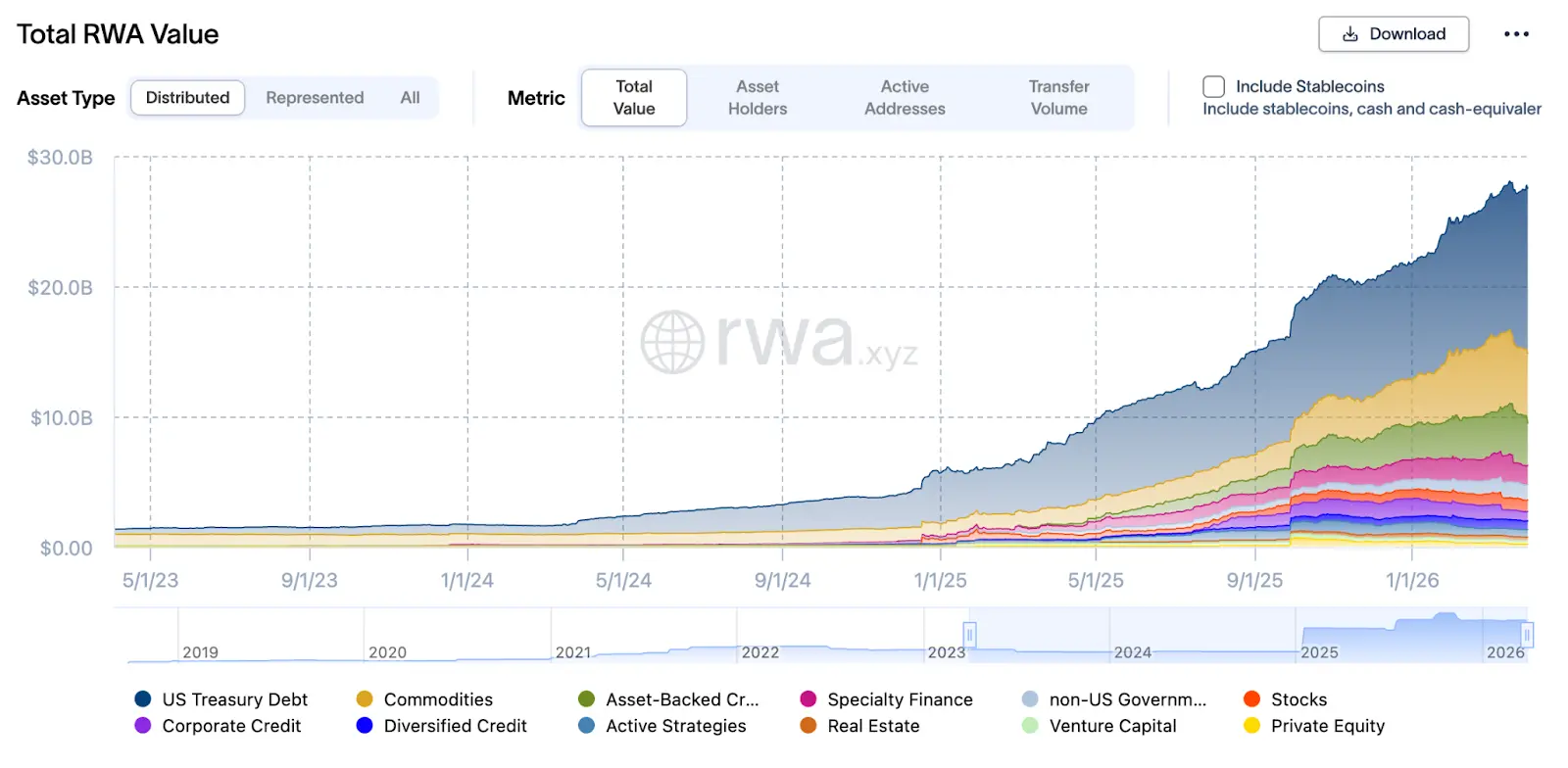
At the heart of this structure is RWA: as of the end of March 2026, the total value of RWA reached $27.5 billion, more than 2.4 times its value of $8 billion in March 2025. These assets are primarily used by institutions as collateral for stablecoin loans through protocols such as Aave Horizon, Maple Finance, and Centrifuge, creating a re-collateralization flywheel known as an "on-chain repo."
Taking Aave Horizon as an example, its RWA market had accumulated approximately $540 million in assets by the end of 2025, including stablecoins such as Superstate’s USCC and RLUSD, and Aave’s GHO, alongside various U.S. Treasury assets (e.g., VBILL), yielding an annualized return of approximately 4–6%. This structure essentially functions as an “institutional money market fund”: the front end consists of tokenized Treasuries and bills, the back end comprises stablecoin liquidity pools, and smart contracts automatically manage interest payments, refinancing, and liquidations in between.
From “Holding” to “Operating”: Are Institutions Playing On-Chain Repo or Fixed Income?
In traditional fixed-income markets, bonds are not merely tools for earning interest; they are used in repurchase agreements (repos), re-collateralized, split, and embedded into structured products, creating a flywheel of capital efficiency. In 2025, DeFi has begun replicating this logic.
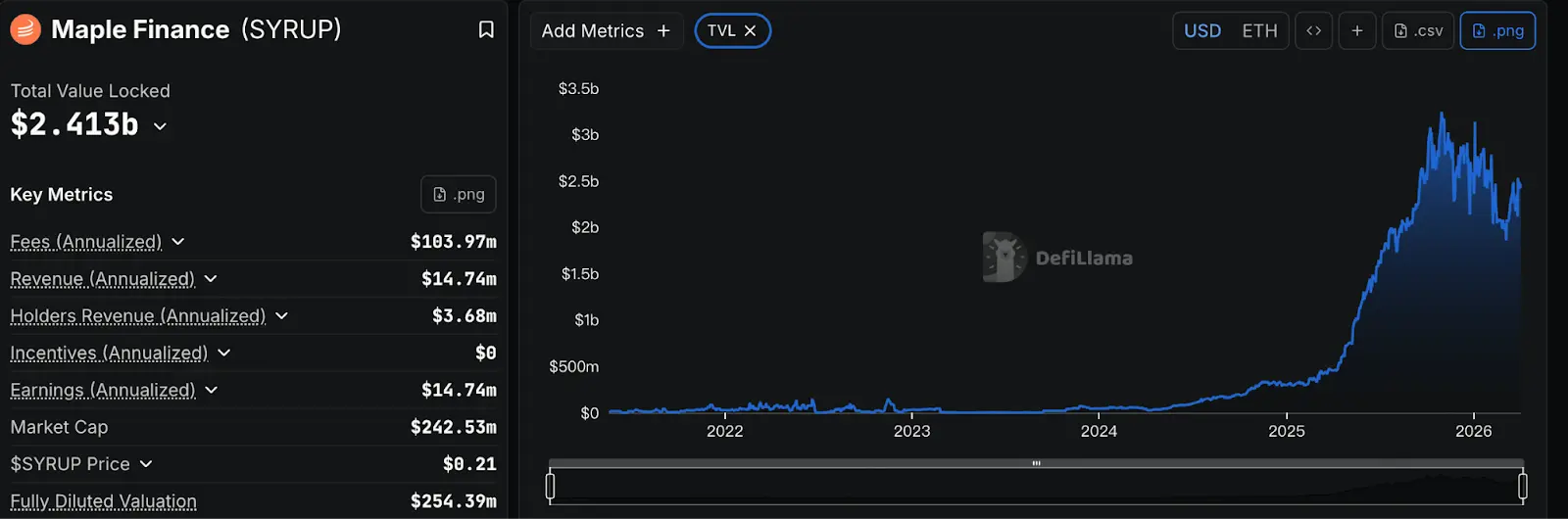
In 2025, Maple Finance's TVL surged from $297 million to over $3.1 billion, at times nearing $3.3 billion, primarily driven by institutional entry into the RWA lending market, where private and corporate loans are tokenized and used for off-chain stablecoin borrowing and refinancing.
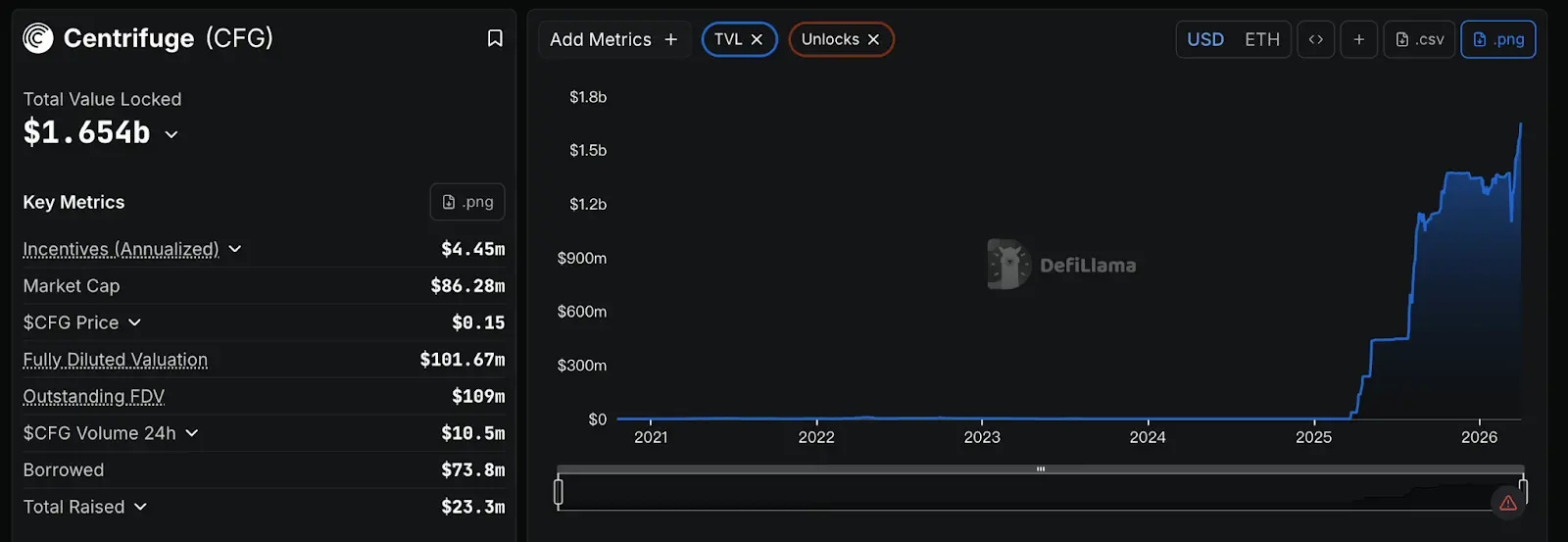
Centrifuge focuses on transforming SME loans, trade finance, and accounts receivable into on-chain assets. To date, its ecosystem has managed over $1 billion in TVL and successfully developed a diverse range of asset pools, extending from private credit to highly liquid U.S. Treasury bonds.
At the same time, Centrifuge is deeply integrated with leading DeFi protocols such as Sky (formerly MakerDAO). Through its collaboration with Centrifuge, MakerDAO can invest its reserves in real-world business loans, providing tangible yield support for the stablecoin DAI. Additionally, Centrifuge has partnered with Aave to create a dedicated RWA market, enabling KYC-verified institutional investors to use Centrifuge’s asset tokens as collateral, enabling cross-protocol liquidity loops.
Yield tokenization and yield trading market: Can interest rate risk be hedged?
If you were to diagram the fixed income market on Wall Street, you would see several key modules: principal and interest can be separated (e.g., zero-coupon bonds, stripped coupons), interest rate risk can be independently traded and hedged, and liquidity and compliance can be decoupled yet connected through middleware.
In May 2025, a paper titled "Split the Yield, Share the Risk: Pricing, Hedging and Fixed Rates in DeFi" on arXiv introduced the first formal framework for "yield tokenization": splitting yield-bearing assets into principal tokens (PT) and yield tokens (YT), and pricing and hedging interest rate risk using SDEs (stochastic differential equations) within an arbitrage-free framework.
This design has already been implemented in certain protocols. For example, Pendle Finance uses a specially designed Yield AMM whose price curve adjusts over time (via a time decay factor), ensuring that the PT price converges to its redemption value at maturity. These mechanisms enable market participants to allocate liquidity according to their risk preferences—for instance, fixed-rate seekers buy PT, while yield speculators buy YT.
For institutions, this means the yield structure can be “modularized” and directly integrated into traditional asset allocation models (such as duration, DV01, and interest rate risk contribution); interest rate risk is no longer limited to off-chain futures or IRS hedging—instead, institutions can directly trade yield tokens on-chain to adjust exposure, enabling immediate and transparent hedging of interest rate risk, significantly improving capital efficiency.
Two real-world challenges: privacy and compliance
Even though DeFi's TVL has surpassed $10 billion, large-scale institutional capital inflows remain stalled by two key challenges: privacy and compliance.
First Dilemma: Public chain holdings are transparent, making liquidation points visible to all.
On major public blockchains, every transaction and wallet balance is publicly visible, posing extremely high risks for institutions. Trading strategies, leverage levels, and liquidation points can be fully exposed to counterparties, making them vulnerable to targeted short-selling and liquidations. In the event of a liquidity crunch or price volatility, malicious actors can place orders against specific addresses to amplify losses—this is one of the key reasons institutional capital remains hesitant to fully enter DeFi.
Here, zero-knowledge proofs may offer a key solution: enabling institutions to prove their legitimacy to regulators without exposing sensitive information. Specifically, regulators can verify that an institution complies with regulatory requirements, while other market participants remain unable to see the institution’s full positions or liquidation points. This is precisely the privacy layer Wall Street seeks—not “complete anonymity,” but “compliance without revealing trade secrets.”
Second challenge: KYC, sanctions screening, and auditing must be embedded directly into the protocol.
Another red line for institutions is that compliance is not an afterthought—it is natively embedded. In traditional finance, KYC, sanctions screening, and audit requirements have long been integrated into settlement systems and transaction workflows; however, in many DeFi protocols, these checks remain confined to the “front-end entry” or “intermediaries,” rather than being directly coded into the protocol logic.
Institutions expect that KYC and sanctions screening will no longer involve "users uploading identity documents and relying solely on trust," but instead be handled by a module or middleware that can verify identity and sanctions lists on-chain without exposing full data; and that audit and regulatory requirements can also be directly encoded as "verifiable rules," such as: a transaction must only execute under specific compliance conditions, or an address's exposure must not exceed a certain limit.
In its November 2025 report, "Tokenization of Financial Assets," IOSCO explicitly emphasized the need to establish "verifiable compliance rules" and "transparent yet controlled audit trails" on DLT (distributed ledger technology). Some institutional DeFi platforms are now experimenting with "compliance modules" that embed KYC, AML, sanctions screening, and regulatory reporting directly into the protocol layer, rather than relying on external tools or retroactive fixes.
Conclusion: What Does DeFi Look Like to Wall Street?
Returning to the original question: What does DeFi look like that Wall Street wants? First, a more advanced asset settlement and servicing system that seamlessly integrates with global compliance infrastructure to build an institutional moat; second, a yield structure that precisely replicates the interest rate decomposition and hedging logic of traditional fixed-income markets, enabling modular risk management; third, on compliance and security, embedding “verifiable compliance” and “programmatic risk control” into the protocol’s foundation through zero-knowledge proofs to achieve a balance between privacy and regulation.
Replacing traditional finance has never been an option on Wall Street’s agenda, but rather an opportunity to more flexibly restructure capital, risk, and returns through programmability in a parallel world.