





Article by Glendon, Techub News
As global market attention gradually shifts away from cryptocurrencies, another key sector of the crypto industry is experiencing a major change.
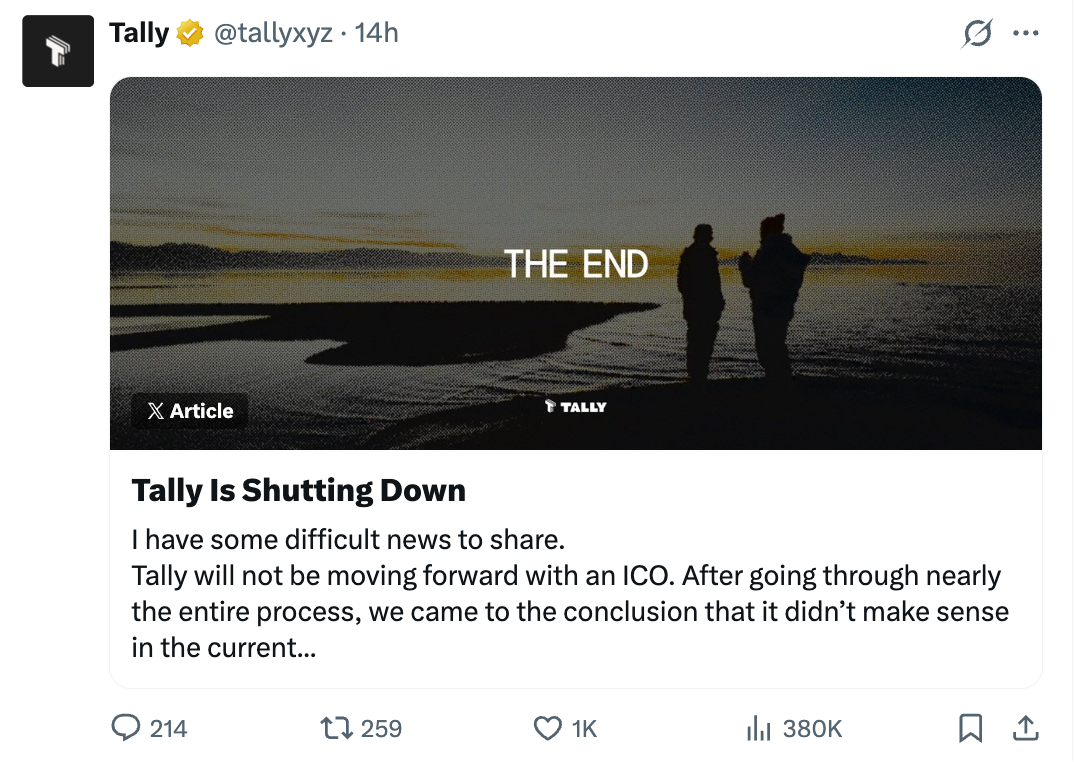
Last night, a shocking announcement shook the DAO governance space: Tally, the platform providing core governance infrastructure such as on-chain voting and delegation to over 500 leading DAOs including Uniswap, Arbitrum, and ENS, announced it will officially shut down after nearly six years of operation.
Surprisingly, in early February, Tally publicly announced plans to launch an ICO, intending to document the entire process over the next 60 days and building an ICO fundraising platform based on the Uniswap CCA mechanism to help teams of all sizes raise capital. Yet, within just one month, Tally’s decision shifted abruptly from preparing to “set sail” to “running aground”—a sudden change that caught many off guard. What exactly happened behind the scenes to cause such a rapid reversal?
In Tally's public letter, CEO Dennison Bertram revealed the direct reason for Tally's closure—a reason that also serves as a mirror reflecting the deeper challenges facing the current DAO governance landscape. (Related reading: 2026 List of Crypto Projects That Shut Down, Transformed, or Went Bankrupt)
Tally's Development History
Before analyzing the reasons behind Tally's decline, let's quickly revisit Tally's development journey.
Tally was co-founded by Dennison Bertram (CEO) and Rafael Solari (CTO) as a leading platform providing on-chain governance infrastructure for decentralized autonomous organizations (DAOs), with a core mission to lower the barrier to participation in DAOs and enhance governance efficiency and transparency.
Since 2021, Tally has gradually become a mainstream DAO governance tool, widely referred to by communities as the “DAO governance dashboard,” providing users with intuitive and convenient on-chain voting, proposal creation, delegation management, and treasury monitoring features. Since then, Tally has continuously expanded its scope, evolving into a full-cycle on-chain organization operating system encompassing token issuance, fundraising, scaling, and staking incentives. Its platform serves over 500 prominent DAOs, including Arbitrum, Optimism, ENS, Uniswap, AAVE, ZKsync, and Wormhole, and at its peak, became one of the most widely used governance toolkits in the Web3 ecosystem.
Looking back at Tally's development, several key milestones cannot be overlooked:
2021–2022: The Tally platform expanded its influence, raising $7.5 million through two funding rounds. During this period, it was referred to by the community as the “DAO Governance Dashboard,” supporting on-chain voting and delegation features;
September 2023: Tally launched on the zkSync Era mainnet, enabling protocols, projects, and public goods on zkSync Era to create and operate DAOs, expanding support for the zero-knowledge proof ecosystem;
April 2024: Tally, in collaboration with Wormhole and ScopeLift, launched MultiGov, a multi-chain governance system enabling DAOs on Solana, Ethereum Mainnet, and EVM L2s to operate seamlessly, breaking down barriers between blockchains;
June 2024: Tally launched the Tally Protocol, unlocking the economic potential of governance tokens by providing a liquidity layer for governance staking and restaking, and optimizing the allocation of voting power to bring economic security back to blockchain protocols, offering an innovative solution for DAO economic governance;
April 2025: Tally completes an $8 million Series A round led by Appworks and Blockchain Capital, with participation from BitGo and others, bringing total funding to $15.5 million;
February 2026: Tally plans to conduct an ICO and build an ICO fundraising platform based on the Uniswap CCA mechanism.
As of the time of writing, Tally’s official website metrics show that the platform has facilitated the transfer of over $1 billion in value, generated more than 7,000 proposal votes, and recorded over 270,000 token claims. In the open letter, Dennison Bertra further emphasized that throughout the company’s lifetime, the systems it helped operate have secured over $80 billion in protocol value, served more than one million users, and enabled tens of millions of token holder addresses to participate in governance through the platform.
Based on the above data, Dennison Bertra believes Tally has demonstrated that decentralized governance can operate at scale. Yet, it’s puzzling that, given this, Tally is shutting down.
The dream of "Infinite Garden" shatters as the business model becomes unsustainable
Dennison Bertra succinctly summarized the direct reason for Tally’s shutdown in an open letter: there has yet to be a venture-backed decentralized protocol governance tool company, and the crypto industry’s product-market fit remains primarily focused on payments and speculation.
Behind this reality lies the practical challenges facing the DAO industry: the collapse of the "Ethereum infinite garden" assumption.
At one time, the crypto industry optimistically envisioned the Ethereum ecosystem nurturing countless innovative DAO projects—thousands of decentralized protocols, millions of active participants, and robust governance systems operating at scale, forming a flourishing “infinite garden” (a diverse ecosystem of protocols and communities requiring complex coordination and governance infrastructure). In reality, industry resources have continuously concentrated among a few leading protocols, creating a strong Matthew effect where the powerful grow stronger. Major DAOs like Uniswap, Aave, and Arbitrum dominate the vast majority of governance demand, while smaller and mid-sized DAOs, hampered by limited funding and weak governance motivation, have minimal demand for professional governance tools.
In short, the crypto market is far from mature. Practitioners originally envisioned a rich ecosystem composed of consumer applications, protocol communities, and governance organizations, but this vision has not come to fruition. Under these circumstances, Tally has been unable to build a viable business model around this concept and has struggled to grow.
At the same time, it is worth noting that under today’s complex and challenging conditions, Tally and the entire crypto industry are deeply affected by talent attrition. In recent years, the explosive growth of the artificial intelligence industry has drawn away a large number of top technical talents. In comparison, talent loss in the crypto industry has become increasingly severe. It is important to recognize that the crypto industry requires continuous investment in human resources for product development and technological iteration to meet evolving market demands. However, lured by the high salaries in the AI sector, many core technical professionals have switched fields, severely impacting innovation and business models within the crypto industry.
Dennison Bertra went further, stating: "AI has become the new narrative of the future, and its scope is even broader and more extensive than that of cryptocurrency." Although he still has strong confidence in the crypto industry, he no longer agrees with the notion that the industry remains in its early stages.
Regulatory trends have shifted abruptly, making governance needs optional rather than essential.
In addition to the above factors, Dennison Bertram, in his CoinDesk report, emphasized that Tally’s rise and fall were closely tied to the volatile shifts in U.S. cryptocurrency regulatory policy. He noted that during Gary Gensler’s tenure, the U.S. Securities and Exchange Commission (SEC) adopted a stricter stance on classifying crypto tokens as securities, prompting many projects to undergo decentralization via DAO structures to mitigate the legal risk of their tokens being deemed securities. During this period, DAO governance tools became an essential, non-negotiable requirement for project compliance. Tally quickly emerged as an industry standard, thanks to its reliable on-chain voting system, delegation management features, and deep integration with leading smart contracts such as OpenZeppelin Governor, attracting top protocols like Uniswap and Arbitrum.
However, as the U.S. government's regulatory stance gradually shifts toward a more relaxed approach, compliance pressures on the crypto industry have significantly eased. For example, in yesterday’s released Crypto Asset Regulatory Safe Harbor document, the U.S. SEC explicitly classified four categories of crypto assets as non-securities: digital commodities, digital collectibles, digital tools, and payment stablecoins defined under the GENIUS Act. Additionally, the SEC’s interpretive guidance on crypto assets lists 16 examples of digital commodities, including SOL, HBAR, LINK, and ADA, stating that these assets fall outside the scope of securities.
The openness of regulatory policies has led many projects to realize that decentralized governance is no longer a necessary means to evade regulation; instead, it may become a burden on project development due to issues such as low decision-making efficiency and high governance costs. This fundamental shift in demand has directly compressed the market space for governance tools like Tally. Many teams, in an effort to reduce costs, have chosen to stop paying for governance tools, paving the way for Tally’s demise. For this reason, Tally’s cessation of operations appears inevitable.
What impact does Tally's shutdown have on the DAO community?
Tally is scheduled to gradually shut down starting at the end of the month. Its closure has undoubtedly had profound and multifaceted impacts on the DAO community, exposing the fragility of the current decentralized governance ecosystem and accelerating industry reflection and restructuring.
On one hand, Tally provided core functions such as on-chain voting, proposal management, delegation systems, and treasury monitoring for over 500 DAOs, serving as the "operating system" for the daily governance of leading protocols like Uniswap, Arbitrum, and ENS. Its sudden shutdown means these organizations now face pressure to migrate their governance tools in the short term. Although on-chain data is immutable and proposal records remain intact, the absence of a stable and user-friendly frontend interface will significantly raise the barrier to entry for ordinary members participating in governance, potentially further reducing voter turnout and exacerbating the issue of "governance apathy."
It’s important to note that DAO governance has long faced issues such as low participation, slow decision-making, and a small group of active voters controlling systems worth billions of dollars. Following Tally’s shutdown, some DAOs now urgently need to find alternative solutions or rebuild their processes—a transition that will inevitably increase operational costs and the risk of errors, leading to “short-term pain.”
On the other hand, this event may prompt the community to question the sustainability of DAO governance tools. The closure of Tally, an industry benchmark, sends a strong signal to the entire Web3 community: even the most successful infrastructure projects may struggle to survive amid changing external conditions. This undermines the DAO community’s trust in third-party governance tools. At the same time, Tally’s shutdown reveals the fundamental business model challenges facing DAO governance tools: despite serving hundreds of protocols, Tally was still unable to establish a sustainable path to profitability.
However, in the long term, crises often give rise to opportunities. While Tally’s closure has cast a shadow over the DAO governance industry, it does not signify the end of DAO governance. This event may serve as a catalyst for the DAO community to accelerate technological autonomy and ecosystem reconstruction. It could prompt communities to place greater emphasis on decentralized deployment of governance frontends, or encourage the industry to explore new forms of governance tools. For instance, AI-powered governance assistants are emerging, capable of automatically summarizing proposals, analyzing voting trends, and alerting users to key deadlines—thereby lowering the barrier to participation for voters.
In addition, changes in the regulatory environment may also bring new opportunities for DAO governance. If regulatory authorities introduce clearer and more reasonable crypto regulatory frameworks in the future, explicitly defining the legal status and governance boundaries of DAOs, it will help reduce market uncertainty and promote the healthy development of the DAO industry. At that time, DAO governance tools may also experience new growth opportunities.
Conclusion
Tally’s rise and fall reflects the complete cycle of DAO governance, from hype to sober reflection. Its "farewell" marks a significant milestone in the evolution of the DAO governance industry. It has revealed the multifaceted challenges the industry faces in regulation, market dynamics, and talent, prompting deeper reflection on the future of DAO governance.
Perhaps Tally's departure is not an end, but a beginning toward a more mature phase of DAO governance. In this era of uncertainty, only through continuous innovation and adaptation can we find new hope in the winter and propel DAO governance toward a more mature future.