





Author: Eric, Foresight News
At around 1:00 AM Beijing Time on February 1, 2026, Bitcoin briefly dropped below $76,000, falling below the cost line of Strategy for the first time in over two and a half years. This marked the first time since April 12, 2025, that Bitcoin had dipped below the $80,000 level, bringing it very close to the low of around $74,500 recorded on April 7, 2025.
According to CoinAnk data, the total value of cryptocurrency futures liquidations across the entire network within 24 hours has reached nearly $2.2 billion, with over 335,000 investors being wiped out, setting the highest single-day liquidation volume since "October 11." Among them, Ethereum saw approximately $961 million in liquidations, Bitcoin had $679 million in liquidations, and SOL had $168 million in liquidations.
Several high-profile "whales" were also not spared. Huang Licheng, known as "Big Brother Mahji," had his entire position liquidated on the evening of January 31. The 0x9ee... address, famously referred to as "CZ's opposing position," suffered over $60 million in liquidations, wiping out all previous profits and resulting in losses exceeding $10 million. Additionally, the so-called "insider big shot" who shorted after the 1011 crash was liquidated for over $200 million, with his position turning from a $142 million profit to a total crash in just 56 days.
Meanwhile, as Ethereum once dropped to $2,240, Trend Research, a subsidiary of Evergrande, suffered a maximum floating loss of nearly $1.2 billion on its 651,300 Ethereum holdings. Currently, Trend Research has deposited 175,800 WETH as collateral on Aave, borrowing approximately 274 million USDT. The health factor of this leveraged position is 1.29, and the liquidation price is $1,558. Although the liquidation price is still somewhat distant from the current price, if the market remains weak, reaching $1,500 is not out of the question.
Recent financial market fluctuations have been extremely intense. Calculated by closing prices, gold and silver spot prices fell by more than 10% and 26%, respectively, on the last trading day of this week—unprecedented drops not seen in decades. Microsoft's market value alone dropped over $350 billion after its Azure growth rate declined by just 1% quarter-over-quarter. These staggering figures clearly demonstrate that capital is highly concentrated in a few assets, and everyone is on edge. A mere tiny crack is enough to trigger a stampede-like exodus.
Geopolitical risks are intensifying, and the U.S. government has shut down again.
According to Xinhua News Agency, an explosion occurred in a residential building in Bandar Abbas Port, Iran, on the evening of January 31, Beijing time. The instability in the key oil hub of the Strait of Hormuz, which handles about 20% of the world's seaborne oil, combined with the escalating tensions between the U.S. and Iran, has further heightened market concerns over the Middle East situation. While the risk-aversion sentiment due to the international situation may be a trigger, Punchbowl News founder tweeted around 4 a.m. today that Democratic members of the U.S. House of Representatives have informed Republican leadership in the House that they will not assist Republicans in passing a funding bill under the current funding suspension. This development suggests that a government shutdown initially expected to last only a few days could turn into a second prolonged shutdown within months.
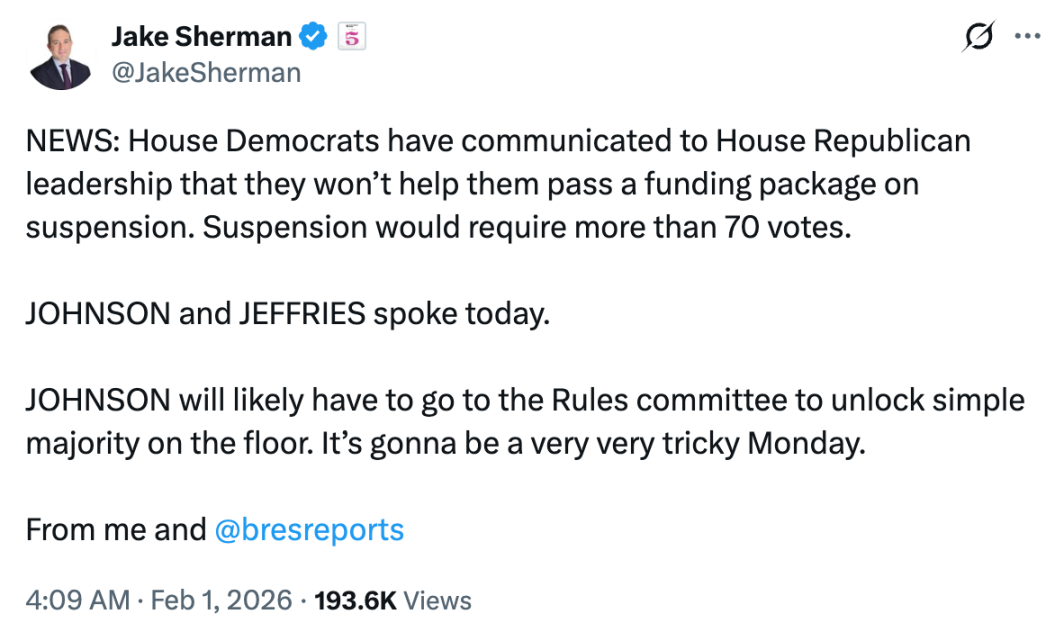
Although the message was released after the start of the decline, the panic caused by multiple uncertainties, combined with thin liquidity over the weekend, was enough to trigger a cascade of liquidations without a very large-scale sell-off. Last night, the Heka Fund under Abraxas Capital transferred 2,038 Bitcoin to Kraken.
Regulatory bills severely damage confidence; Bitcoin's status faces scrutiny
Since "10/11," the performance of the cryptocurrency market has gradually lagged behind that of stock, precious metal, and commodity markets. In addition to a significant decline in liquidity, the crypto market structure bill—which was originally expected to provide strong regulatory support but instead imposed regulatory intensity on crypto assets comparable to that of securities—may also be one of the culprits. The previous prosperity of cryptocurrencies was largely driven by a lenient regulatory environment. Developments in areas such as stablecoins and tokenized real-world assets (RWA) have already begun to integrate into the mainstream, yet the survival of "crypto-native" businesses has unexpectedly been suppressed. The gap between ideals and reality has caused the previous excessive optimism to backfire.
On January 29, Beijing time, the U.S. Securities and Exchange Commission (SEC) issued new regulatory guidance clarifying that tokenized stocks are subject to the same regulatory rules as traditional stocks, effectively putting an end to the expectations of a "lighter regulatory regime" for tokenization.
In addition, the recent divergence in Bitcoin's performance from both risk-on and safe-haven assets has raised questions about its inherent characteristics. For a considerable period in the past, Bitcoin tended to follow the trends of technology stocks or gold. However, since October, Bitcoin has neither kept pace with the U.S. stock market and silver, which have risen due to AI developments, nor with gold, which has surged amid geopolitical risks. Clearly, at present, whether one is bullish on AI development or seeking safe-haven assets, there are better investment options available than Bitcoin.
The fact that spot ETFs experienced a net outflow of nearly $3 billion over two consecutive weeks also indirectly confirms this. Last weekend, U.S. stocks and gold and silver all experienced significant declines, yet funds did not flow into the cryptocurrency market, indicating that market interest in cryptocurrencies has clearly waned.
2026 will be an ultimate test of the resilience of the cryptocurrency market. Although we do not wish for the industry to face another blow, most people would agree that:A major shake-up would definitely not be a bad thing for the current cryptocurrency industry..