





Written by: David Christopher
Compiled by Saoirse, Foresight News
The debate between x402 and MPP is the wrong direction. The real issue is: which party will Cloudflare choose to issue the NET Dollar stablecoin?
Recently, Stripe launched MPP (Machine Payment Protocol) as the flagship product for the Tempo mainnet launch.
Tempo is an EVM-compatible blockchain focused on payments, built by former Paradigm employees and former Ethereum core developers. MPP is an open, HTTP-based protocol for payments between agents and machines; it revives the long-neglected HTTP 402 status code (Payment Required), similar to x402 but with a different architectural philosophy.
The core trade-off between the two protocols is straightforward: x402 prioritizes openness, while MPP offers better integration with existing payment systems—at the cost of being locked into the Stripe ecosystem.
Instead of continuing to debate these technical details, let’s shift focus to another dimension. At this stage, arguing over which technology—MPP or x402—is superior is less meaningful. Beneath the surface, a more important and impactful struggle is unfolding: Coinbase and Stripe are competing for a partnership with the third-party giant Cloudflare, and Cloudflare’s alignment will greatly influence which standard becomes the industry norm.
Web scrapers destroyed the old model.
Before we proceed, let’s restate the core problem that agent payments aim to solve: AI agents have made web scraping too easy.
From 2024 to 2025, Wikipedia traffic surged by 50% due to web crawlers, placing immense pressure on its servers and causing costs to skyrocket. At least 65% of its high-consumption requests originated from bots. In February 2025, the image website DiscoverLife was bombarded with millions of crawler requests daily, nearly bringing the site to a halt. In August, cloud provider Fastly reported bots making 39,000 requests per minute to a single website. The Directory of Open Access Journals (DOAJ) experienced similar issues, describing this wave of crawling as “equivalent to a functional denial-of-service attack.” On one day in November, its traffic increased by 968% year-over-year.
Although websites implement robots.txt rules to instruct crawlers which pages to access and which to avoid, more than 13% of crawlers ignore these rules entirely. They overwhelm servers and place significant strain on websites that rely on donations to operate.
Commercial websites have not been spared: Reddit has tightened its request rate limits; eight of the top ten global news sites now block bots used for training; overall, 71% of leading content platforms completely block retrieval crawlers.
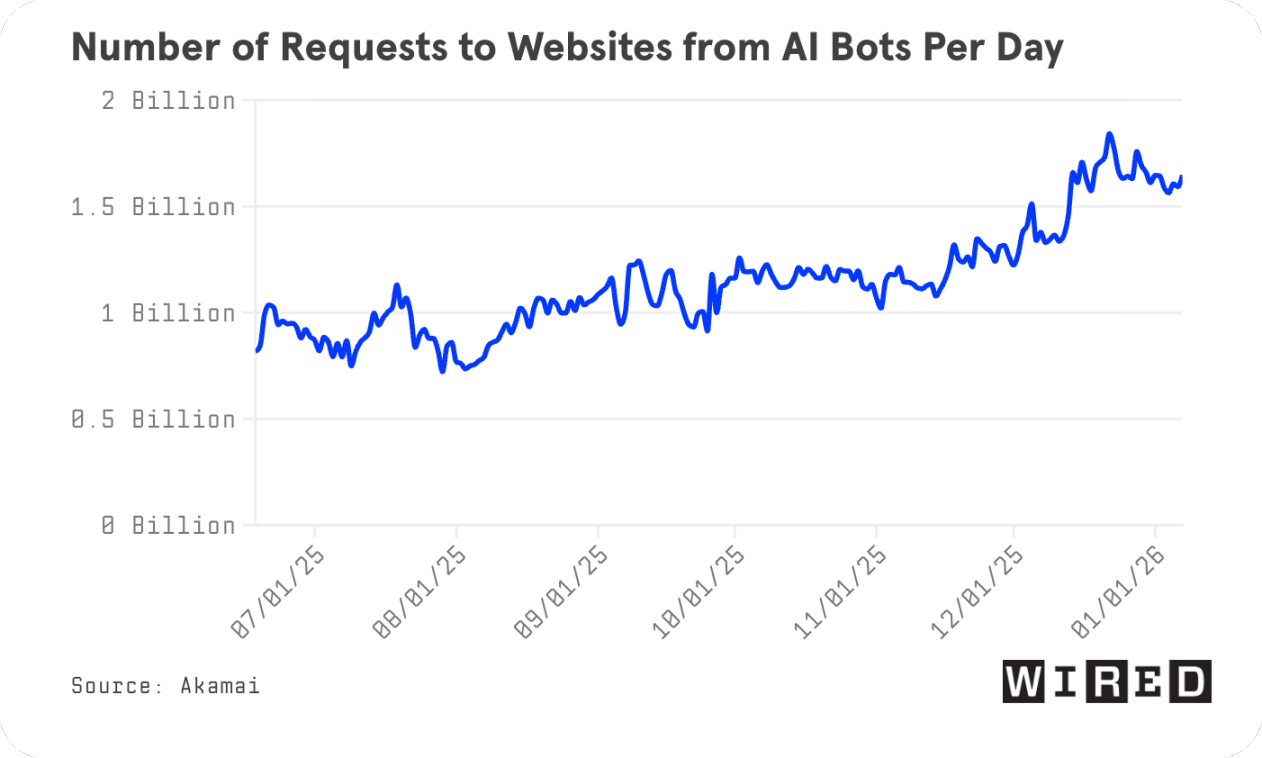
Daily website request volume trend for AI bots
But the internet is not fully blocked. Websites offering high-value, high-timeliness data—such as prices, hotel bookings, and professional datasets—are beginning to charge for data access. Ordinary, low-value content can still be freely scraped via caching and proxies. Bots won’t disappear, but the internet is splitting into free content and paid content. This is precisely why x402 and MPP have emerged.
As Serpin, founder of Ethos Network, said: “This crawling trend means the internet will change: more closed websites, more CAPTCHAs, and greater separation between human and machine traffic.”
Cloudflare is in a critical position.
Cloudflare acts as an intermediary between websites and visitors: protecting against attacks, accelerating load times, and handling massive traffic volumes. Approximately 20% of websites worldwide use it, making it one of the most critical hubs on the internet. Any decision Cloudflare makes regarding traffic rules affects one-fifth of the internet.
This also means that Cloudflare has felt the most direct pressure from the surge in bot traffic and rampant crawling, and is actively addressing it.
Initially, it simply provided websites with the ability to block all bots. Last year, Cloudflare introduced "pay-per-crawl": websites no longer need to block bots outright but can charge small fees to AI crawlers. When a bot accesses a page, it must either pay for access or receive a 402 "Payment Required" response. Billing is handled by Cloudflare. This is a middle ground between complete blocking and complete free access.
After launching pay-as-you-scrape in July, Cloudflare partnered with Coinbase in September to establish the x402 Foundation. A few days later, they announced the launch of NET Dollar—a stablecoin designed for agent payments.
In other words, Cloudflare is both building a “wall” (blocking) and opening “windows” (paid access). It decides who is kept out, who is allowed in, and under what conditions. It is precisely this position that makes its next choices critical.
The NET Dollar is the real signal.
When Cloudflare announced the NET Dollar, it did not disclose the issuer. Even though its partner Coinbase publicly launched its enterprise custom stablecoin issuance service in December, Cloudflare has yet to make an official announcement.
A recent report by The Information has clarified the situation: Cloudflare has yet to decide which partner to collaborate with on issuing the NET Dollar, with companies like Coinbase and ZeroHash competing for the opportunity, leaving room for others such as Stripe.
More notably: immediately after MPP's release on Wednesday, Cloudflare launched an MPP-compatible proxy. This is not surprising, as MPP also supports x402 payments, and the two are not entirely competing standards. However, the issue is that Cloudflare has not identified a stablecoin issuer, and Coinbase—the former co-founder of the x402 Foundation—is merely one of many contenders.
Why does this matter? Because the NET Dollar will become the default currency for Cloudflare’s “pay-per-crawl” and other paid access services. The entity responsible for issuing it will have its corresponding payment standard prioritized within the Cloudflare ecosystem.
- If Coinbase issues NET Dollar, Cloudflare will continue building around x402.
- If Stripe issues, MPP will gain significant momentum.
Given that Cloudflare serves one-fifth of websites worldwide and is building a "block + pay" bot traffic system, its choice will directly determine which protocol becomes the internet standard.
Debating whether x402 or MPP is better is far less important than focusing on which partner Cloudflare ultimately chooses. That is the real core issue.