





Original Authors: Amrith Ramkumar, Dylan Tokar, Gina Heeb, The Wall Street Journal
Translated by Luffy, Foresight News
Last week during the World Economic Forum in Davos, Brian Armstrong, CEO of the largest U.S. cryptocurrency platform Coinbase, was having coffee with former British Prime Minister Tony Blair when Jamie Dimon, CEO of JPMorgan Chase, suddenly approached and interrupted their conversation.
"You're talking nonsense," Jamie Dimon said, pointing directly at Brian Armstrong's face. The banker, who has long been skeptical of cryptocurrencies, previously called Bitcoin a scam.
According to insiders, Jamie Dimon's main point was to tell Brian Armstrong to stop spreading false statements on television. Just a few days earlier, Brian Armstrong had publicly accused the banking industry of trying to block legislation aimed at establishing a new regulatory framework for digital assets, during several business television programs.
This direct confrontation is at odds with the initial purpose of the Davos Forum, which aims to promote cooperation among global leaders.
As cryptocurrencies rapidly integrate into the mainstream of U.S. finance, Wall Street's major players have finally recognized the threat posed by this sector. Although banking institutions have accepted some applications of cryptocurrencies, such as offering services for customers' Bitcoin investments and using digital assets to improve the efficiency of fund transfers, they have drawn a clear line when it comes to cryptocurrencies encroaching on their core business—retail deposit services.
Currently, the banking industry and Coinbase have a fundamental disagreement on one core issue: whether cryptocurrency exchanges have the right to pay regular returns to users who hold digital tokens. These so-called yield rewards refer to ongoing fees paid to stablecoin holders, at an interest rate of about 3.5%.
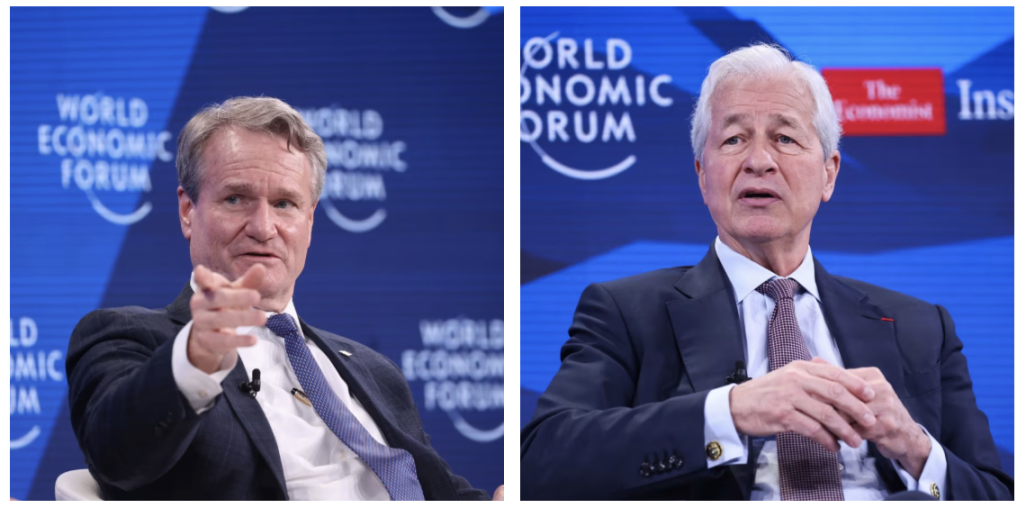
Bank of America CEO Brian Moynihan, JPMorgan Chase CEO Jamie Dimon
The banking industry views the returns paid by cryptocurrency exchanges to users as fundamentally no different from the interest earned on bank deposits. Since the interest rate on demand deposits in banks is typically less than 0.1%, significantly lower than the returns offered by cryptocurrencies, banks are concerned that consumers will transfer large amounts of funds into the cryptocurrency market. They argue that this trend would severely impact community banks and also affect the availability of business loans. On the other hand, Brian Armstrong and other participants in the cryptocurrency industry believe that the market should follow the principles of free competition. They argue that if banks want to compete with stablecoins, they can simply raise deposit rates or directly enter the stablecoin business.
This piece of legislation, named the "Clarity Act," may reshape the future landscape of everyday financial services, covering core areas such as bank deposits and electronic payments.
According to informed sources, the White House plans to convene a meeting on Monday with banking and cryptocurrency industry groups to facilitate a compromise between the two sides. David Sacks, the Trump administration's special envoy for artificial intelligence and cryptocurrency affairs, is expected to attend. Some sources said that Kara Calvert, Coinbase's U.S. policy director, has also been added to the list of attendees.
Brian Armstrong, 43, co-founded Coinbase in 2012 and has since led the cryptocurrency industry in its pursuit of legalization and mainstream acceptance. As the leader of a company valued at approximately $55 billion, Armstrong holds significant influence in policy debates related to the industry, including the recent legislative battle in Washington. "Better to have no bill than a bad one," Armstrong posted on the social media platform X the day before a Senate committee had planned to vote on a draft bill. If passed, the bill would have effectively prevented companies like Coinbase from paying earnings to their customers or cost Coinbase tens of billions of dollars. Just hours later, the vote was abruptly postponed, causing a major stir across the financial world.
"Today's situation is more often interpreted as a confrontation between Coinbase and the banking industry, rather than a clash between the entire cryptocurrency sector and banking," said Ron Hammond, Wintermute's policy and advocacy lead, a well-known crypto market maker.
Brian Armstrong's rebuttal did not end with his January 14th post on X. In subsequent television interviews, he reiterated his stance, telling Bloomberg that banking lobbyists are "actively moving around, trying to eliminate competitors," and he accused the banking industry of "using customers' deposits for lending without their real consent." According to insiders, these remarks also led to several awkward face-to-face encounters with multiple bank CEOs at the Davos Forum.
"If you want to do the business of banking, then just get a banking license," said Brian Moynihan, CEO of Bank of America, last week during a 30-minute meeting with Brian Armstrong at the main exhibition center in Davos. The meeting was generally cordial, but the conversation remained somewhat awkward throughout.
Citigroup CEO Jane Fraser spent less than a minute speaking with Brian Armstrong. Coinbase is a client of both Citigroup and JPMorgan Chase, and also has business relationships with several other banks.
Meanwhile, Bank of America CEO Charlie Scharf didn't even spare a minute. When Brian Armstrong approached to strike up a conversation, Charlie Scharf bluntly said there was nothing to discuss between them. This exchange took place while Charlie Scharf's former boss, Jamie Dimon, was nearby.
Aim to "Replace Traditional Banks"
Brian Armstrong graduated from Rice University in Houston with a major in economics and computer science. He was an early advocate of the concept of digital currency and the underlying blockchain technology. He studied the original Bitcoin white paper published in 2008 by the mysterious figure Satoshi Nakamoto. While working at Airbnb in 2011, he encountered numerous difficulties when making transfers to South America.
These experiences laid the groundwork for him to found Coinbase. At that time, many investors were eager to get involved in cryptocurrency, but they faced a core problem: there was no dedicated platform to store digital assets. Coinbase was created precisely to solve this issue. When some customers wanted to trade bitcoin rather than just store it, Coinbase evolved into a cryptocurrency exchange.
Coinbase's starting point was a small apartment in San Francisco, which also served as the company's first office. In 2017, after another co-founder left the company, Brian Armstrong became the undisputed leader.
Several former colleagues previously interviewed by the Wall Street Journal described Brian Armstrong as shy, and at times, struggling to communicate effectively with certain employees. He also appeared awkward when reprimanding subordinates. Some former employees likened his style to that of the Vulcans from Star Trek, an alien race known for their emotional restraint and calm composure.

In 2014, Coinbase CEO Brian Armstrong spoke on stage at TechCrunch Disrupt Europe (London).
However, Brian Armstrong has never shown any hesitation in pursuing Coinbase's development vision. He has positioned Coinbase as a leading company driving the integration of cryptocurrency into the mainstream U.S. market. Today, Coinbase's business spans multiple areas, including electronic payments, stock trading, commodity trading, and prediction markets.
"Our ultimate goal is to become an alternative to traditional banks in people's eyes," he said in an interview with Fox Business last year. "We aim to develop a super financial app that provides users with a wide range of financial services."
As the company's business expanded, Brian Armstrong invested millions of dollars to build the largest lobbying team in the cryptocurrency industry. After experiencing several cycles of dramatic price surges and crashes in the cryptocurrency market, Coinbase officially went public in April 2021, with its market value briefly exceeding $100 billion. At that time, the value of Brian Armstrong's personal stake reached approximately $13 billion.

In 2021, Coinbase employees opened champagne outside the NASDAQ in New York to celebrate the company's initial public offering (IPO).
After surviving the industry's collapse in 2022 and weathering regulatory pressure from the Biden administration in 2023, Brian Armstrong began launching a counteroffensive and gradually found his voice. Once a manager who preferred wearing headphones and coding in the office, avoiding public speaking, Armstrong has now become a staunch advocate for the cryptocurrency industry in Washington, D.C. And Washington's attitude toward cryptocurrency is about to undergo a dramatic transformation.
Coinbase has invested approximately $75 million through a series of super PACs (Political Action Committees) for the 2024 U.S. elections, targeting candidates who are skeptical of cryptocurrency. The company has also established grassroots organizations to gain public support for cryptocurrency-related legislation. The super PAC announced on Wednesday that its current funding has reached $193 million.
Trump's victory in the 2024 election has opened a long-awaited ten-year window for policy breakthroughs for Brian Armstrong. He praised Trump for ushering in the "dawn of a new era for cryptocurrency" and attended the "Crypto Ball" held during Trump's inauguration, which featured Snoop Dogg. Now, the executive has been at least visiting Capitol Hill in formal attire every two months, a change from his usual T-shirt and black jacket.
"Coinbase is at the forefront of all cryptocurrency-related matters in the United States," said Anthony Scaramucci, founder of SkyBridge Capital and a long-time cryptocurrency investor.
Last summer, Trump signed the "Genius Act," which cleared the way for numerous companies to issue stablecoins and directly fueled the explosive growth of the stablecoin industry. The bill prohibits stablecoin issuers themselves from paying interest to users, but it does not impose such restrictions on exchanges like Coinbase or third-party institutions. Banking groups view this omission as a legal loophole, directly sparking the intense debate surrounding the "Clarity Act."
A Long Legislative Journey
The U.S. House of Representatives passed its version of the "Clarity Act" last year, but advancing the bill in the Senate is considered extremely difficult, partly due to disagreements among senators over the regulatory rules that cryptocurrency companies should follow. The Senate Agriculture Committee, which oversees legislation related to the Commodity Futures Trading Commission (CFTC), passed its version of the bill draft on Thursday this week. Ultimately, senators will need to push for passage of a specific version of the bill by the full Senate and then negotiate with the House of Representatives to resolve differences between the versions.
According to informed sources, Brian Moynihan's core message to Brian Armstrong was that if cryptocurrency companies like Coinbase wish to offer deposit-like services, the banking industry generally believes these firms should be subject to the same regulatory constraints as traditional banks. Regulatory bodies such as the U.S. Federal Reserve and the Office of the Comptroller of the Currency conduct rigorous reviews of banks' risk profiles, regularly examine their operations, and establish clear rules regarding capital requirements for lending and investment activities.
"The controversy surrounding yield rewards is truly an exception in our partnerships with the banking industry," said Coinbase Chief Policy Officer Faryar Shirzad. "We maintain close collaborations with multiple banks and have also announced several cooperative plans."
Coinbase has established a lucrative partnership with stablecoin issuer Circle, through which Coinbase earns significant revenue sharing from the popular stablecoin USDC. Unlike other companies in the cryptocurrency industry, Coinbase, relying on this exclusive partnership, offers a 3.5% yield reward to some USDC holders. The company stated that such incentives help attract users and provide consumers with more options in the current environment of extremely low bank savings rates.
"There is no reason to prohibit paying interest to consumers," Brian Armstrong said last year in an interview with The Wall Street Journal.
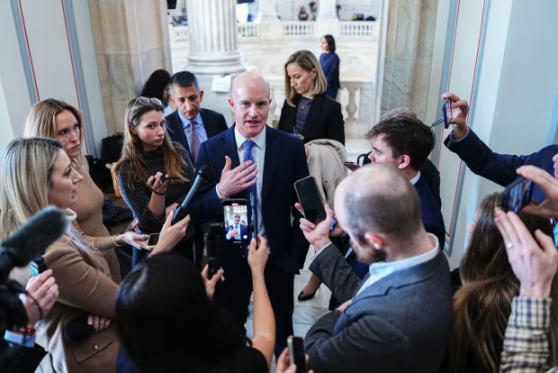
Brian Armstrong speaking to the media on Capitol Hill.
As the Clarity Act was about to enter the voting stage in Congress, the banking industry began high-intensity lobbying efforts behind the scenes. They cited a government estimate to warn senators that approximately $6.6 trillion in deposits within the traditional financial system could be at risk of being siphoned off by the cryptocurrency market. This lobbying campaign proved effective, as the nearly 300-page bill draft included several provisions and potential amendments that Brian Armstrong viewed as unfavorable to the cryptocurrency industry. In response, he promptly withdrew his support for the bill. Hours later, Senator Tim Scott, the Republican chairman of the Senate Banking Committee from South Carolina, announced the cancellation of the vote.
According to informed sources, Brian Armstrong has proposed his own solution to the current deadlock. He suggested to Brian Moynihan that a completely new category of stablecoin issuer be established. If such issuers met stricter regulatory standards, they could be permitted to pay yield rewards to users. In theory, this proposal would allow the banking industry and Coinbase to compete on a more level playing field in the stablecoin business. Other sources have also suggested an alternative approach: banning most yield reward payments, while granting only a very narrow exemption for a few companies like Coinbase.
The advancement of any solution would not be possible without the support of Brian Armstrong.
"Today, the fate of this bill is believed to rest in the hands of Coinbase," said Hilary Allen, a law professor at American University and an expert in securities law, who is also a skeptic of cryptocurrencies. "This is truly shocking."