


Brian Armstrong, CEO of Coinbase, recently offered his take on how banning stablecoin rewards in the CLARITY act would benefit the exchange’s operation. Nonetheless, he came under fire on social media, with his position criticized as disingenuous, causing the bill to stall on this issue.
Coinbase CEO Comes Under Fire On Stablecoin Rewards Ban Position
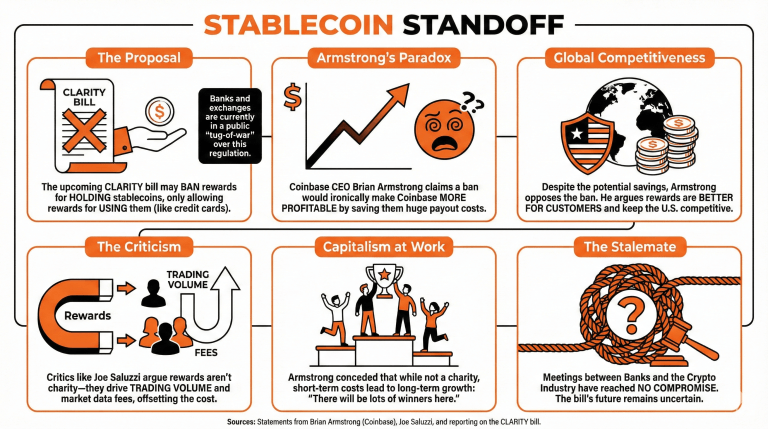
The issue of stablecoins and the inclusion of rewards for holding them in the upcoming CLARITY market regulation bill is in the spotlight, since banks and exchanges have been involved in a public tug-of-war over it.
Brian Armstrong, CEO of Coinbase, has been one of the largest critics of the current proposal, which allows customers to receive rewards for using stablecoins rather than for holding them. This approach makes them similar to payment instruments like credit cards.
Nonetheless, Armstrong recently stated that if the bill passes in its current form, it will benefit Coinbase, given that it will be able to keep the rewards the exchange currently gives USDC holders.
On social media, he stated:
“Ironically, if a crypto rewards ban went into law, it would make us more profitable since we payout large amounts in rewards to our customers holding USDC.”
Furthermore, he added that Coinbase doesn’t want this to happen, as it would be “better for customers to get rewards, and it’s better for the U.S. to keep regulated stablecoins competitive on a global stage.”
Armstrong’s position came under fire on social media, criticized as disingenuous, as rewards bring customers to the exchange. Joe Saluzzi stated that while these rewards do cost the companies, they encourage “more volume and the exchanges make more money in trading and market data-related fees.”
Armstrong conceded on the point, agreeing that Coinbase was not a charity and that it benefited from the growth of the crypto business as a whole. “Just pointing out the short term vs long term effect. There will be lots of winners here with stablecoin rewards (one of the great parts of capitalism),” he concluded.
While there have been several meetings between banks and the cryptocurrency industry, no compromises have been reached on this point, and the bill’s future remains uncertain as neither side has shown any intention of budging.
FAQ
What is the current debate surrounding the CLARITY market regulation bill?
The bill emphasizes stablecoins and rewards for usage versus holding, leading to a conflict between banks and exchanges over its implications.What is Brian Armstrong’s stance on the bill’s reward structure?
Brian Armstrong, CEO of Coinbase, criticizes the proposal for allowing rewards on usage rather than holding stablecoins, likening them to payment instruments.How does Armstrong believe the bill, if passed, would affect Coinbase?
He noted that if the bill becomes law as it currently stands, Coinbase could retain the rewards offered to USDC holders, potentially benefiting the exchange financially.What challenges does the stablecoin industry face regarding the regulation bill?
Despite discussions between banks and the cryptocurrency industry, no consensus has been reached, leaving the bill’s future uncertain and contentious.