





Key Insights
- Banks now view crypto as an existential priority, shifting from skepticism to strategic adaptation worldwide.
- Tokenization and stablecoins dominate Davos talks, promising faster transactions and access for billions of unbrokered adults.
- Regulation and AI integration highlight crypto’s future, with U.S. policy and global competition shaping adoption.
Crypto news from Davos has drawn global attention. Coinbase CEO Brian Armstrong reported that a top‑10 global bank now views crypto as its “number one priority” and an “existential” issue. At the World Economic Forum, Armstrong met with leaders of major financial institutions.
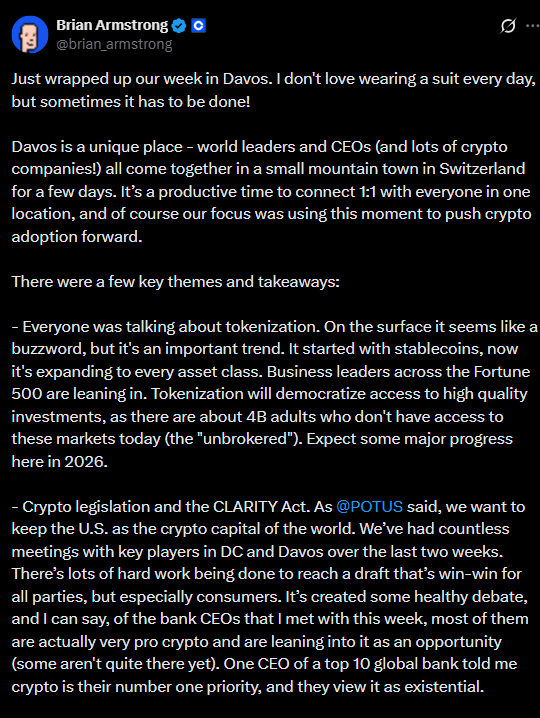
The conversations revealed a sharp shift. Just a few years ago, banks dismissed crypto as speculation. Today, they see it as both a challenge and an opportunity. Digital assets, stablecoins, and tokenization are reshaping the financial system.
Crypto News: Banks Shift from Doubt to Fear
Armstrong said banks are no longer skeptical. They now recognize crypto as a direct competitor, and for some, an existential priority. Stablecoins, decentralized finance (DeFi), and tokenized assets threaten traditional revenue streams. Deposits, fees, and payment processing are at risk.
Most leaders at Davos were pro‑crypto. They want to adapt instead of resist. Partnerships are already happening. PNC Bank recently joined with Coinbase for bitcoin trading. This shows banks are moving from defense to collaboration.
Analysts warn that stablecoins could drain trillions in deposits. Bank of America’s CEO raised this concern. If customers move funds into stablecoins, banks lose their base of operations. This is why crypto is now seen as an existential issue by some bank leaders.
Tokenization and Stablecoins Take Center Stage
Tokenization was one of the hottest topics at Davos. Armstrong described how assets such as equities, credit, and real-world items can be turned into blockchain tokens. This makes transactions faster, cheaper, and more accessible. He predicted major progress in 2026.
Tokenization could open markets to billions of people. Armstrong highlighted the 4 billion “unbrokered” adults worldwide. They lack access to traditional investments. With tokenization, they could join global markets.
Stablecoins were also central to discussions. They offer instant global transfers without intermediaries. This challenges legacy banking rails. Stablecoins are cheaper, faster, and borderless. Banks see them as a direct competitor to their payment systems.
Crypto news shows how stablecoins are reshaping payments. Their rise is forcing banks to rethink their role in global finance.
Crypto News: Regulation and AI Shape the Future
Armstrong praised the U.S. administration under President Trump. He stated, “Trump and the current administration are the most crypto‑forward government in the world. They’re committed to getting market structure done, and done correctly.”
He also emphasized that support for bills like the CLARITY Act is strong. Clear rules are seen as vital for competitiveness.
However, tensions remain. Coinbase recently withdrew support for a major market structure bill. This caused delays. Armstrong stressed that proper frameworks are needed to balance innovation and oversight.
China is investing heavily in stablecoin infrastructure. This raises global competition. The U.S. wants to stay ahead by supporting crypto innovation.
Armstrong linked the rise of crypto to artificial intelligence. He said, “AI agents will increasingly rely on stablecoins for seamless, restriction‑free payments. The infrastructure exists, and usage is rapidly growing.”
Crypto news from Davos shows that AI and crypto are now seen as twin forces. Together, they could transform how money and technology interact.
The post Crypto News: Coinbase CEO Says Banks View Crypto as ‘Existential’ Priority appeared first on The Market Periodical.