




- Senate deal on stablecoin yield limits revives CLARITY Act momentum in Congress.
- Senator Tim Scott signals progress as bipartisan CLARITY Act markup push gains momentum.
- Draft bans passive yield on stablecoins but allows rewards tied to DeFi activity.
A Senate deal on stablecoin yield limits has renewed momentum for the CLARITY Act, a major piece of market structure legislation. Punchbowl News reported Friday that senators reached an agreement to restrict interest or yield payments on stablecoins.
Industry reactions were mixed. In an X post, crypto investor Nic Carter wrote, “The banks won.” Scott Johnsson, general counsel at Van Buren Capital, wrote on X, “This is fine. It may not feel like it, but it is.”
Stablecoin Deal Pushes CLARITY Act Forward
However, Senate Banking Committee Chair Tim Scott later said lawmakers were making progress on digital asset market legislation. He wrote on X that committee Republicans were nearing consensus and working toward a bipartisan markup in May.
Coinbase CEO Brian Armstrong gave the response that carried the most weight. “Mark it up,” Armstrong said, signaling support for a committee vote that could advance the bill. However, Polymarket odds for the CLARITY Act passing in 2026 rose from 46% to 64%
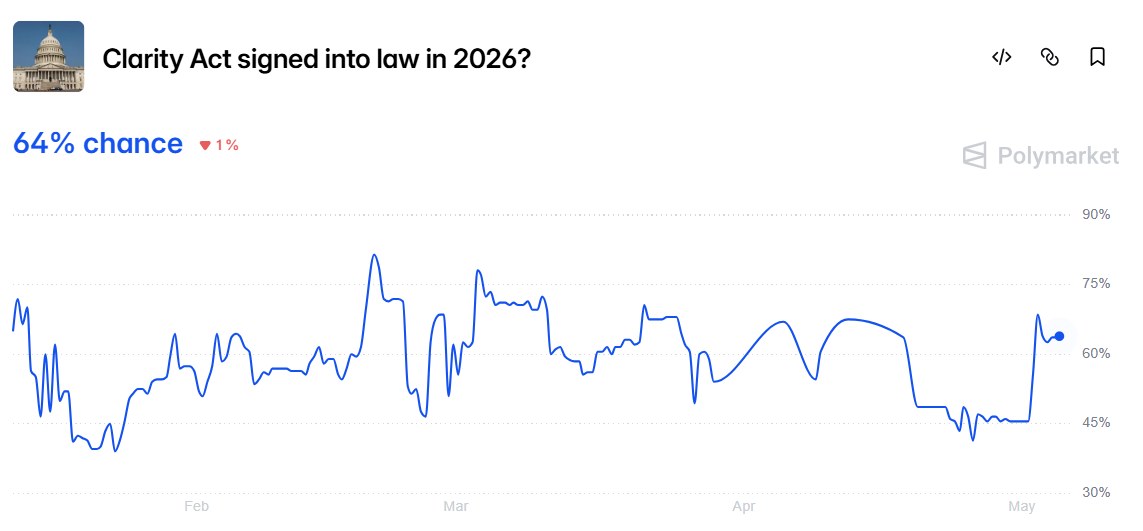
Source:Polymarket
.
Armstrong had helped stall the bill in January. He pulled support before a scheduled markup because of concerns over stablecoins and other parts of the draft. However, Scott then postponed the markup.
Stablecoin yield has become one of the central disputes in the legislation. Last year’s GENIUS Act barred stablecoin issuers from paying interest or yield on customers’ digital dollars.
Regulators to Clarify Stablecoin Yield Rules
Banks supported that restriction because they feared deposit flight. Customers could move funds from checking and savings accounts into stablecoins that often offer higher returns.
However, January’s compromise banned companies from paying passive yield on stablecoins. Yet it allowed rewards or incentives tied to transactions, payments, transfers, remittances, and liquidity provision in DeFi protocols.
Copies of the latest draft circulating online suggest that much of that language remains. The CLARITY Act would ban interest or yield that is “economically or functionally equivalent” to interest or yield on a bank deposit.
At the same time, the draft would allow “rewards or incentives” linked to “bona fide” activities or transactions. That wording leaves room for interpretation. U.S. financial regulators would have one year to publish rules under the bill.
Despite the unclear language, industry groups welcomed the agreement. Blockchain Association CEO Summer Mersinger said resolving the stablecoin yield issue clears the path to a Senate Banking Committee markup.
Mersinger added that the deal brings lawmakers closer to comprehensive market structure legislation becoming law. She urged the committee to move forward without delay.
A markup could happen as soon as this month. Before becoming law, the Senate draft would still need to be reconciled with the House version, which passed nearly one year ago.
Related: CLARITY Act Odds Rise Above 60% on Polymarket
Disclaimer: The information presented in this article is for informational and educational purposes only. The article does not constitute financial advice or advice of any kind. Coin Edition is not responsible for any losses incurred as a result of the utilization of content, products, or services mentioned. Readers are advised to exercise caution before taking any action related to the company.