





The GENIUS Act, passed in 2025, created a regulatory framework for U.S. stablecoins. However, clear rules for the rest of the crypto market are still missing.
That may soon change, as the recent data from Santiment suggested the Digital Asset Market CLARITY Act is moving closer to the final stage of the legislative process.
If passed, the bill could mark a turning point for institutional investment in crypto, providing clearer regulatory guidance for large investors.

CLARITY Act talks continue
Talking about the same at the DC Blockchain Summit on the 17th of March, Senate Banking Committee Chair Tim Scott said the bill is still delayed due to a disagreement over interest-bearing stablecoins.
While the crypto industry supports such products, banks fear they could pull large amounts of money away from traditional deposits.
That said, Senators Thom Tillis and Angela Alsobrooks are currently reviewing these concerns and pushing for stronger safeguards if crypto products function like bank services.
This cautious approach has slowed the bill’s progress. Meanwhile, political pressure is growing, especially after U.S. President Donald Trump urged lawmakers to pass the Act quickly.
President Trump demands CLARITY Act passage
On the 4th of March, U.S. President Donald Trump wrote in a post on Truth Social,
The Genius Act is being threatened and undermined by the Banks, and that is unacceptable — We are not going to allow it. The U.S. needs to get Market Structure done, ASAP.
Donald Trump’s statement has shifted the debate around the CLARITY Act from a technical policy issue to a broader economic and strategic concern.
He argues that without clear crypto regulations, capital and innovation could move to countries like China, making the bill important for maintaining U.S. financial leadership.
Trump also criticized major banks for resisting crypto reforms, despite reporting record profits, suggesting they are prioritizing their own interests.
By linking the CLARITY Act to his goal of making the U.S. the global crypto capital, he has increased pressure on lawmakers to move the legislation forward.
Crypto community stands confident
The confidence was also reflected in the crypto community, as noted by Senator Kevin Cramer when he said,
I think we have to make this a committee priority for some time just before Easter or shortly after.
Echoing similar sentiments, Dan Spuller, EVP of Industry Affairs at Blockchain Association, added,
I’m now increasingly confident we’re going to get CLARITY through, and we’re not going to let the banks rig the outcome.
Polymarket odds and other hiccups
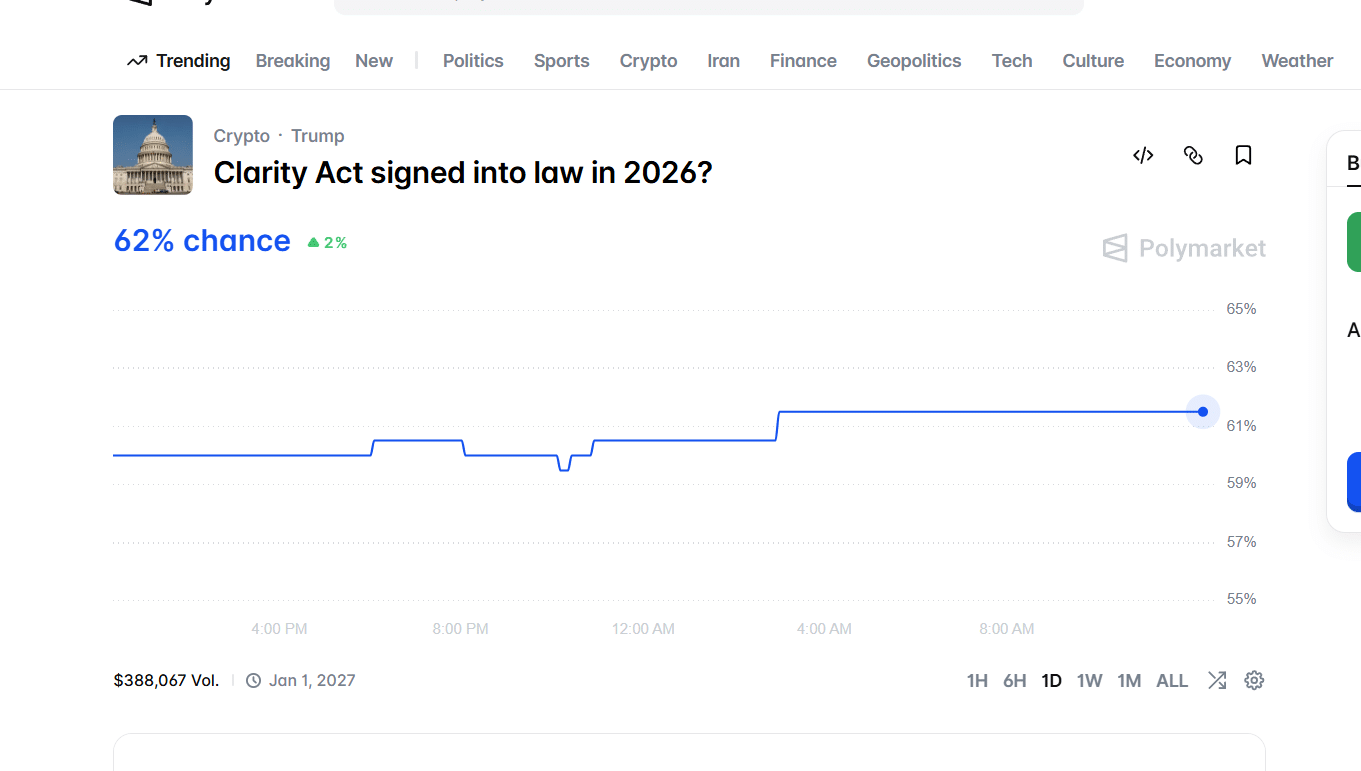
Additionally, Polymarket bettors have also pushed the odds of the CLARITY Act passing in 2026 to a commanding 62%.
Needless to say, the bill has now become the center of a growing clash between the U.S. government and traditional banks.
This disagreement has stalled the bill since early 2026. Thus, as expected, Trump’s crypto advisor, Patrick Witt, had put it best when he said,
The CLARITY Act must remain a pro-innovation piece of legislation. Attempts to hijack the legislative process and turn it into an anti-competition bill are shameful.
Final Summary
- Clear rules could unlock large institutional capital that has remained cautious due to regulatory uncertainty.
- However, a key disagreement over interest-bearing stablecoins continues to slow progress.