





Recently, Wall Street research firm Citrini Research released a thought experiment report titled "The Global Intelligence Crisis of 2028," sparking widespread market discussion. The report’s central premise points to a brutally cold logic of commercial realignment: AI agents will eliminate all "friction" in human interactions, thereby dismantling every old business empire built on information asymmetry and intermediary models.
Coincidentally, just as this Wall Street "doomsday report" went viral online, Web3 industry icon Sun Yuchen also made a series of eye-catching posts on social media. He defined 2026 as "the time when miracles will happen," and even urged young people: "Chat with AI instead of humans... fully embrace the future!"
To the public, this may seem like another highly personal “traffic frenzy” by Sun Zhen. But if we peel back the emotional surface and contrast these remarks with the macro-level projections in “The Global Intelligence Crisis 2028,” we uncover a profound truth: the “collapse of the old order” that Wall Street fears in its macro models is precisely the “Web4.0 new era” that Sun Zhen actively champions and seeks to accelerate through his micro-level actions.
Faced with the same future, pessimists saw a abyss, while Sun Yuchen saw a staircase leading to the singularity.
Hash power, electricity, and tokens—AI and crypto are fatefully intertwined.
The vision of "frictionless disappearance" depicted in "The Global Intelligence Crisis of 2028" is essentially a highly ruthless, AI-driven revolution of disintermediation.
The report sharply points out that when an omniscient AI agent can instantly match supply and demand, execute transactions, and deliver services at nearly zero cost, the moats upon which modern commerce relies will be completely breached.
For a long time, countless business models—from traditional financial intermediaries and advertising distribution platforms to law firms and consulting firms that charge exorbitant fees—have essentially thrived on human cognitive limitations, decision delays, and information gaps. Once AI eliminates these human-made "frictions," these old empires will collapse like dominoes.
This trend resonates remarkably with the "decentralization" principle that blockchain has championed since its inception.
If the Web3 movement that emerged over a decade ago sought to dismantle the "trust monopoly" of centralized institutions by leveraging cryptography and distributed ledgers at the architectural level, then the rise of AI agents today eliminates the very need for "trust" in many scenarios in a more thorough and efficient manner—because agents can not only automatically verify facts but also autonomously execute value exchanges.
A deeper alignment lies in the fact that the material foundation supporting this dual revolution is entirely common in origin.
Whether AI-generated inference tokens or cryptographic tokens on a blockchain network, they both conceal a long-overlooked but unyielding physical truth: they are digital embodiments of electricity.
Every inference of a large AI model consumes real computational power; each on-chain transaction confirmation and every smart contract execution relies on the continuous energy consumption of mining rigs or validation nodes. Tokens are not magic—they are vouchers of energy conversion, representing the projection of value in the digital world after electricity has passed through chips, algorithms, and protocols. In this light, it forms a perfect闭环 with Sun Yuchen’s earlier assertion: “In the short term, we lack chips; in the long term, we lack energy; forever, we lack storage.”
Thus, we see two forces—seemingly opposing yet sharing a common origin—converging: on one side, capital elites foreseeing the collapse of their own power structures through model simulations; on the other, crypto natives actively embracing a new文明 protocol—devoid of intermediaries, friction, and redundancy—through code and slogans. The narrative of the “post-intermediary era,” co-written by AI and blockchain, may have only just begun.
Why AI Is Destined to Choose Crypto Settlement
However, this grand historical convergence is not merely a philosophical or physical resonance. When the narrative comes down to concrete business operations, a highly practical question confronts AI: In this new world即将由机器接管执行力, who will provide financial services to these disembodied "silicon-based life forms"?
Centralized payment networks are designed for "humans."
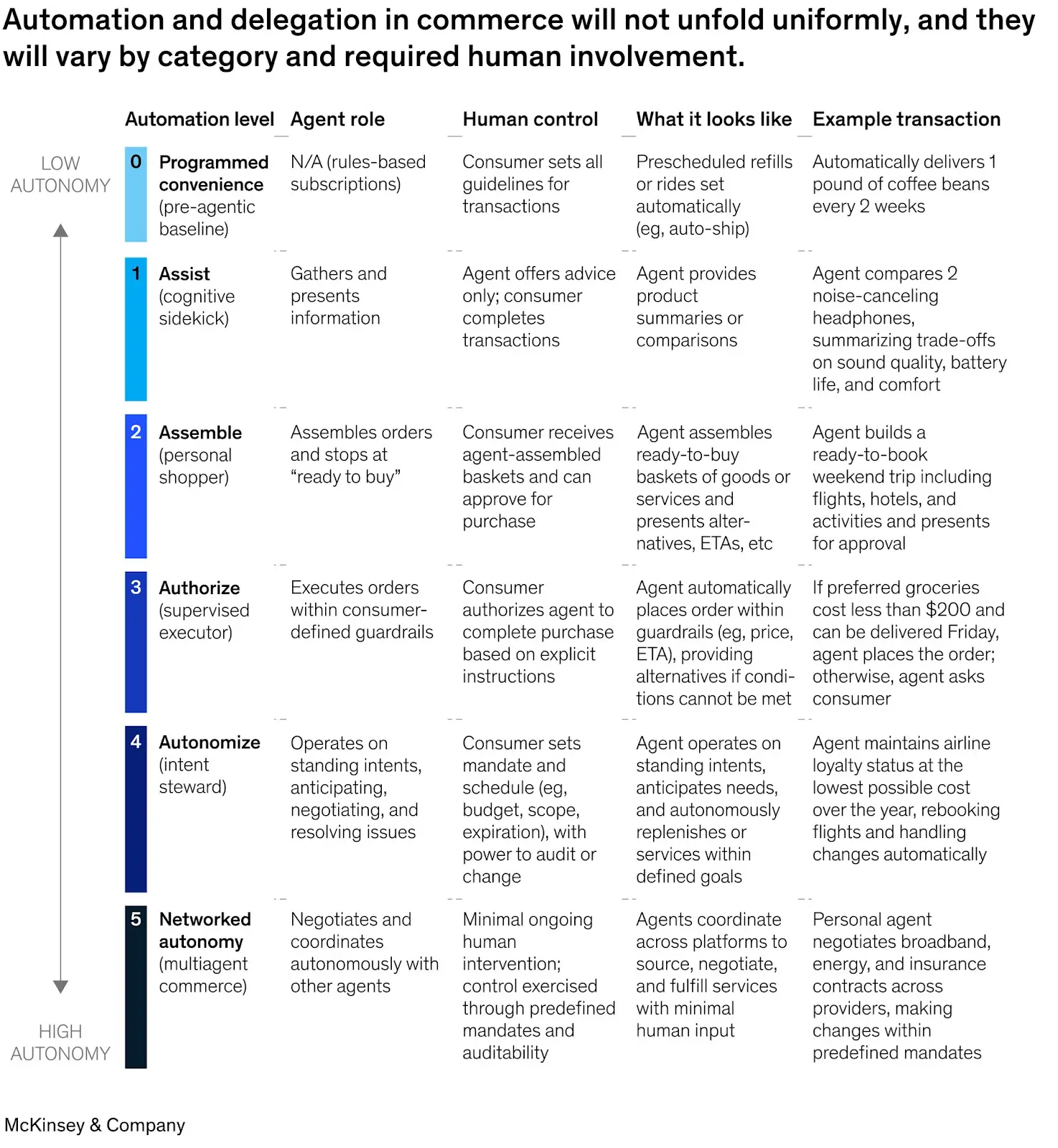
McKinsey categorizes AI-driven business automation into six levels. Levels 0 through 4 can still operate within the existing financial system, as transactions remain tied to human identities. However, at Level 5, agents begin transacting directly with one another without human intervention. At this point, there is no "human identity" to inherit, and traditional KYC processes are no longer viable; payments must be programmatic, condition-triggered, settled in milliseconds, and agent reputations must be cross-platform portable. Blockchain thus becomes indispensable.
AI has no physical form and cannot hold an ID card to queue for KYC. For them, a string of asymmetrically encrypted private keys is an account; a blockchain enabling instant settlement, fees approaching zero, and programmable smart contracts is the perfect clearinghouse.
In "The Global Intelligence Crisis of 2028," there is a highly realistic simulation: the space for price matching and information aggregation is ultimately limited. Once agents begin trading with each other, the most direct and effective path is to eliminate various fees. They start seeking payment methods faster and cheaper than credit cards. Most ultimately choose to settle using stablecoins on Solana or Ethereum Layer 2 networks, where transactions are nearly instantaneous and fees are as low as a fraction of a cent.
For this reason, crypto wallets are destined to become the "native banks" of AI agents.
This also completely shatters the long-standing external stereotype of crypto: issuing tokens is far more than just a means for speculative trading on secondary markets. In an AI-driven future, crypto tokens and peer-to-peer payments will truly become the foundational financial infrastructure for high-frequency collaboration between agents.
Sun Yuchen's open strategy in AI: What is the source of his confidence and ambition?
Sun Zhenyu chose to bet on Web4.0, driven by an extremely meticulous business logic and strategic objectives.
First, TRON's "stablecoin dominance" is the natural settlement layer for Web 4.0.
It is well known that the TRON network supports the largest circulating supply of USDT globally. As previously mentioned, the core of Web4.0 is machine-to-machine payment interactions, and AI requires a payment network with fast transfers, low fees, and high liquidity. TRON’s USDT payment network perfectly aligns with the underlying financial needs of AI agents. All Sun Zhuochen needs to do is build a payment API on the TRON network that AI can seamlessly access, allowing him to continue earning passively in the Web 4.0 era.

Second, identify the breakthrough point for the post-Web3 era.
The traditional Web 3.0 has entered a phase of zero-sum competition, lacking new breakout narratives. Meanwhile, AI has become the most certain and best-funded growth赛道 in the world today. Sun Yuchen keenly recognized that Crypto’s future must be tied to AI. By going “All in Web 4.0,” he aims to redirect the AI funding and attention from the traditional tech sector back into the crypto market. Tron’s prior establishment of a $100 million AI development fund is a clear signal of its strategic positioning for Web 4.0.
Third, establish a closed loop for the "decentralized network."
Sun Yuchen controls BitTorrent (decentralized storage and transmission), the Tron blockchain (underlying settlement), and a vast user base on Huobi. By integrating decentralized computing power and AI models, he has the opportunity to build a full-stack Web4.0 infrastructure that does not rely on Amazon AWS or Google Cloud.
The irony of history is often this: while the guardians of the old order are still calculating the losses from the fall of the walls, the barbarians of the new world have already laid the foundations on the ruins.
The transformation written by AI and crypto is not yet complete, but the direction is clear. The real question is no longer whether AI will reshape business, but who will secure a central position in the infrastructure of this reorganization.