



Author: Lucas Shin
Compiled by Deep潮 TechFlow
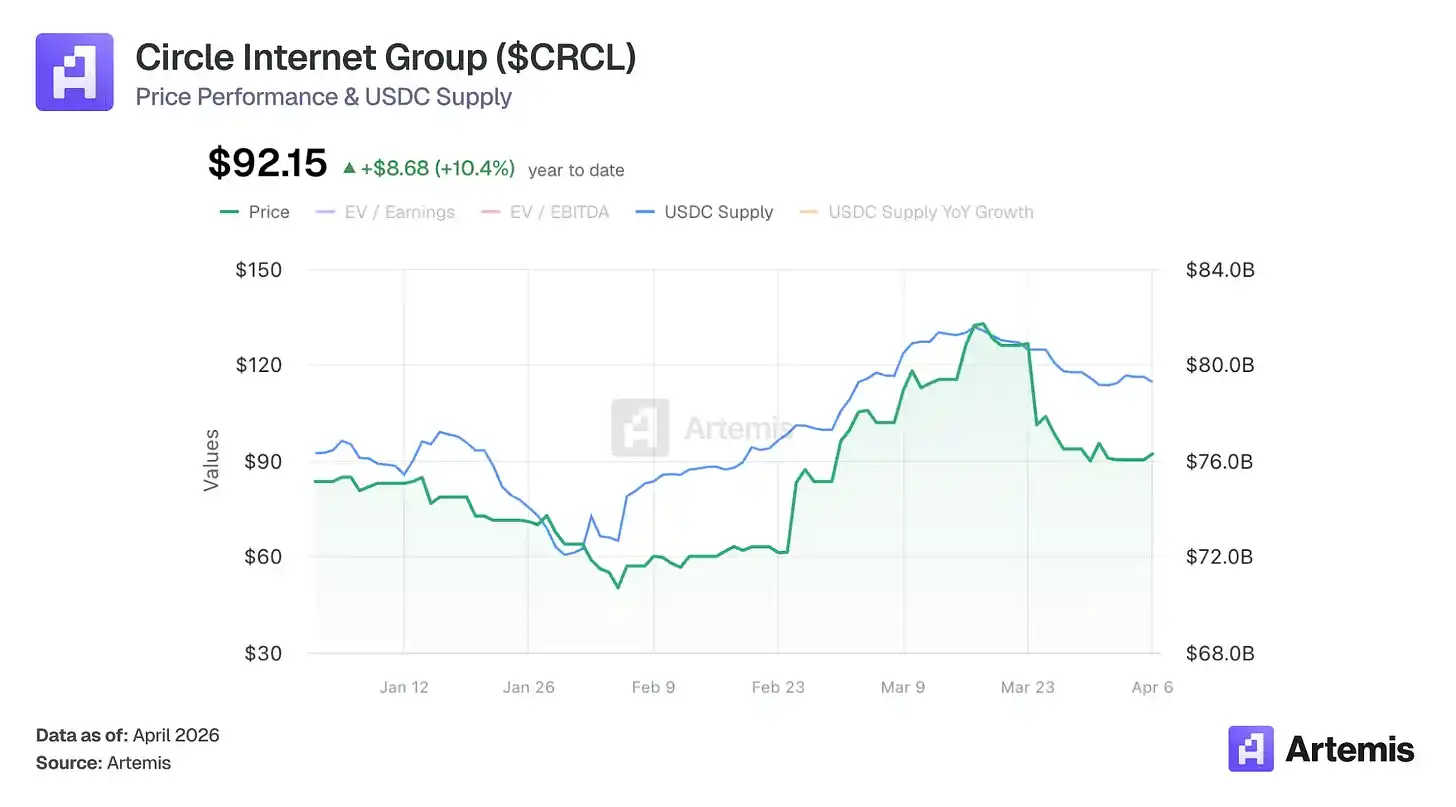
Shenchao Overview: The market treats Circle as an interest-rate-sensitive money market fund, yet USDC supply grew by 72% even as interest rates declined. More overlooked is the wave of AI agent commerce: McKinsey forecasts agent-driven transactions to reach $3–5 trillion by 2030, and of the $106 million in transaction volume on the HTTP payment standard x402, 99.6% were settled in USDC. This represents a structural opportunity for stablecoin demand—not merely an interest-rate bet.
Conclusion:
The market has priced Circle as an interest-rate-sensitive money market fund, betting that the Federal Funds rate is anchored on a blockchain track. We believe this framework misprices the business. USDC supply grew 72% to $75.3 billion in 2025, even as the Fed cut rates by 75 basis points in the second half of the year, indicating that USDC demand is driven by real utility adoption rather than pure yield-seeking behavior. Our base case forecasts the total stablecoin market to reach approximately $1.5 trillion by 2030, with USDC’s average supply at $284 billion. Even as reserve yields are expected to compress, we anticipate Circle’s reserve income to rise to $9.2 billion by 2030 (roughly 3.5 times the 2025 level), as supply growth outweighs rate compression. Combined with Circle Payment Network (CPN) expanding to $350 million in revenue and distribution costs declining from 60% to 55%, our base case projects total revenue of $9.8 billion and net income of approximately $1.8 billion in 2030.
Several tailwinds are supporting this trajectory: the GENIUS Act established a federal stablecoin framework favorable to compliant issuers; Circle’s payment network has gained early traction, with 55 financial institutions registered and an annualized transaction volume of $5.7 billion, providing transaction-based revenue streams that diversify away from interest rate sensitivity; stablecoin adoption is expanding in B2B payments, cross-border settlement, and DeFi. Our base case yields a forecasted EPS of $6.73 by 2030, implying a target price of approximately $168 based on a 25x terminal P/E ratio, representing an 83% upside from current levels.
Comparable Companies Table:
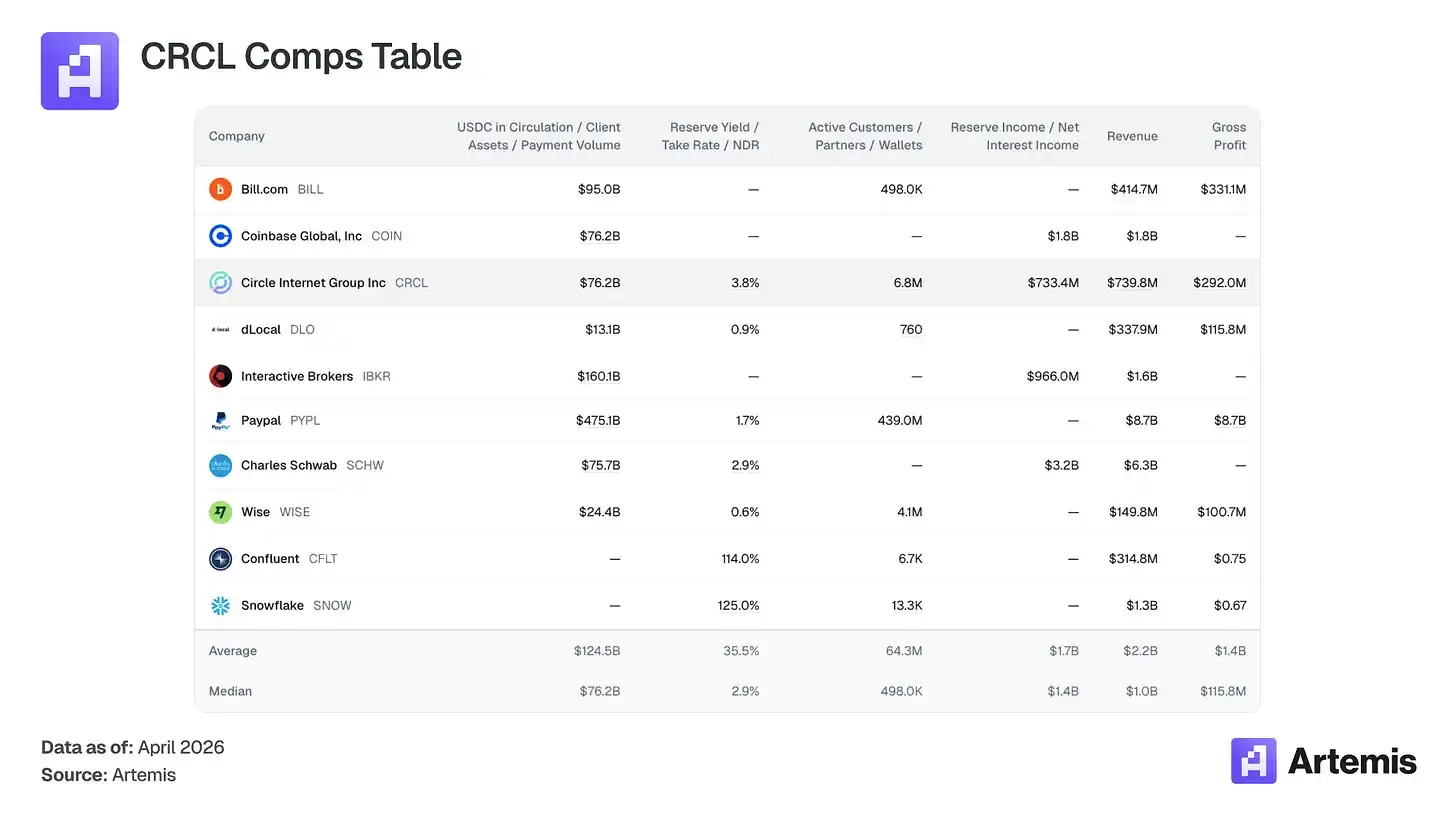
There are no direct publicly traded comparable companies as stablecoin issuers that monetize reserve float. Our comparable set includes companies that share key attributes with Circle’s business: float-based revenue models (Charles Schwab, Interactive Brokers), digital payment infrastructure (PayPal, Wise, dLocal, Bill.com), crypto-native platforms (Coinbase), and high-growth infrastructure with usage-based economics (Snowflake, Confluent).
What does Circle do?
Circle is the issuer of USDC, a USD-pegged stablecoin that is pegged 1:1 to the U.S. dollar. USDC is minted when users deposit U.S. dollars and burned when they redeem it. The yield generated by the reserves—approximately 43% repurchase agreements, 43% U.S. Treasuries, and 14% bank deposits, held by BNY Mellon and managed through BlackRock’s USDXX fund—constitutes Circle’s primary source of revenue.
Key cost structure details: As the primary distribution partner for USDC, Coinbase receives 100% of the reserve income from USDC held on its platform and 50% of the reserve income from USDC held off-platform. In 2025, Coinbase earned $1.35 billion, accounting for 51% of Circle’s total reserve income. Including non-Coinbase distribution (12.7%), total distribution costs consumed approximately 61% of reserve income, leaving a 39% gross margin. We project that distribution costs will decline from 60% to 55% by 2030 due to growth in non-Coinbase distribution, as new financial institutions, banks, and custodial partners negotiate more favorable terms than Circle’s current agreement with Coinbase. This drives the gross margin to expand from 39% to 54%.
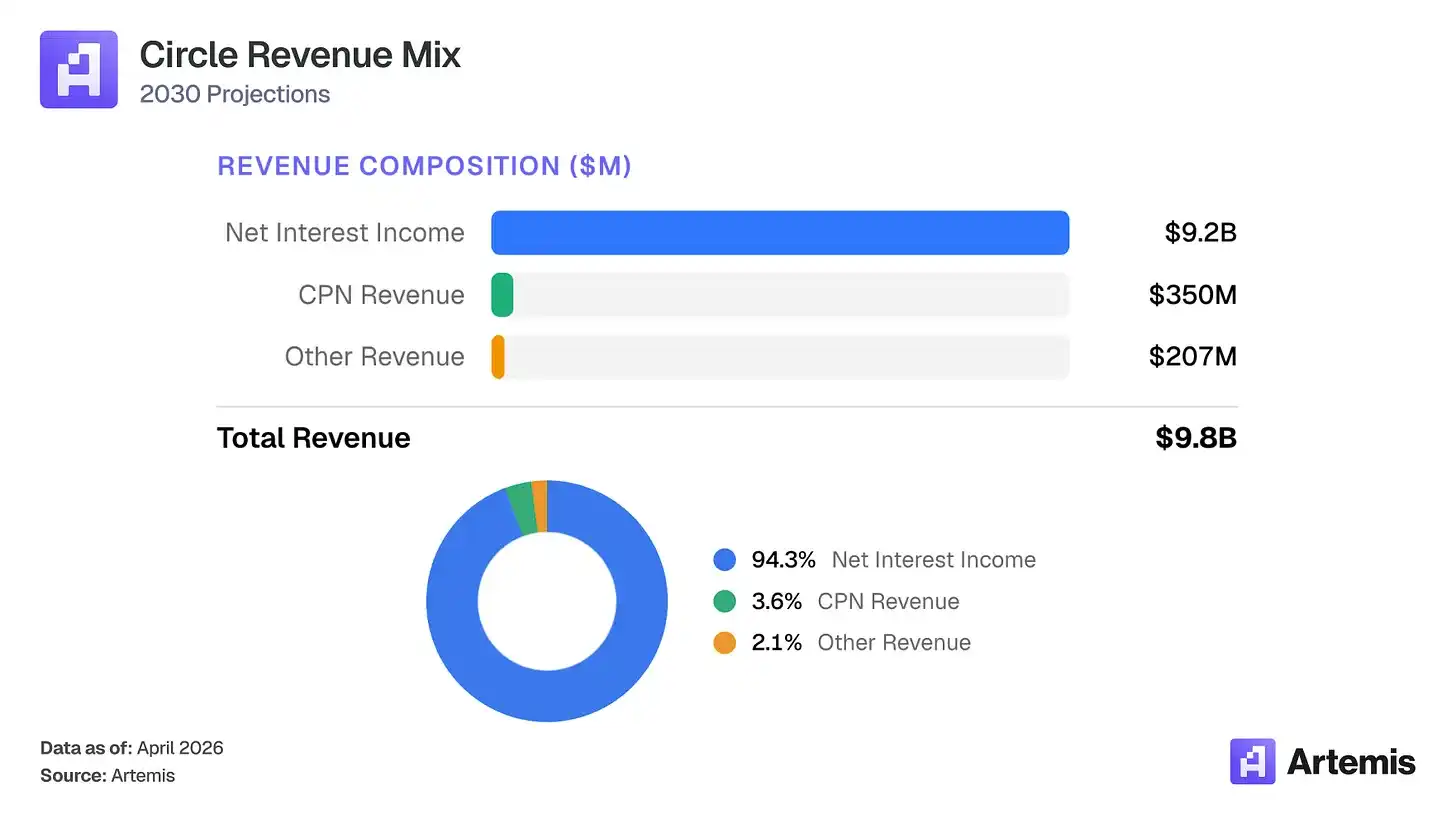
In addition to reserve income, Circle’s most important growth lever is the Circle Payment Network (CPN), a cross-border B2B settlement network built on USDC. Launched in May 2025, CPN has onboarded 55 financial institutions, processed $5.7 billion in annualized transaction volume, and has a pipeline of 500 financial institutions. We project CPN will scale to $17.5 billion in transaction volume by 2030, generating $350 million in transaction-based revenue at a 0.2% fee rate (consistent with a blended cross-border fee of 20 basis points). This revenue stream is interest-rate insensitive, diversifying Circle away from reliance solely on reserve yields. Additional revenue streams (labeled “Other Revenue” in our model), including CCTP (47-50% of cross-chain bridge volume) and Arc settlement infrastructure, are projected to total $207 million by 2030.
Argument #1: Supply growth overwhelms interest rate compression
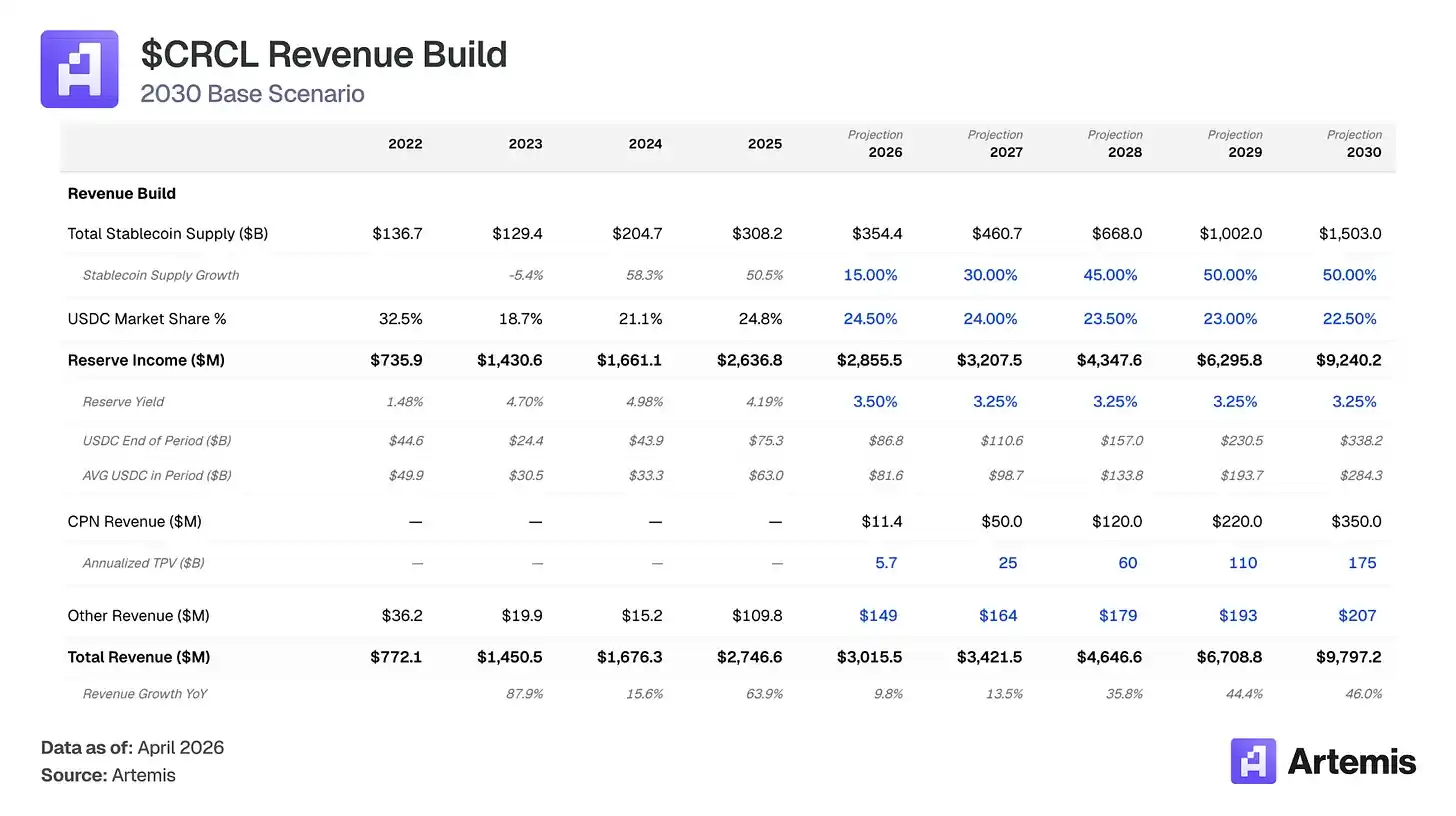
The total market for stablecoins expanded from approximately $137 billion in 2022 to about $308 billion in 2025. Our model forecasts approximately $1.5 trillion by 2030, representing a compound annual growth rate of about 37%. Today, the total circulating supply of stablecoins (approximately $316 billion) represents about 1.4% of the $227 trillion U.S. M2 money supply. Our base case scenario implies approximately 6%, still a modest share of dollar-denominated liquidity.
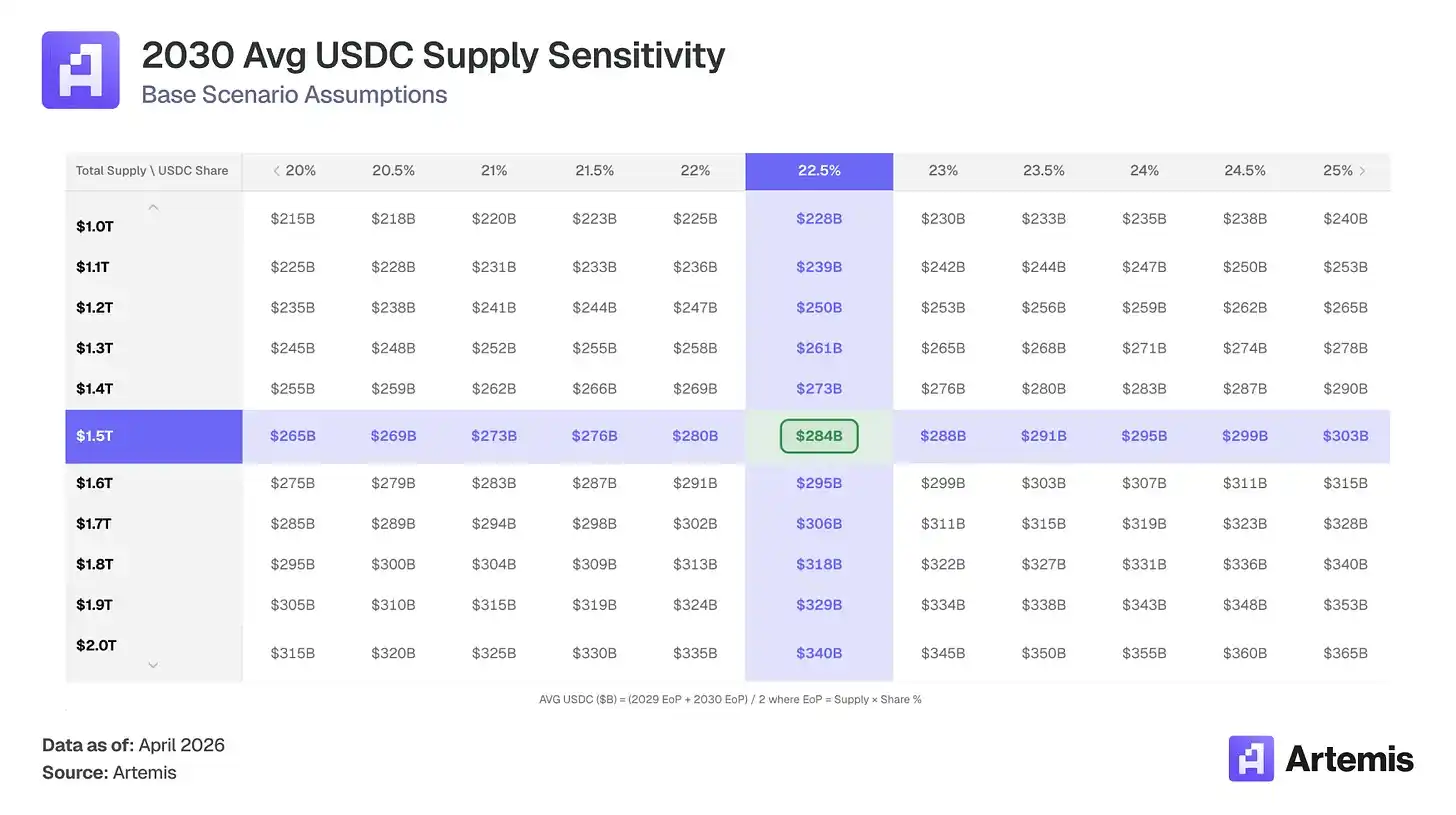
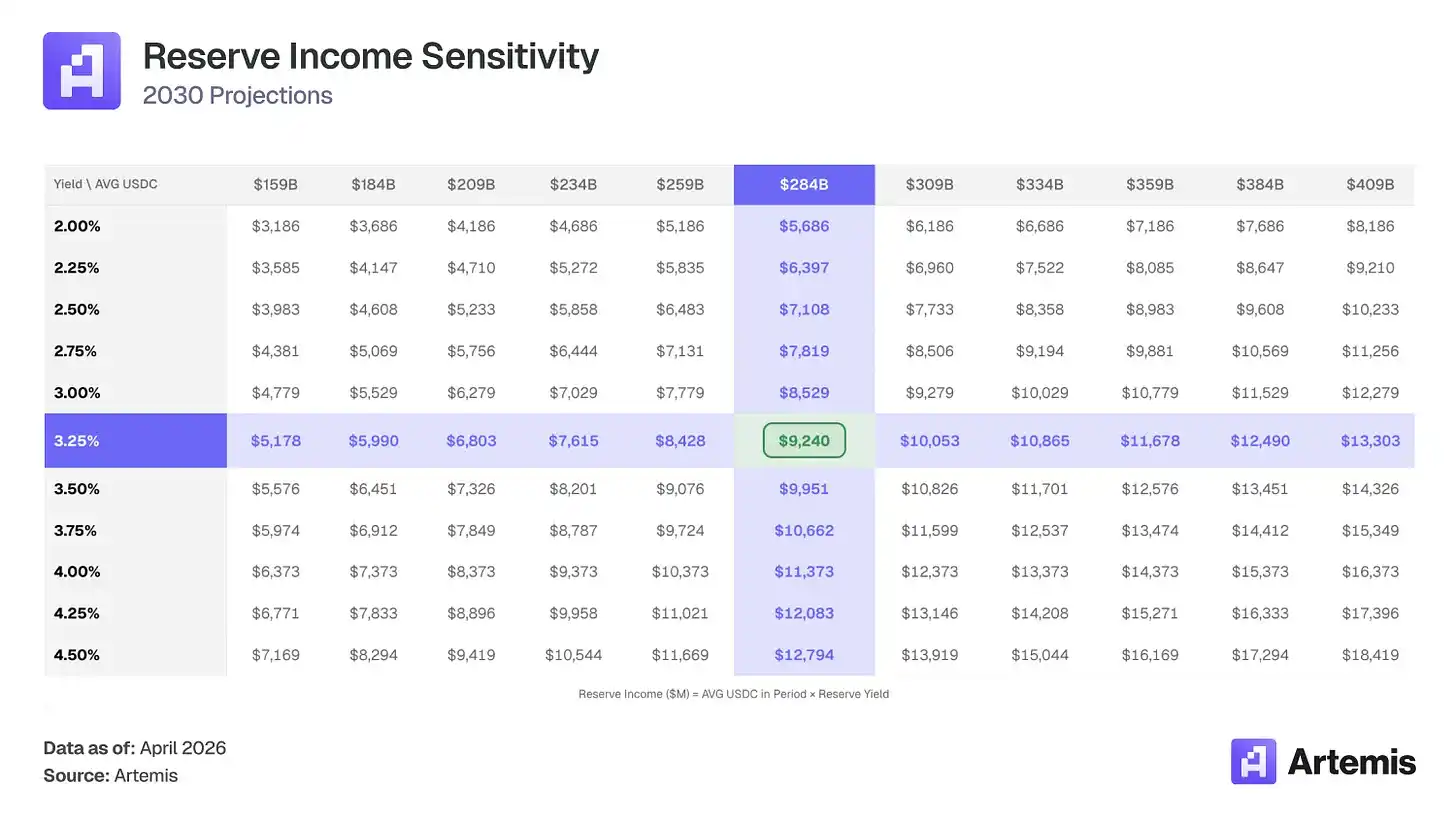
We project that USDC will maintain a 22–25% market share (a modest decline from 24.8% due to white-label and bank-issued stablecoins capturing market share), resulting in a USDC supply of $338 billion by 2030—approximately 4.5 times today’s level. Simply put, even if Circle’s effective reserve yield declines, the pure growth in USDC supply—from $63 billion to an average of $284 billion—is sufficient to offset this. As a result, reserve income increases 3.5-fold, from $2.64 billion to $9.24 billion.
Argument #2: Agency commerce will drive the next wave of stablecoin demand.
AI agents are on track to autonomously execute trades by 2030. McKinsey predicts global agent-driven commerce sales will reach $3–5 trillion by 2030; Gartner estimates that by 2028, AI agents will mediate over $15 trillion in B2B procurement. These transactions inherently require a stablecoin infrastructure:
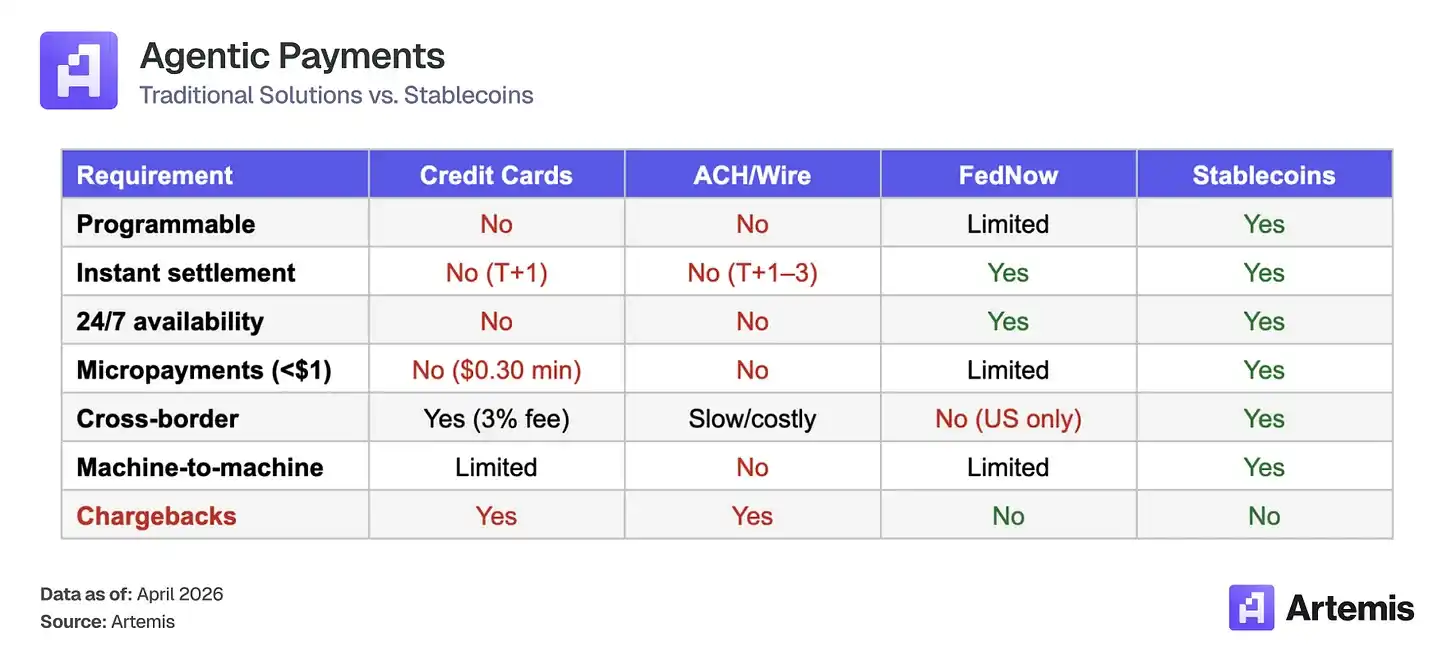
Stablecoins are becoming the settlement layer for this emerging agent economy, and Circle’s business model is expanding accordingly. When agents hold USDC in their wallets to fund autonomous transactions, Circle earns yield on every dollar sitting in these reserves. The larger the pool of USDC held by agents, the greater the revenue base—regardless of transaction frequency.
USDC has become the default stablecoin for proxy payments. In the six months since the x402 payment standard (HTTP-native micropayments) gained traction, it has processed approximately 17.7 million transactions with a volume of about $106 million, over 99.6% of which was settled in USDC.
First-mover advantage has created a flywheel: new builders default to USDC due to its deepest integrations, which further deepens those integrations and makes it harder for alternatives to break through. We do not model agency revenue in our base case, but agency demand is embedded as an upside option in our bull case. If 1–2% of McKinsey’s low-end $3 trillion prediction settles on the USDC rail, this would imply an incremental $30–60 billion in USDC float in agency wallets, from which Circle could earn passive yield.
Valuation and Scenarios
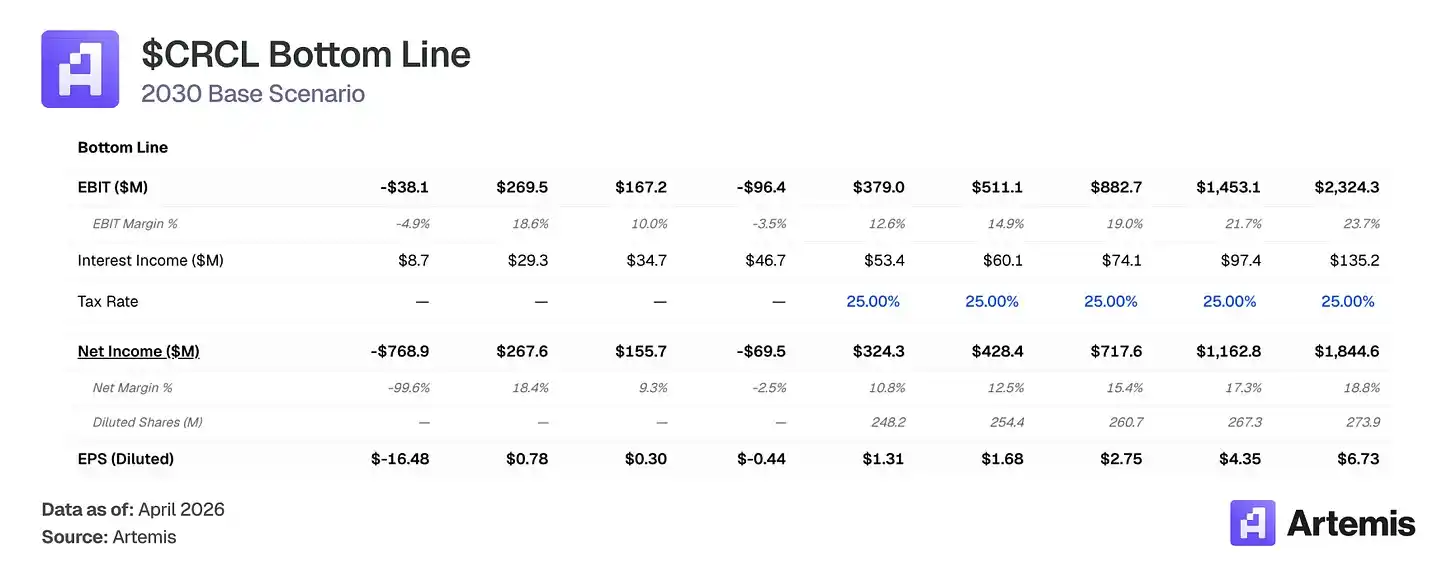
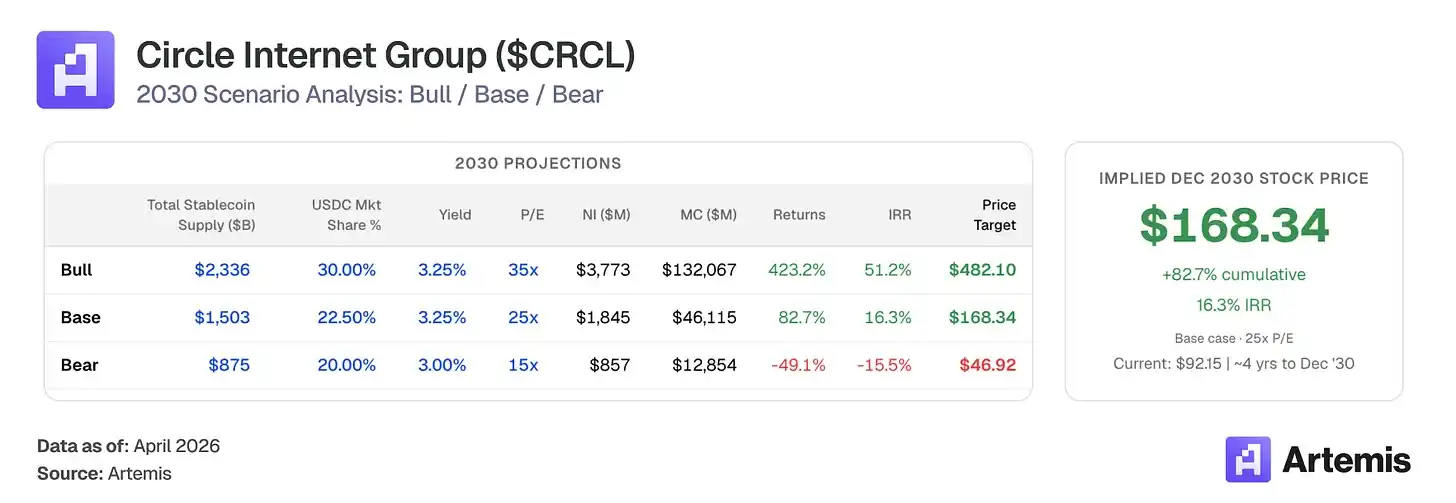
We value CRCL using a terminal P/E ratio based on the 2030 forecasted EPS. Under our base case, net income of $1.84 billion on 273.9 million diluted shares yields an EPS of $6.73. A terminal P/E of 25x—above the comparable weighted average, reflecting Circle’s structural growth trajectory, revenue diversification driven by CPN, and regulatory moat—implies a per-share price of approximately $168 in 2030, representing an 83% upside from current levels.
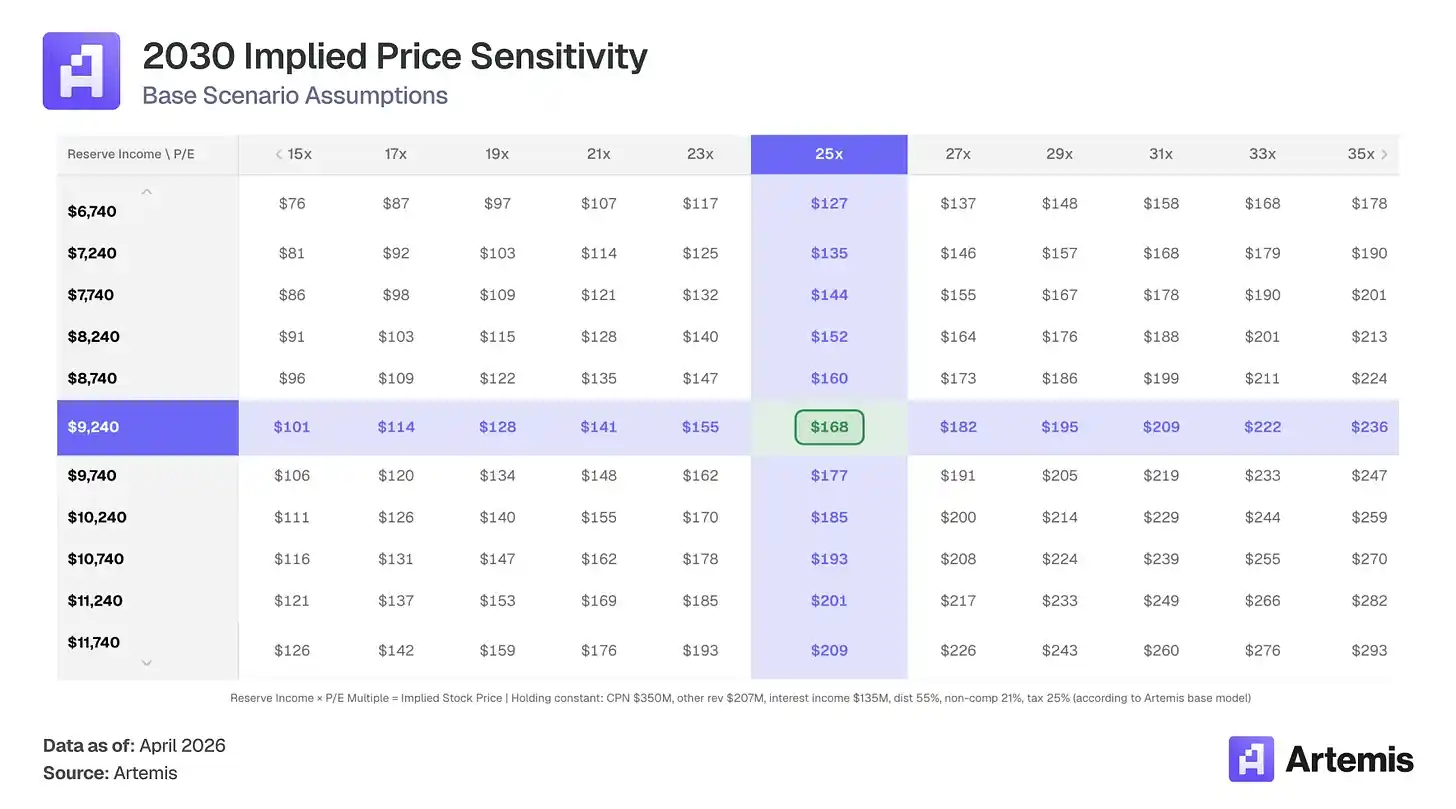
The 25x multiple falls between JPMorgan’s approximately 15x and Coinbase’s approximately 38x, making it suitable for a high-growth infrastructure business transitioning toward recurring, interest-rate-insensitive revenue.
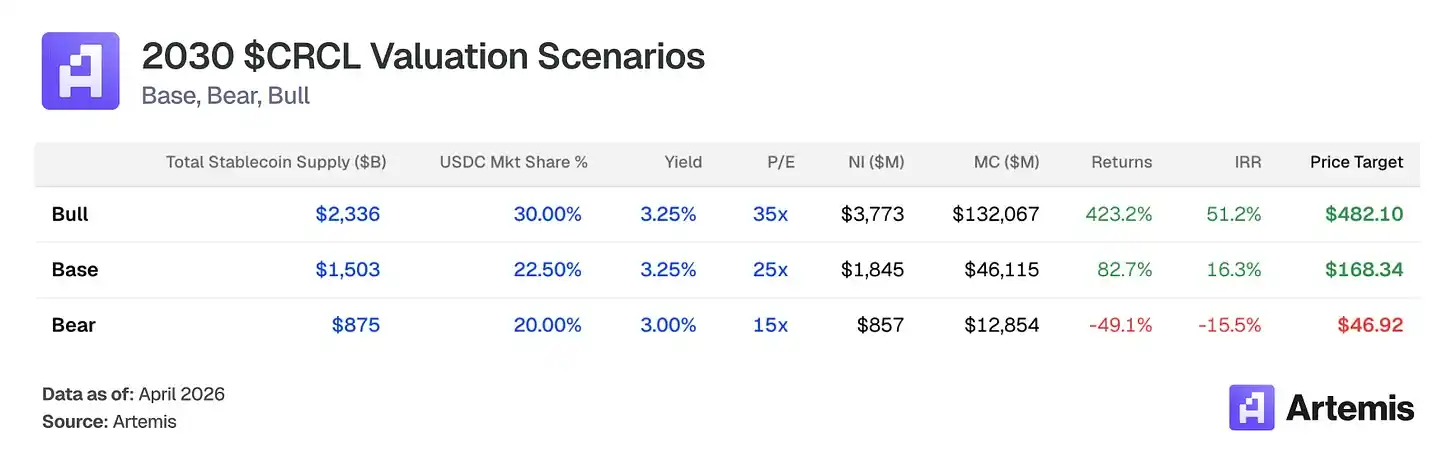
Base case: Assuming continued growth in supply and CPN expansion, the stablecoin market reaches $1.5 trillion, with USDC maintaining a 22.5% market share. Distribution costs moderately decline to 55% due to new financial institution partners negotiating lower revenue shares. Exiting at a 25x terminal P/E multiple based on 2030 projected earnings implies a target price of $168.34—representing an 82.7% upside and a 16.3% IRR.
Bull case: Accelerated stablecoin adoption driven by favorable regulation, CPN network effects, and broad access to traditional finance. Total stablecoin market reaches $2.3 trillion, with USDC capturing a 30% share. Distribution costs compress to 50% due to expansion beyond Coinbase origins. Exit at a terminal P/E multiple of 35x projected 2030 earnings implies a target price of $482.10—representing over 423% upside and a 51.2% IRR.
Bear market scenario: Assuming stablecoin adoption slows and white-label stablecoins erode USDC’s market share to 20%, and interest rate cuts compress reserve yields to 2.75%, CPN’s appeal is disappointing. Exiting at a terminal P/E multiple of 15 times 2030 projected earnings implies a target price of $46.92—approximately a 49% downside potential and a -15.5% internal rate of return.
We believe management quality in the crypto infrastructure space is above average, with particular strengths in regulatory navigation (MTL in 49 states, first MiCA-compliant).
Jeremy Allaire co-founded Circle in 2013 and serves as Chairman and CEO. A serial entrepreneur (formerly CTO of Macromedia and founder/CEO of Brightcove, which went public in 2012), Allaire shifted Circle from a consumer payments app to stablecoin infrastructure, co-launching USDC with Coinbase in 2018, and completed a traditional IPO on the NYSE in June 2025 after a failed SPAC merger.
Heath Tarbert serves as President, having been promoted from Chief Legal Officer in January 2025. Tarbert is a former Chairman and CEO of the CFTC (2019–2021), former Assistant Secretary of the U.S. Treasury, and former Chief Legal Officer of Citadel Securities.
Jeremy Fox-Geen has served as CFO since January 2021. Previously, he was CFO of iStar/Safehold (a NYSE-listed REIT) and CFO of McKinsey & Company’s North America business. He oversaw Circle’s IPO and manages the reserve architecture supporting over $70 billion in outstanding USDC.
Dante Disparte serves as Chief Strategy Officer and Head of Global Policy and Operations. Formerly a founding executive and vice chairman of the Diem Association (Meta’s stablecoin project), he leads global regulatory strategy, public policy, market expansion, and international operations.
The key management risk is founder concentration and high post-IPO equity compensation (over $500 million in 2025, including $424 million in accelerated IPO-related RSUs), which is currently normalizing (Q3 and Q4 2025 equity compensation amounted to $59 million and $48 million, respectively, trending toward an annualized run rate below $200 million).
White-label vs. Platform-Native Stablecoins
The most underestimated risk to USDC’s market share is the launch of branded stablecoins by platforms, major applications, and financial institutions. For example, Hyperliquid has USDH, PayPal has PYUSD, Fidelity has FIDD, and JPMorgan has JPMD. Most recently, Polymarket launched "Polymarket USD," currently wrapped as USDC but potentially a stepping stone toward independent settlement. If this strategy expands under the GENIUS Act framework, USDC could gradually lose its position as the default settlement rail. Our base case forecasts USDC’s market share will decline from 24.8% to 22.5% by 2030 to reflect this fragmentation.
Mitigating factors: White-label stablecoins still require reserve infrastructure, compliance, and—most importantly—deep liquidity. Given that USDC is integrated into every major exchange, wallet, DeFi protocol, and bridge, new branded stablecoins must replicate this liquidity network to function as independent settlement tokens. Deep liquidity pools, tight spreads, and instant redeemability are not easy to establish, and fragmented stablecoins with weak liquidity result in poorer execution for users. The switching cost to launch a fully independent reserve is high enough that most platforms may never complete the transition.
Federal Funds Rate Sensitivity
Reserve income is directly tied to interest rates. A forecast of $284 billion in average USDC reserves in 2030 implies a loss of approximately $2.8 billion in total reserve income for every 100 basis point rate cut. If the Federal Reserve cuts rates to 2.0%, reserve income in 2030 is projected to decline by 25–30% compared to our baseline scenario. The Kalshi prediction market currently prices a 63% probability of further rate cuts before 2027.
Mitigating factor: Even at a 2.5% yield, the average $284 billion in USDC generates $7.1 billion in reserve income—2.7 times the $2.64 billion earned at a 4.19% yield in 2025. Supply growth overwhelms all scenarios except the most extreme interest rate conditions.
Single-product concentration and Coinbase dependency
USDC reserve income accounted for over 96% of 2025 revenue. Coinbase controls approximately 67% of the U.S. cryptocurrency exchange market share and captures 51% of reserve income. As previously noted, Coinbase’s entire revenue base is at risk if it launches its own stablecoin, aggressively renegotiates terms, or if regulatory headwinds slow the growth of USDC supply.
Mitigating Factor 1: Given that Coinbase earns $1.35 billion annually from its arrangement with Circle with virtually no balance sheet risk, it is unlikely they would choose to launch a competing stablecoin. Doing so would require Coinbase to build the regulatory infrastructure and liquidity that Circle spent years developing.
Mitigating Factor 2: For years, the market has leveled similar criticisms at Visa (labeling it a single-product business), yet Visa’s value-added services generated over $10.9 billion in 2025 (a 24% year-over-year increase), demonstrating reduced reliance on interchange fees. We view CPN as Circle’s key diversification lever. By the end of 2030, we project CPN will generate $350 million in transaction-based revenue (approximately 4% of total revenue), which is interest-rate insensitive and independent of Coinbase relationships. Over time, institutional and B2B USDC origins that bypass Coinbase should organically reduce mixed distribution costs.
Tether Resilience and Competitive Landscape
The current supply of USDT is nearly 2.5 times that of USDC, and Tether is actively narrowing the regulatory gap exploited by USDC. In January 2026, Tether launched USAT, a compliant stablecoin issued through Anchorage Digital Bank (regulated by the OCC) under the GENIUS Act, providing Tether with access to the previously locked-in U.S. institutional market. If Tether successfully executes its dual strategy—using USDT for global liquidity and USAT for U.S. compliance—the regulatory moat of USDC will significantly narrow.
Mitigating factors: The competitive landscape is nuanced. USDT dominates centralized exchange trading and remittances outside the U.S., while USDC leads as collateral in DeFi (the default choice on Aave, Compound, and Uniswap), institutional adoption in the U.S., cross-chain bridging (CCTP accounts for 47–50% of bridge volume), and B2B payments ($235 billion in 2025, up 733% year-over-year, with USDC accounting for approximately 65%). These are effectively distinct products serving different total addressable markets. That said, our thesis is built on the expansion of the overall stablecoin market, not on gaining market share at Tether’s expense. Both stablecoins are poised for significant growth.
Disclosure: This material is for informational purposes only and does not constitute investment advice, financial advice, trading advice, or any other form of advice. The views expressed are those of the author and should not be construed as recommendations to buy, sell, or hold any asset. The author or affiliated entities may hold positions in the assets discussed. You should conduct your own research and consult with appropriate financial professionals before making any investment decisions.