




Original author: Sanqing, Foresight News
On March 24 (Eastern Time), Circle (CRCL), the stablecoin issuer, closed on the NYSE at $101.17, recording a single-day decline of over 20%, the largest daily drop since its listing. Its largest distribution partner, Coinbase (COIN), also fell nearly 10%, closing on Nasdaq at $181.04.
The trigger for the sell-off was the leak of details from the latest draft of the Clarity Act, which proposes to prohibit digital asset service providers from paying yields directly or indirectly on stablecoin balances, as well as any structural arrangements economically or functionally equivalent to interest.
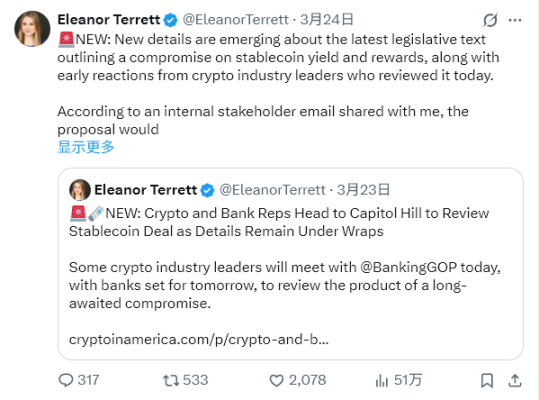
Image source: Tweet by Eleanor Terrett, host of Crypto in America and former Fox Business reporter
On the same day, its competitor Tether announced that it has hired one of the Big Four accounting firms to conduct its first full financial audit, including USDT reserves.
"Directly or indirectly," five characters shut down whom?
The draft text was submitted to representatives from the crypto industry for review in a closed-door meeting on March 24, with banking representatives set to follow up with their review the next day. Journalist Eleanor Terrett disclosed details of the draft in a tweet, citing an email from a stakeholder.
USDC has never paid interest, and Circle, as the issuer, has never paid any yield to token holders. So, how does the draft prohibiting issuers from paying interest relate to Circle?
The scope of the draft extends beyond the issuer. Coinbase is the entity actually paying returns to users.
According to the revenue-sharing structure disclosed in Circle’s prospectus, 100% of the reserve interest on USDC held on the Coinbase platform belongs to Coinbase; for USDC circulating outside the platform, 50% of the reserve interest belongs to Coinbase.
Coinbase passes through the vast majority of reserve earnings generated on its platform to users in the form of USDC Rewards. According to an analysis by Columbia Law School, Coinbase’s profit margin on USDC Rewards is extremely narrow, retaining only a spread of approximately 20 to 25 basis points.
The "direct or indirect" and "economically or functionally equivalent to interest" provisions in the Clarity Act draft were specifically designed to close this loophole.
This regulatory ban may have limited financial impact on Coinbase, or even be positive. As a shareholder in Circle and a recipient of 50% of the pure profits from reserve earnings held off-platform, Coinbase’s business incentive to promote USDC will not disappear.
However, USDC's competitors are not just USDT, but also the U.S. dollar itself.
USDC rewards have positioned USDC as a de facto digital high-yield savings account, one of the key drivers behind USDC's two-year streak of faster growth compared to USDT. Once this channel is closed, users' earnings from holding USDC drop to zero, reducing their willingness to hold it.
The transmission path of shrinking demand points to Circle. Weakening retail demand for holdings has slowed the growth rate of USDC’s total circulating supply, leading to a deceleration in the rate at which reserves are being accumulated. As a result, Circle’s revenue growth narrative, built on expectations of scale expansion, begins to unravel.
The draft also retains the exemption for "activity-based rewards," allowing rewards tied to payments, transfers, or platform usage. However, this represents a completely different product from the current "hold-to-earn" model.
Moreover, the phrase "economically or functionally equivalent to interest" is overly vague, leaving significant room for future regulatory interpretation, and the boundaries of activity-based rewards remain at risk of being tightened.
Another pressure on the same day
If the Clarity Act draft is dismantling Circle’s growth engine, then Tether’s audit announcement released on the same day points to another of Circle’s competitive advantages.
USDC's long-standing differentiated narrative has largely been built on compliance.
Circle regularly accepts reserve attestations from top accounting firms; during those years when regulatory uncertainty weighed on Tether, being "the transparent and compliant one" was a powerful advantage for institutional clients and compliance-sensitive exchanges.
Tether, on the other hand, relies on quarterly attestations rather than full audits to address external concerns; S&P Global downgraded USDT’s credit rating to "weak" in 2025 and warned of the risk of insufficient collateral should Bitcoin prices fall further.
Additionally, the GENIUS Act requires large stablecoin issuers to undergo annual independent audits; Tether’s decision to hire one of the Big Four is more of a response to this legal obligation. But regardless of the motivation, the timing of this signal is sufficient to amplify existing negative sentiment in the market.
Over the past two years, USDC has consistently outpaced USDT with higher growth rates. The narrative of compliance and transparency has been one of the most important drivers of this growth. Tether’s engagement of the Big Four auditors has not yet begun, and the outcomes remain uncertain. However, if the audit is successfully completed, it is clear that Circle’s compliance premium, which has sustained its growth advantage, will be compressed.
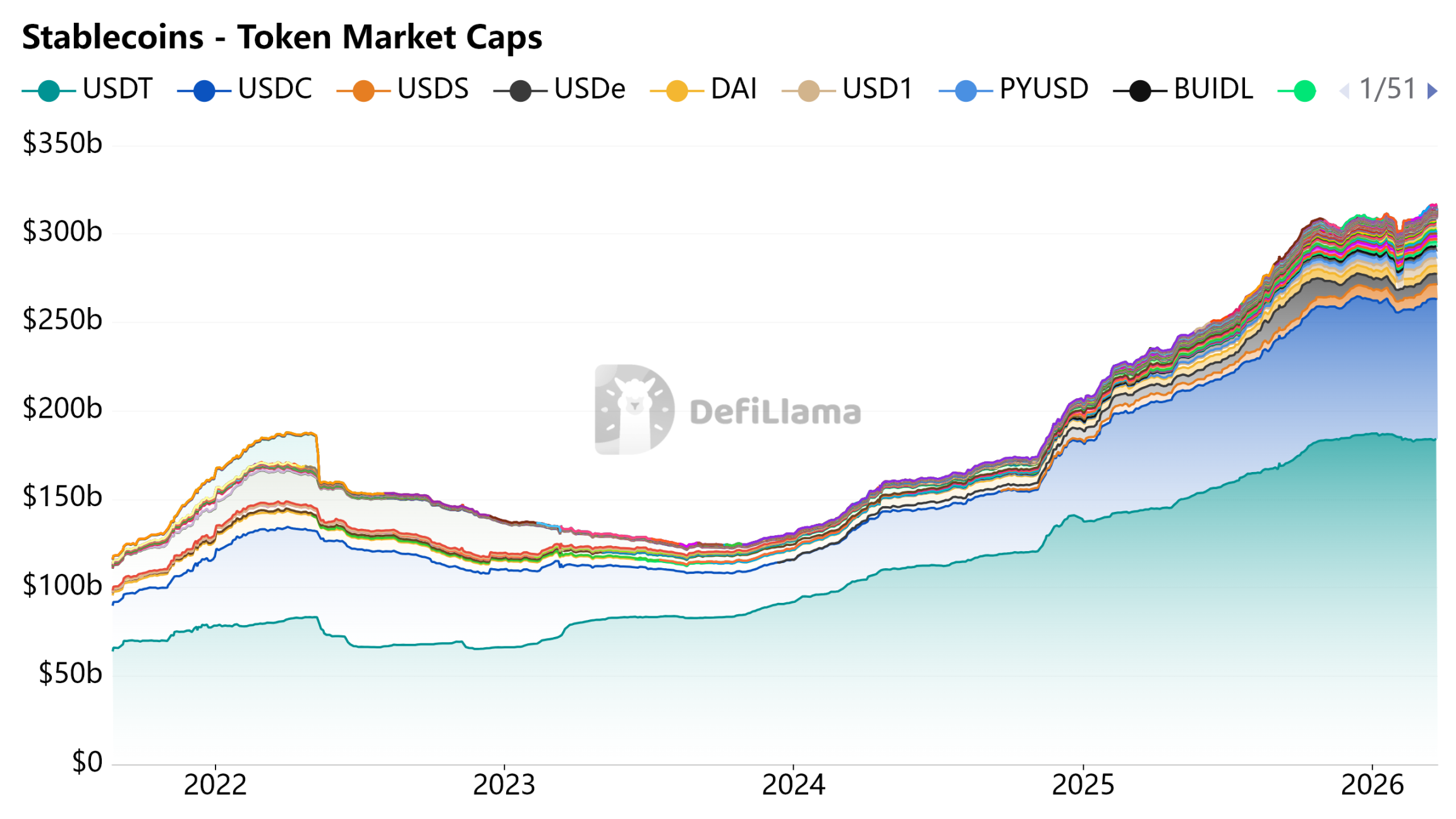
Source: DeFiLlama - Stablecoins
A payment tool, not a savings account
Circle's value is driven by a growth model in which yield incentives encourage users to hold USDC, scaling expands the reserve pool, and reserve interest supports revenue growth. This model works only if stablecoins are permitted to function as interest-bearing assets or savings deposits.
The Clarity Act draft is negating this premise at the legislative level.
Without yield incentives, USDC's growth must rely instead on organic adoption through real-world payment use cases. This path is not impossible, but it is significantly slower and far less certain than yield-driven growth.
Compliance preserved Circle’s license, but not its growth model. Bankers’ answer was clear: stablecoins can exist, but they cannot earn interest.