

Author:Random Thoughts on Observing the Subtle to Understand the Significant
A while ago, I was strongly recommended several small metal stocks, and looking back, I can only say they really paid off. We shouldn't start researching after we're already stuck in a bad position, but rather conduct our research before getting into any investment. Therefore, I'm starting a new series recently: metal and mineral research, to take a look at the market dynamics of various small metals.
Sometimes it feels quite interesting to read these short articles. For example, a few days ago, there was a report about increased import of explosives in the佤邦 (Wa State) of Myanmar, and soon after, the price of tin dropped a bit. At that moment, there was a potential supply-side logic at play.
[Reminder: Fundamentals are just fundamentals and should not be used as a guide for trading.]
So-called "minor metals" may not actually be minor, especially in the foundation of industrial transformation. Once there is a technological breakthrough, these minor metals could very likely become strategic metals.
Before becoming a "energy metal," lithium had a relatively small market scale and was mainly used in areas such as glass, ceramics, and lubricants. However, with the explosive growth of the new energy vehicle and energy storage industries, lithium, as a core material for power batteries, has experienced a sharp increase in demand and market size, leading to a fundamental change in its status.
Magnesium is currently a minor metal with relatively clear potential to become the next commodity listed on futures markets. The global magnesium market size is approximately at the million-ton level at present, mainly used in aluminum alloy additives and die-casting applications. In the future, if magnesium triggers major changes in lightweight materials (such as in the automotive and aerospace industries) or in battery technologies, leading to orders-of-magnitude growth in its production and consumption, it could very well be upgraded to a base metal or a separate category.
I remember a part of the previous conversation between Huaxia and Everbright regarding the colored market conditions:
Strategic minor metals, such as rare earths, tungsten and molybdenum, cobalt, nickel, and tin, will continue to see their value reassessed in the future. The core logic lies in the broader context of global competition. Even if Sino-US competition temporarily eases, in the long term, the competitive nature of strategic metals will only intensify. These metals must meet two conditions: either they are highly scarce, or their supply chains are highly concentrated.
For example, cobalt: the Democratic Republic of Congo (DRC) is the main supplier, and it uses cobalt supply as a significant bargaining chip, with strong political factors influencing its pricing. Another example is Indonesia's nickel and tin—global dependence on Indonesia is high, and these resources are inherently scarce, making them likely to become key commodities in the next round of geopolitical competition. These commodities are either at the bottom of their cycles or have not yet fully realized their value, and thus have significant potential for future revaluation.
This year, the non-ferrous metals sector has shown strong performance. Apart from macroeconomic factors related to funding, an important reason is that global supply chain security—particularly the security of resources and mineral resources—has faced significant challenges.
China established a strategic mineral layout through top-level design as early as 2016: the State Council issued the "National Mineral Resources Plan (2016–2020)," with the core principle of "ensuring the country's economic security, national defense security, and the development needs of strategic emerging industries." It officially included 24 types of minerals—such as chromium, aluminum, nickel, tungsten, tin, antimony, cobalt, lithium, rare earths, zirconium, crystalline graphite, petroleum, natural gas, shale gas, coal, coalbed methane, uranium, gold, iron, molybdenum, copper, phosphorus, potassium salts, and fluorite—into the list of strategic minerals. This list includes several key strategic metals, laying a solid resource foundation for the high-quality development of related industries.
China has "resource endowments + production advantages" in four mineral fields: tungsten, antimony, tin, and molybdenum. Tungsten, antimony, tin, and molybdenum are China's four major strategically advantageous minerals. Let's now look at the supply of these four minerals.
I. Types of Tin Supply Sources
The main source of tin supply is cassiterite (SnO₂, tin oxide), which is the primary natural form of tin and accounts for more than 95% of the world's tin ore resources. In addition, there are small amounts of sulfide minerals such as stannite (Cu₂FeSnS₄), but they have relatively low economic value. Cassiterite is concentrated through mineral processing to obtain tin concentrate, which is then refined into refined tin through pyrometallurgical or hydrometallurgical processes.
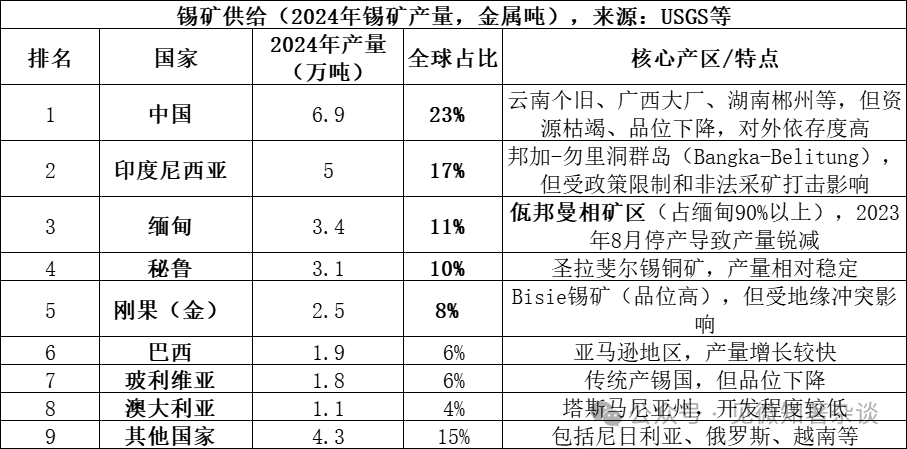
The 2025 data has not been fully released yet. However, due to continued production halts in the佤邦 (Wa State) region of Myanmar, output is expected to further decline to below 20,000 tons, reducing its share to around 7%. The top five producing countries together will account for approximately 69%, while the top eight countries combined will account for 85%, indicating a highly concentrated supply.
The佤邦 (Wa State) in Myanmar has a significant impact on the tin industry chain, and the core reasons are as follows:
1) Large historical supply volume: Before the production halt in August 2023, Myanmar normally produced about 50,000 to 60,000 tons annually (accounting for 15-20% of the global supply), with the Wa State region contributing over 90% of Myanmar's total production, i.e., approximately 45,000 to 54,000 tons annually. This volume represents about one-sixth of the global supply, and the sudden production halt created a significant supply gap.
2) Critical to China's tin exports: China is the world's largest producer of refined tin (accounting for 45% of global production), but domestic mine resources are depleting, leading to heavy reliance on imports. Myanmar used to be China's largest source of tin ore imports. In 2022, China imported approximately 36,000 metal tons of tin concentrate from Myanmar, accounting for 60-70% of China's total imports. The shutdown in Wa State directly caused a shortage of raw materials for Chinese smelters.
3) High uncertainty in resuming production: Although the Wa State began its production resumption process in 2025, the actual progress has been significantly lower than expected due to multiple factors such as policies, equipment issues, and the rainy season. As of the end of 2025, the monthly average export volume was only 2,000–3,000 physical tons (approximately 1,000–1,500 metal tons), far below the pre-shutdown monthly average of 3,000 metal tons.
4) Exacerbating the global tight supply-demand balance: The global tin market has long been in a state of tight supply and demand (reserve-to-production ratio of only 15 years), and any minor fluctuations in production from a major producing country are significantly amplified by the market. The "shutdown-slow recovery" process in Wa State has become the most critical driving factor behind the sustained rise in tin prices from 2024 to 2025.
Tin ore rarely occurs in isolation and is commonly associated with various metallic and non-metallic minerals.
Ore deposits associated with medium-acid granites: This is the most important type of tin deposit. In skarn-type deposits (e.g., the Shizhuyuan deposit in Hunan) and cassiterite-sulfide-type deposits (e.g., the Gejiu deposit in Yunnan and the Dachang deposit in Guangxi), tin is commonly closely associated with tungsten, molybdenum, bismuth, copper, lead, zinc, and silver, forming large-scale polymetallic ore fields. In pegmatite-type deposits, tin tends to occur together with rare elements such as niobium, tantalum, lithium, beryllium, rubidium, and cesium.
Placer tin ore: Formed by the weathering and transportation enrichment of primary tin ore. In addition to cassiterite, placer deposits often simultaneously enrich heavy minerals such as native gold, wolframite, monazite, rutile, and xenotime, making the comprehensive utilization value of placer tin ore very significant.
II. Types of Ore in the Supply Side of Antimony
The main source of antimony supply is stibnite (Sb₂S₃, antimony sulfide), which is the most important antimony mineral in nature and accounts for more than 80% of the world's antimony ore resources. In addition, there are small amounts of secondary minerals such as antimony oxide (Sb₂O₃). Stibnite is concentrated to produce antimony ore concentrate, which is then processed through pyrometallurgical or hydrometallurgical methods to produce metallic antimony or antimony compounds.
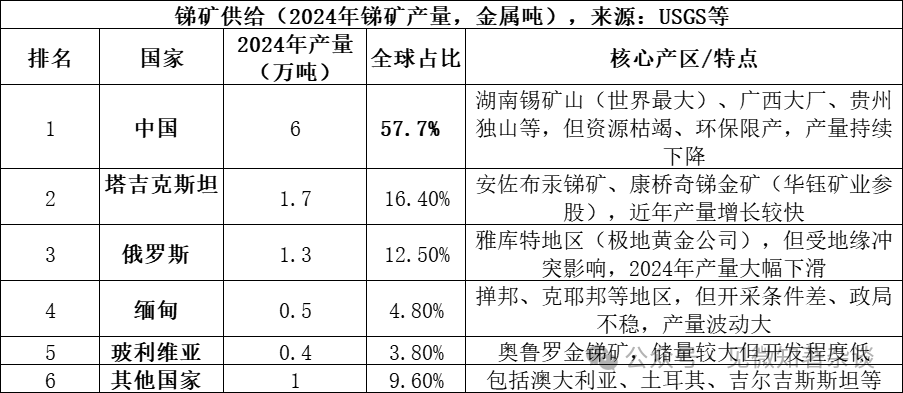
The top three producing countries (China, Tajikistan, and Russia) together account for 86.6%, indicating a highly concentrated supply. Although China's production share exceeds 50%, it has significantly declined from 90% in 2010, mainly due to stricter environmental policies and resource depletion.
Associated mineral assemblages of antimony ores:
It mainly forms in medium- to low-temperature hydrothermal environments: the majority of economically valuable antimony deposits are formed under medium- to low-temperature hydrothermal conditions. In such environments, stibnite often precipitates together with cinnabar (mercury), pyrite, quartz, and other minerals, forming typical low-temperature hydrothermal deposits.
Combinations of different types of mineralization: 1) In the famous antimony deposit at Xikuang Mountain in Hunan, stibnite coexists with pyrite, realgar, orpiment, cinnabar, calcite, and quartz; 2) When antimony mineralization overlaps with gold or tungsten mineralization, it forms more complex and valuable deposits such as antimony-gold-tungsten deposits.
III. Types of Tungsten Ore in the Supply Side
The main sources of tungsten supply are scheelite (CaWO₄, calcium tungstate) and wolframite ((Fe,Mn)WO₄, iron-manganese tungstate), which are the two primary ore forms of tungsten in nature. Scheelite accounts for more than 70% of the world's tungsten resources, while wolframite accounts for approximately 25–30%. Scheelite is commonly found in skarn-type deposits, whereas wolframite is typically found in high-temperature hydrothermal quartz vein-type deposits. Both ores are processed through mineral dressing to produce tungsten concentrate (with WO₃ content ≥ 65%), which is then further refined by pyrometallurgical or hydrometallurgical methods to produce ammonium paratungstate (APT), tungsten oxide, or metallic tungsten.
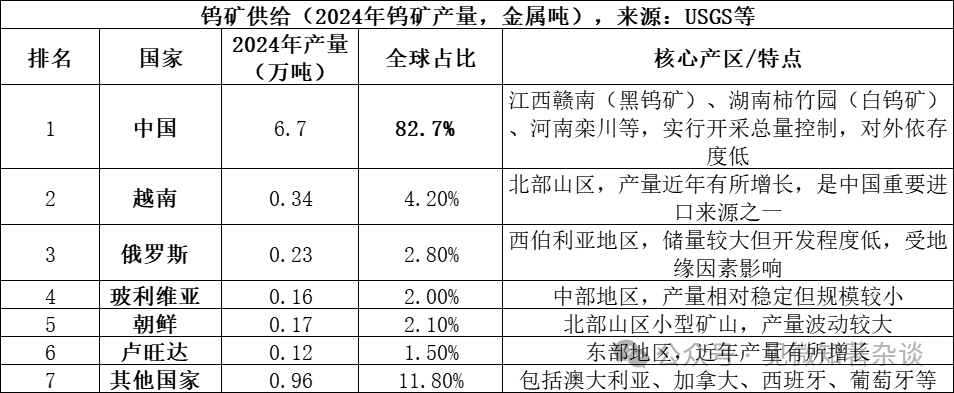
Tungsten Market Supply Landscape:
1) China dominates supply but faces weak growth: China is not only the largest tungsten producer (accounting for 83% of global production) but also holds approximately 52% of the world's tungsten ore reserves. However, domestic tungsten mining is subject to strict total production control quotas. Although the 2024 mining quota was set at 114,000 tons, the actual output reached 127,000 tons, indicating that over-mining has been effectively controlled. At the same time, long-term mining has led to the depletion of high-grade ores, and the grade of raw ore continues to decline, which restricts supply growth from the source.
2) Limited New Supply from Overseas: In 2024, global tungsten mine production outside of China is expected to be approximately 14,000 metal tons, with a dispersed source structure. Significant new supply will mainly come from projects such as the Bakutau tungsten mine in Kazakhstan; however, these contribute a relatively small share to the global supply and are unlikely to change the supply structure dominated by China in the short term.
3) Recycled tungsten is an important supplement: In addition to primary ores, recycled tungsten (such as scrap cemented carbides) also serves as a significant supply source. Currently, about 35% of the global tungsten supply comes from recycling. However, China's recycling rate and product quality still lag behind international advanced levels.
Associated mineral assemblages of tungsten deposits:
Quartz vein-type and greisen-type deposits: These types of deposits are usually associated with granite intrusions. The associated minerals are very diverse, including, in addition to wolframite, cassiterite, molybdenite, bismuthinite, beryl, topaz, tourmaline, and others. They are commonly found in quartz veins at the top of granite bodies or in the surrounding rocks nearby.
Skarn-type deposits: These deposits form at the contact zones between intermediate to felsic intrusive rocks and carbonate rocks (such as limestone), primarily containing scheelite. The associated mineral assemblage differs from that of quartz vein-type deposits and commonly occurs closely with sulfide minerals such as chalcopyrite, galena, sphalerite, and molybdenite. The Shizhuyuan deposit in Chenzhou, Hunan, is a world-class example of this type, simultaneously enriched in tungsten, tin, molybdenum, bismuth, beryllium, fluorite, and other resources.
Four. Molybdenum Supply Side Ore Types
The main source of molybdenum supply is molybdenite (MoS₂, molybdenum disulfide), which is the most important and economically valuable molybdenum mineral in nature. Molybdenite commonly coexists with metals such as copper and tungsten in porphyry-type ore deposits. The ore is processed through mineral dressing to obtain molybdenum concentrate (typically requiring a MoS₂ content of ≥85%), which is then further processed via roasting or hydrometallurgical methods to produce molybdenum oxide (industrial molybdenum oxide), ferromolybdenum, or ammonium molybdate. These products are subsequently used in steel alloys, chemical industries, and other fields.
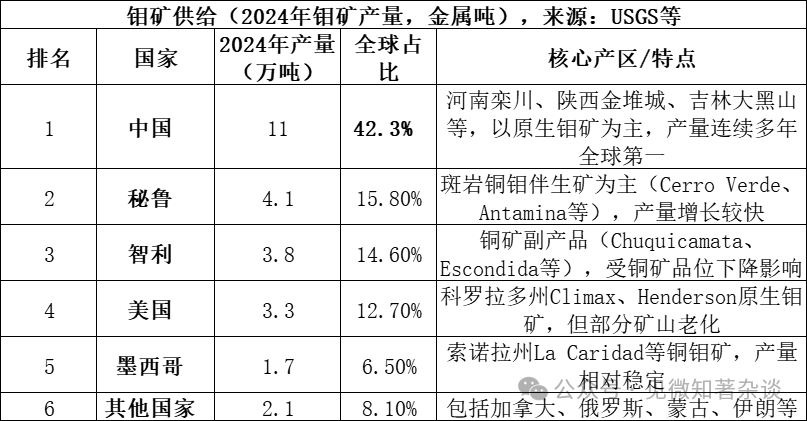
The five largest producers (China, Peru, Chile, the United States, and Mexico) account for a combined 91.9%, indicating a highly concentrated supply. In 2024, global molybdenum reserves are approximately 15 million tons, with China holding 5.9 million tons (39.3% of the total), resulting in a reserve-to-production ratio of about 57 years.
China holds a triple position in the molybdenum market: "resources + production + consumption":
1) Resource Endowment Advantage: China's molybdenum reserves account for nearly 40% of the global total (590,000 tons in 2024), primarily in the form of primary molybdenum ores. These deposits are large in scale and relatively high in grade (for example, the Luanchuan molybdenum deposit has an average grade of about 0.1%), giving China a more favorable resource endowment compared to most other countries.
2) Absolute production dominance: China's molybdenum production accounts for more than 42% of the global total and has remained the world's largest for many consecutive years. Unlike metals such as tin and antimony, China's molybdenum industry does not rely on imports, with a domestic raw material self-sufficiency rate of over 90%. This contrasts with the tin market, where China depends on imports from Myanmar.
3) Complete industrial chain: China has a complete industrial chain covering mining, ore dressing, smelting, and deep processing (ferromolybdenum, molybdenum powder, molybdenum chemicals). Leading enterprises such as CMOC (Chinalco Molycorp) and Golden Molybdenum Co., Ltd. possess global competitiveness.
4) Consumer Market Center: China is also the world's largest consumer of molybdenum (approximately 130,000 tons in 2024, accounting for more than 45% of the global total), primarily used in steel alloys (more than 70% of total consumption), forming a closed-loop system of self-production and self-consumption.
5) A significant portion of the world's molybdenum is a by-product of copper mining: the ore grades of many large porphyry copper deposits are declining. Several major copper mines may reach the end of their operational lifetimes in the mid-2030s, which will constrain future molybdenum supply growth.
Associated mineral assemblages of molybdenite:
Porphyry molybdenum deposits / Porphyry copper deposits: This is the most important type of molybdenum deposit in the world. In porphyry copper deposits (such as Dexing Copper Mine), molybdenum (as molybdenite) is a by-product that occurs closely associated with copper sulfides. In porphyry molybdenum deposits (such as Luanchuan in Henan and Jinduicheng in Shaanxi), molybdenum is the main product, but it is often accompanied by elements such as tungsten and rhenium.
Skarn-type deposits: These types of deposits form at the contact zone between intermediate to felsic intrusive rocks and carbonate rocks. In this environment, molybdenite often occurs closely associated with wolframite, forming a molybdenum-tungsten association (e.g., the Shizhuyuan deposit in Hunan), and can also be accompanied by various metal sulfides.
Quartz vein-type and greisen-type deposits: These types of deposits are usually associated with granite. In wolframite-quartz veins, molybdenite is often present as an associated mineral, and may also be accompanied by other minerals such as bismuthinite and arsenopyrite.