





Author: TechCrunch / Sensor Tower
Compiled by Deep潮 TechFlow
Shenchao Digest: The news that OpenAI is collaborating with the U.S. Department of Defense (renamed the "War Department" under the Trump administration) has sparked strong backlash among users.
Meanwhile, Anthropic gained user trust through its refusal to cooperate, causing Claude’s daily downloads to surge and top the App Store. These figures directly quantify the real-world impact of AI ethical stances on user behavior.
The full text is as follows:
On February 28 (Saturday), the number of U.S. users unloading the ChatGPT mobile app surged by 295% compared to the previous day. This reaction directly followed the announcement of a collaboration agreement between OpenAI and the U.S. Department of Defense (DoD)—a department that was renamed the "War Department" during the Trump administration.
This data comes from the market research firm Sensor Tower. A single-day increase of 295% is a significant anomaly compared to ChatGPT’s average daily uninstall rate of 9% over the past 30 days.
Meanwhile, downloads of Claude, Anthropic’s AI model and a competitor to OpenAI, saw a reverse surge in the U.S. Downloads rose 37% on February 27 (Friday) compared to the previous day, and further increased by 51% on February 28 (Saturday). Previously, Anthropic announced it had declined to collaborate with the U.S. Department of Defense, citing an inability to reach agreement on terms—Anthropic expressed concerns that AI could be used to monitor U.S. citizens or deployed in fully autonomous weapon systems lacking adequate safety capabilities.
Data shows that a significant portion of users tend to support Anthropic’s position on this issue.
ChatGPT’s downloads were also affected. On the Saturday following the announcement of the partnership, its U.S. downloads declined by 13% compared to the previous day. The downward trend continued on Sunday, with a further 5% drop. In contrast, on the Friday before the partnership announcement, the app had recorded a 14% day-over-day increase in downloads.
These rapid changes are also reflected in Claude’s App Store ranking. On Saturday, Claude rose to the number one spot on the U.S. App Store’s free apps chart and maintained this position as of Monday, March 2. This represents an increase of more than 20 positions compared to approximately a week earlier (February 22, 2026).
Users have also expressed their views on the decision to partner with OpenAI through app ratings. Sensor Tower data shows that on Saturday, the number of 1-star reviews for ChatGPT surged by 775%, and on Sunday, they increased a further 100% week-over-week; meanwhile, 5-star positive reviews dropped by 50% during the same period.
Data from other third-party providers corroborates Sensor Tower’s findings.
For example, Appfigures noted that on Saturday, Claude’s total daily downloads in the U.S. surpassed ChatGPT for the first time. The firm also observed an increase in Claude’s U.S. downloads, but estimated a higher figure: an 88% day-over-day increase on Saturday.
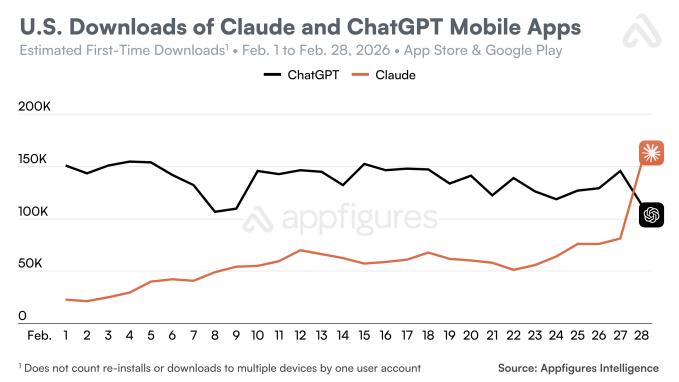
Appfigures also noted that Claude is currently the top free iPhone app in six countries outside the U.S., including Belgium, Canada, Germany, Luxembourg, Norway, and Switzerland.
Third market research firm Similarweb stated that over the past week, Claude’s downloads in the U.S. were approximately 20 times higher than in January, but the firm noted that this may not be entirely due to political factors, as other reasons could also be at play.