





Meme coin traders in Chinese and English-speaking communities are primarily active on BSC and SOL, respectively. However, when it comes to complaining, players from both regions have converged in the same way.
In Chinese-speaking circles, people complain about Niu and Afeng, while in English-speaking circles, the recent target of widespread criticism is Cented.
"7-Second Trader"
According to data from cielo.finance, Cented's realized historical profits have exceeded $10 million.
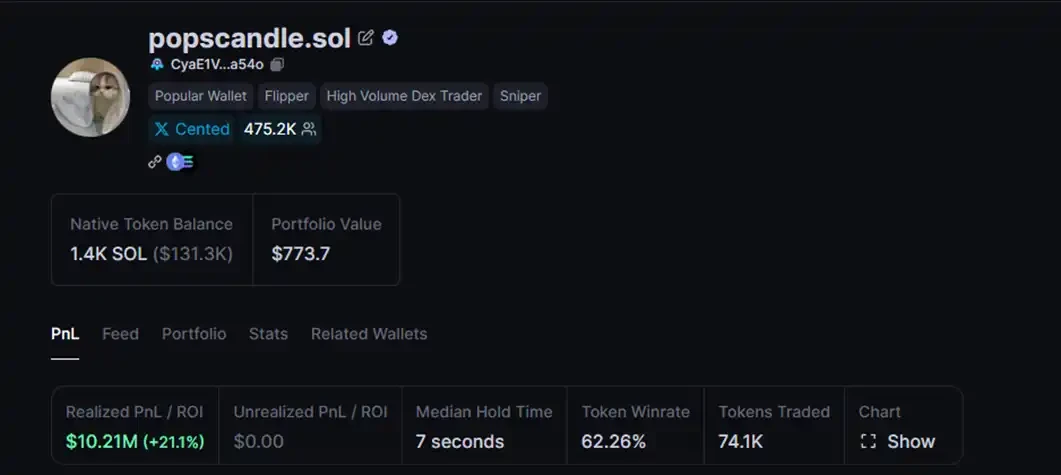
His realized profit over the past 30 days was approximately $727,000, and over the past 7 days, approximately $190,000.
This profitability, often described as a "money printer," corresponds to a total of 308,666 trades over 357 days, a win rate of 62.3%, and a median holding time of just 7 seconds.
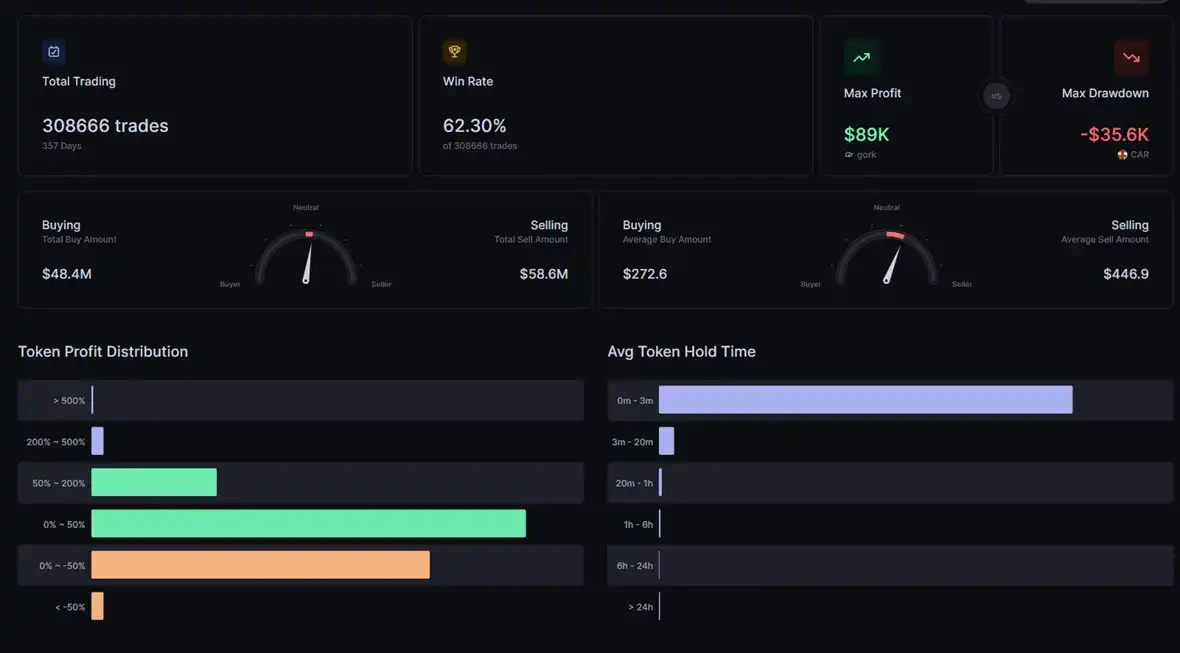
His millions in profits came from no single "big win" by diamond hands; the largest single profit was from $GORK, totaling just around $90,000. In the ranking of his profitable tokens, much of his earnings came from coins most of us have likely never heard of.
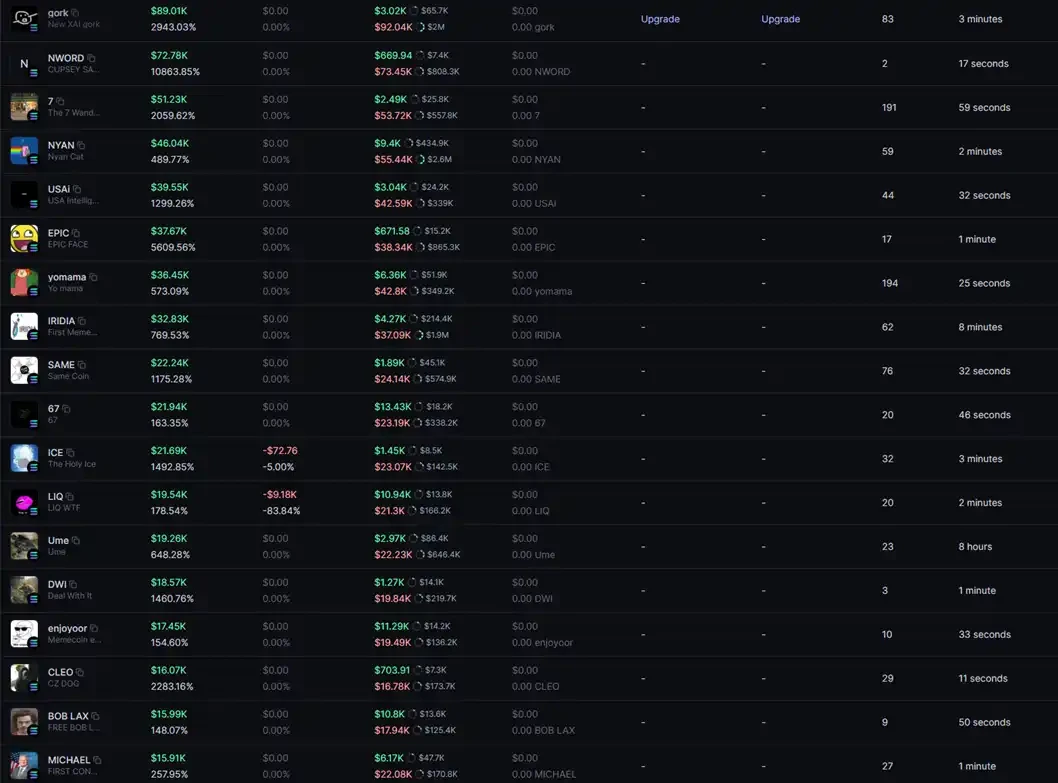
Like many negative perceptions of meme coins, their lifecycle—from creation to demise—may last less than an hour, existing solely to be gambled on. Without traders like Cented, who bring follow-along traffic, these coins would never be seen by real people amid the tens of thousands of new coins launched daily, filtered out by monitoring bots.
On average, Cented executes 845 trades per day, earning approximately $33 per trade, resulting in daily revenues of around $28,000 and monthly revenues of about $850,000. This frequency means a trade is executed roughly every one and a half minutes, filling all 24 hours of the day—leaving no time for meals, sleep, or bathroom breaks.
"Copy traders," including Cented, have long been accustomed to purchasing in bulk through their main wallet alongside dozens or even hundreds of smaller分散 wallets when market caps are in the thousands of dollars, then exiting as soon as the market cap reaches $100,000 or even lower.
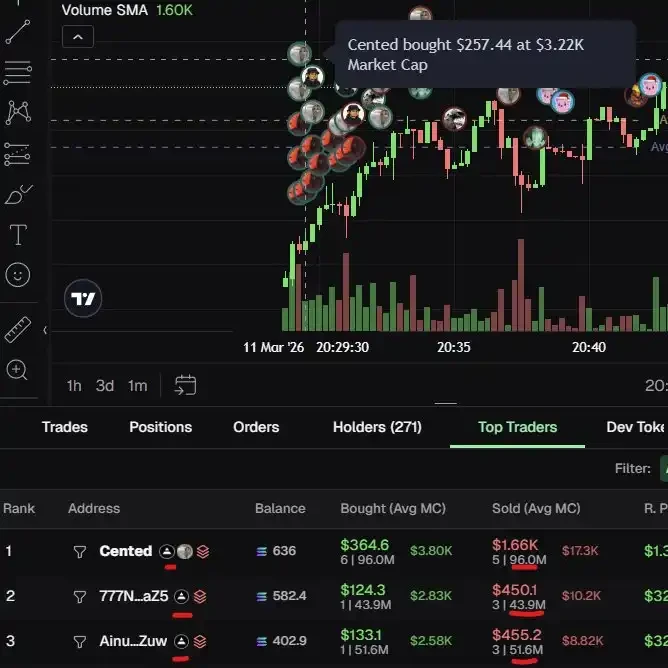
Their profits are a cognitive tax levied on current meme coin traders who believe they must trade new coins intraday to make money. Platforms like pump.fun, Axiom, and gmgn rely on them to promote and cultivate the myth that “you can get rich just by sitting still with the right tools.” In reality, multi-wallet bundling tools on platforms like Axiom are already highly refined, allowing these KOLs to effortlessly execute operations, reinforce their personal brands with each bundle, and earn additional profits through rebates from trading terminals.
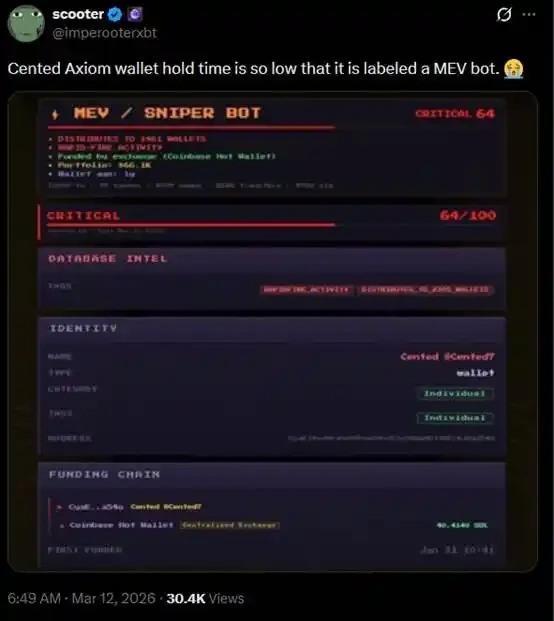
Due to the extremely short holding period and excessively high trading frequency, Cented's address has even been flagged as an MEV bot.
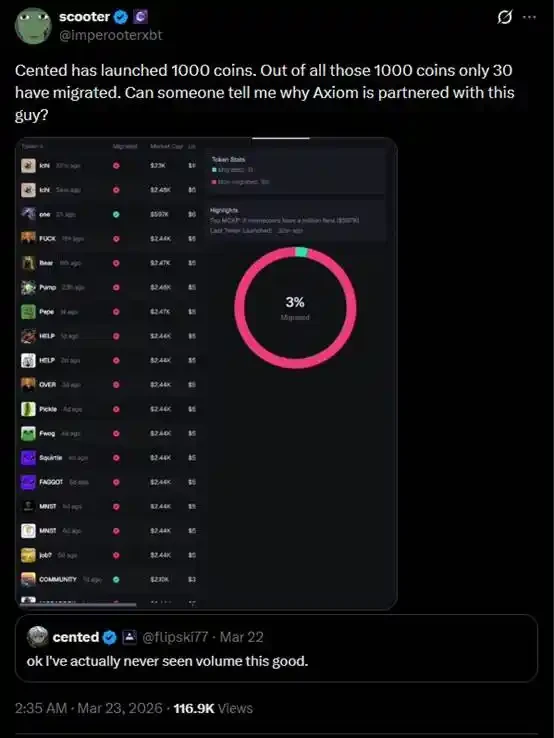
Additionally, Cented issued 1,000 coins, but only 30 coins successfully graduated.
Three days ago, he launched a coin called $Ichi, posted the contract address, but ultimately showed that his public address held it for only one hour, earning approximately $2,800 in profit.

The people have suffered under Qin for a long time.
What can we learn from traders like Cented, who make trades in just 7 seconds?
cookin.fun simulated the trades of numerous KOLs by copying their trades with a 10-second real-time delay and selling after 10 minutes, to test whether following KOLs can genuinely generate profits. The result of copying Cented's trades showed a return of -21.3%.

Trump’s coin-making wealth story has plunged the meme coin market into a state of “passive delusion”—the belief that as long as you sit in front of your computer for over ten hours a day, frantically operating trading terminals, you’ll eventually stumble upon your own A7 or A8 miracle in the blink of an eye.
This misconception merely turns more people into "traders" like Cented, feeding them as bait for copy-traders.
We can learn nothing from their philosophy of selecting investments; the only thing that seems to be learned is bundling and targeting others, turning their losses into one’s own profits. When everyone chases extreme speed in entering and exiting positions, the entire market becomes like a battle royale where everyone is fully equipped, making it increasingly difficult to attract new players.
So, many voices have emerged, viewing players like Cented as having become the "cancer of meme coins."
Meanwhile, Murad, once known for “Believe in something,” whose position peaked at over $50 million, now has only about $9.38 million remaining.
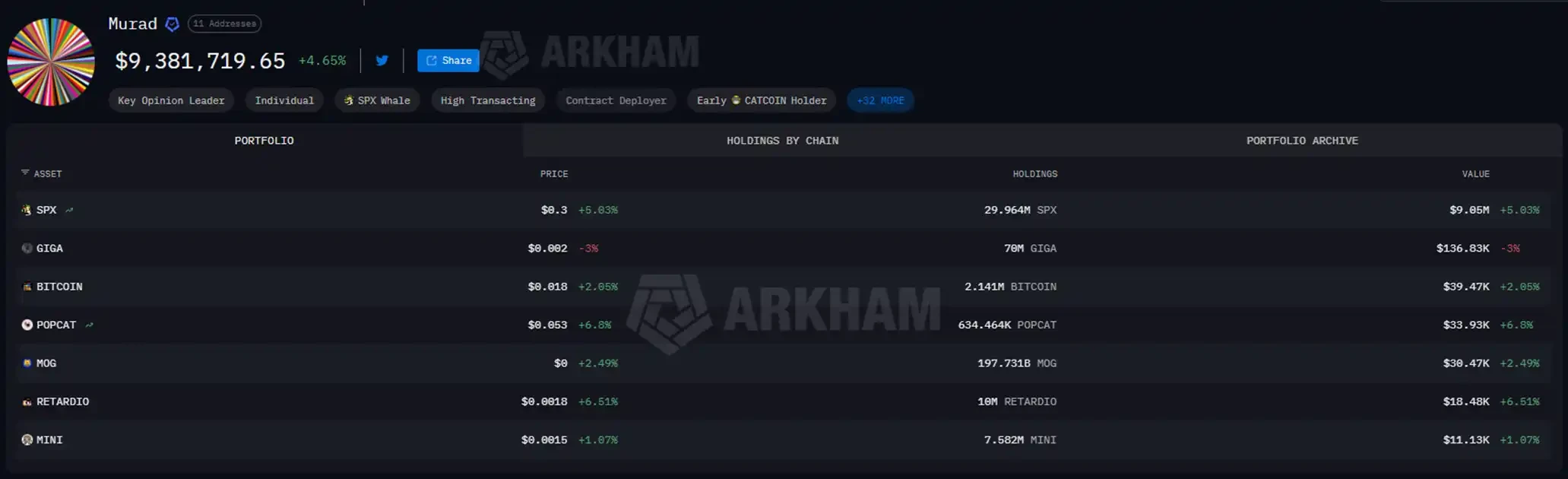
The token that made Murad legendary, $SPX, endured a year-long dormancy before surging from a market cap of less than $8 million to $1 billion, during which it experienced three declines of over 80%. Only those who held on until the end know the pain they endured.
Faith must be tested—SPX is no exception, but Bitcoin even more so. It is story after story of "believing and being rewarded" that has driven cryptocurrency forward to where it is today.
Yet, these hard-won beliefs, which once created a self-fulfilling prophecy myth around cryptocurrency, have ultimately become fuel for celebrity coin launches, rug pulls, and other malicious behaviors—something truly lamentable.
In the English-speaking community, more and more participants are realizing this—we need to return to the era when buying meme coins genuinely brought a smile, long-term holding wasn’t seen as foolish, and communities persisted in building and spreading their ideals despite bleak market conditions.
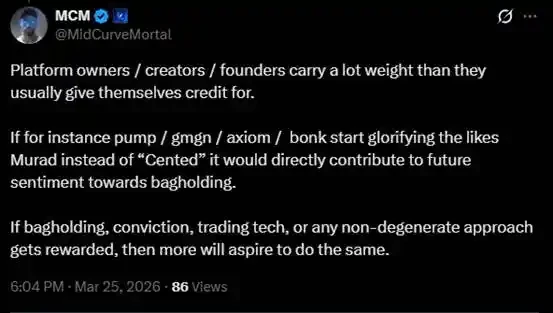
If platforms like pump.fun, gmgn, axiom, and bonk.fun begin promoting KOLs like Murad instead of figures like Cented, people’s attitudes toward trading will shift. When long-term holding and conviction-based strategies are rewarded, more people will emulate these classical approaches.
We are not at the end of the road. Sometimes, the path ahead isn’t completely blocked—perhaps we simply need to look back at where we’ve come from.