



The co-founders of Celsius, the bankrupt crypto lender, are now subject to permanent court orders that bar them from broad parts of the crypto and asset-services business.
The FTC put the founders’ combined obligations at $16.5 million, though Goldstein’s entered order lists $2.014 million.
Alexander Mashinsky and Shlomi Daniel Leon may not advertise, market, promote, offer or distribute products or services used to deposit, exchange, invest or withdraw assets, or assist in those activities.
Mashinsky's order covers assets generally, while Leon's expressly covers cryptocurrency, banking and financial assets. Both bans apply whether they act directly or through an intermediary.
Goldstein's order focuses on retail crypto. He may not advertise, market, promote, or offer for sale retail products or services used to buy, sell, deposit, withdraw, distribute, or trade cryptocurrency, or assist in those sales and marketing activities.
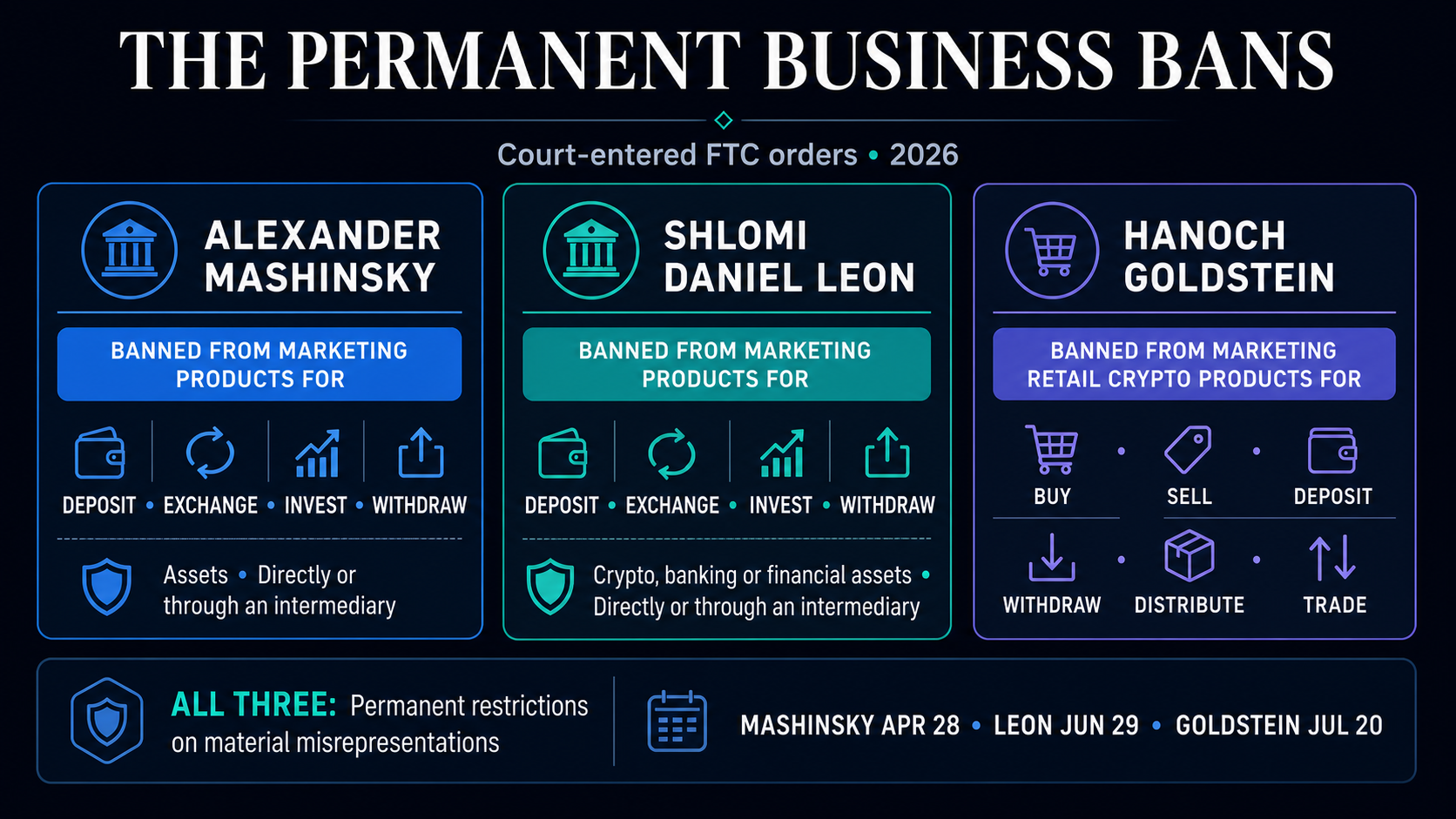

All three orders also prohibit material misrepresentations about products and services. They bar obtaining or attempting to obtain customer information of a financial institution through false, fictitious, or fraudulent representations, including bank-account details, login credentials, private keys, and wallet information.
Mashinsky and Leon additionally must obtain express informed consent before disclosing consumers' nonpublic personal information.
Those restrictions track the conduct alleged in the FTC's 2023 complaint. The agency alleged Celsius was marketed as safer than a bank, promised withdrawals at any time, and advertised yields as high as 18.63% APY.
It also alleged the company claimed it had sufficient reserves on June 7, 2022, five days before freezing withdrawals and transfers. Celsius filed for bankruptcy on July 13, 2022.

The bans follow the founders beyond Celsius and cover assistance they provide to others. Mashinsky and Leon’s orders also extend to work performed through intermediaries.
For years, the founders must file reports and keep records, giving the FTC a trail to follow and the court grounds to enforce the injunctions. The orders apply to these three founders and show how consumer-protection cases can place lasting limits on marketing custody, yield, and trading products.
Payments through DOJ forfeiture and Celsius bankruptcy settlements count toward the $16.5 million obligations.
Mashinsky's $10 million obligation can be satisfied through qualifying Justice Department forfeiture. Leon's $4.1 million obligation and Goldstein's $2.014 million clause credit qualify for payments or releases in the Celsius bankruptcy adversary proceeding.
The legal channels are separate but overlap economically, and the orders do not guarantee Celsius creditors an additional payout.
Money the FTC actually receives may fund consumer redress or related relief, with money not used for relief deposited in the U.S. Treasury.

The post Celsius founders face permanent crypto bans that could cost more than their $16.5M obligations appeared first on CryptoSlate.