




Original Author: Mankun Brand Department
"In Guangdong, especially in Shenzhen, some seemingly ordinary part-time jobs are mass-producing criminal suspects."This isDeng Xiaoyu, Partner, Man Kang Law Firm (Shenzhen)Recently, a reminder was posted on the Xiaohongshu platform. In the post, he pointed out that this type of..."Cash to Cryptocurrency" "Offline Coin Exchange Runner"Part-time jobs with such names have already developed a highly procedural "hunting mechanism," and the primary targets are often young people with higher education but insufficient awareness of risks.
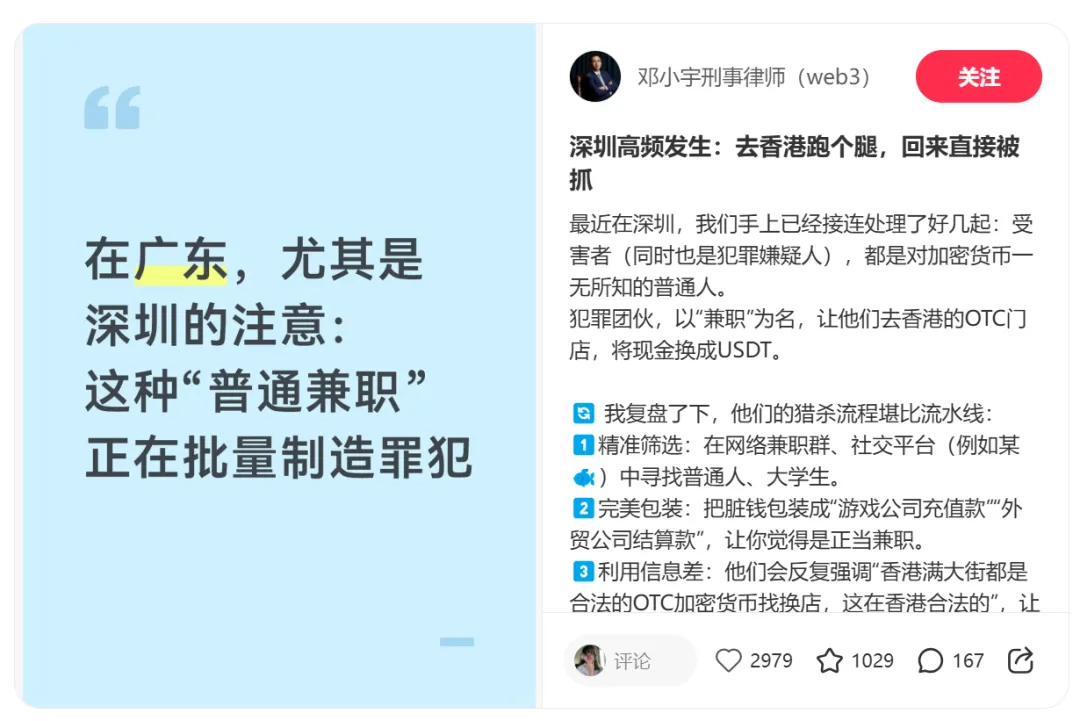
In these tasks,Part-time workers are usually only required to follow instructions, convert funds into Hong Kong dollars, and then go to a designated OTC cryptocurrency exchange store to complete the transaction. It seems to be a simple "errand," but unknowingly completes a crucial step in money laundering—called "human transit."Once funds are identified as proceeds of crime, participants may be directly exposed to criminal risks.
Lawyer Deng Xiaoyu believes that in recent years, such part-time models with "low barriers to entry and high returns" have been systematically exploited by criminals for money laundering activities. Many participants, without realizing the nature of their actions, have already crossed the boundaries of criminal law.
Based on the above judgment,Lawyer Deng Xiaoyu (partner at Manqun Law Firm, specializing in criminal matters related to crypto assets) and Huang Wenjing (compliance advisor at Manqun Law Firm) recently accepted an interview with Shenzhen News Network.Based on real cases, this analysis systematically dissects the related criminal patterns, social harms, and legal risks, attempting to "unravel" this hidden and complex money laundering network, and helping more people understand the legal realities involved.
"Why is 'just helping to exchange currency' considered money laundering?"
Reporter from Shenzhen News Network:
Lawyer Xiao Yu Deng, in the cases you have recently handled, criminal gangs are usually...How to recruit young people under the name of "part-time work"?
Deng Xiaoyu:
We recently handled a case like this.Typical Case: OneAn undergraduate student in the mainland China.received a "errand part-time job" on a second-hand item trading platform,The other party requested them to go to Hong Kong and purchase a certain amount of Tether (USDT) through a local cryptocurrency exchange store (OTC store), then transfer it to a specified blockchain address.
Specific processYes: Part-time workers first receive RMB into their personal bank cards, then exchange for Hong Kong dollar cash at RMB exchange points on the mainland, then go to a designated Hong Kong OTC store to purchase USDT, and the store directly transfers the cryptocurrency into the designated wallet.
After the student purchased tens of thousands of yuan worth of USDT through the aforementioned method, he/she...Bank cards and WeChat Pay accounts were frozen by law enforcement agencies on the mainland.and was informed that the funds he had collected originated from transfers made by victims of an upstream fraud case.
Afterward, we collaborated with a professional on-chain technology team for analysis and confirmed that this was a case of...The typical "Wash back to U" money laundering methodand is associated with organized crime networks in the Southeast Asian region.
After that, we received several similar inquiries. Some participants have been investigated and charged with crimes such as fraud, concealing or disguising criminal proceeds, and aiding and abetting information network-related criminal activities. Others, although not criminally detained, have had their bank cards and payment accounts frozen for a long time, which has seriously affected their daily lives, studies, and work.
Reporter from Shenzhen News Network:
Advisor Huang Wenjing, black industry criminal gangWhy are Hong Kong cryptocurrency OTC stores frequently chosen as operational nodes?Is this mode harder to track?
Huang Wenjing:
From a practical perspective, Hong Kong OTC (over-the-counter) pharmacies are vulnerable to exploitation by criminal groups mainly for three reasons.
First, the regulatory boundaries are relatively unclear, and AML requirements are not uniform.
Currently, Hong Kong has a relatively mature licensing and regulatory framework for centralized virtual asset trading platforms. However, cryptocurrency OTC (over-the-counter) stores still operate in a regulatory gray area, with a diverse range of business entities and inconsistent compliance standards. Some stores clearly lack in areas such as verification of fund sources, transaction monitoring, and anomaly analysis, leaving room for illicit activities.
Second, cash transactions themselves are a high-risk scenario.
OTC stores primarily conduct cash transactions. Anonymous cash lacks the account trails and structured data provided by bank transfers, making investigations more reliant on physical surveillance, witness statements, and physical evidence, which significantly increases the overall difficulty of tracing the source.
Third, frequent financial activities provide a larger space for concealment.
In the 2024 VAOTC consultation background provided by the Hong Kong government, it was also mentioned that in some fraud cases, OTC stores were used for the first round of laundering the involved funds. As an international financial center, Hong Kong features multiple currency circulation and active cross-border transactions, which make it easier for criminal groups to fabricate transaction backgrounds and conceal the true purpose of the funds.
A Dual Loss for Individuals and Society: Criminal Risks Concealed by "Legitimate Narratives"
Reporter from Shenzhen News Network:
Lawyer Deng Xiaoyu, in the cases you have taken on, many of the so-called..."Part-timers" are all young people with high education.TheyWhy are we prone to falling into such traps?What legal consequences might one face once involved in a legal case? What long-term impacts could it bring?
Deng Xiaoyu:
In my view, the reason why such part-time jobs can be misleading is because...Highly educated groups, the key is that the other party has built aA narrative scenario that appears complete, reasonable, and legal.
When part-time workers raise questions, such as "Why must the person themselves go to Hong Kong to operate it?" the other party usually explains that virtual asset transactions are restricted on the mainland but are legal and open in Hong Kong. Since the principal is overseas, the cost of traveling to Hong Kong specifically for this purpose is too high. Instead, having a nearby part-time worker perform the operation is more "cost-effective and efficient." Under this self-consistent line of reasoning, many students do not perceive any obvious abnormalities in their rational judgment, thus lowering their guard and developing trust.
ButCriminal riskoften has obviousLagging effectMany part-time workers only gradually discover that their bank cards or payment software accounts have been frozen, or they suddenly receive phone calls from public security authorities, or are intercepted by customs while normally entering or leaving the country. Such sudden changes often plunge students, who lack social experience, into intense panic, continuously affecting their mental state and normal studies and daily life.
Reporter from Shenzhen News Network:
The general public may not be aware that such part-time jobs, if...How does money laundering contribute to the growth of black and gray industries?What other impacts will it have on financial regulatory order and the anti-money laundering system?
Huang Wenjing:
Taking, for example, the telecom and internet fraud crimes that the state has been cracking down on in recent years,"Money laundering" itself is just the first step; the real key lies in how to quickly transfer and conceal the flow of funds, making it difficult to recover.
If the involved funds remain only in the criminals' accounts, it would not be difficult to track and freeze them once the victims report the crime. However, through the methods involved in this case, the funds are quickly fragmented and transferred across a financial system characterized by "multiple assets, multiple pathways, and multiple nodes," ultimately creating a vicious cycle where "fraud is committed faster, funds are transferred faster, and recovery becomes even more difficult."Such part-time jobs essentially provide key financial channel nodes for illegal and gray industries, directly promoting the large-scale and industrialized operations of upstream criminal activities.
From a broader perspective, money laundering transactions often exhibit characteristics such as fragmentation, decentralization, and high frequency, significantly increasing the compliance costs for regulatory authorities and financial institutions. If the proportion of such non-genuine and abnormal economic activities continues to rise within a region's financial system, it will not only distort financial data but also pose potential risks to the overall financial security.
Once this risk draws attention from the international community, the region may be labeled as a "high-risk jurisdiction." For example, some countries and regions have been placed on the Financial Action Task Force (FATF) Grey List due to inadequate anti-money laundering regulations. Citizens of these jurisdictions face practical difficulties in cross-border financial activities, such as restricted account openings and hindered transactions, which can have long-term and far-reaching negative impacts on the country's reputation and economic development.
Qualitative Analysis and Consequences: The Logic of Identifying Money Laundering and the Limits of Sentencing
Reporter from Shenzhen News Network:
Attorney Deng Xiaoyu,Why did you post on social media platforms to specifically warn the public about such money laundering traps?From the perspective of criminal law and judicial interpretations, how are such behaviors typically characterized? Also, how should we distinguish between "sporadic personal transactions" and "commercial exchange activities"?
Deng Xiaoyu:
I post on social media platforms, partly because IThe legal education responsibilities of a member of the Committee on Common Crime Defense of the Shenzhen Bar AssociationOn the other hand, it is also...We hope to protect the young people in society as much as possible..
In the cases I have encountered, there are many...The original intention of part-time workers is to supplement their living expenses and reduce the burden on their families through their own labor.But it is precisely this mindset, free from malice, that...Easy to be exploited by criminalsand thus become involved in specific aspects of money laundering activities.
From a judicial practice perspective, the conduct of such part-time personnel is more frequently evaluated within the framework of money laundering crimes.For individuals who merely follow instructions to complete currency exchange or transfer, they should generally not be directly deemed guilty of the crime of "illegal business operations." Instead, the focus should be on examining whether they objectively participated in the transfer, concealment, or hiding of illicit proceeds.
As forThe distinction between "individual sporadic transactions" and "commercial foreign exchange activities"The key does not lie in whether a fee is charged, but rather in...Are there characteristics of continuity, organization, and external business operations?Ordinary part-time workers who do not actively solicit customers or establish a stable business model typically do not meet the essential elements required to constitute the crime of illegal business operations. However, this does not necessarily mean that there is no potential criminal risk.
Reporter from Shenzhen News Network:
Advisor Huang Wenjing, if the involved amount reaches...What penalties might relevant individuals face for "particularly serious circumstances"?What are the differences in liability between corporate crimes and individual crimes?
Huang Wenjing:
Taking the crime of money laundering as an example, according to the "Criminal Law of the People's Republic of China" and the "Interpretation on Several Issues Concerning the Application of Law in Handling Criminal Cases of Money Laundering,"Once deemed as "seriously circumstance," the punishment is usually directly determined in the second category, which is a fixed-term imprisonment of more than five years but less than ten years, along with a fine.
It should be emphasized that in judicial practice, the amount involved is only one of the thresholds for determining criminal liability and sentencing.Whether it constitutes "serious circumstances" also needs to be comprehensively judged in combination with behavioral and result-oriented factors, such as repeated implementation, causing significant losses, and refusal to cooperate with the recovery of illicit gains. It cannot be simply concluded based on the amount involved.
In addition, the crime of money laundering is subject to a "dual penalty system."This means that if the act is carried out in the name of the unit, the unit itself will be fined. However, the directly responsible supervisors and other directly responsible individuals will not be exempt from liability simply because "the act is attributed to the unit." They will still be held personally criminally liable for money laundering in accordance with the relevant legal standards. If the circumstances warrant a more severe punishment, they may also face fixed-term imprisonment of more than five years but less than ten years, along with a fine.
Risk Alert: How to Avoid Becoming a "Money Laundering Frontman"?
Reporter from Shenzhen News Network:
How can the public identify money laundering risks in part-time jobs?What self-protection measures should be taken once a suspicious transaction is encountered?
Huang Wenjing:
In fact, identifying such risks requires only one key criterion:
Any part-time job that asks you to help with financial transactions or account operations essentially turns you into a channel for money. 99% of these are scams or money laundering.
In practice, common "red flags" include:
- Requesting you to provide, open a new bank card, or open a corporate bank account;
- Lending out WeChat or Alipay payment QR codes to collect and transfer funds immediately after receiving payments;
- Requires cash withdrawal offline, or going to an exchange store to convert cash into virtual currency, then transferring it to a specified address;
- Repeatedly emphasizing that "cash trading of virtual currencies in Hong Kong is legal," "real stores are open, so it can't be illegal," and "I'm just helping run errands."
The common point of these phrases is that they deliberately shift attention.The real risk does not lie in whether a specific action is formally legal, but rather in whether it...The purpose is to conceal the true source and destination of the funds..
Once the funds originate from upstream crimes such as telecom fraud or gambling, your account and identity may be regarded as part of the criminal chain. At the very least, your account may be frozen or investigated; in severe cases, you may be held legally responsible.
Reporter from Shenzhen News Network:
Attorney Deng Xiaoyu,What more targeted advice do you have for young people?Should we be cautious of seemingly legal temptations such as "exchange rate arbitrage"?
Deng Xiaoyu:
I would like to give a special reminder to the young:
Any part-time job that uses you as a "funding channel," no matter how "legal and compliant" it may seem to be packaged, should be firmly rejected at the first instance.
Many people think money laundering is far removed from their daily lives, but in reality, it is often disguised as professional-sounding or even reasonable-sounding terms such as "errand-running and proxy services," "cross-border settlements," "arbitrage through exchange rate or spread differences," or "crypto trading arbitrage."Essentially, they all ask you to use your real-name-verified identity to "launder" unfamiliar funds.
In the cases we have dealt with,What the other party truly values is not the part-timer's "labor," but rather their real-name account and the transaction trails generated through their operations, which are used to conceal illicit funds.Once the upstream funds are traced, the original "part-time workers" may instantly become "individuals involved in the case." The most direct consequence is account freezing and restricted daily life. In severe cases, they may also have to bear corresponding legal responsibilities.
Mr. Man Kun warns: Be alert to these high-risk signals
Based on the interview content and practical experience, we would like to particularly highlight the following:
- InvolvedPart-time jobs in third-party payments, cash handover, account operations, and cryptocurrency exchangeand should remain highly vigilant;
- Compensation that is clearly mismatched with the job responsibilities is often not a "good opportunity";
- The other party deliberately avoiding the issue of the source of funds is an important risk signal;
- Once doubts arise,The earlier you consult with a professional lawyer, the more likely you are to avoid serious consequences..
We will continue to learn fromProfessional perspectiveParticipate in public issue discussions and also hope toBy using real cases and legal analysis, we help the public better understand legal boundaries and avoid potential criminal risks.