





War shows the world the ruins, but capital cares only about prices.
As the fires of war reignite in the Middle East, colleagues in Dubai send word of explosions and air raid sirens—the sky torn by missiles, humanity awaiting an uncertain fate.
On another invisible timeline, global financial markets have already begun recalculating: How high should oil prices rise? Will gold continue to climb? When will stock markets hit bottom and rebound?
Capital does not sympathize, nor does it anger. It simply and calmly does one thing: price uncertainty. To most people, it is invisible and intangible, its logic cold and its pace relentless.
But in turbulent times, understanding capital operations and risk pricing logic may be the last line of defense for ordinary individuals against the tide of history. Looking back at human geopolitical conflicts and financial history, you’ll find a pattern that has barely changed: in the face of war, capital markets always follow the same script—and over the past 36 years, this script has been fully enacted four times.
What capital fears most is not conflict, but "waiting."
From the 1991 Gulf War, to the 2003 Iraq War, and then to the 2022 Russia-Ukraine conflict, the script has always been the same. These three geopolitically significant crises have demonstrated the capital markets’ pricing pattern through the phases of “preparation—outbreak—clarification.”
Financial markets are essentially discounting machines. When conflicts are brewing, fears of unknown supply disruptions drive crude oil and gold to astronomical prices, while global stock markets plummet sharply. Yet, Wall Street has a bloody rule: "Buy to the sound of cannons."
Once the first shot is fired (or the situation becomes clear), the greatest uncertainty is resolved. Safe-haven assets often quickly peak and decline, while stock markets complete a deep V-shaped reversal at the lowest point of despair. The war may still be ongoing, but capital's panic has ended.
Here is an in-depth analysis of the capital market changes during these three historical events:
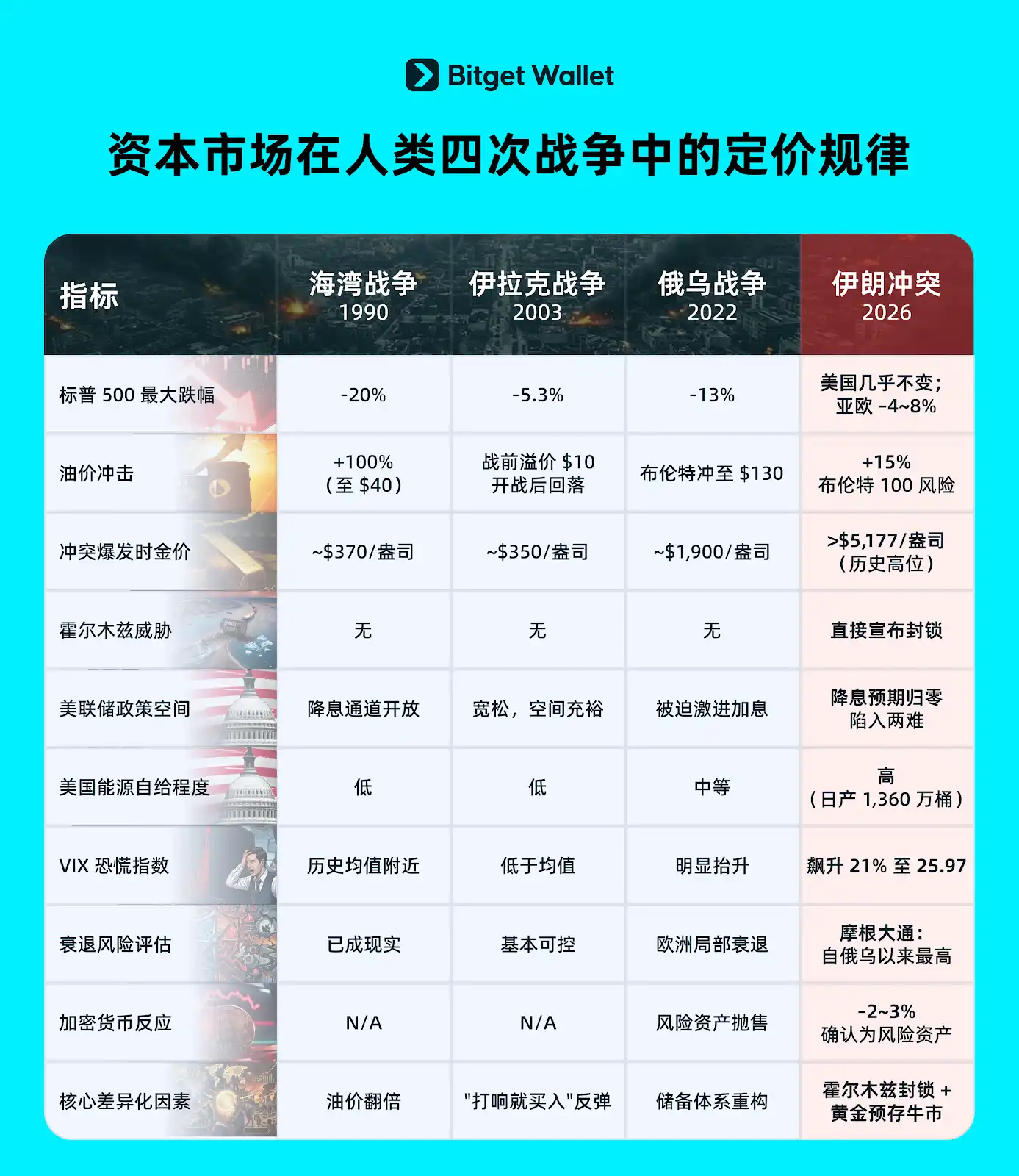
1. 1990–1991 Gulf War: A Classic "V-Shaped Recovery" and Oil Shock
This war is a textbook case for studying geopolitical shocks in modern financial history, perfectly illustrating the principle of "buy the rumor, sell the fact."
· Crisis酝酿期 (August 1990 - January 1991): Panic and Risk Aversion
Crude oil prices surge: After Iraq invaded Kuwait, the market was gripped by panic over a potential cutoff of Middle Eastern oil supplies. Within just two months, international oil prices skyrocketed from around $20 per barrel to over $40, more than doubling.
Stock market plunge: Amid soaring oil prices and the shadow of war, the U.S. S&P 500 index dropped nearly 20% between July and October 1990.
· The Boot Drops (January 17, 1991): An Counterintuitive Market Shift
On the first day of the U.S.-led Operation Desert Storm, the market experienced a highly counterintuitive move: as the war progressed with overwhelming dominance, "uncertainty" vanished instantly.
Crude oil plunges: On the day the conflict began, oil prices recorded one of the largest single-day drops in history, falling more than 30%.
Stock market rally: The S&P 500 surged sharply on the day, followed by a powerful V-shaped recovery, reclaiming all previous losses within six months and setting a new all-time high.
2. 2003 Iraq War: A "Weight Lifted" After a Prolonged Decline
The 2003 Iraq War, combined with the lingering effects of the dot-com bubble burst and post-9/11 security anxieties, led the market to respond with a sense of relief—viewing prolonged pain as worse than a swift one.
· Crisis酝酿 period (late 2002 - March 2003): Slowly cutting the flesh
After months of diplomatic stalemate and military preparations, financial markets have become as skittish as birds startled by the sound of a bow. The S&P 500 has continued its steady decline, while global capital, driven by risk-aversion, has flooded into gold and U.S. Treasury bonds.
Crude oil prices rose slowly from $25 to nearly $40 due to factors such as war expectations and strikes in Venezuela.
· The boot has dropped (March 20, 2003): Bad news fully priced in is good news
Interestingly, the absolute bottom of the U.S. stock market occurred about a week before the war began (around March 11, 2003).
When missiles actually began falling on Baghdad, the market viewed it as "bad news already priced in." Stock markets quickly surged, launching a four-year bull market. Safe-haven assets like gold rapidly cooled off as the conflict progressed smoothly.
3. 2022 Russia-Ukraine Conflict: Supply Chain Disruptions Triggering "Super Stagflation"
Unlike the two previous Middle East wars—where the United States achieved swift, overwhelming victories without causing long-term, substantive disruptions to global supply chains—the Russia-Ukraine conflict has had a deeper, heavier impact on capital markets and has fundamentally altered the underlying logic of macroeconomic trends.
· Crisis Erupts (February 2022): An Epic Commodity Storm
Russia is a global powerhouse in energy and industrial metals, while Ukraine is known as the "granary of Europe." Following the outbreak of conflict, Brent crude oil briefly surpassed $130 per barrel; European natural gas prices surged several-fold; and commodities such as wheat and nickel reached record-high prices.
· Ongoing Impact: The "Double Hit" of Inflation Rebound and Monetary Tightening
Stock and bond markets fall together: The most devastating market impact of the Russia-Ukraine conflict is that it completely shattered the fragile global supply chains established after the pandemic, directly triggering the worst inflation in Europe and the United States in 40 years.
To combat this "imported inflation" triggered by geopolitical conflict, the Federal Reserve was forced to launch the most aggressive interest rate hiking cycle in history. As a result, 2022 saw a rare "stocks and bonds sell-off" (both equities and bonds declined), with the Nasdaq index plunging more than 30% that year.
Deadly Illusion: Never try to profit from war.
Let's bring the timeline back to reality.
The sudden escalation of tensions in the Middle East has once again plunged global capital markets into a period of uncertainty—a stress test.
From the perspective of macroeconomic transmission channels, the most critical threat that the Middle East conflict poses to capital markets is: "physical supply chain disruption → energy prices surge → global inflation rebounds → central banks forced to maintain tight policy → risk assets plummet."
Analysis of chain reactions in the capital market
1. International Crude Oil: The Absolute Center of the Storm
Chain reaction: The Middle East controls the lifeline of global crude oil (particularly key shipping lanes such as the Strait of Hormuz). If there is a risk of conflict escalating or affecting major oil-producing nations, the market will immediately price in a "geopolitical risk premium," causing short-term spike surges in Brent and WTI crude oil prices.
Deep impact: Crude oil is the lifeblood of industry. A sharp rise in oil prices not only increases costs for aviation, logistics, and chemical industries, but also directly threatens the global CPI—still recovering—through imported inflation.
2. Precious Metals (Gold/Silver): The Traditional Ultimate Safe Haven
Chain reaction: In the face of war, geopolitical instability, and potential hyperinflation, capital naturally flows into gold. Gold prices typically gap upward before and during the early stages of conflict, reaching阶段性 or even all-time highs; silver, due to its industrial properties, exhibits higher volatility than gold.
Deep impact: It’s important to note that gold’s sharp rallies are often driven by sentiment. Once the situation becomes clearer—even if conflicts continue—the flight-to-safety sentiment fades, and gold prices are likely to surge then reverse, reverting to a pricing framework dominated by real U.S. interest rates.
3. U.S. Stock Market: The Specter of Inflation and the "Valuation Kill"
Chain reaction: War is generally negative for the overall U.S. stock market. The volatility index (VIX) will surge rapidly, prompting capital to exit high-valuation tech stocks (such as AI and semiconductors) and flow into defensive sectors like defense, traditional energy, and utilities.
Deep impact: What Wall Street fears most isn't the gunfire in the Middle East, but the inflationary rebound triggered by it. If a sharp rise in oil prices keeps U.S. CPI elevated, the Fed will be forced to delay rate cuts—or even resume hiking rates. This tightening of macroeconomic liquidity would deliver a severe valuation hit to technology stocks, represented by the Nasdaq.
4. Crypto Market: Liquidity Siphoning of High-Risk Assets
Chain reaction: Although Bitcoin has long been associated with the narrative of "digital gold," during previous genuine geopolitical crises—such as the early stages of the Russia-Ukraine conflict and the escalation of tensions in the Middle East—the actual performance of the crypto market resembled more of a "highly elastic Nasdaq Index."
Deep impact: In the face of war-related panic, Wall Street institutions prioritize selling the most liquid and highest-risk assets to cash out, often hitting crypto markets first and causing price declines. Altcoins simultaneously face liquidity shortages. However, when conflicts trigger local fiat currency collapses or disrupt traditional banking systems, crypto assets’ censorship-resistant and borderless transfer properties may attract partial safe-haven capital.
By comparing three historical geopolitical conflicts, we can distill the core principles for ordinary individuals to respond to geopolitical crises:
1. "Uncertainty" is the biggest killer: the most severe stock market declines almost always occur during the buildup and negotiation phases before war breaks out. Once war actually begins (especially when the situation becomes predictable), the stock market often hits bottom and rebounds. This confirms the Wall Street adage: "Buy when the cannons roar."
2. The "Last-In Trap" for Commodities: Before and during the early stages of war, crude oil and gold often surge to extraordinary highs due to panic-driven sentiment. However, if the conflict does not substantially and permanently disrupt physical supply (as seen in the Gulf and Iraq wars), prices typically plummet by more than half shortly after the outbreak of hostilities. Blindly chasing higher commodity prices makes investors easy targets for institutional players to offload their positions onto.
3. Distinguish between “emotional shock” and “fundamental disruption”: If the war is merely an emotional shock (e.g., a localized conflict with uneven power dynamics), the stock market will likely rebound quickly after a decline. However, if the war causes long-term disruptions to critical supply chains (such as the energy and food crises triggered by the Russia-Ukraine conflict), it will alter the global pricing benchmark for capital through “inflation and interest rate hikes,” resulting in a prolonged period of market turmoil.
History does not repeat itself exactly, but it often rhymes. When observing current capital movements, we must remain calm and assess: Is the conflict before us merely temporary panic, or will it truly become a black swan that reshapes the global inflation and interest rate cycle?
Geopolitical maneuvering follows no predictable pattern—a ceasefire announcement in the middle of the night can instantly wipe out highly leveraged long positions. In times of crisis, the paramount principle is always preserving your capital.
Defensive Strategy in Turbulent Times: How Can Ordinary People Make Their Moves?
Under the dual shadows of war and inflation, the primary goal for ordinary investors must shift from “pursuing high returns” to “preserving capital, hedging against inflation, and mitigating tail risks.” We recommend reorganizing your assets using the following “defensive counterattack” strategy:
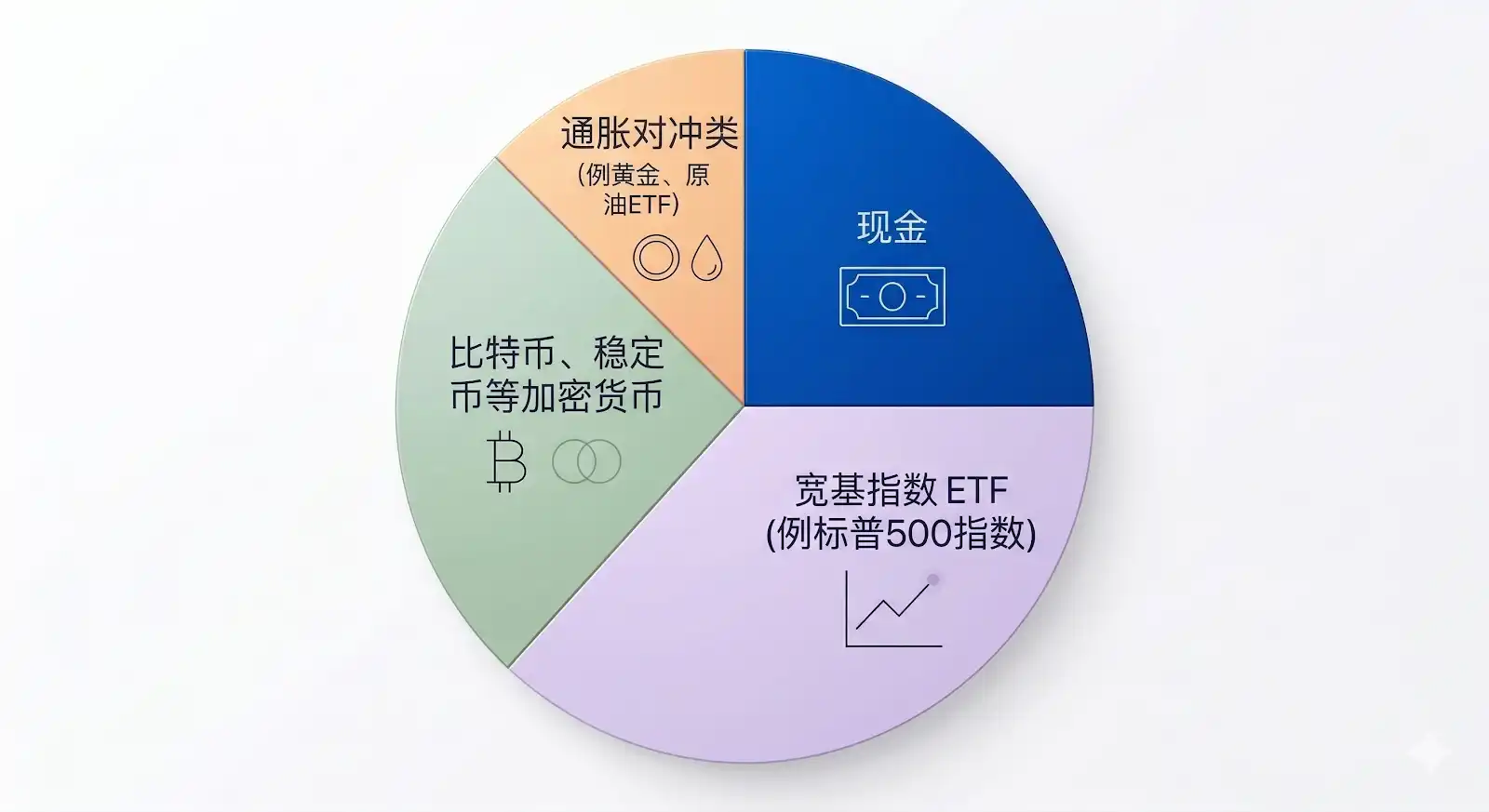
Strategy 1: Build a High Cash Moat (20%-30% Allocation)
Strategy: Increase holdings of cash and cash equivalents (such as high-yield USD deposits, short-term government bonds, and money market funds).
Logic: In times of crisis, liquidity is a lifeline. Holding sufficient cash not only safeguards your family’s standard of living against soaring prices but also gives you the firepower to buy high-quality assets after a market crash.
Strategy 2: Buy inflation "insurance" (10%-15% allocation)
Strategy: Appropriately allocate to gold ETFs, physical gold, or a small portion of broad-based energy ETFs.
· Logic: The purpose of this allocation is not to make huge profits, but to hedge. If a war disrupts crude oil supplies and causes prices to surge, the increased cost of living can be offset by gains in gold and energy sectors. Remember: Do not go all-in on purchases when headlines are overwhelming.
Strategy 3: Consolidate Your Position and Defend Core Interests (30%-40% Allocation)
Strategy: Sell low-quality, highly leveraged, unprofitable stocks and reallocate capital to broad-market index ETFs (such as the S&P 500) or large-cap companies with strong cash flows.
· Logic: During wartime, individual stocks face enormous black swan risks (such as bankruptcy due to sudden supply chain disruptions). Embracing broad-market indexes leverages national fortune and the systemic resilience of the entire economy to hedge against the fragility of individual companies. By consistently investing over time and ignoring short-term paper losses, crises often create long-term "golden opportunities."
Strategy 4: De-risking Cryptographic Assets (for Web3 Users)
Strategy: Reduce positions in highly volatile altcoins and meme coins; consolidate funds into Bitcoin (BTC) as a long-term core holding, or convert them into USD-pegged stablecoins (USDC/USDT) and deposit them into leading compliant platforms to earn demand deposit yields. Once geopolitical risks are deemed under control and market liquidity returns, allocate 10–30% of your capital according to your risk tolerance to invest in meme coins and capture alpha opportunities.
Logic: Liquidity crises triggered by war have a greater impact on low-market-cap cryptocurrencies. Stablecoins serve as a safe haven during crises and offer more flexible liquidity reserves than traditional banks.
Absolute non-negotiable红线
1. No leverage allowed: Geopolitical conditions can change rapidly—a single ceasefire announcement can cause crude oil to plummet 10%. With leveraged trading, you may not survive the short-term volatility long enough to see a long-term win.
2. Abandon the mindset of profiting from war: Information asymmetry in capital markets is extremely harsh. When you decide to go long on certain assets due to escalating conflict, Wall Street quantitative institutions have likely already prepared to "take profits and sell the news."
In the face of macroeconomic upheaval, the most powerful weapon ordinary people have is not precise prediction, but common sense, patience, and a healthy balance sheet.
Wars will eventually end, and order will always be rebuilt from the ruins.
At the peak of extreme panic, the most counterintuitive move is to stay rational, and the most dangerous action is to panic-sell. Remember the oldest adage in investing: never bet on the end of the world—because even if you win, no one will pay you.
And our greatest hope remains the cessation of conflict, the reunification of families forced apart, and peace throughout the world.