








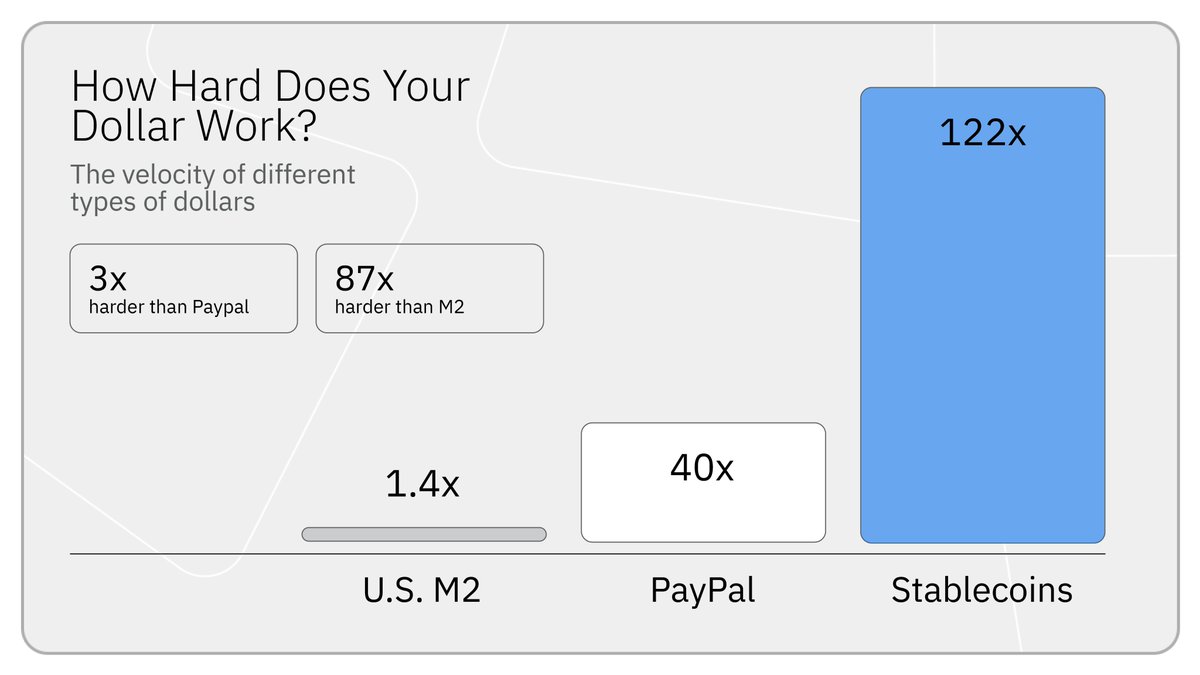
The on-chain usage efficiency of $1 is approximately 3 times that of PayPal and 87 times that of U.S. M2 money supply.
Written by Jonah Burian, Investment Manager at Blockchain Capital
Compiled by Chopper, Foresight News
Software is eating the world, and blockchain is attracting massive capital.
The adoption of stablecoins and on-chain economic activity have now formed a positive flywheel, and this growth structure is irreversible. Yet the core logic driving this irreversible trend has been severely underestimated: stablecoins flow on-chain → developers build diverse use cases that lock in funds → more stablecoins are continuously attracted to enter → creating a self-reinforcing cycle.
Each cycle attracts more capital. Capital transferred on-chain continues to generate value, deeply integrated into lending markets, decentralized exchanges, and derivatives sectors. To withdraw this capital back into the traditional financial system, one must relinquish all on-chain utilities. Therefore, capital remains on-chain, causing the flywheel effect to continuously build and amplify.
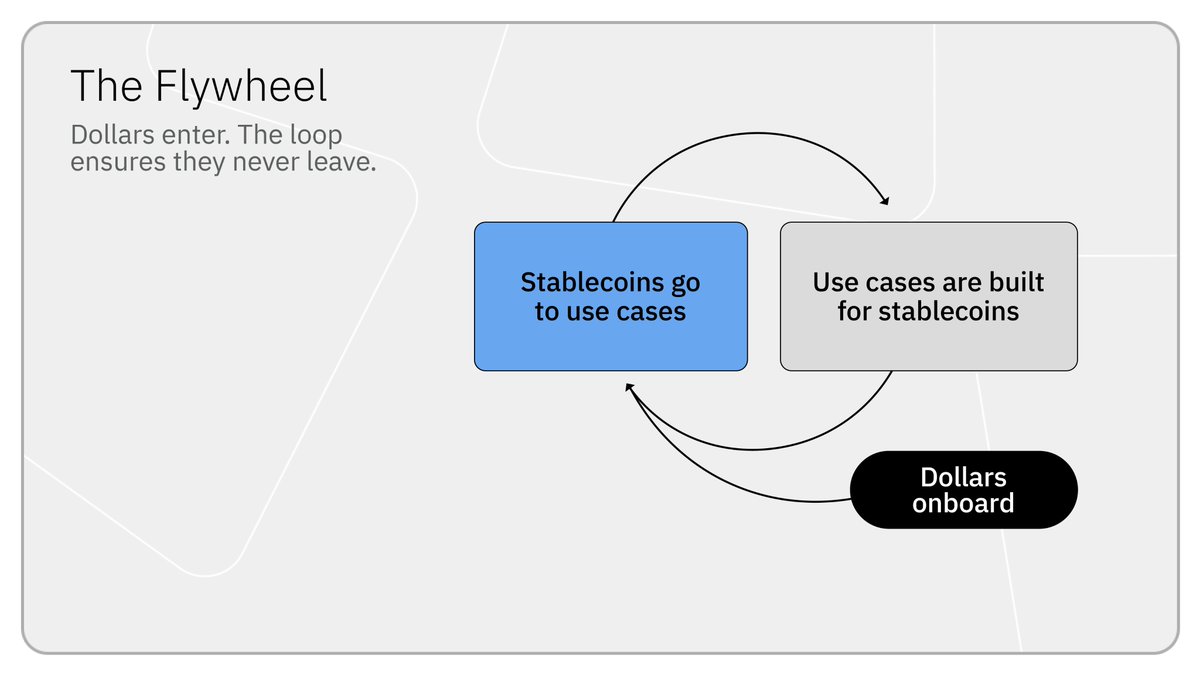
This cycle has already spawned a new financial economy with annual revenues in the billions of dollars. We, along with Spencer Bogart, believe that the same mechanism is now beginning to continuously draw all global capital into on-chain ecosystems.
Each rotation of the flywheel generates significant economic value.
Whenever $1 billion in newly minted stablecoins enters the on-chain economy, this capital is distributed across various positions in the financial system, reused over a hundred times within a year, generating tens of millions of dollars in annual revenue.
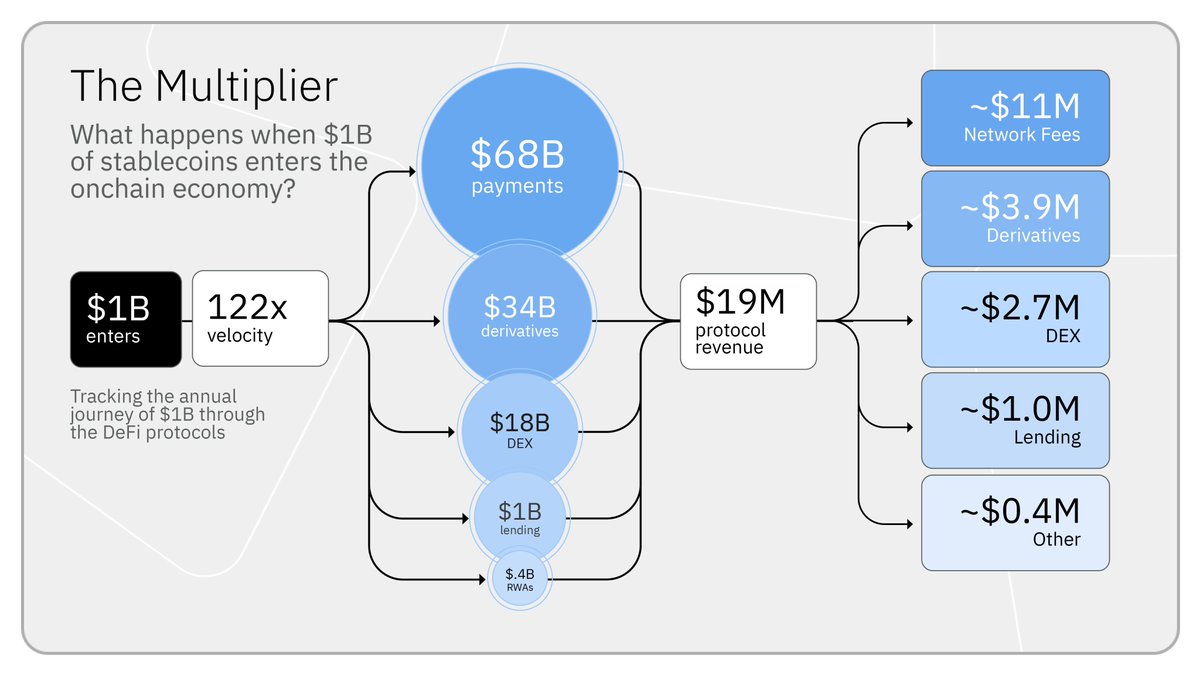
For every $1 billion in stablecoins, approximately $122 billion in annual economic activity is generated, with a velocity of 122x. In comparison, PayPal USD circulates about 40 times per year, while the U.S. broad money supply (M2) has a velocity of only 1.4x. This means that the usage efficiency of $1 on-chain is roughly 3 times that of the PayPal system and 87 times that of U.S. M2. The reason: stablecoins can circulate infinitely across use cases such as payments, exchanges, and lending, whereas traditional capital is severely constrained by T+1 and T+2 settlement systems.
Within the $122 billion in annual economic activity generated by 10 billion in stablecoin supply, the breakdown is as follows:
- Payments and Transfers: Approximately $68 billion
- Derivatives: Approximately $34 billion
- Decentralized exchange: approximately $18 billion
- Lending market: approximately $1 billion
- Real-world assets (RWA): approximately $400 million
For every $1 billion in on-chain stablecoins absorbed, approximately $19 million in annual protocol revenue is generated, funding the development of next-generation products and attracting more stablecoins.
It should be noted that the $19 million only accounts for direct revenues at the on-chain protocol level and does not include the annual earnings generated by stablecoin issuers from their existing funds (estimated at a 3.5% risk-free rate, yielding approximately $35 million annually per $10 billion in assets), nor the substantial derivative revenues from wallets, payment service providers, fiat on/off-ramps, custody, and compliance sectors.
Across the entire on-chain economy, in 2025, stablecoin issuers generated over $13 billion in revenue solely from interest rate spreads on existing funds (Tether: over $10 billion, Circle: $2.7 billion); decentralized exchanges, lending protocols, derivatives platforms, and blockchains collectively achieved over $5 billion in protocol-wide revenue driven by stablecoins.
Capital won't leave
Once capital enters the chain, it can continuously generate returns, further strengthening the cycle. Funds operate efficiently across lending, exchange, and derivatives markets; in contrast, traditional finance is constrained by T+1 settlement, fragmented banking hours, and isolated ledgers—abandoning the chain means relinquishing high liquidity and high reusability. Therefore, capital tends to remain on-chain long-term, with the flywheel effect continuously reinforcing itself.
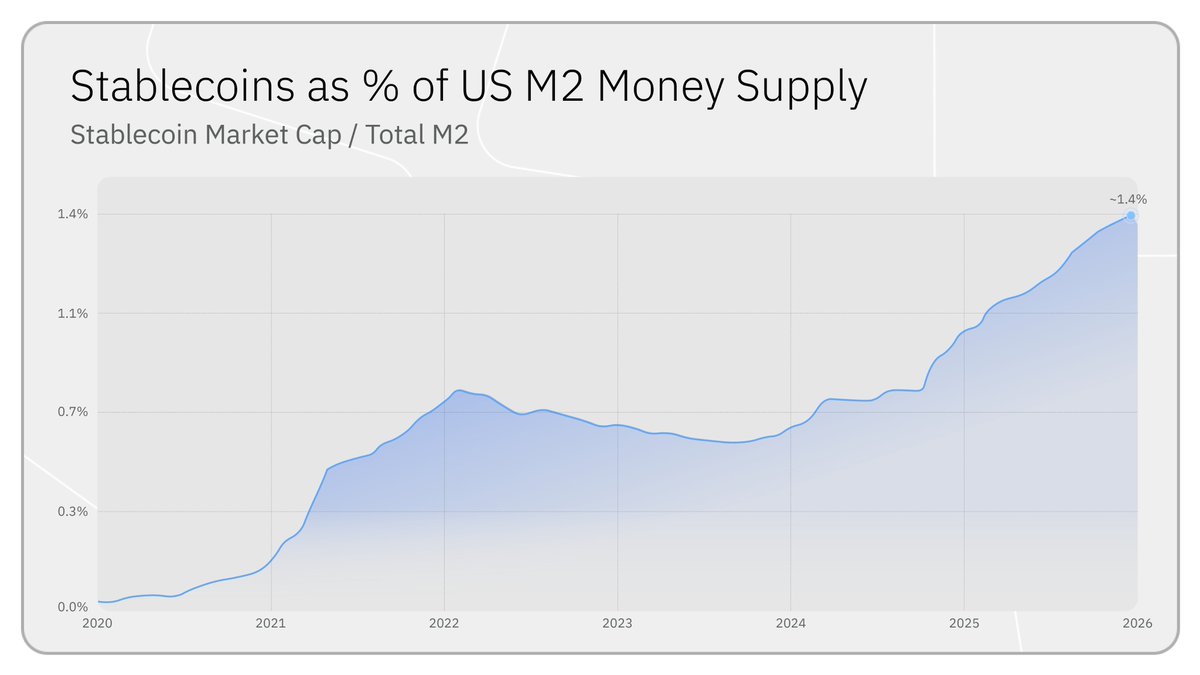
Since early 2020, the total supply of stablecoins has grown approximately 60-fold, expanding from $50 billion to $300 billion, currently accounting for about 1.4% of the U.S. M2 money supply. In 2025 alone, over $120 billion in new stablecoins were minted, marking the largest annual increase on record. The total volume of stablecoin transactions for the year reached $33 trillion.
The flywheel spins faster
Previous industry growth was primarily driven by retail capital and native crypto use cases. The next phase of the flywheel’s expansion will be led by institutional capital, bringing a significant leap in scale and influence.
Institutional capital is beginning large-scale on-chain deployment, compelling more asset issuers to tokenize assets and launch on-chain products to compete for new capital. BlackRock’s BUIDL product and Apollo’s on-chain credit fund are early prominent examples, and such deployments will only increase. Within two years, the total value of tokenized real-world assets has grown from $8 billion to approximately $25 billion, with BlackRock’s BUIDL product alone surpassing $2 billion.
The entry of institutional U.S. dollar capital will further attract Treasury tokenization, private credit products, and structured financial products onto the blockchain. Where capital flows, financial products follow. And as more on-chain financial products are deployed, they will encourage more institutions to shift their existing assets, creating a positive feedback loop.
Currently, the real-world assets sector represents the smallest share and lowest revenue within the overall ecosystem, yet it is the fastest-growing segment and serves as the critical bridge connecting on-chain economics to trillions of dollars in institutional capital markets. The on-chain infrastructure built over the past five years by retail demand—decentralized exchanges, lending markets, and payment channels—is now becoming the shared foundational layer for institutional entry.
The derivatives market is the best proof. Whenever traditional financial markets close and geopolitical risks emerge, there is a surge in on-chain perpetual contract trading on platforms like Hyperliquid. During traditional exchange holidays, on-chain trading volumes for assets such as crude oil, silver, and gold consistently spike dramatically.
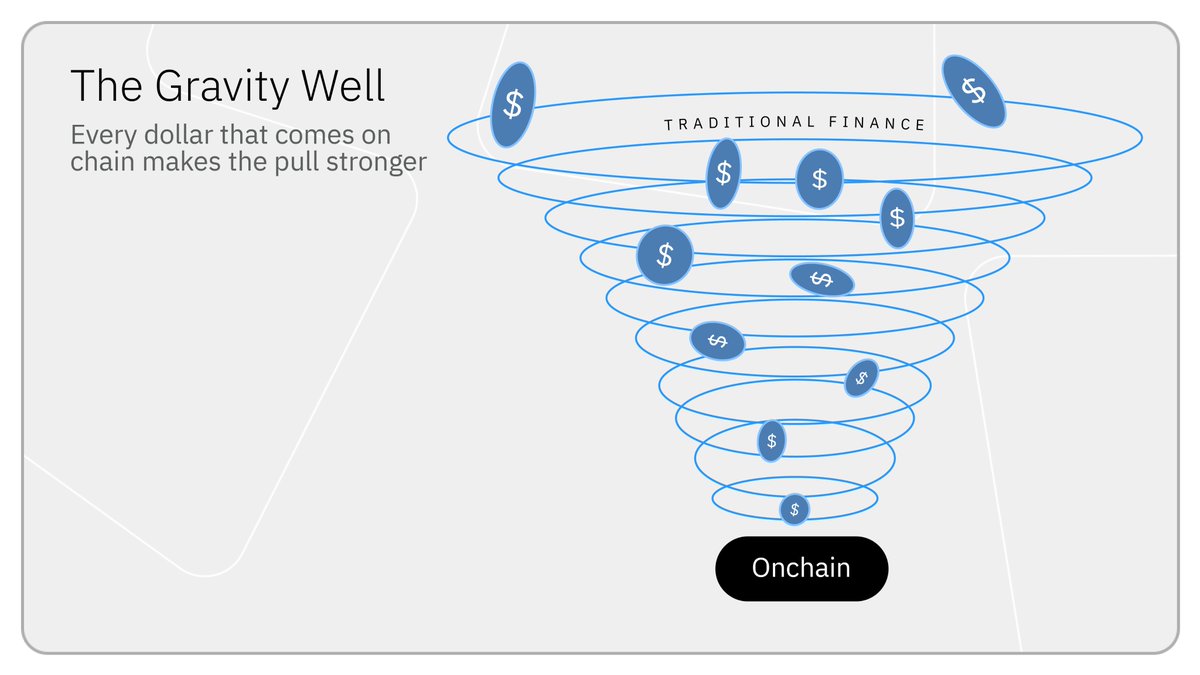
Great Capital Migration
Stablecoins are the first real-world assets to be adopted at scale on-chain. USD funds are migrating from bank accounts onto the blockchain, continuously accumulating and compounding through a flywheel effect. The author, along with Spencer Bogart, believes a massive capital migration is underway: global capital is systematically shifting from traditional infrastructure to on-chain systems.
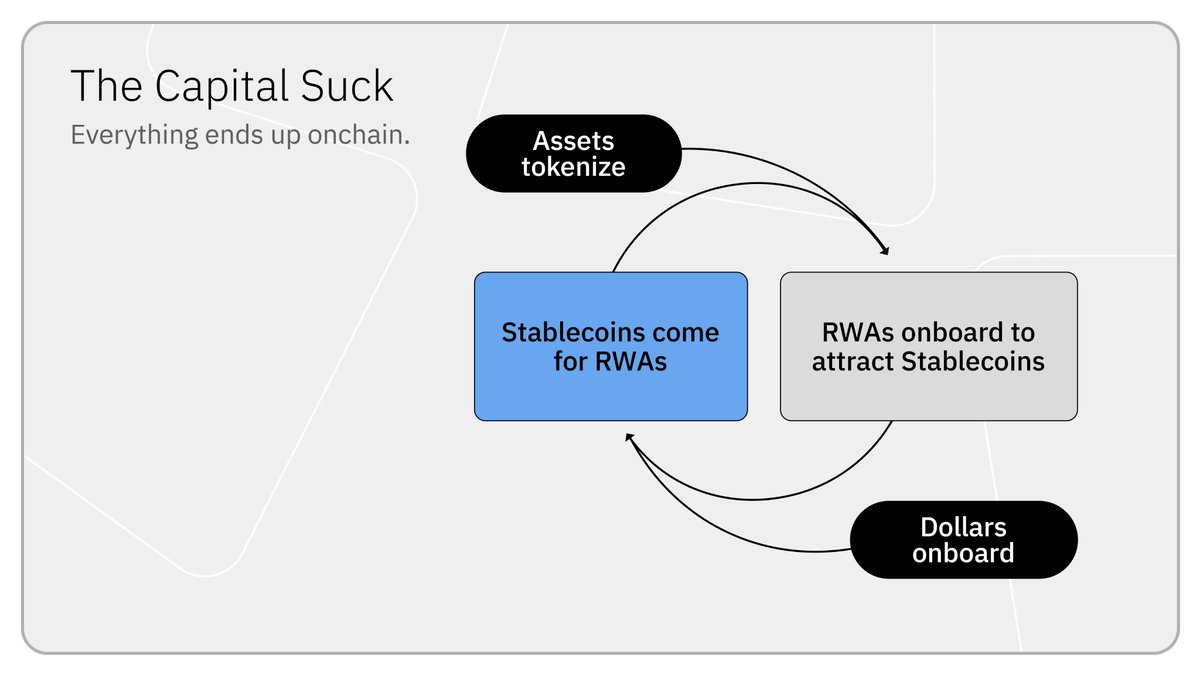
We have already seen this trend: issuers are tokenizing assets, institutional capital is flowing in, and more issuers are tokenizing their products to compete for this capital, thereby attracting even more capital on-chain.
The flywheel that once only absorbed stablecoins now encompasses a full range of assets, including equities, credit, government bonds, and structured financial products. The transformation is still in its early stages, but the invisible flywheel that drove stablecoin adoption 60-fold over the past six years will ultimately enable the on-chain migration of all assets.
Disclaimer: The views expressed in this article are solely those of the author and do not represent the position or opinions of this platform. This article is provided for informational purposes only and does not constitute investment advice of any kind. Any disputes between users and the author are unrelated to this platform. If any articles or images published on this webpage infringe upon your rights, please send an email to support@aicoin.com with relevant proof of rights and identification, and our team will review your submission.