





Original | Odaily Planet Daily (@OdailyChina)
Author | Azuma (@azuma_eth)

In the early hours of Beijing time today, Block, the fintech company founded by Jack Dorsey (also the founder of Twitter), announced a major layoff plan—cutting nearly 4,000 positions, reducing its workforce from over 10,000 employees to fewer than 6,000, to drive a leaner, flatter, and AI-centric organizational structure.
Jack Dorsey is a passionate Bitcoin enthusiast and a Bitcoin Maximalist who believes Bitcoin will ultimately become the native currency of the internet. Block is deeply intertwined with Bitcoin, not only holding Bitcoin directly on its balance sheet but also offering products and services such as trading, wallets, and mining. Additionally, Block has been a long-term funder of Bitcoin core developers.
But that’s not the focus of this article—the key point is that, unlike other companies forced to lay off employees due to business contraction, Block proactively cut nearly 40% of its roles while experiencing simultaneous growth in revenue and profit margins, and at the same time raised its gross profit guidance for 2026 to $12.2 billion.
Jack Dorsey addressed the reasons behind this decision in his announcement: “Some things have changed. We’ve seen that the intelligent tools we’re building and using, combined with smaller, flatter teams, are giving rise to an entirely new way of working—fundamentally altering what it means to build and run a company, and this shift is accelerating rapidly... Rather than passively accepting change and gradually laying people off over the coming months or years, we choose to act now.”
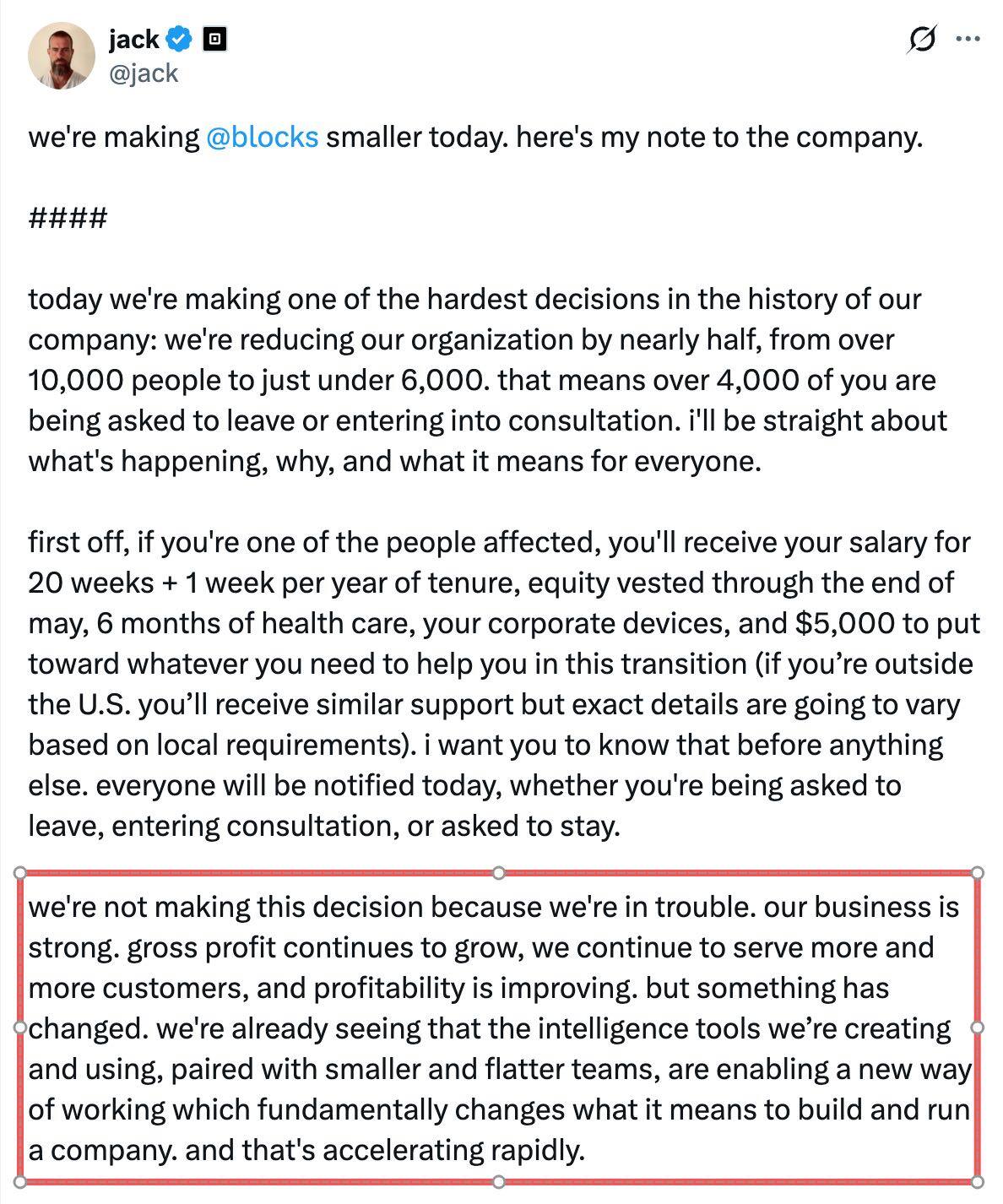
The changes mentioned by Jack Dorsey are not new—the rapid advancement of AI is transforming the traditional paradigm of productivity growth. In the past, businesses primarily relied on linear increases in workforce size to boost productivity and scale operations; today, with rapidly evolving AI tools, companies can achieve exponential productivity gains while maintaining or even reducing their employee count.
Overseas influencer and product growth expert Aakash Gupta pointed out that Block is not the first company to make this decision: “Block is not an outlier—ASML laid off 1,700 people last month while also announcing record-order volumes; Salesforce laid off 5,000 people after AI began handling 50% of customer interactions; Amazon laid off 16,000 people in January last year and another 14,000 in October... All these companies made their layoff decisions while still in a growth trajectory. Jack Dorsey simply voiced what everyone has been quietly acknowledging—that AI tools combined with smaller teams have fundamentally transformed how companies operate.”
More notably, after Block announced its layoff plan, the capital market quickly responded—Block’s stock price surged 20%, adding nearly $6 billion to its market capitalization, which means approximately $1.5 million in enterprise value was created for each job eliminated.
It has long been a societal consensus that AI will disrupt the job market and eliminate certain professions, but many still underestimate the speed at which this change is arriving. In recent weeks, we have witnessed Anthropic’s disruptive impact across multiple industries such as SaaS; we’ve seen the 30-million-read article "Global Intelligence Crisis 2028" now stirring public emotion; and now comes Block, proactively downsizing and openly stating the reasons why.
Another counterintuitive reality is that while people once believed AI’s threat to jobs would progress gradually from low-end to high-end roles, the actual situation is that, due to the immaturity of physical interaction domains, AI has begun displacing white-collar jobs—once considered relatively mid- to high-level—first. The reason is straightforward: white-collar work fundamentally involves “input → processing → output” of information based on specific industry standards, which is precisely the area where large AI models excel.
In this round of layoffs at Block, affected employees will receive 20 weeks of severance pay plus an additional week for each year of service, along with a $5,000 transition allowance. Block will also continue health insurance coverage for six months and allow employees to keep company equipment. While the severance package is relatively generous, for these white-collar employees whose roles are already under threat from AI, it’s time to consider how to stay relevant in the age of AI.