





On March 12, 2026, Ethereum staking reached a historic milestone.
BlackRock, the world's largest asset manager, has officially launched on Nasdaq the staked Ethereum ETF with yield generation, the iShares Staked Ethereum Trust (ticker: ETHB)—it holds spot Ethereum and stakes the majority of its assets on-chain, distributing earnings regularly to investors.
After more than a year of market discussion, the launch of ETHB has effectively resolved the core issue that has remained unanswered since the introduction of Ethereum spot ETFs: Can ETH be officially recognized by the mainstream financial system as an "interest-bearing asset"?
This also marks the formal integration of "staking"—once an activity limited to on-chain native users—into Wall Street’s asset allocation framework.

What is ETHB, and how does it work?
From both a timing and market environment perspective, BlackRock’s ETHB launch is perfectly timed.
On one hand, BlackRock’s iShares Bitcoin Trust (IBIT) currently manages over $55 billion in assets, while the iShares Ethereum Trust (ETHA) has reached $6.5 billion in assets under management, validating institutional acceptance of crypto asset ETFs. On the other hand, discussions and policy preparations regarding whether ETFs should be permitted to participate in staking have been ongoing for over a year, from the United States to Hong Kong.
Looking closely, the key difference between ETHB and previous Ethereum spot ETFs like ETHA is that it does not let ETH sit idle.
Traditional crypto ETFs operate in a very straightforward manner—typically buying ETH, holding it in custody, tracking its price movements, and doing nothing else. ETHB, however, introduces a key innovation: it enables the held ETH assets to participate in network consensus and generate yield.
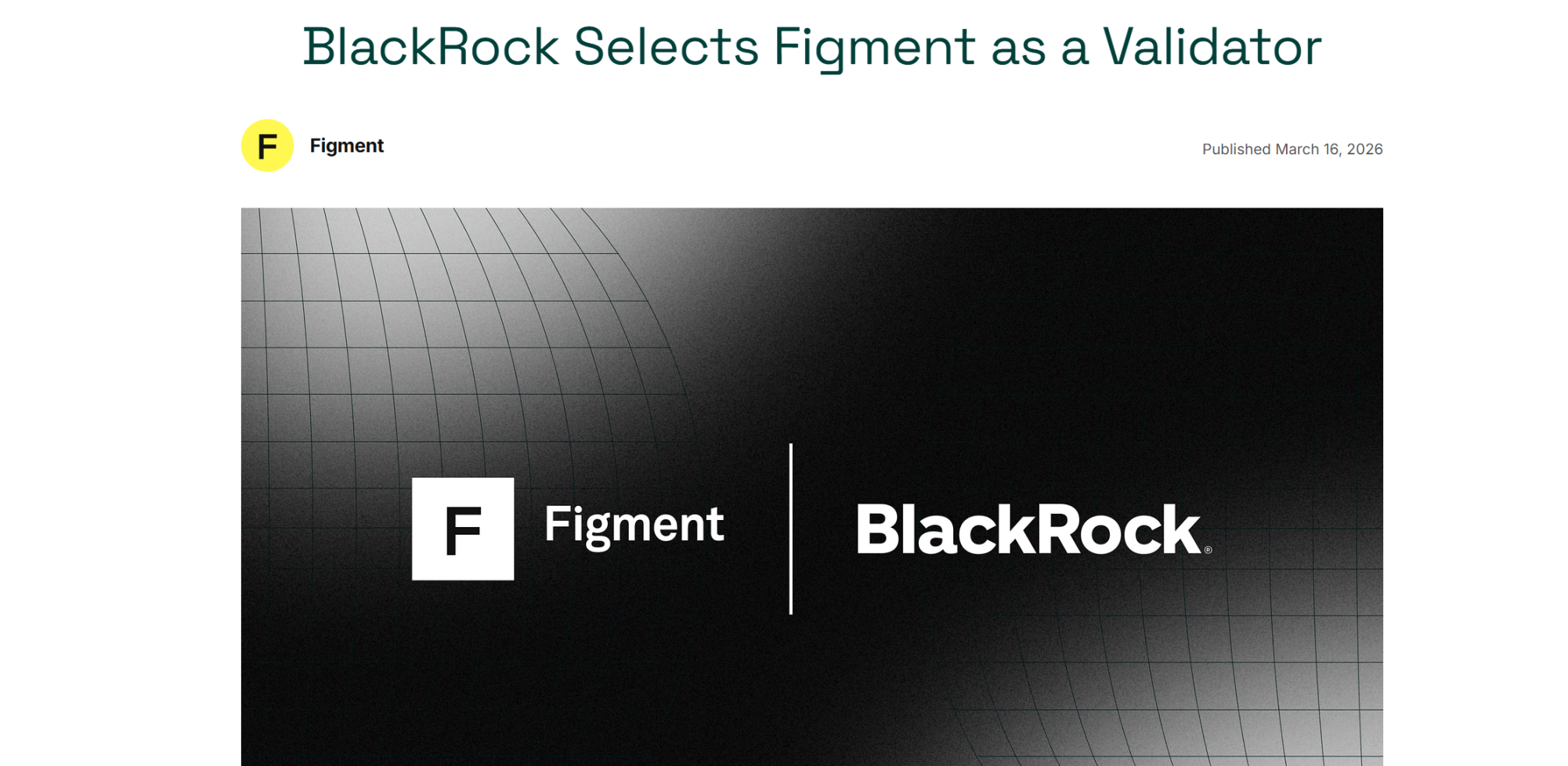
It delegates 70% to 95% of the ETH holdings in the position to professional validators such as Figment via Coinbase Prime, actively participating in Ethereum network consensus maintenance and earning staking rewards.
To break down this mechanism in detail:
- Investors purchase shares of the ETHB fund;
- The fund uses raised capital to purchase spot ETH;
- Most ETH is staked;
- The rewards generated from staking are distributed approximately 82% monthly to fund holders, with the remaining 18% retained as service fees by entities such as BlackRock;
- The fund also charges an annual management fee of 0.25% (with a discounted rate of 0.12% for the first $2.5 billion in assets under management);
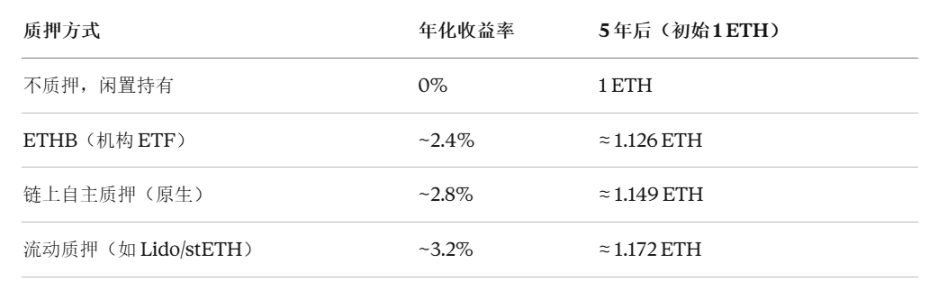
This also highlights the core value of compound staking. For example, with stETH, users’ stETH token balances automatically increase with staking rewards—no manual action required—each reward becomes part of the principal and continues to generate new returns.
For ETHB, we can perform a similar calculation—Ethereum’s current annualized staking yield on-chain is approximately 2.8% to 3.1%. Since ETHB distributes about 3.1% × 82% to investors, the net yield after management fees is approximately 2.3% to 2.5%.
Although the numbers may not seem high, the key is that it represents a consistent, automatic, and predictable cash flow, meaning that ordinary investors who purchase ETHB will now be able to benefit from compounding interest going forward.
Of course, although ETHB distributes rewards monthly, investors will not benefit from compounding unless they actively reinvest their distributed earnings to purchase additional ETF shares, which may give on-chain native staking a slight edge in long-term returns.
II. Why is the emergence of ETHB so important?
The significance of ETHB goes far beyond the launch of a new fund.
It is well known that during the tenure of former U.S. Securities and Exchange Commission (SEC) Chair Gary Gensler, all Ethereum ETF applications were required to remove staking functionality, as staking was deemed to potentially constitute an unregistered security. With Gensler’s departure and the appointment of new Chair Paul Atkins, the regulatory stance has clearly shifted, ultimately paving the way for the creation of ETHB.
BlackRock currently manages over $130 billion in crypto-related ETP assets, and its iShares product line captured approximately 95% of global digital asset ETP net inflows in 2025. When such a massive institution incorporates "Staking" into its product structure, it sends a clear signal to the entire market that staking yields are a legitimate and sustainable source of investment returns.
Therefore, much like the surge of follow-up applications for Ethereum, Solana, and other cryptocurrencies after the approval of Bitcoin ETFs, ETHB’s issuance is likely to prompt a wave of质押 ETF applications from PoS networks such as Solana, Cardano, and Polkadot, with all crypto asset ETF issuers quickly moving to follow suit.
We can even anticipate that, within the next six months, a significant amount of spot ETF capital will flow back into yield-oriented ETFs.
In fact, as early as January this year, Ethereum ETFs began entering this space, allowing holders to receive interest regularly, just like holding securities—Grayscale’s Grayscale Ethereum Staking ETF (ETHE) has distributed staking rewards to existing share holders, marking the first spot crypto asset trading product in the U.S. to distribute staking yields to its holders.
Although this move may seem routine to Web3-native users, it marks a historic milestone in the history of crypto finance—the first time Ethereum-native yields have been packaged within the standard framework of traditional finance.
It should be emphasized that this does not mean Ethereum staking has been fully compliant, nor does it indicate that regulators have issued a unified stance on ETF staking services; however, economically, a key change has occurred: non-crypto-native users have, for the first time, indirectly earned native yields from Ethereum network consensus without needing to understand nodes, private keys, or on-chain operations.
From this perspective, Ethereum staking has taken a crucial step toward entering the broader capital landscape.
III. What’s next?
Of course, not everyone will earn staking rewards by purchasing ETHB. For most crypto users, a more direct approach is to participate on-chain.
We still need to review the main Ethereum staking methods, which primarily consist of three pathways.
First and foremost is native staking, which requires users to stake at least 32 ETH and run an independent validator node. Although it offers the highest rewards and maximum decentralization, the barrier to entry is high, making it better suited for technically skilled, advanced users.
Second is liquid staking, the current market standard, with a total volume nearing 15 million ETH and a total value exceeding $35 billion. Users can participate without needing 32 ETH through protocols such as Lido (stETH) and Rocket Pool (rETH).
After staking, you receive liquidity tokens pegged 1:1 to your original assets, allowing you to continue participating in DeFi activities, maximizing the compounding effect.
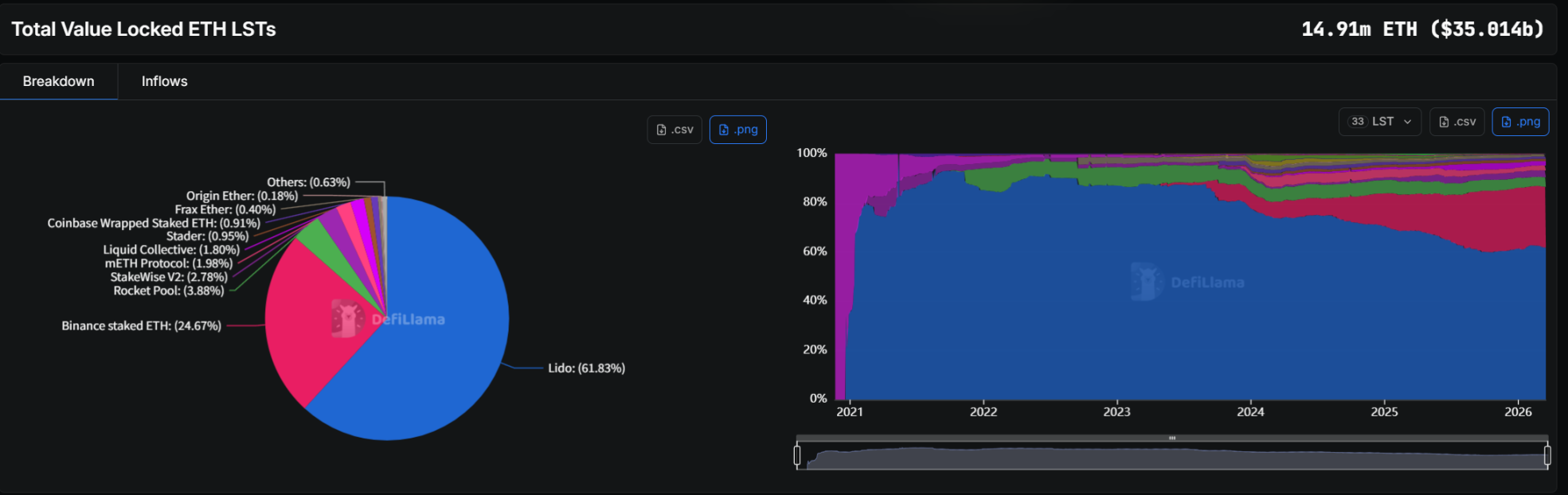
Source: DeFiLlama
There is also node staking, which primarily involves direct participation through wallets that support staking functionality—simple to use and ideal for non-technical users—this also places higher demands on supporting infrastructure such as wallets.
Overall, BlackRock’s launch of ETHB marks a significant milestone in the evolution of Ethereum staking from a “on-chain native activity” to a “mainstream financial product,” validating the legitimacy of staking yields and accelerating the flow of institutional capital into the Ethereum ecosystem.
For ordinary coin holders, a more significant signal is that staking, as a way to keep assets continuously working, has been recognized by the world’s largest asset management institutions.
When ETH begins to earn interest automatically, the logic of asset pricing changes. It is no longer just a speculative asset waiting to appreciate, but a "yield-generating machine" that continuously produces cash flow. Whether through ETFs or on-chain staking, this trend is irreversible.
And are you ready to put your ETH to work?