





Author: Max.S
The capital market's belief in "decentralized AI" (DeAI) is undergoing an unprecedented stress test.
Recently, Bittensor ($TAO), the undisputed leader in the decentralized AI space, suffered a devastating internal upheaval. Covenant AI, one of the top development teams within the Bittensor ecosystem and the team that recently successfully trained a 72B large language model, suddenly announced on social media its complete withdrawal from the Bittensor network. In its departure statement, Covenant AI directly targeted Bittensor’s founder, Jacob Steeves, condemning his “absolute and authoritarian” control over the network, accusing him of arbitrarily cutting off token rewards for subnets, and declaring that so-called decentralized AI was nothing more than a carefully staged “performance.”
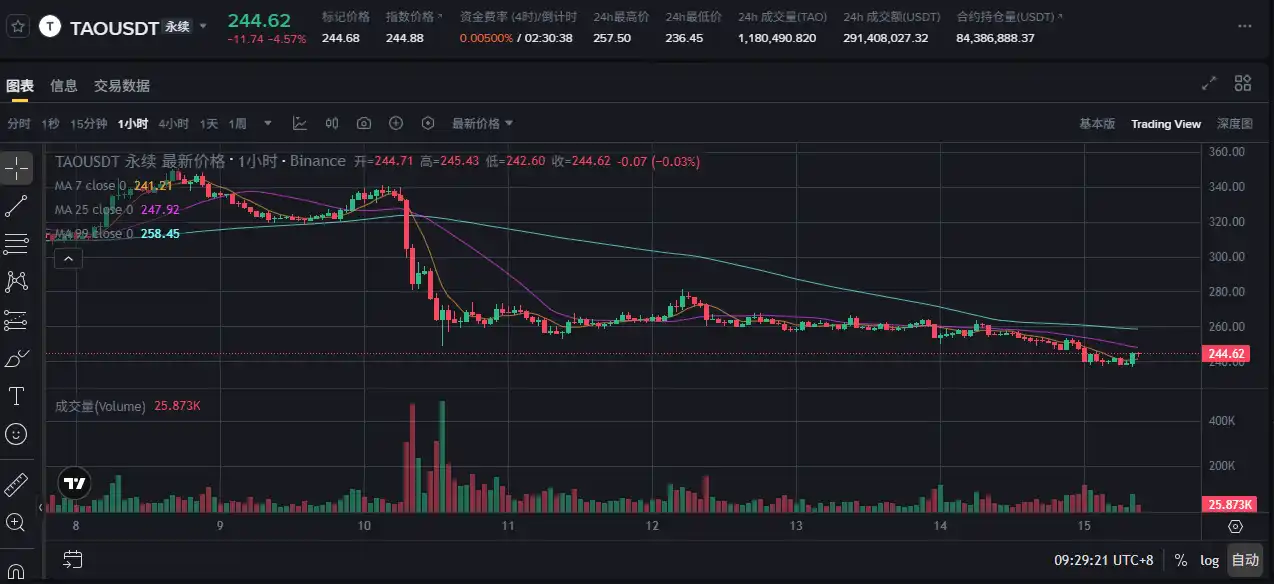
Affected by this black swan event, the $TAO token price suffered a panic sell-off on secondary markets, plunging 15% to 25% in a single day and wiping out hundreds of millions of dollars in market value. While the crypto community watched the public fallout between top-tier teams and founders, it also began seriously examining a deeper industry question: In the AI sector, which heavily relies on computational capital and complex engineering, is tokenomics-driven "decentralization" a utopia that reshapes production relations—or merely a glamorous facade masking centralized power?
To understand the impact of this event, it’s essential to recognize Covenant AI’s significance within the Bittensor ecosystem.
Within Bittensor’s multi-subnet architecture, most subnets are still in early stages—handling low-level API calls, model fine-tuning, or simple task routing. Teams capable of training models from scratch or at large-scale parameter levels are exceedingly rare. Covenant AI stands out as a true hardcore representative within this ecosystem. Just before announcing its exit, the team delivered a landmark achievement to the community: successfully training an open-source large model with 72 billion parameters (72B) in a decentralized network environment.
At current compute costs, training a 72B model requires mobilizing a massive GPU cluster—typically equivalent to thousands of H100s running continuously for weeks—alongside extremely high hardware and electricity expenses. Covenant AI is willing to bear this substantial upfront sunk cost because of Bittensor’s “Emissions” mechanism: as long as its models and compute receive high scores in subnet evaluations, it earns continuous rewards in $TAO tokens. This is precisely the most compelling flywheel effect in the DeAI narrative.
However, the momentum came to an abrupt halt. According to Covenant AI, after investing heavily to complete training of the 72B model and launching it, founder Jacob Steeves and his stakeholders directly cut off token rewards flowing to the Covenant AI subnet by controlling validator nodes, without any warning or transparent governance process.
For miners and developers, cutting off emissions is like pulling the plug. The ROI on massive computational investments instantly drops to zero, and this highly unpredictable systemic risk directly triggered Covenant AI’s angry exit.
The term "charade" used by Covenant AI in its exit statement precisely struck at Bittensor's most vulnerable nerve: control of the network.
Bittensor’s underlying design relies on the Yuma consensus, which centers on "validators" assessing the contributions of "miners" and determining how newly minted $TAO tokens are distributed. Theoretically, this is a decentralized game-theoretic system based on staking and algorithms. But Covenant AI’s allegations reveal a harsh reality: while computing power is decentralized, power and capital are highly concentrated.
On the current Bittensor root network, the top validator nodes that dominate token allocation flows have their staked stakes highly concentrated among early investors, the foundation, and addresses associated with the founder, Jacob Steeves. This means the founder is not only the rulemaker but also the largest referee.
Covenant AI points out that when a subnet's output conflicts with Jacob's personal interests or potentially threatens the interests of other "core" subnets, Jacob can easily leverage his substantial staking weight to alter the Yuma consensus outcomes. This top-down form of intervention renders decentralization at the smart contract level meaningless. Developers who spend millions of dollars on computing power ultimately find their fate determined by the subjective will or opaque maneuvers of a single founder.
Objectively, Jacob and his supporters may defend their actions by citing reasons such as “maintaining the overall quality of the network” or “preventing specific subnets from exploiting rule loopholes to mint coins.” However, in the absence of transparent DAO governance mechanisms and on-chain hearing or appeal channels, this centralized intervention—acting as self-appointed enforcers—severely undermines the network’s core value as a “trusted, neutral infrastructure.”
$TAO experienced a single-day plunge of 15-25%, not merely due to retail investor panic selling, but also because institutional capital is repricing the "governance risk discount" associated with Bittensor.
Bittensor commands a large market cap and a high valuation premium because the market views it as the only realistic target for a "decentralized OpenAI." This grand narrative rests on the system’s need for strong predictability: whenever you contribute computing power and high-quality models, the protocol automatically guarantees your rewards through code.
The Covenant AI incident shattered this expectation. Top financial professionals and institutional investors detest "unpredictable single points of failure," and here, that point of failure was Jacob Steeves' power.

If even the absolute top team capable of training a 72B model can instantly lose everything due to founder interference, then for other cryptocurrency holders观望算力 providers and AI research institutions, deploying capital-intensive resources on Bittensor is akin to playing Russian roulette with a随时可能被“掀桌子” risk. When high-quality supply-side participants—miners and developers—refuse to enter due to fear of centralized tyranny, the use cases and intrinsic value of the $TAO token become water without a source. The frantic exodus of capital is a preemptive vote against this deteriorating fundamental reality.
Covenant AI's departure is not merely a public relations crisis for Bittensor, but an inevitable growing pain as the decentralized AI sector enters its advanced stage. It brutally reveals the "impossible trinity" in DeAI: model quality and scale, decentralized trustworthiness and neutrality, and incentive alignment against malicious behavior.
Centralization of scale versus decentralization of mechanism: Training frontier AI models (such as those larger than 72B parameters) is a typical capital-intensive, centralized endeavor requiring highly coordinated GPU clusters, creating a fundamental physical divide from Web3’s principles of permissionless, decentralized nodes.
Anti-sybil vs. Trustworthy Neutrality: To prevent low-quality nodes from cheating the system through mutual traffic boosting and fraudulently earning tokens (Sybil attacks), the network must introduce subjective “quality assessments.” However, today, as AI evaluation criteria have not yet been fully objectified mathematically, entrusting this assessment power to a small group of validators easily leads to centralized rent-seeking.
Bittensor attempts to bridge the two using tokenomics, but the Covenant incident demonstrates that the load-bearing pillars of this bridge—its governance mechanisms—remain dangerously weak.
Covenant AI's departure punctures the romantic illusion of Bittensor's "absolute decentralization." For $TAO, this may be a painful moment of disillusionment, but for the entire DeAI industry, it is a necessary wake-up call.