





Bitcoin has reclaimed and held above the $75,000 region after the latest rebound, but derivatives data shows the recovery lacks broad conviction.
Bitcoin In The Middle Of A Credibility Problem
Bloomberg claims Bitcoin has a credibility problem right now. Funding rates on perpetual futures have stayed negative for around a month and a half, meaning leveraged traders are still paying to stay short even as spot grinds higher.
This divide ranks among the largest this year between spot price action and how derivatives traders are positioned. Bitcoin has climbed about 14% off its April lows, helped by renewed inflows into US‑listed ETFs and fresh accumulation by Michael Saylor’s Bitcoin treasury firm, MicroStrategy.
Such a gap between positioning and price rarely lasts long, and it usually ends brutally for someone. When Bitcoin keeps grinding higher, traders shorting the move rack up losses and can be forced to rush in and buy back their positions, driving an abrupt, self‑reinforcing spike known as a short squeeze. The longer this standoff drags on, the more violent that eventual reversal can become.
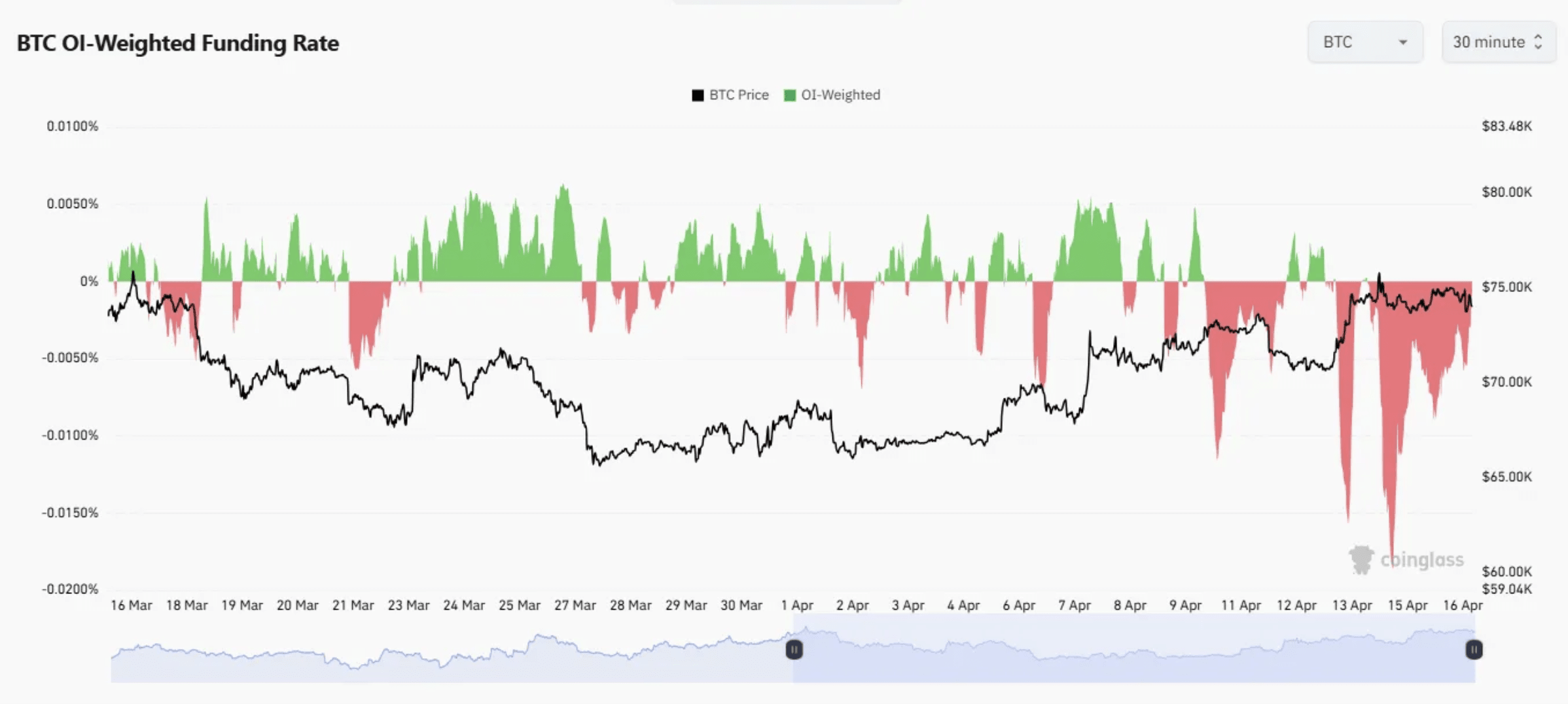
The data brought by Bloomberg shows that net flows into US‑listed spot Bitcoin ETFs have hit about $332 million so far this week, with roughly $26 million added on Thursday alone. By 8 a.m. in London on Friday, Bitcoin was changing hands near the $75,000 mark.
This has been one of the longest bearish funding streaks since the post‑FTX capitulation period in late 2022, when sentiment was similarly washed‑out.
A Short-Squeeze RiskVetle Lunde, head of research at K33, told Bloomberg that “Traders are actively building short positions and betting against a breakout, creating conditions where a short squeeze becomes more likely if upward momentum persists”.
The current structure looks like a textbook squeeze setup. Negative funding shows that short sellers still dominate leverage and are paying to stay in the trade, even as Bitcoin grinds higher. That slow grind means many of those shorts are already underwater but haven’t capitulated yet, leaving them vulnerable. At the same time, spot liquidity looks thin, so any sharp move can quickly ripple through derivatives and turn into a fast, cascading squeeze.
Bloomberg explains that the short-heavy backdrop looks even more fragile given the wave of bullish catalysts hitting the market at the same time, any one of which could spark the kind of upside jolt that forces bears to scramble out of their positions.
A Soft Recovery For Bitcoin?MicroStrategy has disclosed two purchases worth a combined $2.6 billion in just the past two weeks, a steady bid that FalconX senior derivatives trader Bohan Jiang says has helped support prices. On top of that, Charles Schwab has unveiled plans to roll out spot crypto trading this year and floated the idea that clients could dedicate up to 8.8% of their portfolios to Bitcoin. This signals just how much fresh demand could still be waiting in the wings.
Over the past week alone, US‑listed Bitcoin ETFs have pulled in more than $800 million, flipping from the outflows seen earlier in the year to strong net demand. Every new leg of ETF buying pushes prices higher and makes it more expensive for short sellers to sit in losing trades, ratcheting up the squeeze pressure that has been quietly building in the derivatives market for weeks.
According to Bloomberg, bearish traders could still come out ahead if this latest bounce ultimately breaks down. Deribit data shows options desks paying up for downside protection, with notable open interest clustered in put contracts around the $60,000 and $50,000 strikes. They called this a soft recovery.
Laurens Fraussen, research analyst at Kaiko, believes that Bitcoin might see rally that is sure to “catch some people off guard”. Fraussen claims that a break above $76,000 could see BTC extend toward $85,000.

Cover image from Perplexity. BTCUSDT chart from Tradingview.