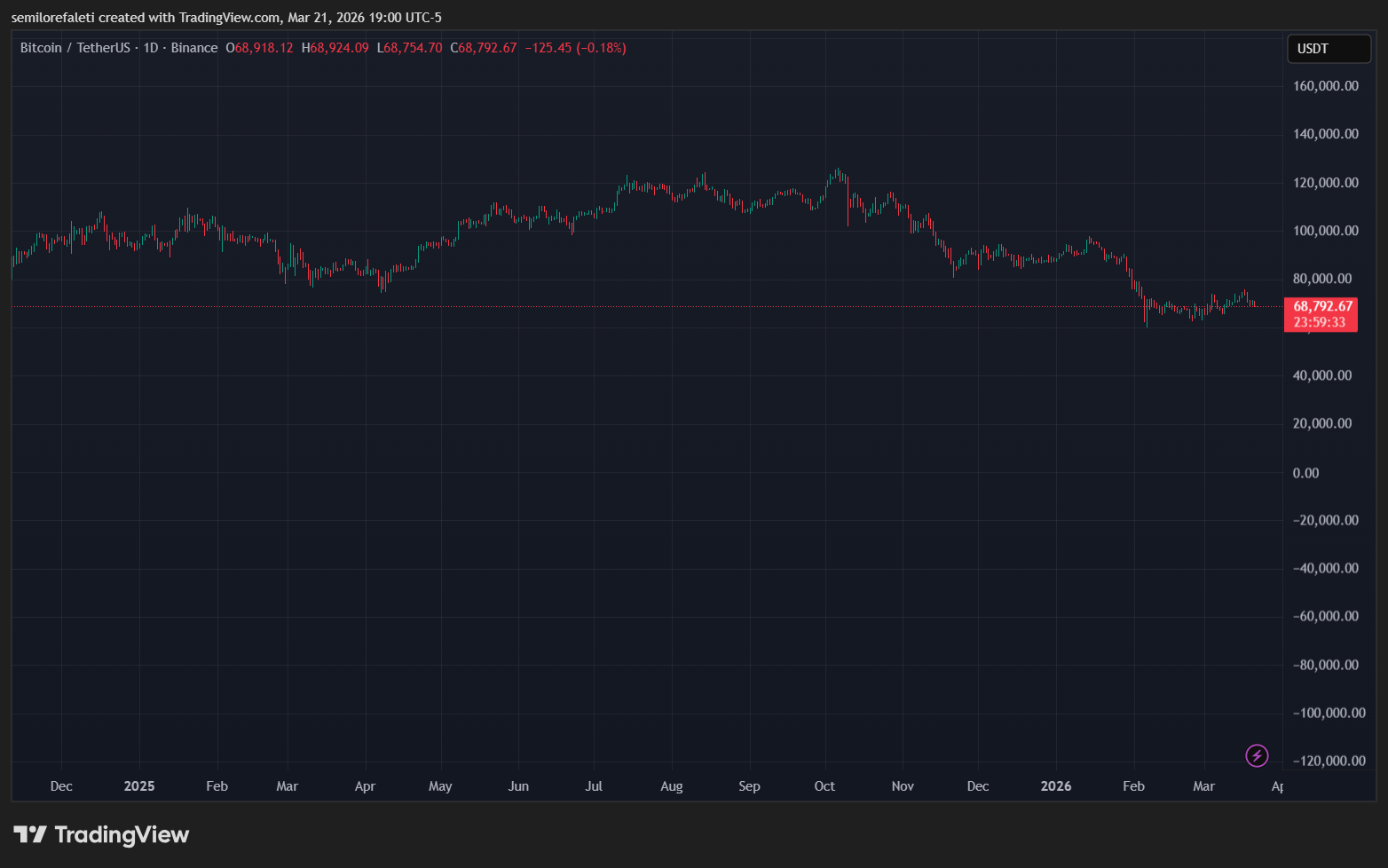


The Bitcoin market commenced an extended bearish phase in October 2025, after an initial flash crash triggered a 19% decline from the present all-time high at $126,000. In the subsequent months, Bitcoin would experience a steady loss combined with major drawdown moments, eventually pulling its price to a local bottom of $60,000, before entering a mid-term consolidation phase.
In the last month, Bitcoin has shown a moderate recovery with a net gain of 4.89%, with prices trading as high as $75,000. While this recent performance may be indicative of a stabilizing market, recent data on the correlation between the premier cryptocurrency and the S&P 500 has presented new bearish concerns.
Historical Correlation Coefficient Data Hints At Potential Market Crash
In an X post on March 21, market analyst Tony Severino reports that recent developments with the BTC-S&P 500 Correlation Coefficient indicate Bitcoin is in danger of another major downswing. Notably, the Correlation Coefficient is a figure between -1 and +1 that measures how strongly and in what direction two assets, i.e., Bitcoin and the S&P 500 in this case, move relative to each other over time.
Observation
Historically, when Bitcoin's correlation with the S&P 500 drops to -0.5 on the Correlation Coefficient, and then turns sharply up, it is a warning sign that the stock market is going to collapse and take BTC with it
Usually there's a bounce first to add to the pain pic.twitter.com/Tefbzo2nd3
— Tony Severino, CMT (@TonySeverinoCMT) March 21, 2026
At +1, the coefficient indicates that the assets move exactly together in the same direction, while at -1, a perfect negative correlation occurs, with the assets moving in opposite directions. At 0, movements are considered unrelated, with no identifiable pattern, as both assets trend independently of each other.
Amid the bear market that has persisted since late 2025 and early 2026, the 20-day Bitcoin-S&P Correlation Coefficient dipped to around -0.5 as Bitcoin prices fell while equities rose. However, Severino notes that this coefficient had recently rebounded to around -0.10, creating a market sequence that has previously preceded major Bitcoin downturns.

According to the seasoned expert, each time the 20-day BTC S&P 500 correlation dropped to -0.5 before sharply reversing, it has triggered stock market crashes that induced a significant sell-off in the Bitcoin market. However, there is usually an initial price bounce lasting 10-17 weeks before the drawdown commences. Severino’s analysis suggests the limited rebound observed since early February represents this preliminary gain, which is now 8-weeks old.
As observed in 2018, 2020, and 2022, the resulting correction from this setup threatens a potential price fall of 70-80% from the peak of this initial price bounce.
Bitcoin Market Outlook
At the time of writing, Bitcoin trades at $68,584 after a 2.41% decline in the last 24 hours. Meanwhile, the daily trading volume has declined by 41.21%, representing a fall in the traders’ participation as Bitcoin continues to consolidate following its failed breakout above $75,000 in the last week.