





Bitcoin’s latest pullback has prompted renewed speculation about whether the market is witnessing a period of institutional accumulation rather than a fundamental shift in sentiment. While prices have trended lower in recent weeks, some analysts argue that the decline may be creating an attractive entry point for larger investors looking to build positions before the next major catalyst emerges.
How Large Investors Typically Approach Bitcoin Volatile Markets
Bitcoin’s recent weakness may be part of a broader accumulation phase rather than a sign of deteriorating long-term fundamentals. An analyst known as Ash Crypto on X stated that institutions are intentionally pushing the price lower to accumulate at a lower price before the Clarity Act is signed into law.
This perspective draws a similar pattern. In August 2022, BlackRock filed for a private BTC trust, and the BTC price later dropped by roughly 36% before forming a bottom. Less than a year ago, in June 2023, BlackRock filed for the first Spot BTC ETF, an event that preceded a powerful 95% rally. By January 2024, when spot ETFs were officially approved, BTC hit a new high of $126,000.
While there is no public evidence proving that institutions are intentionally driving prices lower, the narrative highlights growing expectations that institutions are repeating the same strategy with the Clarity Act.
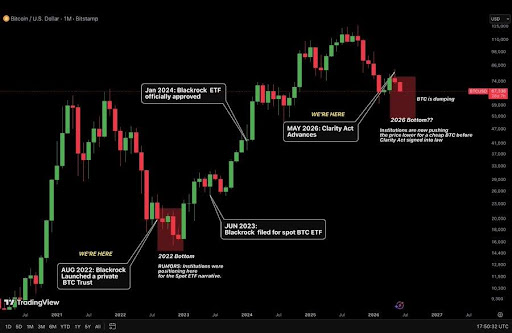
BlackRock’s aggressive selling of Bitcoin highlights exactly what is happening behind the scenes in the market right now. Crypto trader and investor EliZ has noted that this is another demonstration of how the market is often driven by liquidity rather than investor sentiment.
If the selling pressure were to continue, the market could simply be experiencing a distribution phase aimed at pushing the price downward, raising cash, and creating fear in the market. These types of cycles are not new; they are dynamics that have played out before. According to EliZ, when market sentiment reaches an extreme bottom, and most traders have lost confidence, that is when big money returns to accumulate, driving the market towards new highs.
For now, patience and disciplined risk management remain essential during these periods. Rather than rushing to anticipate every move, understanding that the broader market moves in phases, and this could be one of many.
What Negative ETF Flows Could Mean For BTC’s Next Move
May marked a notable shift in Bitcoin outflows from ETFs. Analyst Darkfost revealed this trend after examining the chart that compares the number of BTC held by ETFs between the beginning and end of the year, showing a sharp decline in net holdings growth.
Within a single month, net ETF holdings reportedly moved from more than 57,000 BTC earlier in the year to less than 6,940 BTC, pushing the metric back into negative territory compared to the start of the year. Currently, a correlation with the price can be observed, but ETF flow dynamics this year are starting to diverge from those of 2024 and 2025.
