





If there’s one theme shaping the 2026 cycle so far, it’s that networks are starting to prioritize security.
A week ago, Solana [SOL] ran a quantum-resistance test to evaluate whether the network could withstand quantum-related attacks. The key takeaway was a significant trade-off: about a 90% drop in speed in exchange for stronger security guarantees.
Notably, other networks are now starting to follow suit.
In the past two days, two major quantum-related updates came out for Bitcoin [BTC]. One prototype allows users to recover funds if quantum computers ever break current signature schemes.
Now, a proposal by Avihu Levy suggests that Bitcoin transactions could be made quantum-safe without requiring changes to the core protocol.
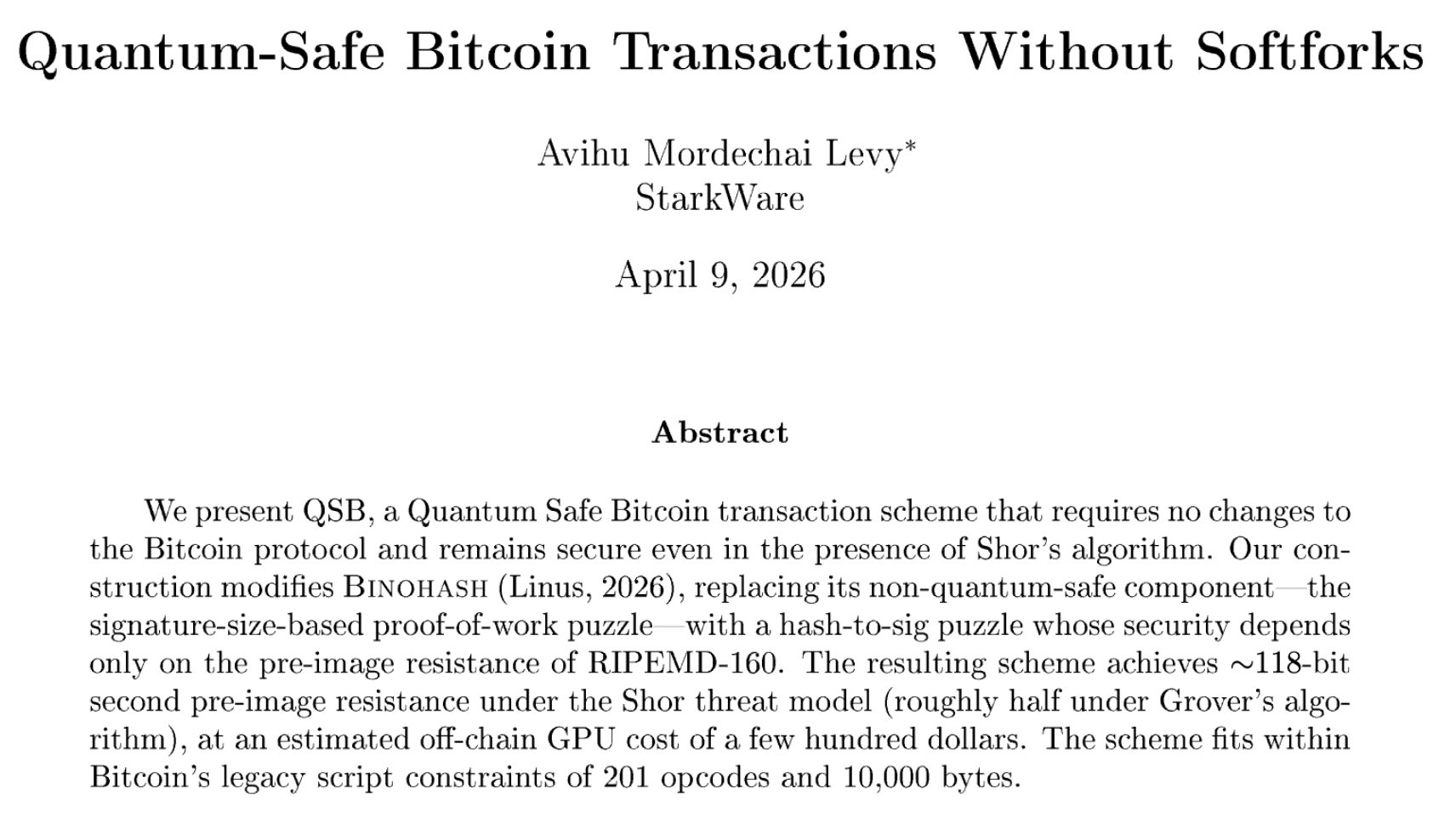
Interestingly, the latter has become the main focus among crypto enthusiasts.
Levy released a whitepaper highlighting how Bitcoin transactions could become quantum-resistant without requiring a soft fork. That said, it doesn’t come without trade-offs.
Notably, Bitcoin can be made quantum-safe today without a protocol upgrade, though each transaction could cost around $75 to $150 in GPU compute.
Put simply, this means users would pay more in computing power and cost in exchange for stronger security without changing Bitcoin’s base protocol.
In short, security for networks won’t come without trade-offs. First, Solana proved it with a 90% reduction in speed, and now Bitcoin with higher transaction costs.
In this context, does this setup give a potential edge to networks that can better balance security with efficiency without pushing either cost or speed too far?
Bitcoin’s quantum debate shifting attention toward XRP
One clear signal from recent moves is that quantum threats are shifting from hype to a real concern.
Why does this matter? As networks roll out ways to become more quantum-resistant, it will likely become a key factor in deciding where user trust forms across L1s.
In turn, that trust directly influences how users interact with a network, including on-chain growth, usability, and ultimately transaction activity over time.
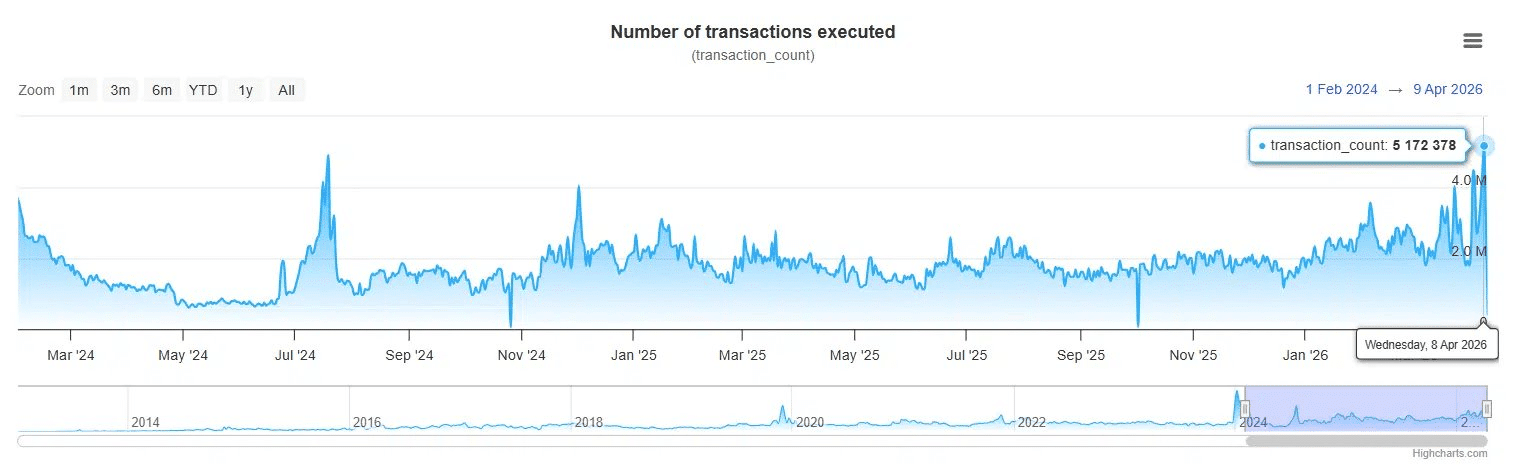
In this context, the recent transaction milestone on Ripple [XRP] starts to carry more weight. As the chart below shows, XRP transactions have surged past a 2-year high of 5 million.
What’s more, the network maintained low fees, throughput stayed above 140 TPS, with peak blocks processing up to 987 transactions.
And it doesn’t stop there. Experts suggest XRP may carry significantly lower quantum risk than Bitcoin.
From their perspective, a large share of XRP wallets have never exposed public keys. In contrast, BTC has an estimated 35% of supply that may be vulnerable.
Additionally, XRPL’s escrow locks help reduce exposure. Meanwhile, Bitcoin’s model requires users to move funds, which exposes public keys in the process.
In short, XRP’s network design may strengthen its positioning in a shifting security landscape. At the same time, Bitcoin’s higher exposure highlights a different risk profile.
Against this backdrop, XRP remains better positioned, while Bitcoin continues to face trade-offs between scale, security, and legacy exposure.
Final Summary
- Bitcoin is increasingly prioritizing quantum resistance, but upgrades come with clear trade-offs.
- Against this backdrop, XRP is gaining attention for maintaining low fees while being viewed as potentially lower quantum risk.