

Analyst Willy Woo has highlighted how some old-school Bitcoin on-chain models could suggest a bottoming zone for the asset in the current cycle.
Bitcoin Bottomed Between Realized Price & CVDD In Past Bear Markets
In a new post on X, analyst Willy Woo has talked about where the Bitcoin bottom could lie according to two on-chain models. The models in question are the Realized Price and CVDD.
First, the “Realized Price” keeps track of the cost basis or acquisition value of the average token part of the cryptocurrency’s circulating supply. Whenever the spot price is above this metric, the investors as a whole could be assumed to be in a state of net unrealized profit. Similarly, the asset being below the level can imply the dominance of loss on the blockchain.
As shown in the chart shared by Woo, the Bitcoin Realized Price has been sliding down recently, meaning that average investor cost basis has been declining. In other words, the average capital invested per holder is down, so some net capital could be considered to have left the cryptocurrency.

Following the drawdown in the Realized Price since November, its value has dropped to around $54,200. So far in the latest bearish market phase, Bitcoin has yet to retest this level. From the chart, it’s visible that past bear markets found their bottoms when BTC was below the indicator. Interestingly, the other model in the chart, the CVDD, served as a sort of lower bound across these cycles, with BTC never dipping below it.
The CVDD, standing for Cumulative Value Days Destroyed, is an indicator created by Woo that derives from the popular Coin Days Destroyed (CDD) metric. A “coin day” is a quantity that 1 BTC accumulates after being dormant on the blockchain for 1 day. When a token dormant for some number of days is moved, its coin days reset back to zero and are said to be destroyed.
The CDD measures the number of coin days being reset across the network in this manner. The CVDD goes a step further and attaches a USD value to each of these coin days, based on the BTC price at the time, and takes their cumulative sum. Additionally, it applies a normalization factor by taking the sum’s ratio with the total age of the market (in days).
Today, the Bitcoin CVDD is sitting at $45,500. If the pattern from the last few cycles is anything to go by, it’s possible that BTC could find a bottom somewhere between this level and the Realized Price at $54,200. That said, the analyst also added a caution, noting:
Models use past behaviour… there’s only been 4 prior bear markets and they have been inside a secular bull market in risk equities. If that foundation collapses, we will be in uncharted territory (deeper bear).
BTC Price
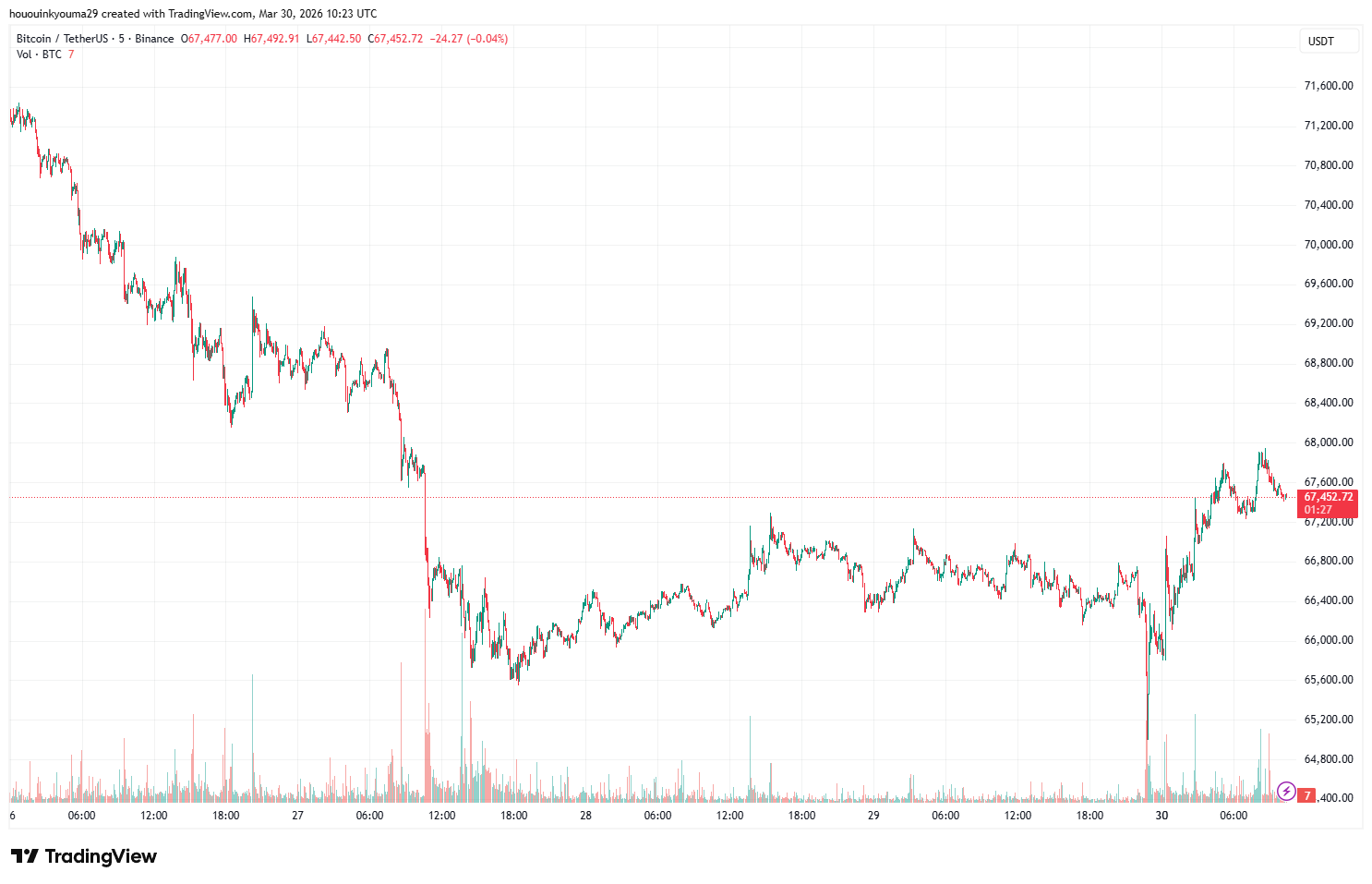
Bitcoin has again failed to maintain its recovery as its price has slipped to the $67,200 mark.