






Key Insights:
- Rising energy costs and inconsistent transaction fee revenue are further squeezing Bitcoin mining profitability.
- Miners collectively hold nearly 1% of Bitcoin’s supply, but most have yet to actively manage those holdings for yield.
- Firms are exploring alternatives such as AI infrastructure hosting or treasury strategies to adapt to the changing economics of mining.
Bitcoin mining news this week is dominated by warnings from trading firm Wintermute that the current mining cycle has hit an unprecedented stress point.
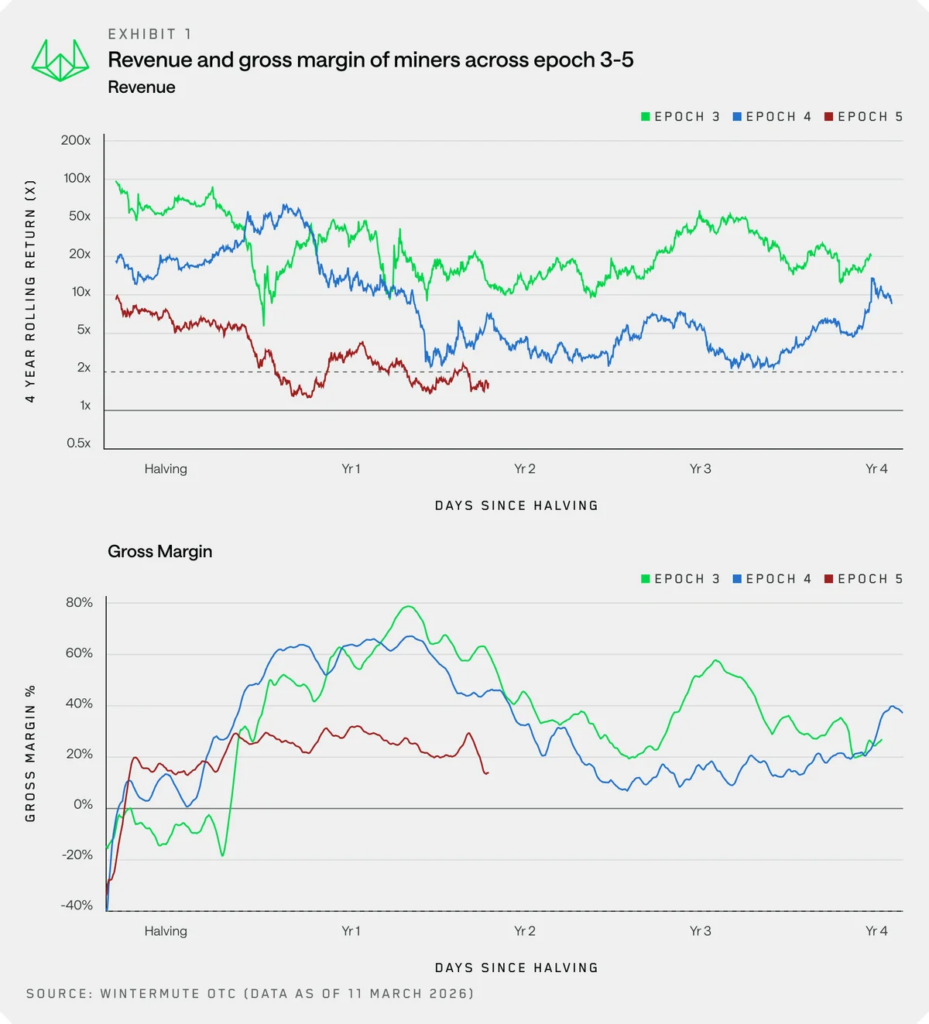
In a March 2026 report, Wintermute analysts note that this cycle failed to deliver the 2× price rally seen in prior halvings. That left miners with razor-thin margins even as operational costs climbed.
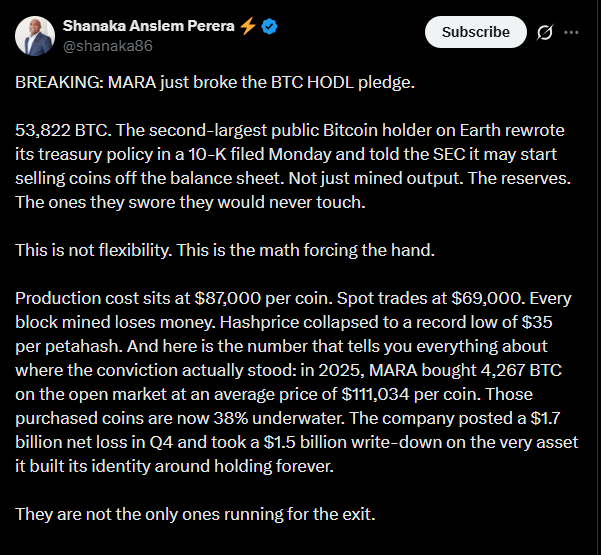
For example, a recent SEC filing on March 3, 2026, signals that MARA Holdings (Marathon Digital) is now open to selling BTC “from time to time” rather than only HODLing.
Industry data show that public miners have sold over 15,000 BTC since last October to cover costs or fund new projects.
Bitcoin Mining Margins and Revenue Under Pressure
Wintermute and other analysts agree that the economics of Bitcoin mining have fundamentally shifted. Wintermute points out that in prior cycles, miners typically saw price gains around 2× the pre-halving level, cushioning the 50% cut in block rewards.
In this cycle, that did not happen: Bitcoin peaked around $126,000 in October 2025 and then fell, so miners never got the usual boost.
The result is that gross margins are as low as previous bear-market floors. “This is the math forcing the hand,” tweeted analyst Shanaka Perera – he notes mining costs are roughly $87,000 per coin against a spot price near $69,000, meaning miners “lose money on every block.”
Seasonal factors have only added to the squeeze. The transaction-fee market – often expected to grow as block rewards fall – remains “episodic, not structural” this cycle.
In practice, fees have not bridged the gap left by the halving. At the same time, many miners have faced higher electricity prices in 2025.
Trading data show average break-even power costs climbed steadily through the year. Together, these trends have forced even large operators to rethink their business.
Bitcoin Mining Firms Explore Yield Strategies and AI Pivot
With pure Bitcoin mining revenues under strain, Wintermute urges miners to deploy new strategies. A key point of the report is that many miners are now sitting on idle capital that could be put to use.
The firm notes miners hold about 1% of all Bitcoin supply on their balance sheets – a legacy “HODL-era” practice – but the “full toolkit of treasury management remains largely untapped.”
In other words, instead of hoarding BTC, miners could actively earn yield on their holdings. This might include derivatives overlays, covered calls, cash-secured puts, or on-chain lending. Wintermute argues the miners who treat their BTC as a “working asset rather than a passive reserve” could gain a lasting edge.
Meanwhile, the biggest new revenue opportunity is in high-performance computing (HPC) and AI. Miners have spent years building vast power infrastructure in low-cost energy regions. Those facilities can be repurposed to train AI models or run data center tasks.
Wintermute acknowledges an AI pivot is “economically compelling,” but also “a drastic and capital-intensive step” for most firms. Not every miner has the land, power contracts, or balance sheet to switch. Still, several major miners have already signaled moves in that direction.
Marathon (MARA) disclosed a March 3 SEC filing (Form 8-K) to allow the sale of BTC reserves, coinciding with a 64% stake acquisition in an AI/HPC operator.
Others, like Core Scientific, Hut 8, Riot, and Terawulf, are quietly repurposing parts of their operations into GPU-backed compute or data-center projects. In Wintermute’s view, these shifts reflect a broader industry dynamic: energy-intensive Bitcoin facilities are exactly the kind of compute resources the AI sector demands.
Outlook: Consolidation and Resilience Ahead
The unwinding is already underway. Public filings and market reports show over 15,000 BTC sold by miners since last fall.
CleanSpark and others have even repaid Bitcoin-backed loans to reduce leverage. Wintermute calls the episode a “healthy shakeup” – painful in the short term but likely to leave a leaner, more efficient sector.
The firms best positioned have strong balance sheets, cheap power contracts, and a willingness to use BTC for liquidity. Indeed, Wintermute notes that historically well-capitalized miners (like Marathon and Bit Mining) may emerge with a “structural edge” if they move swiftly.
For smaller or debt-laden miners, however, the environment is precarious. As margin pressure continues, analysts expect consolidation.
The pattern of sales and divestments is reminiscent of past downturns (e.g. 2018, 2022), but with a twist: this time, holders are proactive. In Wintermute’s words, current conditions could “reframe Bitcoin as a working asset for miners rather than a passive reserve.”
This philosophy underlies recent headlines in Bitcoin news – from MARA’s filing to reports of miners repurposing rigs.
In sum, the Bitcoin mining model is in transition. Verified sources from Wintermute and others show concrete shifts: Bitcoin mining revenue is down, many miners are selling BTC, and new revenue streams are being explored.
This authoritatively draws on-chain data and filings to conclude that mining firms now face a “structural test.” As one industry executive put it, we may see a more resilient Bitcoin mining sector emerge. It would treat Bitcoins as productive capital and embrace diversification – or an acceleration of industry shakeout.
The post Bitcoin Mining Model Faces ‘Structural’ Test in Current Cycle; Wintermute appeared first on The Coin Republic.