





Written by: Eli5DeFi
Compiled by AididiaoJP, Foresight News
Looking back from 2024, Bitcoin mining resembled a group of survivalists trudging through hardship, navigating both the Bitcoin halving and the lingering chill of the crypto winter.
But by early 2026, this perception was completely overturned. The industry had undergone a fundamental transformation, evolving from a speculative frontier of computing power into the foundational pillar of the new era—the “AI factory.”
This shift is driven by a brutal struggle for resources.
As global demand for AI computing power reaches fever pitch, the bottleneck has shifted from “not enough chips” to “not enough electricity.” High-performance computing requires something that cannot be downloaded or rapidly manufactured: land that is already powered.
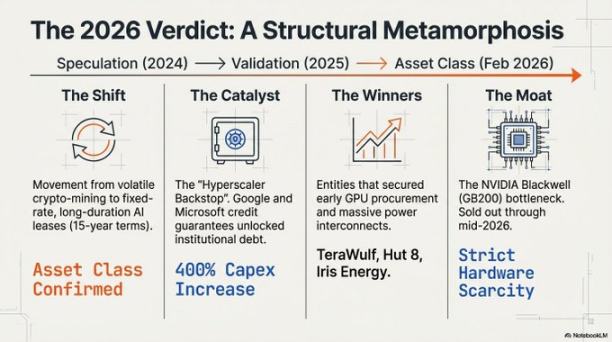
Those Bitcoin miners, once mocked for their volatility and unreliability, successfully transformed the land and electricity resources they secured around 2021 into infrastructure monopolies by 2026, becoming indispensable "landlords" in the AI gold rush.
Great computational flip
In the 2026 landscape, electricity has become a new scarce resource.
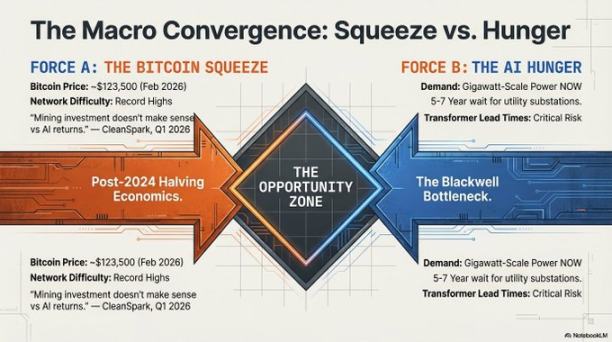
The primary physical moat protecting industry leaders is access to utility power connections. Building a new substation now takes 5 to 7 years, making those already-powered sanctuaries—existing mines connected to the grid—the only places capable of meeting the immediate power demands of cutting-edge AI model training.
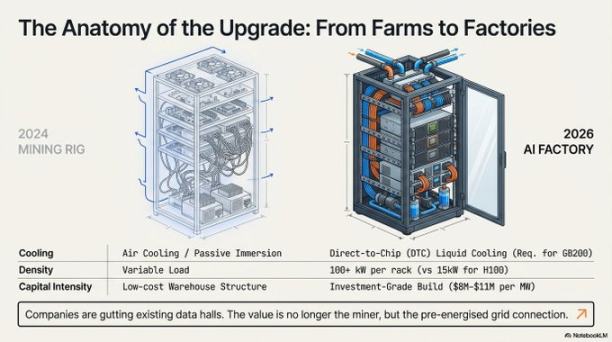
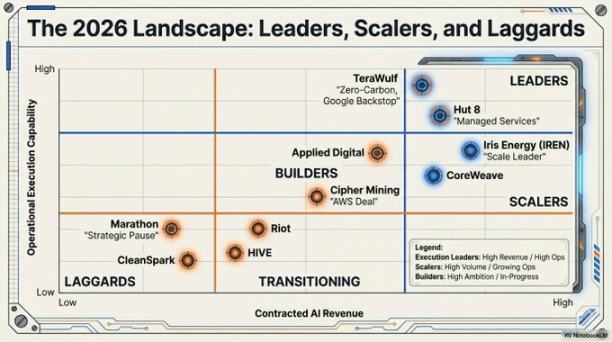
However, the entry barrier has shifted from simple land acquisition to a capital-intensive fortress. Due to the demands of high-density liquid cooling and global transformer shortages, the cost of building an AI-ready facility has surged to approximately $8 million to $11 million per megawatt. This high capital expenditure barrier has created a clear divide between “execution leaders” and other players:
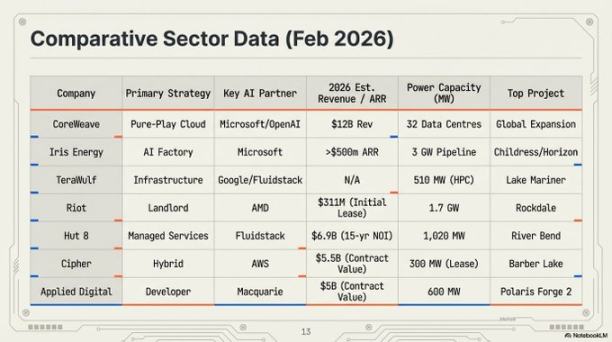
- Iris Energy (IREN): An industry-scale leader with a $14 billion valuation. It controls a 2,910 MW portfolio of power and land supporting its expanding network of "AI factories."
- Riot Platforms: Has 1.7 gigawatts of approved power capacity. Riot has transformed its "Texas Triangle" assets into a strategic hosting hub, recently signing a landmark lease agreement with AMD.
- TeraWulf and Hut 8: Recognized execution leaders. These companies secured contracts worth $6.7 billion and $7 billion respectively, successfully transforming mining facilities into high-value, investment-grade AI assets.
"Guaranteed by Super-Scale Enterprises"—The End of Cryptocurrency Volatility?
The most profound transformation may be the structural reassessment of business models, enabled by "credit enhancement."
In the past, major financial institutions were unwilling to lend to miners due to Bitcoin's extreme price volatility. This has changed with the emergence of "mega-corporate guarantees."
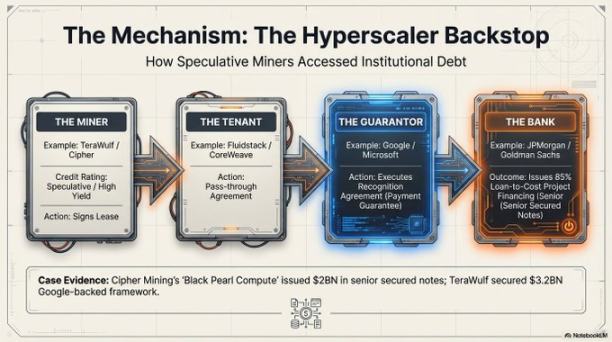
Through the "认可协议," industry giants like Google and Microsoft now provide financial guarantees for the rent paid to these former miners.
As a result, what was once a high-risk mining lease agreement has become a low-risk credit contract backed by tech giants. This has enabled the industry to access the bond market at an attractive interest rate of approximately 7.125%. Companies like Cipher Mining and Hut 8 can now secure project financing covering up to 85% of project costs from institutions such as JPMorgan Chase and Goldman Sachs—without diluting equity. This “take-or-pay” landlord model has attracted substantial capital from institutional investors including Vanguard, Oaktree, and Citadel.
Blackwell Reality and Underwater Data Centers
The technical requirements for AI in 2026 render traditional air-cooled mining machine designs not only obsolete but entirely unsuitable for deploying high-density AI clusters.
The NVIDIA Blackwell GB200 NVL72 platform, with power consumption reaching up to 120 kW per rack, is forcing the industry to transition to direct-to-chip liquid cooling technology.
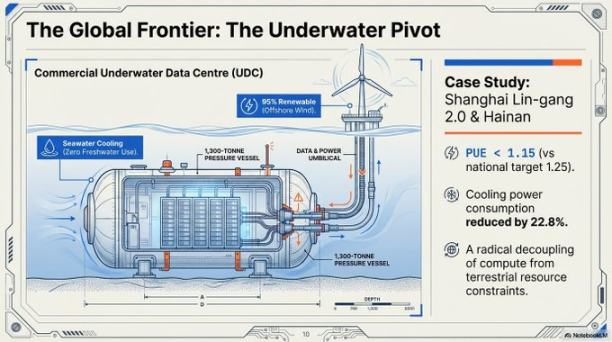
To simultaneously address cooling and land scarcity issues, the industry is turning its attention to the "blue economy." The Lingang 2.0 project in Shanghai is a prime example of commercial-scale underwater data centers.
- Technical Indicators: This facility achieves a Power Usage Effectiveness (PUE) of 1.15, significantly surpassing the national target of 1.25. It uses seawater as its primary cooling source, reducing total power consumption by 40–60%.
- Precise deployment: Guided by GPS, the vessel 'Sanhang Fengfan' lowers these 1,300-ton underwater engine rooms with zero-error precision, powered by offshore wind energy and completely free from terrestrial resource constraints.
The "Blackwell Moat" and Hardware Holders
By 2026, a “supply chain wall” has solidified industry hierarchies. Because NVIDIA’s Blackwell architecture chips are sold out until mid-2026, orders placed by a company in 2024 have become its current competitive advantage.
Without chips, electricity is useless; without electricity, chips are just bricks. The winners are those companies that secured both power and chips early on.
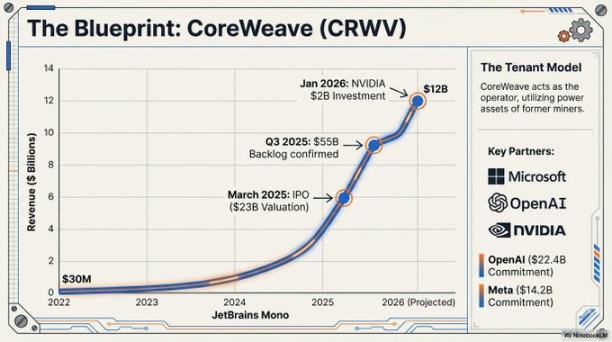
CoreWeave is preparing to go public at a $35 billion valuation, backed by its massive hardware orders, including a $22.4 billion commitment from OpenAI. Those who missed out on securing chips during the 2024 window are essentially locked out of the core AI infrastructure market.
The Blackwell architecture has a backlog of 3.6 million units, effectively locking out newcomers from the AI infrastructure primary market—a situation unlikely to change in the foreseeable future. —— Jensen Huang, CEO of NVIDIA, 2026
Beyond Miners
The shift from “Bitcoin factory” to “AI digital infrastructure hub” marks the maturation of a once-niche industry into a vital component of global industrial policy.
The isolated, purely mining model is coming to an end. In its place are industrial-scale energy transition companies that view computation—whether Bitcoin’s SHA-256 algorithm or training large language models—as an interchangeable output of their core electrical assets, allocated on demand.
As these gigawatt-scale "AI factories" become permanent fixtures of the power grid, we can't help but ask:
With such vast disparities in revenue per megawatt, can a pure mining model without AI business diversification survive? More importantly, as these facilities shift from flexible-power-consuming “mining farms” to AI “baseload” operations requiring stable power supply, how will the global grid adapt? At that point, data centers will no longer be mere electricity consumers—they will become the designers and architects of the grid.
The mining equipment has changed, but this high-risk energy arbitrage game has only just begun.