





Original Title: "From Geopolitical Tensions to Tightening Liquidity, BTC is Pulled into a Chaotic Market"
Original Author: Asher, Odaily Planet Daily
Another "big crash" is about to happen again.
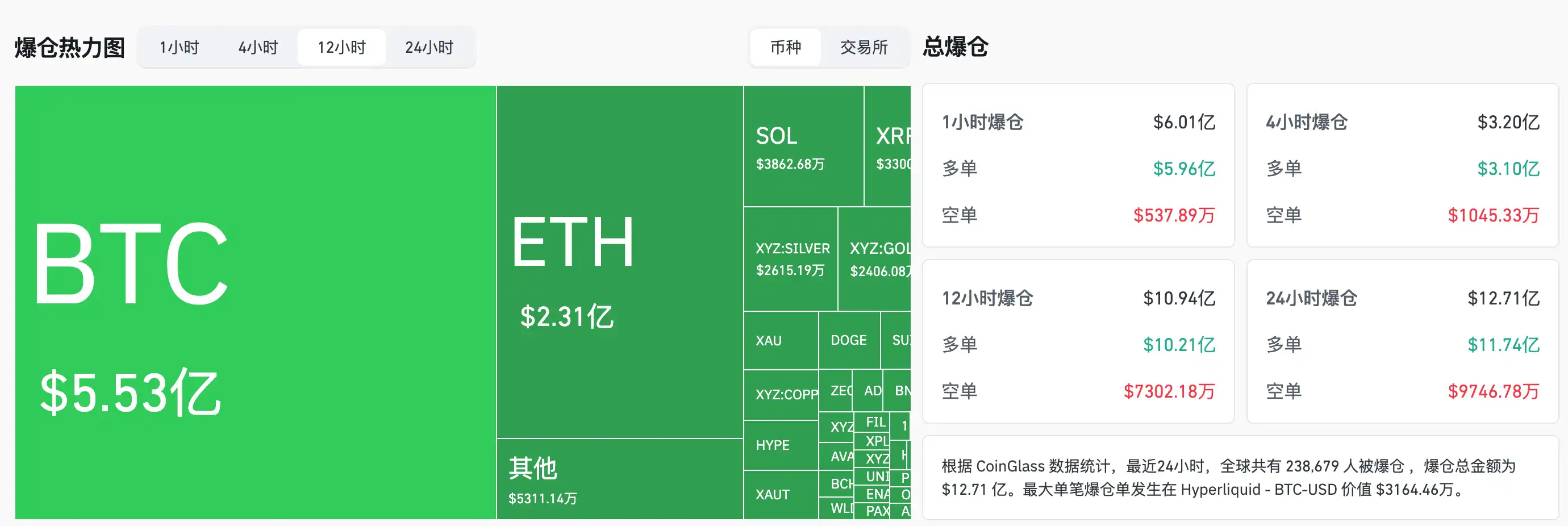
According to market data, from last night to this morning Beijing time, BTC rapidly declined from around $88,000, once falling below $81,200, with a 24-hour drop exceeding 7%. ETH fell from as high as $2,940 to as low as $2,690, a 24-hour decline of nearly 10%. SOL dropped from $123 back to around $112, a 24-hour decline of over 8%. According to Coinglass data, the market saw $1.094 billion in liquidations in the past 12 hours, with long positions accounting for as much as $1.021 billion. Nearly 240,000 traders were liquidated within 24 hours.
This decline was not triggered by a single negative factor, but rather the result of multiple factors converging and being released at the same time.
Tensions in the Middle East have suddenly escalated, and geopolitical risks have re-emerged in the markets.
The sudden escalation of geopolitical risks was one of the key contextual factors earliest factored into the market's decline yesterday.
The latest news indicates that the U.S. aircraft carrier "Abraham Lincoln" and its strike group have entered a "dark ship" status, turning off all non-essential systems and interrupting communications. This move is typically considered a standard operational procedure prior to a major military action. Based on this, the market speculates that related operations targeting Iran are entering a highly sensitive phase.
Meanwhile, Iran's statements have also clearly shifted toward a war-ready posture. Aref, Iran's first vice president, commented on the regional situation, stating that since this government took office, Iran has consistently maintained a state of preparedness. He emphasized that Iran will not initiate a war, but if a conflict is provoked, it will firmly defend itself, stressing that "the outcome of a war will not be decided by the enemy." He also pointed out that the country must now prepare for a state of war.
Although the situation has not yet escalated into a substantive conflict,But this state of "high opacity, non-verifyability, and difficulty in prediction" itself is sufficient to affect market behavior.Against the backdrop of already tight liquidity and a declining risk appetite, the uncertainty from geopolitical factors was quickly priced in, prompting capital to favor reducing directional exposure rather than continuing to bet on high-volatility assets.
FOMC "Hawkish Outcome" Leads to Repricing of Liquidity Expectations
The decline in the crypto market still cannot be separated from the Federal Reserve.
At the January FOMC meeting, the Federal Reserve kept the benchmark interest rate unchanged within the range of 3.50% to 3.75%, and emphasized in its statement that the unemployment rate had stabilized and inflation remained at a relatively high level. While the statement itself did not significantly deviate from market expectations, it effectively completed an "expectation consolidation" in terms of sentiment—The vague expectations previously held by the market for short-term interest rate cuts, or even a policy shift, have been officially curtailed or even completely dispelled.
For risky assets, such moments often do not appear in the form of "new bad news," but rather manifest as "good news can no longer be further extrapolated." Since 2025, Bitcoin has experienced pullbacks following multiple FOMC meetings, which are repeated demonstrations of this mechanism: it is not that policies suddenly turned hawkish, but rather that the market had to acknowledge liquidity would not arrive as expected in advance.
When positions have already accumulated and leverage has already increased, this kind of "announcement" confirmation is itself sufficient to trigger a release of risk—it is not the first push that topples the dominoes, but rather the simultaneous removal of support from all the already precarious structures.
It's not just the cryptocurrency market that is falling—U.S. stocks and precious metals are also "changing their faces" at the same time.
More alarmingly, this decline is not a "solo act" in the cryptocurrency market.
In the U.S. stock market, the decline in equity indices has become a significant signal of a weakening risk appetite. The Nasdaq 100 index fell by about 1.6%, the S&P 500 index dropped approximately 0.75%, and the Dow Jones Industrial Average also declined by about 0.2%. The three major indices are broadly under pressure, with the technology sector showing particularly weak performance, dragging down overall market risk sentiment.
At the same time, the precious metals market, traditionally viewed as a "safe-haven asset," has also experienced significant volatility. After a recent strong rally, gold prices sharply corrected overnight, with the market showing clear profit-taking. Similarly, silver quickly retreated from its high, with a notable pullback. This indicates that capital is not simply shifting from risky assets to safe-haven assets, but rather reducing overall risk exposure in a high-volatility environment.
When stocks decline, crypto assets face pressure, and precious metals also experience a synchronized pullback, the signals from the market have become very clear. Capital is simultaneously reducing exposure across multiple asset classes, indicating a rapid contraction in overall risk appetite.
In such an environment, Bitcoin naturally finds it difficult to remain unaffected.It is not truly regarded by the market as a safe-haven asset, and due to its own high volatility, it often becomes the first target for reduction when market sentiment turns risk-averse..
Continuous outflows from ETFs have significantly reduced the absorption capacity of the cryptocurrency market.
The shift in funding conditions provided the final piece of the puzzle for this round of decline.
According to the data on Bitcoin spot ETFs, funds are continuously flowing out.Data shows that in just the past week, BTC spot ETFs have experienced continuous net outflows, with multiple days recording daily outflows exceeding $100 million.The cumulative net outflow has reached over 1 billion US dollars..
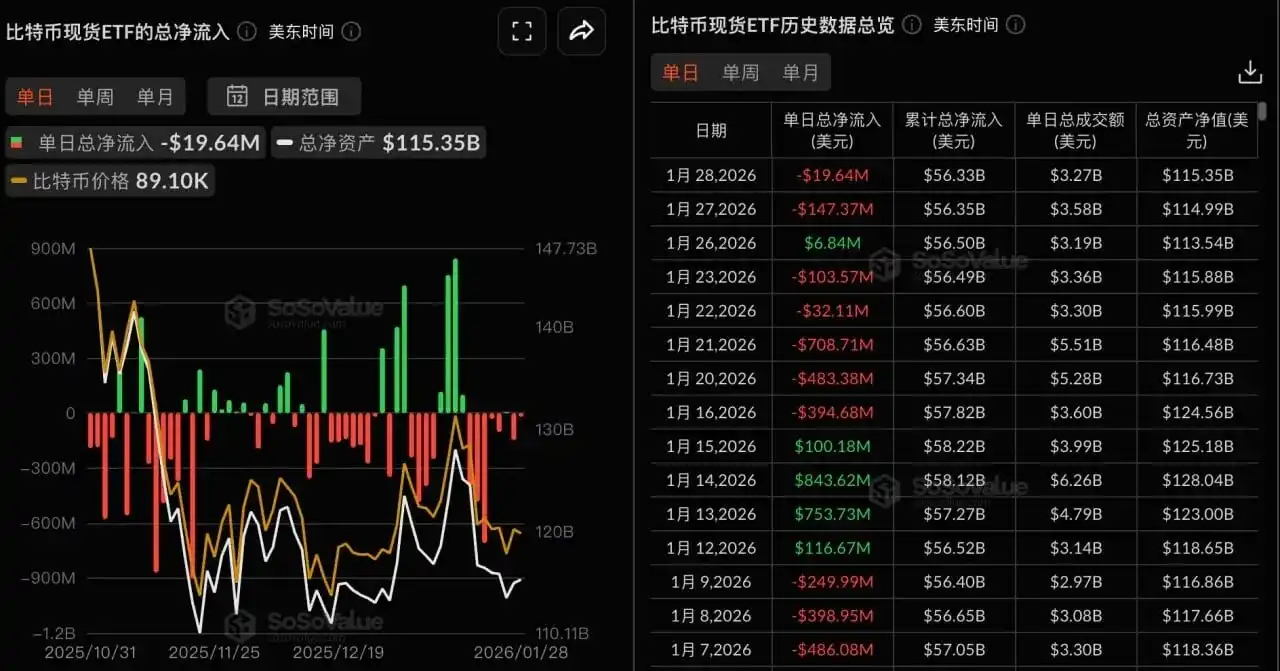
More importantly, the outflow of ETF funds is not a one-time release, but rather...Continuous, multi-day, and trend-based reduction in positionsThis means that institutional funds have not chosen to "buy the dip" during the pullback, but instead are more inclined to reduce overall risk exposure and wait for clearer macroeconomic and market signals.
In such a funding environment, the market has not gained a "cushion." When prices decline, ETFs do not provide sustained buying power, and the market relies more on existing capital to absorb selling pressure on its own. Once key price levels are broken, selling behavior quickly takes dominance, while buying interest clearly lags behind. As a result, prices can only rapidly decline to reestablish equilibrium.
It is not a black swan event, but rather a concentrated release of "forced de-risking."
The essence of this BTC decline is not caused by a single unexpected negative factor, but rather the result of the market's overall repricing of risk assets under the cumulative impact of multiple risk factors. With rising geopolitical uncertainties and revised expectations regarding macro-level liquidity, and against the backdrop of continuous net outflows from ETFs, the crypto market lacks stable structural support, ultimately triggering a self-initiated "braking" behavior by the market.
When long-term capital and passive buying power are absent, the market often breaks below key trend levels, forcing trend-following strategies and leveraged funds to exit passively, thereby completing the first stage of risk release. During this process, Bitcoin fell below the highly-watched 100-week moving average (around $85,000), a level that has repeatedly acted as a "safety net" during corrections since last year and also served as a default defense line for numerous trend models and leveraged positions.
From the results, the current market has completed the first round of rapid deleveraging and sentiment cleansing. However, true stabilization still depends on two conditions: first, whether key technical levels can be retaken and held firmly; and second, whether risky capital is willing to re-enter the market to participate in price discovery. Until then, high volatility and low confidence may continue to dominate as the main characteristics in the short term.
Click to learn about BlockBeats' job openings.
Welcome to join the official Lulin BlockBeats community:
Telegram Subscription Group:https://t.me/theblockbeats
Telegram discussion group:https://t.me/BlockBeats_App
Official Twitter account:https://twitter.com/BlockBeatsAsia