



Key Insights
- Bitcoin ETFs record $561.89 million in inflows on February 2, ending four-day outflow streak
- Fidelity’s FBTC leads with $153.35 million, BlackRock’s IBIT adds $141.99 million
- Ethereum ETFs see $2.86 million in outflows
Bitcoin ETFs recorded inflows of $561.89 million on February 2, 2026, ending a four-day outflow streak that totaled $1.49 billion, according to SoSoValue data.
Fidelity’s FBTC led the recovery with $153.35 million in inflows, while BlackRock’s IBIT contributed $141.99 million.
Ethereum ETFs experienced modest outflows of $2.86 million during the same session. BlackRock’s ETHA recorded $82.11 million in withdrawals, offset by inflows across multiple other Ethereum ETF products.
Multiple Bitcoin ETFs Record Positive Flows
The February 2 Bitcoin ETF inflows were distributed across eight different sponsors. Grayscale’s BTC product attracted $67.24 million, Bitwise’s BITB recorded $96.50 million, and Ark & 21Shares’ ARKB saw $65.07 million enter.
VanEck’s HODL added $24.34 million, while Invesco’s BTCO recorded $10.09 million in inflows.
WisdomTree’s BTCW attracted $3.31 million during the session. Several Bitcoin ETF products reported zero activity, including Grayscale’s GBTC, Valkyrie’s BRRR, Franklin’s EZBC, and Hashdex’s DEFI.
Total value traded across Bitcoin ETFs reached $7.68 billion on February 2. Cumulative total net inflows declined to $55.57 billion from $55.01 billion on January 30. Total net assets stood at $100.38 billion, down from $106.96 billion.
Four-Day Bitcoin ETF Outflow Streak Ends
The February 2 inflows reversed four consecutive days of withdrawals. On January 30, $509.70 million left Bitcoin ETFs, followed by $817.87 million on January 29, $19.64 million on January 28, and $147.37 million on January 27. The combined outflows over the four days totaled $1.49 billion.
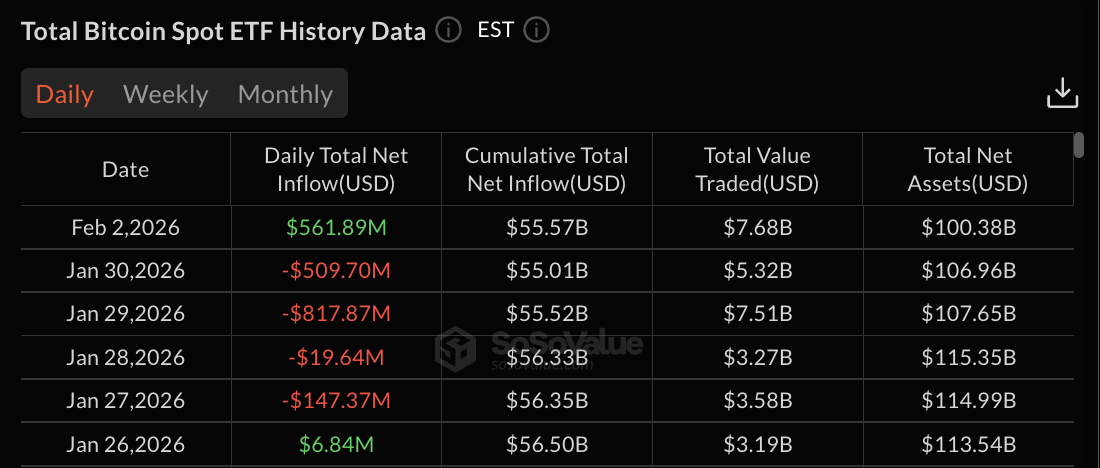
The extended selling period came after a brief one-day recovery on January 26, when Bitcoin ETFs attracted $6.84 million.
Before that, the products had experienced sustained outflows throughout late January, including a $708.71 million withdrawal on January 21.
Weekly data shows Bitcoin ETFs recorded $561.89 million in inflows for the single-day period ending February 2. This reversed the prior week’s $1.49 billion in outflows through January 30.
Asset Base Recovery Begins for Bitcoin ETFs
Total net assets for Bitcoin ETFs reached $100.38 billion on February 2, after declining to a recent low.
The asset base had peaked at $128.04 billion on January 14 before falling $27.66 billion over 19 days. The February 2 inflows provided the first strong signal of recovery.
The asset base had dropped below $107 billion during the late January selling period.
Cumulative net inflows total $55.57 billion, compared with the $57.82 billion peak reached on January 16.
The February 2 recovery brought net flows back above the psychological $55 billion level.
BlackRock leads Ethereum ETF outflows
Ethereum ETFs recorded $2.86 million in net outflows on February 2, with BlackRock’s ETHA accounting for $82.11 million in withdrawals.
Fidelity’s FETH partially offset the decline with $66.62 million in inflows, while Bitwise’s ETHW added $4.99 million and VanEck’s ETHV contributed $7.64 million.
Grayscale’s ETHE, Grayscale’s ETH, Franklin’s EZET, 21Shares’ TETH, and Invesco’s QETH all reported zero activity for the day.
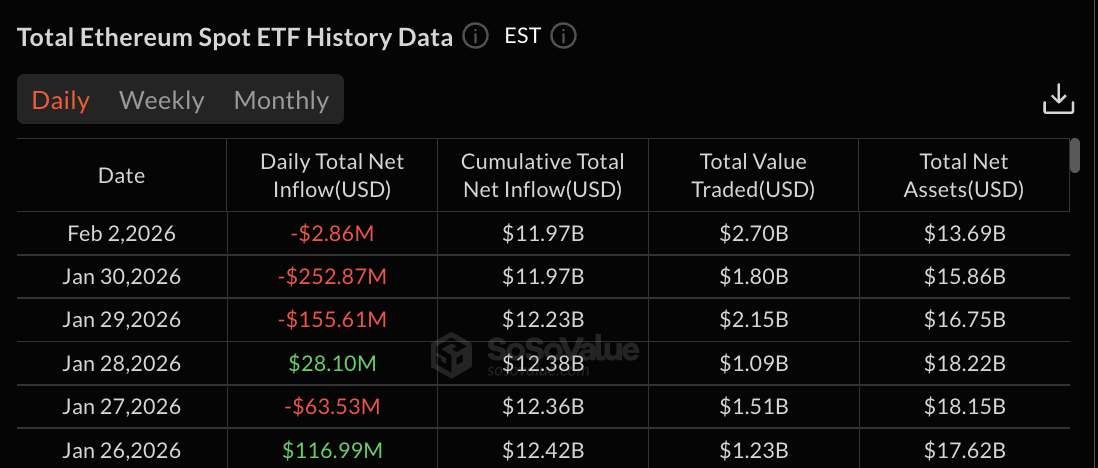
Cumulative total net inflows for Ethereum ETFs declined to $11.97 billion from $12.23 billion on January 29.
Total net assets dropped to $13.69 billion from $15.86 billion on January 30. Total value traded across Ethereum ETFs reached $2.70 billion during the session.
The February 2 outflows followed heavy selling in Ethereum ETFs on January 30, which totaled $252.87 million. The products had recorded $28.10 million in inflows on January 28.
Recent Week Shows Volatile Ethereum ETF Flows
Ethereum ETFs experienced volatility in late January and early February. After recording $116.99 million in inflows on January 26, the products faced $63.53 million in outflows on January 27. The pattern reversed again on January 28, with $28.10 million in inflows.
The selling resumed on January 29 with $155.61 million in outflows, followed by $252.87 million on January 30.
The modest $2.86 million outflow on February 2 came as a relief after the two heavy withdrawal days.
Total net assets for Ethereum ETFs declined from $18.22 billion on January 28 to $13.69 billion on February 2.
The $4.53 billion decrease over five days was driven by both outflows and declines in the Ethereum price. The asset base had peaked at $20.84 billion on January 14.
Solana spot ETFs recorded $5.58 million in inflows on February 2. XRP spot ETFs experienced modest outflows of $0.40 million during the same session.
The post Bitcoin ETFs Pull In $562M as Fidelity’s FBTC Leads; Ethereum, XRP Slip appeared first on The Market Periodical.