





- The Bitcoin cycle shows repeated consolidation before major bull phases.
- Volatility compresses while nominal price targets expand in each cycle.
- Early bull transitions occur in zones of skepticism and accumulation.
The Bitcoin cycle demonstrates consistent historical patterns, with accumulation, volatility compression, and breakouts shaping each major price phase. Current data suggests a similar rhythm may be forming again.
Historical Patterns of Bitcoin Cycles
From 2013 to 2021 each cycle began with a low-volatility accumulation phase. Investors consolidated positions quietly, creating a base for the next major move.
Parabolic expansions where price accelerated sharply, often resulted in euphoric market sentiment. Each cycle then experienced a blow-off top, followed by a multi-month to multi-year correction.
In 2013, Bitcoin reached about $1,100 then by 2017, it peaked near $20,000, and the 2021 high it reached $69,000.
Current Consolidation Signals
Recent market data suggests Bitcoin is in a consolidation phase between $90K and $92K after a peak near $94–95K. This controlled pullback shows buyers defending support levels while weaker positions exit.
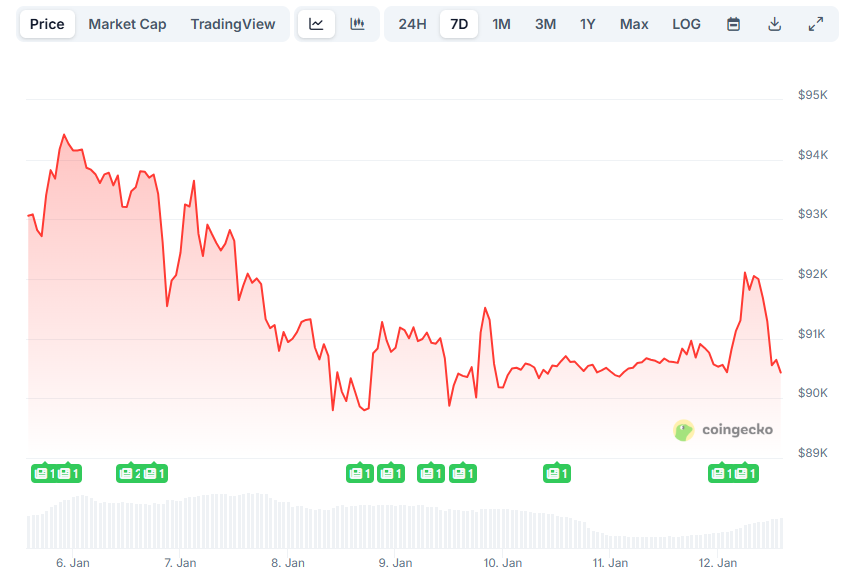
Volatility compression during this phase indicates accumulation by long-term holders. Shallow lower lows and repeated wicks near $90K suggest market absorption, a common precursor to expansion in past cycles.
The time spent correcting reflects a structural reset rather than a breakdown. Time symmetry in the current Bitcoin cycle aligns with historical behavior.
Similar phases in prior bull markets allowed momentum indicators to reset without structural damage. Analysts note that as higher lows hold above $90K, the market is positioned for the next potential upward move.
Path Toward Next Bull Phase
The Bitcoin cycle indicates that the early bull transition occurs in zones of disbelief and confusion. Previous cycles show this phase is where smart money enters, while retail investors remain skeptical.
Sharp rallies often follow this accumulation stage, accompanied by temporary pullbacks. Future projections, following the historical Bitcoin cycle, suggest a potential peak in the $250K–$300K range.
This aligns with the logarithmic growth trend, post-halving dynamics, and increasing institutional participation. Supply constraints from reduced issuance reinforce the structural logic for a higher nominal price.
Recent analysis of market structure points to range compression and stabilization as indicators of strength. As long-term holders accumulate and the narrative slowly shifts, the Bitcoin cycle suggests the next bull phase may be building quietly.