





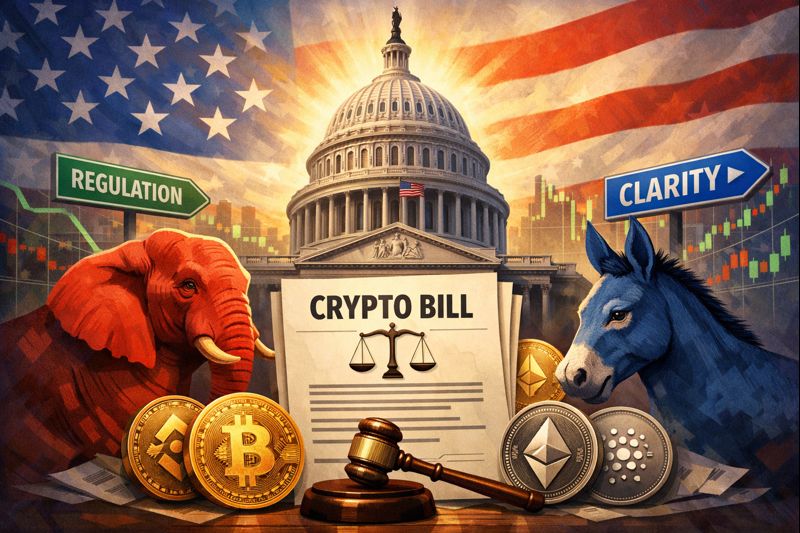
This week, the U.S. Senate will take up a critical bipartisan bill that aims to resolve the long-standing regulatory uncertainty surrounding the digital asset industry. SEC Chairman Paul Atkins has confirmed the bill’s introduction, stressing its significance in providing much-needed clarity for market participants.
The legislation is designed to end the ongoing jurisdictional disputes between the SEC and the Commodity Futures Trading Commission (CFTC). Atkins emphasized the importance of this bill in streamlining regulatory oversight, ensuring that crypto firms know which agency they answer to, and thus eliminating the ambiguity that has hindered industry growth.
Clearer Regulatory Framework for Digital Assets
The primary objective of the bill is to create a clear division of responsibilities between the SEC and the CFTC, a matter that has often left the industry in a state of confusion. According to Atkins, establishing clear jurisdictional lines is critical for fostering an environment of certainty, which he believes will pave the way for the U.S. to solidify its status as the “crypto capital of the world.”
Atkins has also highlighted the importance of the bill in aligning with the broader economic goals of the administration. He pointed out that with clear and stable rules, the U.S. will be in a stronger position to lead in the global cryptocurrency market. The SEC chair expressed his optimism about the potential positive impact of the bill, which he expects will encourage greater investor confidence in the digital asset space.
Legislative Momentum Builds for Crypto Market
The upcoming bill builds upon the foundation set by last year’s “GENIUS Act,” a law that was the first of its kind to officially recognize crypto assets. This earlier legislation provided some clarity for digital assets and stablecoins, marking an important step in the U.S. government’s efforts to regulate the crypto market.
Atkins praised the bipartisan efforts that have made this legislation possible, noting that the current bill is part of a broader commitment to create a more predictable regulatory environment. With the Senate preparing to review the bill, there is growing anticipation that this legislative effort will play a pivotal role in shaping the future of the crypto industry in the U.S.
The legislation represents a significant move toward ending years of regulatory gridlock and setting a clear path forward for crypto businesses. By ensuring certainty in the market, this bill could unlock new opportunities for innovation and investment in the sector, solidifying the U.S.’s position in the global crypto landscape.
This article was originally published as Bipartisan Crypto Bill Set to Clarify Regulatory Landscape, SEC Chair Reveals on Crypto Breaking News – your trusted source for crypto news, Bitcoin news, and blockchain updates.