





Written by: Ignas | DeFi Research
Compiled by Saoirse, Foresight News
CoinGecko tracks 17,148 tokens.
But in today’s cryptocurrency market environment, how many assets truly meet the following criteria as “investable opportunities”?
- Generates returns for holders;
- There is protocol income, even if it has not yet been distributed;
- Strong narrative and market recognition, capable of surviving a bear market.
I'm trying to figure out this issue.
Most data comes from DefiLlama, CoinMarketCap, and several protocols that reflect market sentiment, such as Dexu, Moni, and Lunarcrush.
I use Claude Code to process data and minimize personal bias ——
I would have initially excluded certain tokens (such as XRP, ADA, BCH, etc.), but they have endured multiple market cycles and maintain lasting viability due to their strong liquidity.
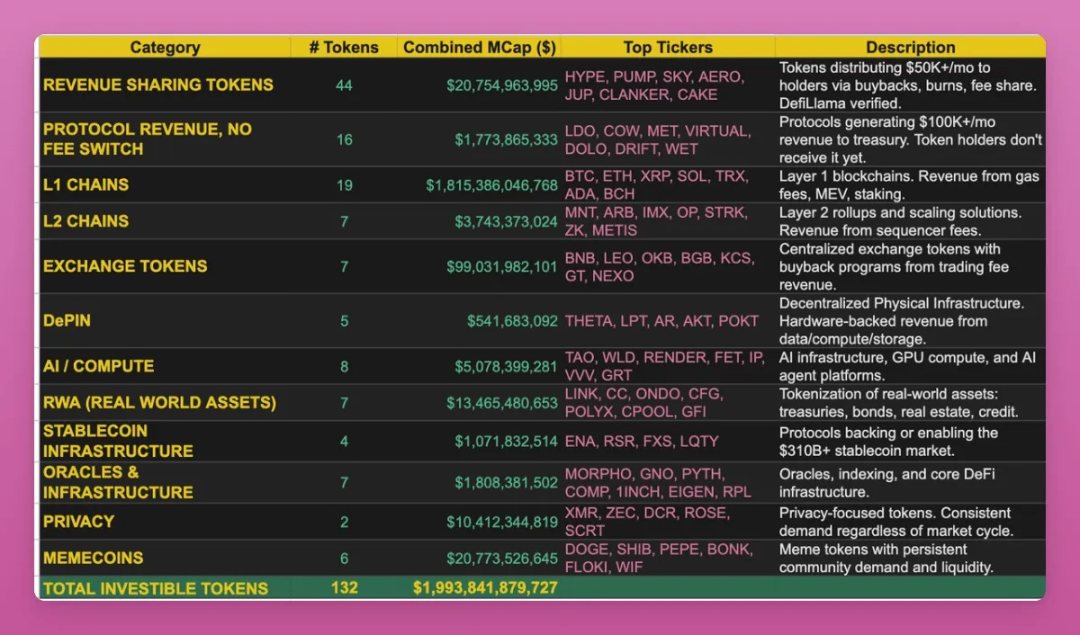
Claude still made quite a few errors, and debugging took ten times longer than writing the article, so the table data is for reference only (link at the end).
Final result:
- A total of 12 categories and 132 investable tokens have been screened;
- Forty-five of them will distribute dividends to holders (excluding those with extremely low returns);
- Annualized yield to holders: $1.8 billion.
These categories are entirely my subjective judgment based on "ability to survive and future potential"—you may disagree.
First key finding: The truly investable cryptocurrency market is tiny.
Almost all tokens that actually generate profits for holders are dominated by just two projects. We’ll go into detail below.
Funny enough, as I organized this list and verified each token one by one, I came to this conclusion:
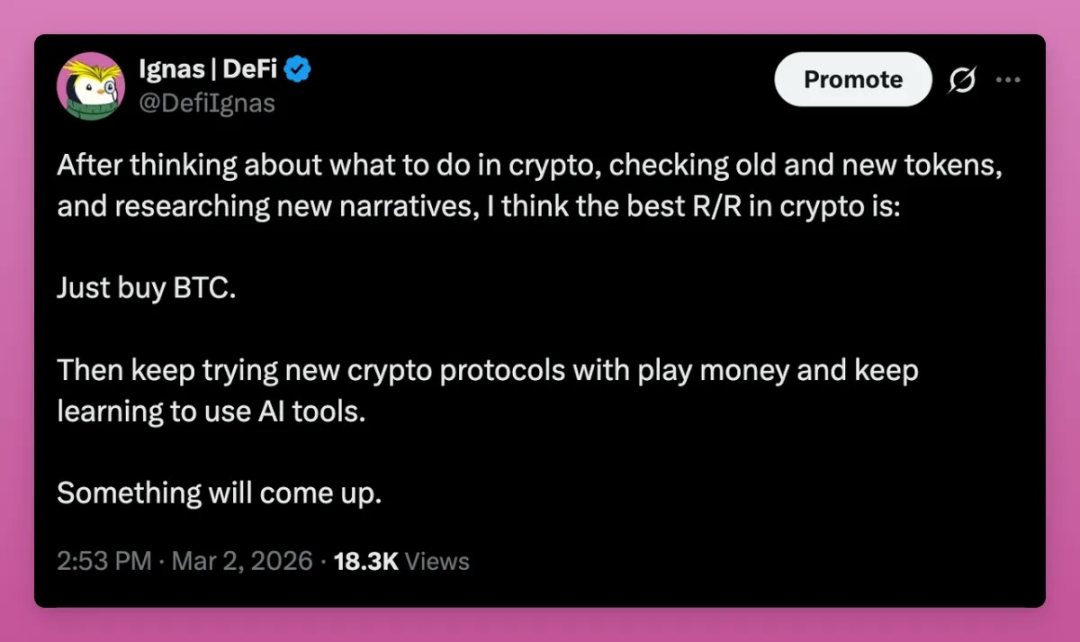
After carefully considering what to do in the crypto space, examining both new and existing tokens, and researching emerging narratives, I believe the optimal risk-reward ratio (R/R) in the crypto world is:
Buy Bitcoin (BTC) directly.
Then, use speculative funds to continuously experiment with new crypto protocols while steadily learning to use AI tools.
New opportunities will always arise.
Top Tokens to Invest In: Revenue-Sharing Tokens
The dominant narrative in today's market is:
Projects with no revenue will eventually die!
Even ETH struggles to escape this "value by income" narrative.
Therefore, the most investment-worthy tokens are those that distribute profits to holders through mechanisms such as buybacks, burns, and fee sharing.
I’ve lowered the threshold to: 30-day holder earnings on DefiLlama ≥ $50,000.
These 45 tokens generate $153 million in monthly returns for holders,
Annualized total of $1.8 billion.
Revenue Share Top 10:
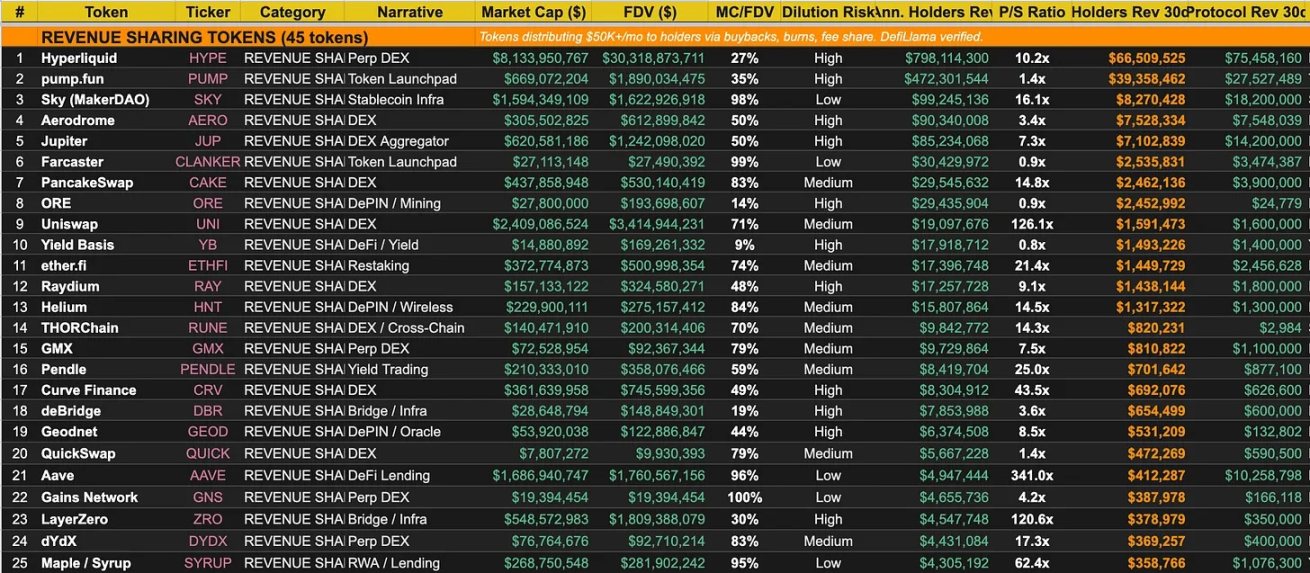
Note: Revenue sharing ≠ Holder earnings on DefiLlama.
For example, EtherFi did not make the holder rewards list, but it has buybacks.
L1 blockchains like Tron have been categorized separately.
After the top five, monthly earnings quickly dropped below $3 million.
If the crypto market continues down the logic of "token = stock,"
The P/S ratio (price-to-sales ratio, market capitalization divided by revenue) will become increasingly important.
- Pump.fun: 1.4x
- Aerodrome: 3.4x
According to traditional financial standards, these are extremely cheap.
At the current income rate, the entire market cap can be recouped in less than three years.
And:
- Uniswap: P/S ratio as high as 121x
- Aave: P/S ratio is 341x
Because the market values them at far more than just their current earnings.
Aave has finally initiated its buyback program, but it currently allocates only $412,000 per month, compared to the protocol’s monthly revenue of $10 million. Future governance changes may alter this situation.
Tokens with the lowest P/S (Price-to-Sales) ratio:
- Farcaster's Clanker: 0.9x
- ORE: 0.9x
- Yield Basis: 0.8x
- Pump.fun: 1.4x
- QuickSwap: 1.4x
All of them can recoup their market value through earnings within three years.
The most important conclusion:
Hyperliquid + Pump.fun = 69% of all holders' rewards!
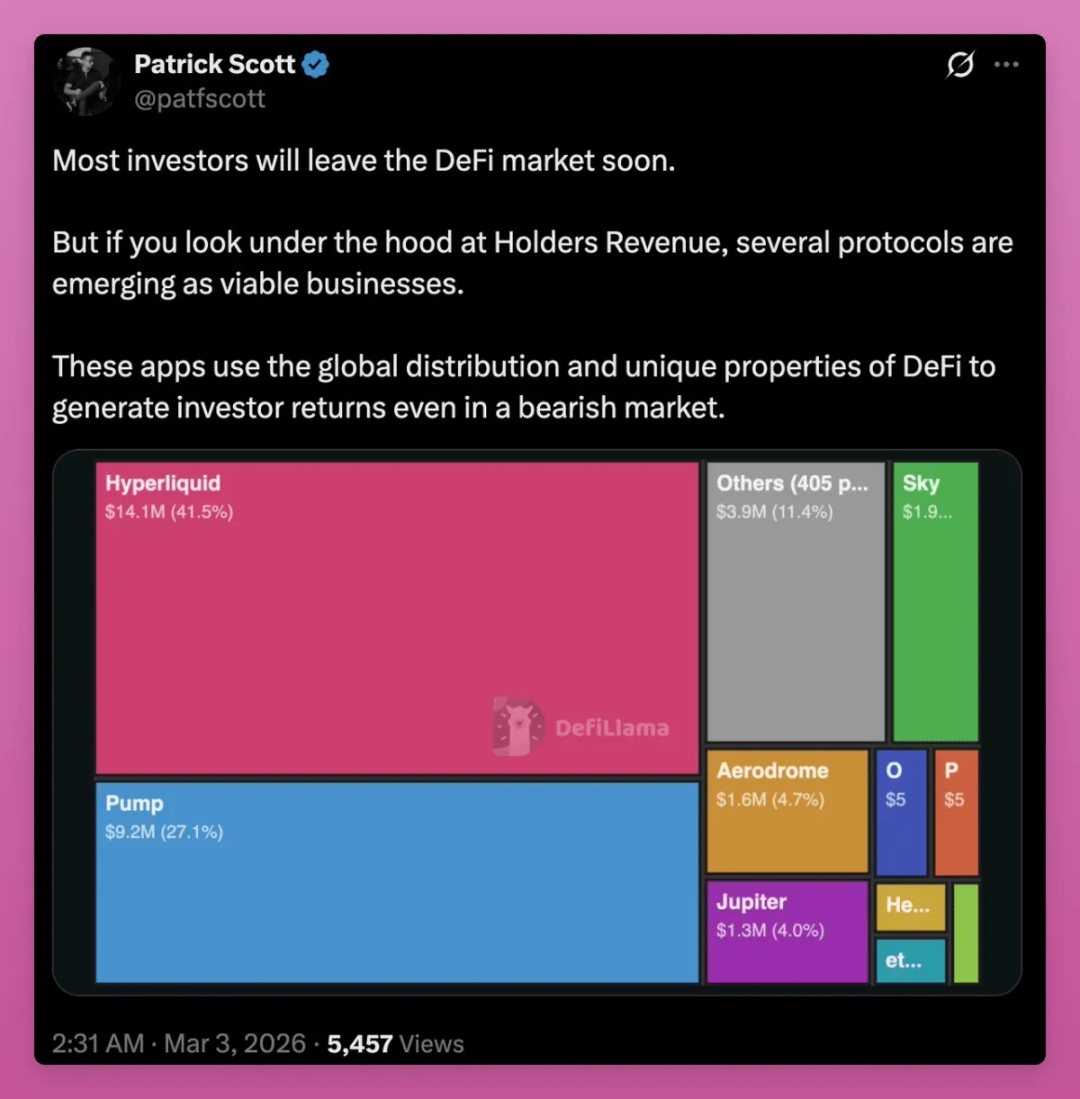
Out of 45 tokens, just two projects accounted for more than two-thirds of the cash flow.
This level of concentration is well worth considering.
Ansem's tweet perfectly summarizes HYPE's investment philosophy:
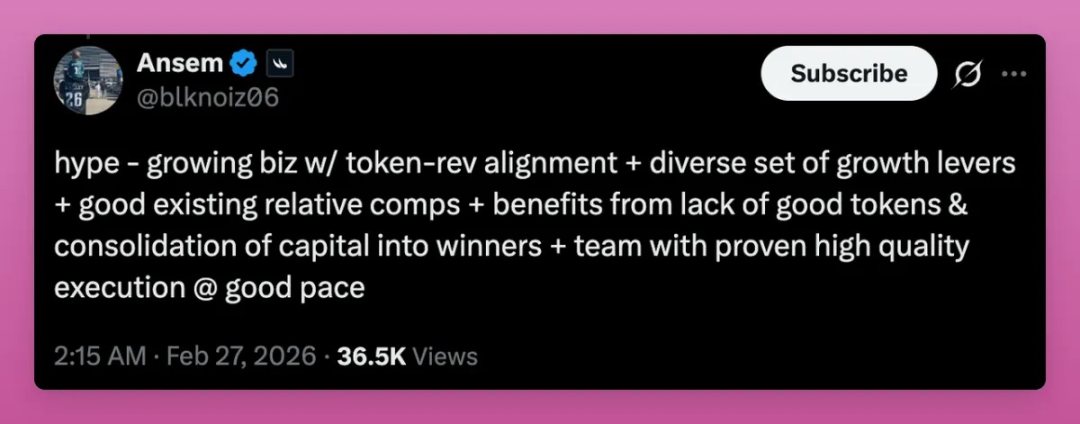
HYPE:
- The business is growing steadily, with token value closely tied to revenue;
- Access to diversified growth levers;
- The current comparable projects are performing well;
- Benefiting from a market environment characterized by scarce high-quality tokens and capital concentrating toward top-tier projects;
- The team has strong execution, a steady pace, and an impressive track record.
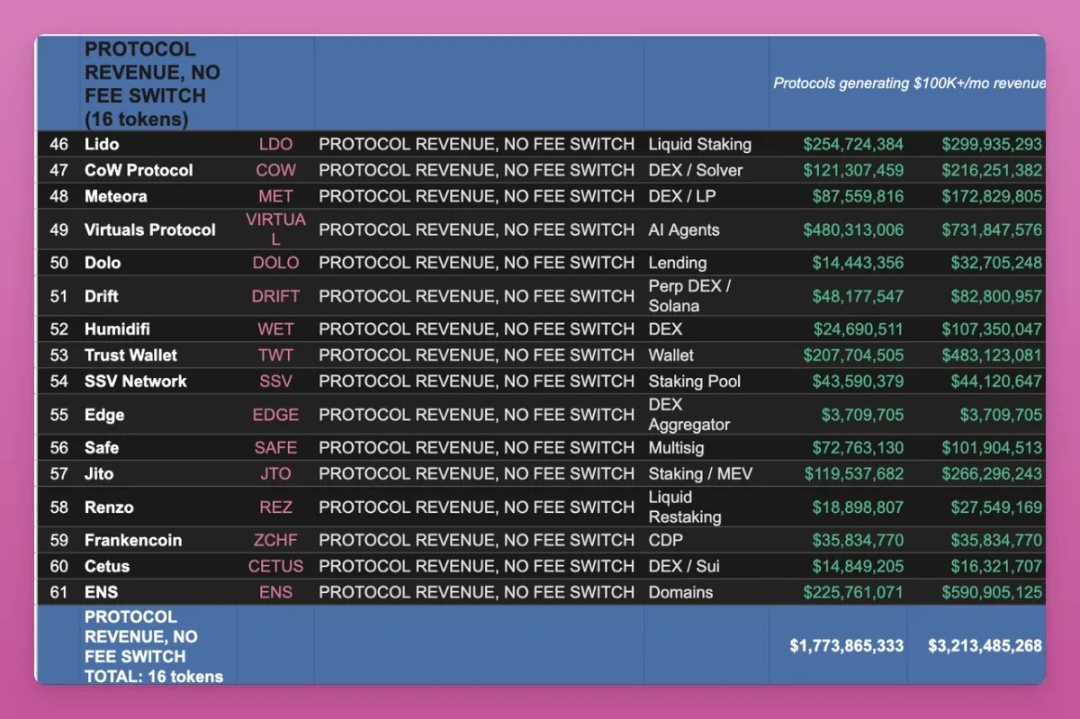
There is protocol income, but dividends have not been enabled.
A total of 16 such tokens generate monthly protocol revenue of at least $100,000, with all revenue retained in the treasury.
Top projects:
- Lido: $4.3 million per month, TVL of $32 billion (staking rewards were proposed last year);
- CoW Protocol: $3 million per month;
- Meteora (Solana): $2 million per month;
- Virtuals Protocol: $1.4 million per month;
- Drift: $868,000 per month.
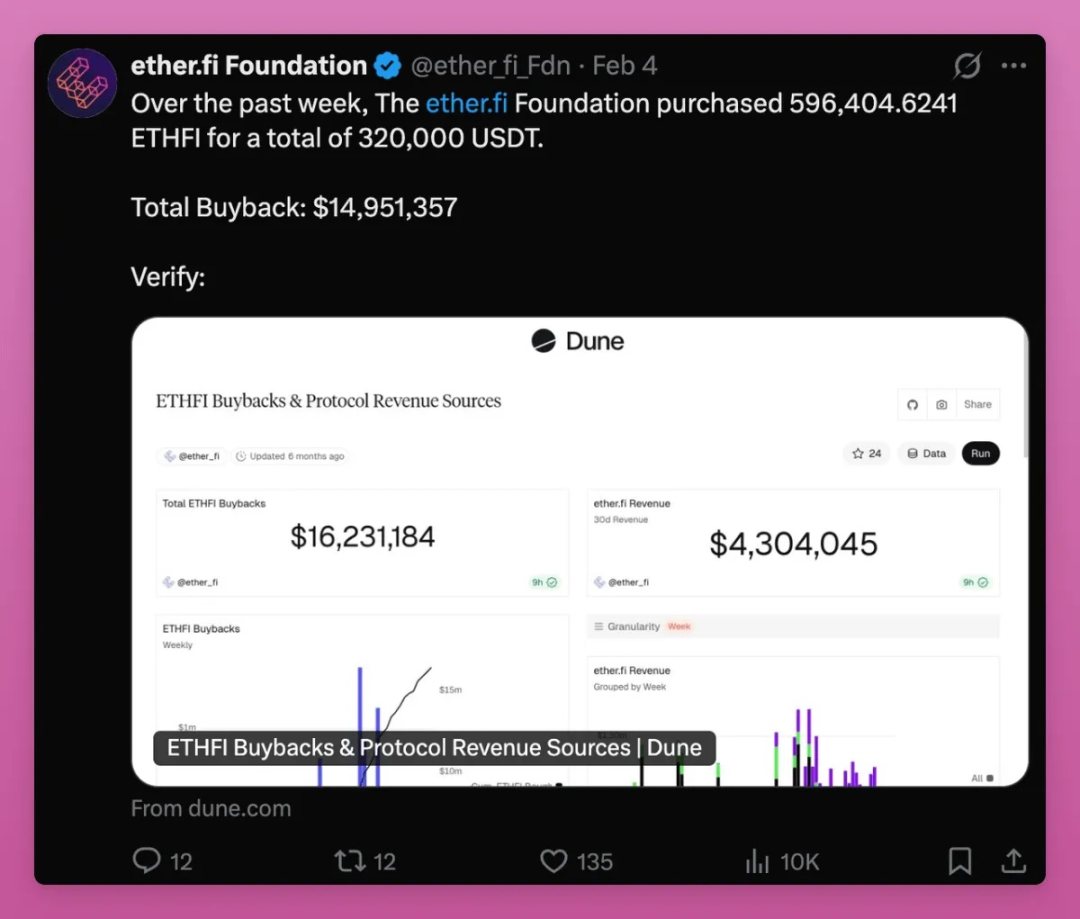
Lido vs ether.fi is an interesting comparison:
- Lido's TVL is 10 times higher, and its revenue is 3 times higher, but LDO holders receive nothing;
- ether.fi distributes $1.5 million monthly to holders through buybacks.
If you're going to navigate a bear market, you'll want one that pays you dividends.
The investment rationale for this type of asset is:
These protocols will eventually turn on the "dividend switch."
Lido has been around for many years.
Jito's total monthly fees amount to $5.3 million, but only $544,000 enters the treasury.
The gap between total fees and holder returns represents both an opportunity and a risk.
Browse Other Sections
Exchange tokens (7 tokens, total market cap of $99 billion, including BNB)
You can make money in both bull and bear markets. CEX trading volume will decline but won't drop to zero.
- BNB: $85 billion;
- LEO and OKB barely declined during the 2022 and 2024 bear markets.
Many have buyback programs, but they are not reflected in the DefiLlama data.
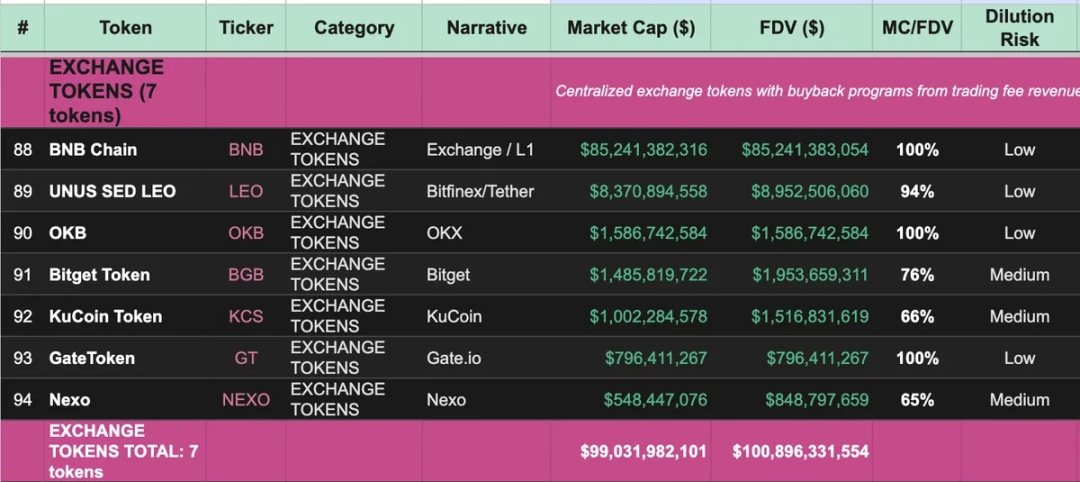
The high circulating supply of CEX tokens further reduces downside risk.
L1 blockchains (19, total market cap of $1.8 trillion)
L1 is the base layer.
- BTC: $1.36 trillion
- ETH: $245 billion
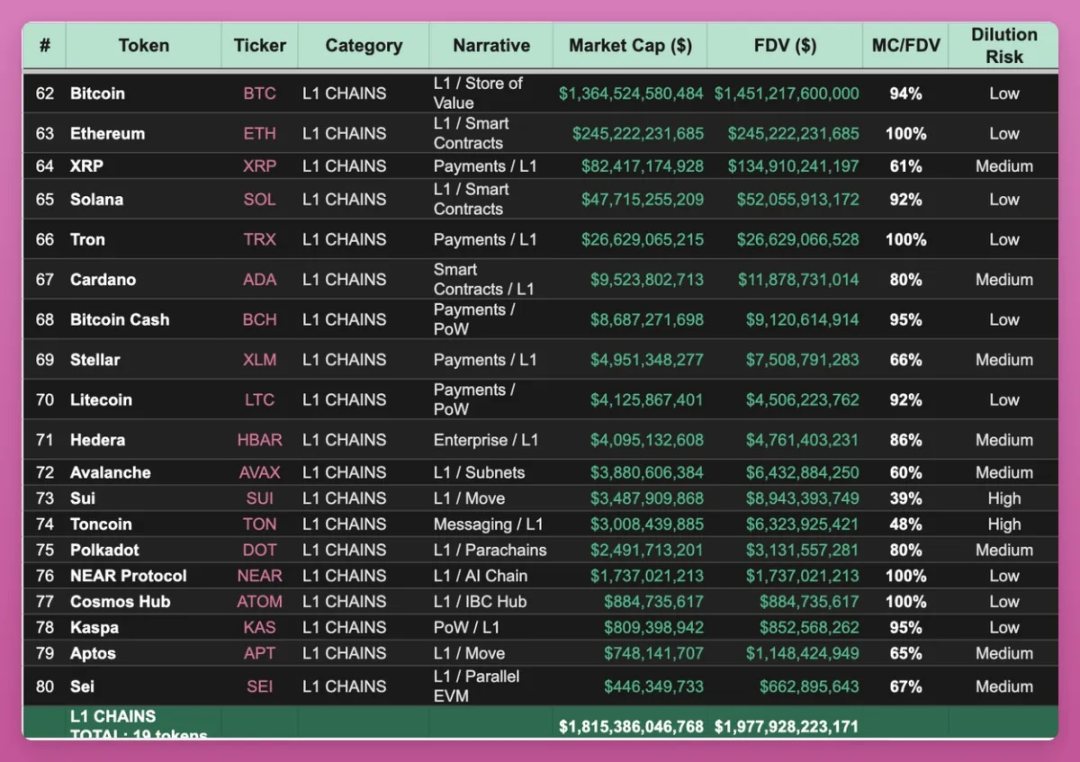
I’ve relaxed my standards for XRP, ADA, and especially Cosmos, as they have survived multiple cycles, have dedicated believers and liquidity, and demonstrate ongoing vitality.
You may dislike TRX, but it generates $26 million in fees monthly—more than Solana and Ethereum.
This cycle has also performed strongly—you can check the candlestick chart yourself.
Layer 1 blockchains will not disappear, but their valuations will fluctuate significantly. Hold at your own risk.
AI and Computing (8, total market cap of $5.1 billion)
Most have no actual income, with one exception:
Venice (VVV): The only AI token supported by subscription and API revenue that has burned 43% of its supply.
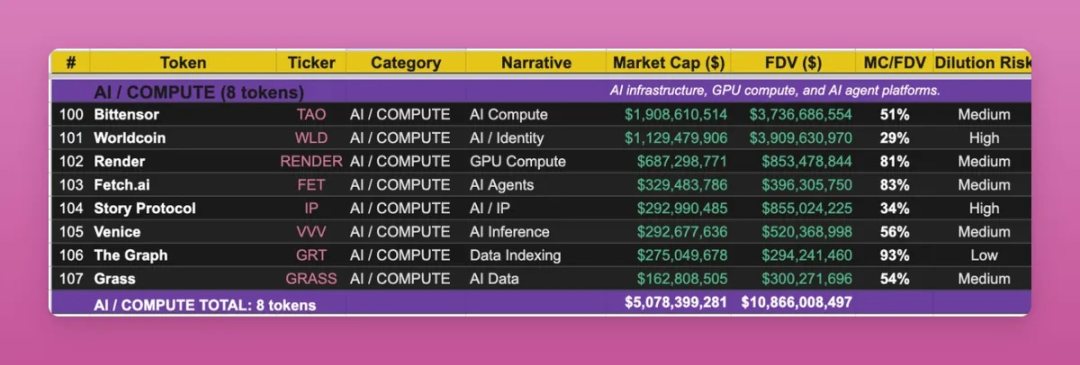
- Bittensor: $1.9 billion market cap, 128 subnets, no protocol revenue;
- Render, Akash: Selling GPU computing power is cheaper than centralized platforms;
- Grass: Provides decentralized network data for AI training.
Note: Some AI tokens not on the list are currently surging and may be suitable for short-term trading, but it’s unclear whether they qualify as “investable.”
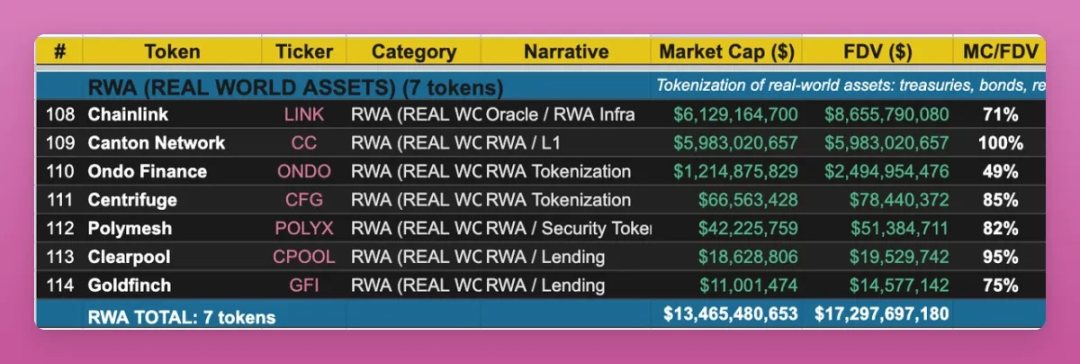
RWA asset tokenization (7 assets, total market cap of $13.5 billion)
While there has been quiet growth, I believe the real RWA bull market hasn't arrived yet.
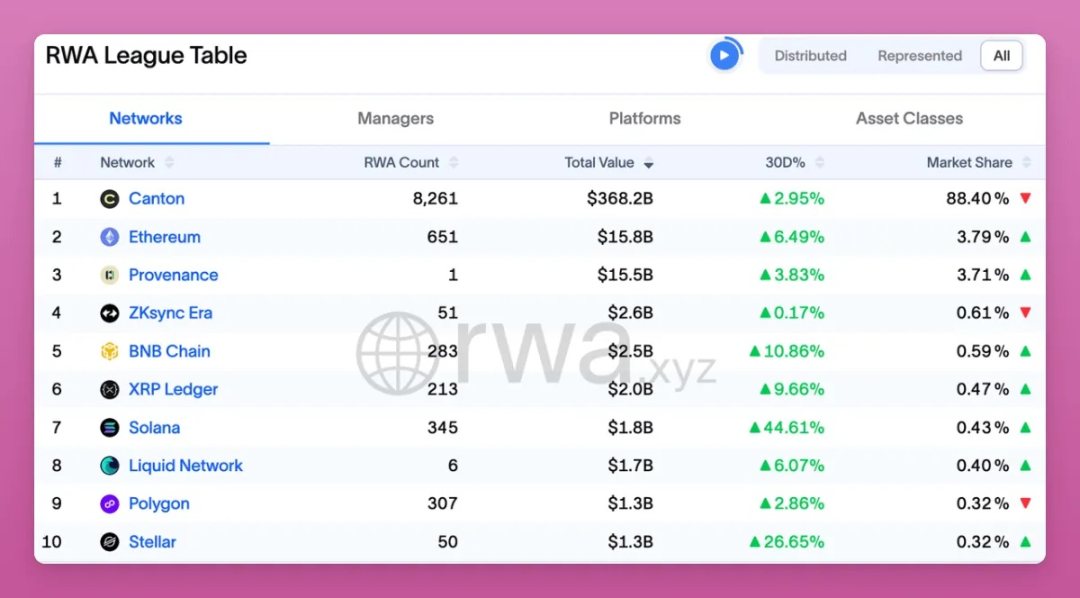
Canton Network holds 88.57% of on-chain RWA, amounting to approximately $372 billion in tokenized assets. However, real-world assets are not as straightforward as they appear.
Chainlink is a key oracle for RWA infrastructure, but LINK staking rewards come from inflation and a fixed reward pool, not protocol revenue sharing.
Chainlink generates solid revenue, but it flows to node operators and the treasury, not directly to holders.
Privacy coins (2, total market cap of $9.7 billion)
High-risk sector: either becomes increasingly important as regulations tighten, or gets outright banned.
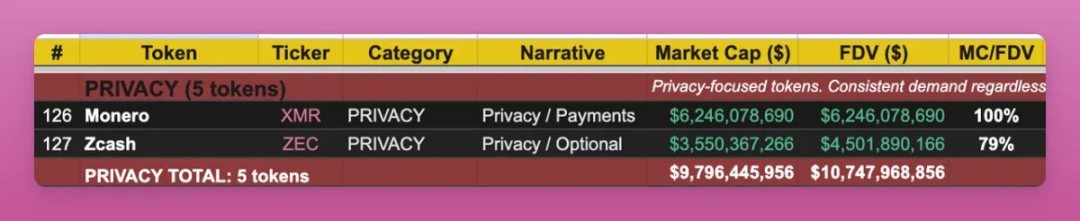
But regardless of market conditions, demand has remained steady.
- Monero (XMR): $6.2 billion
- Zcash: $3.6 billion
Meme coins (6, total market cap of $20.8 billion)
Classifying them as "investable" may be controversial.
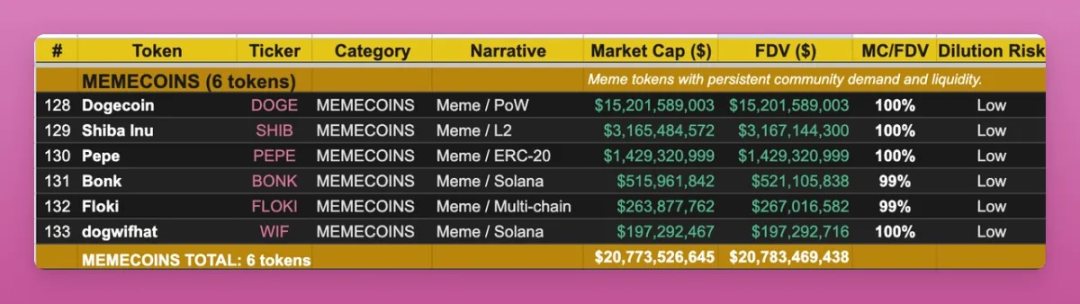
But like Bitcoin, they rely on their communities to survive.
- DOGE: $15.2 billion market cap, existing for over ten years;
- SHIB, PEPE, BONK, FLOKI, and WIF also made the list.
If the market rebounds, they may perform better than high-yield tokens.
Because there is no income cap, there is no ceiling.
And they are almost fully circulated, with minimal selling pressure.
Other Categories
- L2 blockchains (7, total market cap of $3.7 billion);
- DePIN (5 projects, total market cap of $500 million): decentralized storage, data collection;
- Oracles / Infrastructure (7, total market cap of $1.8 billion);
- Stablecoin infrastructure (4, total market cap of $1.1 billion): Ethena leads.
A highly profitable project without tokens
Some of the most profitable crypto businesses have no investable tokens at all.
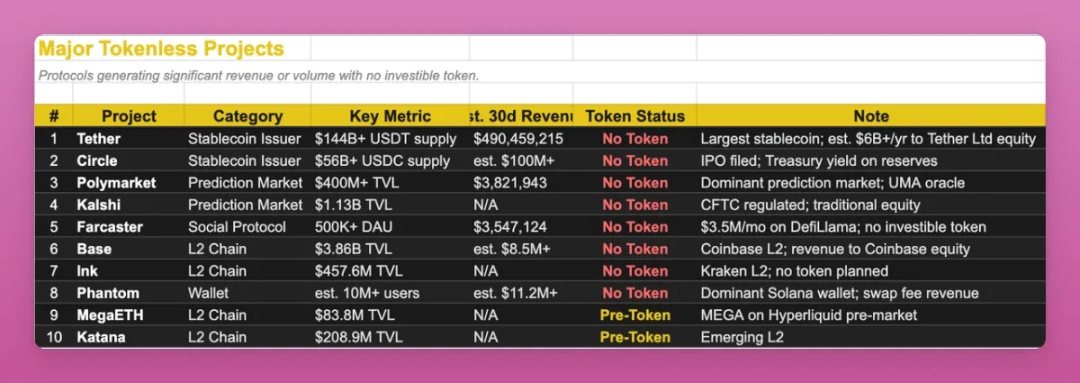
- Tether: Annual revenue of $6 billion+, more than the combined total of those 45 yield tokens, all going to shareholders;
- Polymarket: Monthly revenue of $3.8 million, no token;
- Base: Revenue goes to Coinbase shareholders; tokens may be issued in the future;
- Phantom: Tens of millions of users, extremely high fees;
- Circle: Issuer of USDC, with returns reflected in the IPO;
- Kalshi: Regulated by the CFTC, no token;
- Farcaster: Acquired, expected airdrop significantly reduced, but token issuance may still occur.
So, how do you use this information?
The ideal asset to hold during a bear market, meeting four criteria:
- Holder rewards
- Low P/S ratio (market capitalization / revenue)
- High MC/FDV (Market Cap / Fully Diluted Valuation)
- Demand remains steady and consistent
Very few tokens can be fully satisfied.
Underlying asset:
- PUMP: 1.4x P/S, 33% MC/FDV
- AERO: 3.4x, 50%
- JUP: 7.3x, 51%
- SKY: 16x, 98%
- CAKE: 15.1x, 96%
Low-risk option:
Exchange tokens: LEO, OKB, GT
Nearly fully circulated, supported by exchange profit buybacks, and performed most stably during bear markets.
High risk, high reward:
HYPE: Returns are significantly ahead, but MC/FDV is only 25%.
CoinGecko's new statistics, which exclude long-term illiquid and burned tokens, have dropped to 41%.
Tradeable opportunities:
Stay updated on governance changes:
Bet on projects that generate revenue but haven't yet enabled dividends, and turn on the dividend switch.
Key focus:
Lido, Meteora, Drift, CoW Protocol
Everything else, rely on faith.
Do you believe AI calculations will be put on the blockchain?
Do you believe RWA tokenization will continue to grow?
I believe so, but are these tokens the correct betting targets?