





Key Insights
- Crypto News: Balancer Labs shuts down corporate entity after $128M exploit, citing legal exposure and unsustainable finances.
- Protocol remains viable, generating fees, but governance shifts fully to DAO with leaner operational structure.
- Tokenomics overhaul ends emissions, phases out veBAL, routes fees to DAO, and introduces BAL buyback.
Balancer Labs, the company that created and developed the Balancer decentralized exchange, is shutting down. The decision follows a major exploit in November 2025 that drained $128 million from Balancer V2 pools.
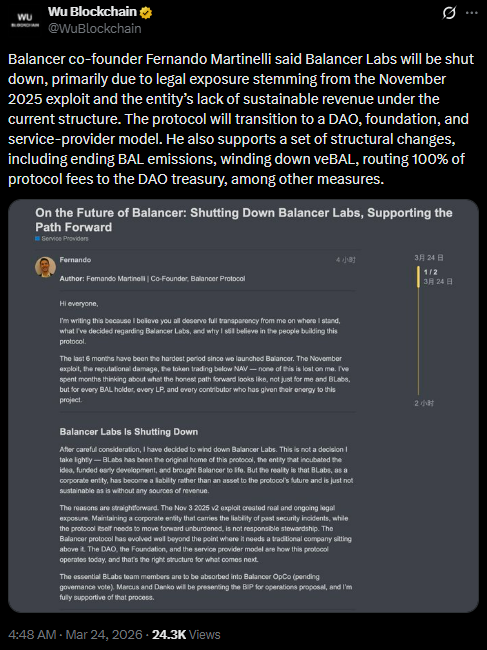
Co‑founder Fernando Martinelli announced the closure in a governance forum post on March 23, 2026. He said the corporate entity had become a liability due to legal exposure and lack of revenue.
Balancer will now operate fully under its decentralized autonomous organization (DAO) and restructure its tokenomics to ensure sustainability.
Crypto News Shifted After Exploit Fallout
On November 3, 2025, attackers exploited a flaw in Balancer V2 ComposableStablePool contracts. Arithmetic precision loss in pool invariant calculations caused the bug.
This allowed balances to be manipulated and funds withdrawn. In less than 30 minutes, $128.64 million was drained across six blockchain networks, including Ethereum, Base, Polygon, and Arbitrum.
The incident was one of the largest DeFi hacks of 2025. It occurred despite Balancer undergoing multiple audits. The exploit caused reputational damage, a sharp drop in TVL, and the BAL token trading below its net asset value.
Martinelli described the six months after the exploit as the hardest period since Balancer’s launch in 2020. He said the corporate entity had become “a liability rather than an asset.” Balancer Labs had zero revenue under its current structure, making continuation impossible.
Crypto News Turns to DAO Survival Plan
Despite the setback, Martinelli emphasized that the protocol itself remains viable. He noted that Balancer generated over $1 million in annualized fees over the past three months. The problem, he said, was not technical but economic.
Under the new structure, Balancer will operate entirely through its DAO, the Balancer Foundation, and a lean service‑provider model.
Key team members, including CEO Marcus Hardt, will move to Balancer OpCo. This transition depends on a community governance vote on a Balancer Improvement Proposal (BIP).
Martinelli will not hold a formal role after the wind‑down but will remain available as an informal advisor. He expressed cautious optimism that the DAO‑led model could achieve sustainability while reducing costs and eliminating emissions.
Crypto News Now Hinges on Overnance Vote
Martinelli backed sweeping changes to Balancer’s tokenomics. He proposed ending BAL emissions immediately, arguing that inflationary rewards diluted holders and fueled a “circular bribe economy.”
He also called for winding down veBAL governance, which had been heavily influenced by external actors such as Aura Finance.
Another proposal is to route 100% of protocol fees to the DAO treasury. Currently, the DAO receives only 17.5% of fees. Under V3, the protocol share will drop to 25% to attract more organic liquidity.
A BAL buyback program will be introduced to provide exit liquidity for holders who do not wish to stay. Product development will focus narrowly on reCLAMM, liquidity bootstrapping pools (LBPs), stables/LST pools, weighted pools, and fewer EVM chains.
The announcement reflects a broader trend in DeFi. Corporate entities often become liabilities after major incidents, pushing projects toward DAO‑only models.
Balancer, launched in 2020, pioneered customizable automated market makers and programmable liquidity. It has powered integrations for Aave, Gnosis, Lido, and CoW Swap.
The next 12 months will be critical. The DAO must vote on operational and tokenomics changes. If approved, Balancer aims to prove that a lean, community‑driven protocol can achieve product‑market fit and long‑term sustainability.
For BAL holders, the transition offers two choices: stay and support the restructured protocol or accept the buyback exit. The core smart contracts and liquidity pools continue to function.
Martinelli closed his post with optimism: “I believe Balancer still has a chance to turn things around and prove to token holders who stay that there can be product-market fit and sustainability.”
The post Crypto News: Balancer Labs Shuts Down After Exploit appeared first on The Market Periodical.